

Picture a steep wall of soft sand beside the ocean.
Now picture a future Olympic champion charging up it, over and over, until his legs give out.
That scene was normal at Percy Cerutty’s training camp in Portsea, Australia.
A popular post says Cerutty pushed athletes to train barefoot on sand dunes instead of relying only on a flat track.
That part is well documented. The bigger question is what dune running really does for you.
The Short Answer
Cerutty did build his coaching around dunes, beaches, bush paths, and barefoot running.
Modern research suggests sand training can improve agility and horizontal jumping more than hard surfaces.
It does not show that sand is better for everything, and some of his wider lifestyle rules were never tested.
Who Percy Cerutty Was
Cerutty was born on January 10, 1895, in Prahran, Victoria.
He died on August 14, 1975, at Portsea, at age 80.
In 1946, he and his wife, Dorothy, bought land at Portsea to start a training camp.
He named the camp CERES and kept living there after he retired from coaching in 1969.
He coached some of Australia’s best known runners.
- Herb Elliott won the 1500 meters at the 1960 Rome Olympics in a world record 3:35.6.
- John Landy was the second man to break four minutes in the mile and won 1500 meter bronze in 1956.
- Betty Cuthbert won the 400 meters at the 1964 Olympics.

Between 1959 and 1967, he published six books on his training ideas.
What “Stotan” Meant
Cerutty called his approach “Stotan.”
The word blends Stoic and Spartan.
It combined natural diets, hard training in natural surroundings, and mental stimulation into one way of living.
His athletes ran up sand dunes and along bark or wood chip paths.
They ran barefoot, and they lifted weights often, which was unusual for distance runners then.
The dunes were not just a leg workout to him. They were meant to build toughness too.
His rules also reached far beyond training.
He banned white flour, cigarettes, and alcohol, and he told athletes not to drink with meals.
Some of that advice, like skipping cigarettes, holds up well. Some of it was simply his preference.
What the Sand Research Shows
In a 2026 review, Tingting Wang and colleagues compared sand training with training on hard surfaces.
They pooled 14 studies with 337 participants aged 12 to 32.
Sand training improved change of direction ability more than hard surface training, measured by the T test.
It also improved the standing long jump more.
There was no significant difference between surfaces for the countermovement jump or the squat jump.
The best T test gains came from programs longer than six weeks.
Three sessions per week, each under 40 minutes, also did better.
The review also noted a trade off.
Soft sand absorbs energy, which reduces the springy rebound your muscles and tendons normally use.
That makes sand harder work, but it can also limit top speed and power during the session itself.
A hard surface lets you run fast. A soft one makes you work for every step. Good training uses both on purpose.
What About Running Barefoot?
In 2010, Daniel Lieberman and colleagues published a well known study in Nature.
They found that habitually barefoot runners often landed on the forefoot first.
Most runners who wore shoes landed on the heel.
Even on hard ground, barefoot forefoot strikers produced smaller collision forces than shod heel strikers.
The authors suggested this style may protect against some impact injuries.
That was a suggestion, not a tested result.
The study measured landing forces, not injury rates over time.
What This Does Not Prove
None of these studies tested Cerutty’s full Stotan program.
The sand review mostly included young athletes, and most were male.
It did not show that sand makes you a faster distance runner.
Elliott and Landy were rare talents, so their success cannot be credited to dunes alone.
His diet rules, such as avoiding drinks with meals, were not backed by research then and have not been since.
So the fair reading is simple.
The terrain idea has support, while the full lifestyle package is a product of its time.
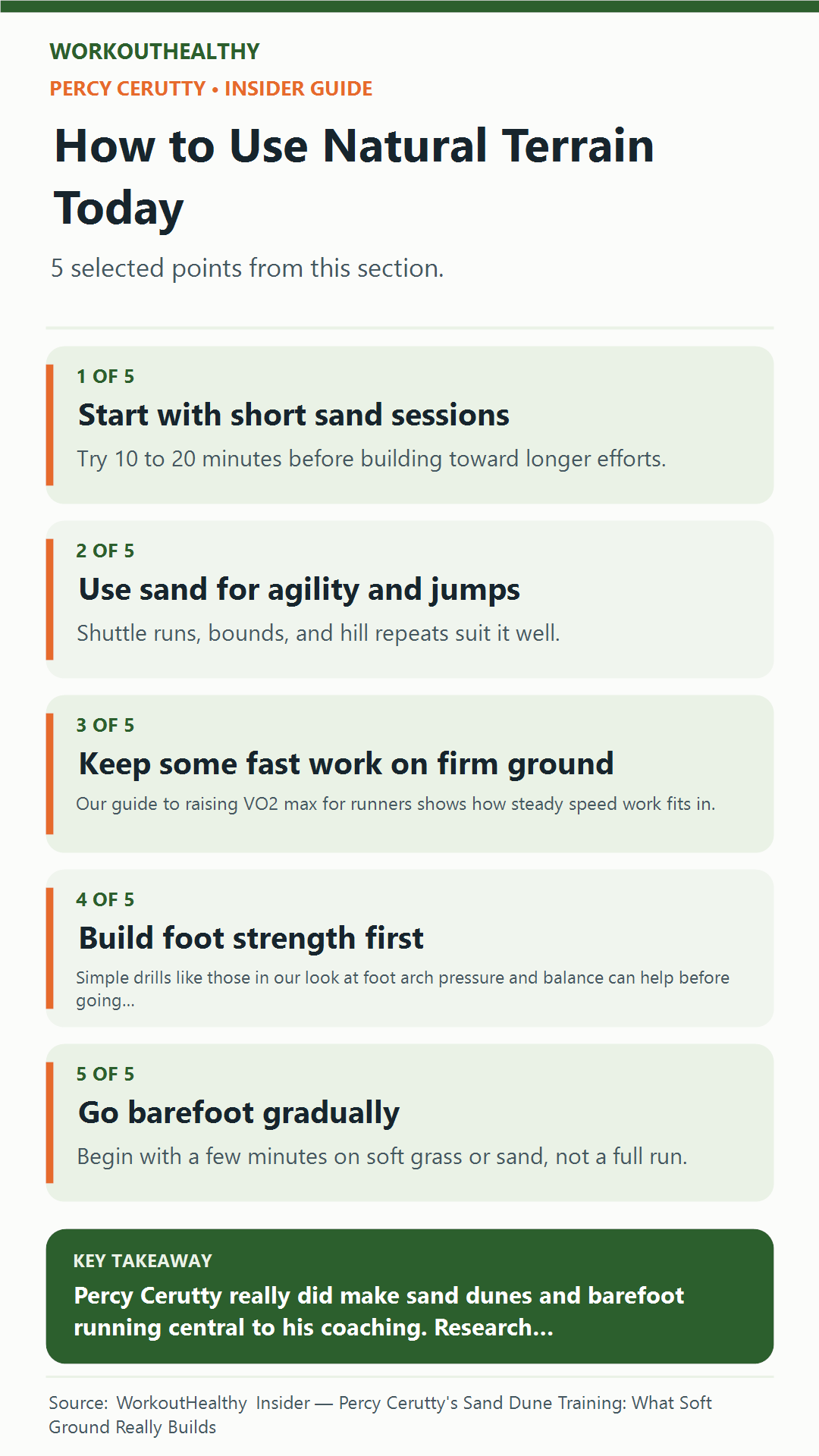
How to Use Natural Terrain Today
- Start with short sand sessions. Try 10 to 20 minutes before building toward longer efforts.
- Use sand for agility and jumps. Shuttle runs, bounds, and hill repeats suit it well.
- Keep some fast work on firm ground. Our guide to raising VO2 max for runners shows how steady speed work fits in.
- Build foot strength first. Simple drills like those in our look at foot arch pressure and balance can help before going barefoot.
- Go barefoot gradually. Begin with a few minutes on soft grass or sand, not a full run.
- Space hard sessions. Dune work is tiring, so give it a day or two of easier training after.
Common Mistakes
The biggest mistake is copying elite volume on day one.
Dune repeats can leave calves and Achilles tendons very sore.
Another mistake is switching to barefoot running overnight.
Feet and lower legs need weeks to adapt to new loading.
A third mistake is adding extra load on top. If you are tempted, read our take on running in a weighted vest first.
Who Should Be Careful
People with Achilles, calf, ankle, or foot problems should get advice before trying sand or barefoot work.
Anyone with diabetes or reduced feeling in the feet should avoid barefoot running on rough ground.
Hot sand can burn, and beaches can hide glass or shells.
Steep dunes can also be hard on the heart, so build up slowly if you are new to hard exercise.
The Bottom Line
Percy Cerutty really did make sand dunes and barefoot running central to his coaching.
Research supports sand as a useful tool for agility and jumping, with limits.
Barefoot running changes how you land, but its injury benefits are still unproven.
Treat natural terrain as one tool in your plan, and add it slowly.
Want more stories like this? Subscribe to WorkoutHealthy Insider for practical explanations behind popular fitness claims.
References
- Lieberman, D. E., Venkadesan, M., Werbel, W. A., Daoud, A. I., D’Andrea, S., Davis, I. S., Mang’Eni, R. O., & Pitsiladis, Y. (2010). Foot strike patterns and collision forces in habitually barefoot versus shod runners. Nature, 463(7280), 531 to 535. https://doi.org/10.1038/nature08723
- Wang, T., Zhai, H., Yan, H., Zhou, Y., Li, Z., Wei, H., & Geng, Q. (2026). Dose-response relationships of sand training compared to other surface training in improving change of direction and jump performance: A systematic review and meta-analysis. Frontiers in Physiology, 16, 1737074. https://doi.org/10.3389/fphys.2025.1737074
- Wikipedia contributors. (n.d.). Percy Cerutty. In Wikipedia. Retrieved September 16, 2026, from https://en.wikipedia.org/wiki/Percy_Cerutty
This article is for general information only and is not medical advice. If you have an injury, ongoing pain, or a medical condition, talk to a doctor or physical therapist before you change how you train or eat.