
Some fitness lines stick because they flip a common complaint on its head.
A popular one credited to strongman Sig Klein says, in one version, “The stronger the body the more it obeys, the weaker the body the more it commands.”
The idea is that strength gives you control, while weakness keeps getting in your way.
The thought is much older than Klein, and its original meaning was a little different.
Tracing the Line
Strength history posts online credit the line to Klein.
None that we found name a specific book, article, or year for it.
We could not confirm that Klein wrote these exact words, so we are not treating it as a verified quote from him.
What we could confirm is a near match in Jean-Jacques Rousseau’s Emile, published in 1762.
In Barbara Foxley’s English translation, Book I reads: “The weaker the body, the more imperious its demands; the stronger it is, the better it obeys.”
Klein may have repeated or adapted the idea at some point.
Without a source, though, the safest reading is that the thought belongs to Rousseau first.
The wording shared online is also smoother than the translation, which suggests it has been reshaped over time.
What Rousseau Meant
Rousseau was writing about raising a child, not about lifting weights.
The sentence sits in a passage about intemperance, fasting, and the passions.
His point was that a weak body is ruled by its cravings, while a strong one follows the mind.
The modern version shifts the focus from desire to daily movement.
Both versions share one core belief. A capable body gives a person more freedom.
Strength is not only for lifting more. It is how you keep saying yes to the things you want to do.
Who Sig Klein Was
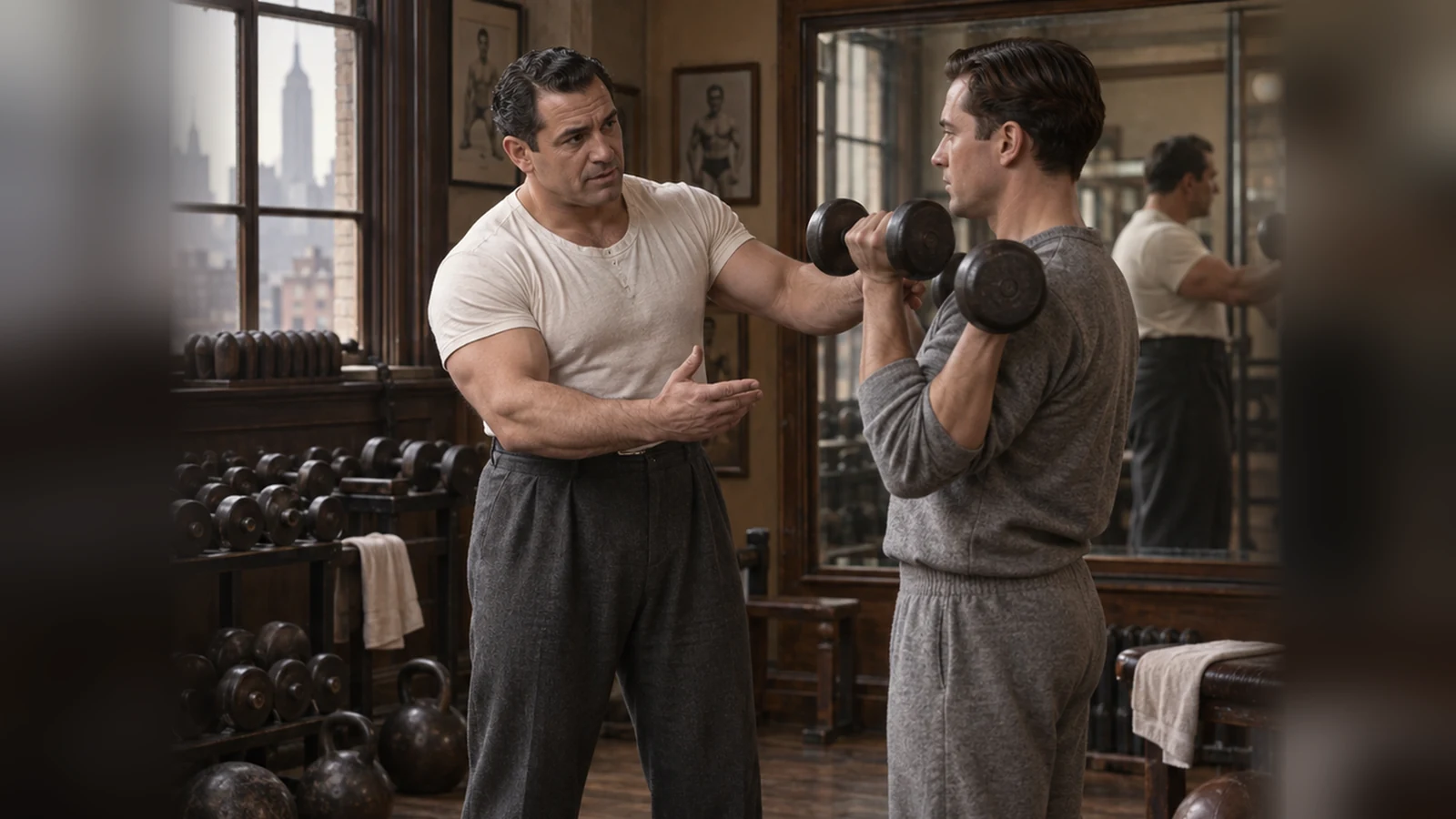
Siegmund Klein was born in 1902 in Toruń, then in Germany, and died in New York in 1987.
He ran a well known Physical Culture Studio in Manhattan from 1926 until about 1974.
According to his Wikipedia biography, his last heavy lifting was at age 35.
After that, he kept working out three times a week in hour long sessions.
That long habit fits the spirit of the line. He trained to stay capable, not just to set records.
What Research Says About Strength and Control
The clearest evidence comes from older adults, where losing strength often means losing independence.
A 2015 meta-analysis by Ron Borde, Tibor Hortobágyi, and Urs Granacher looked at healthy older adults.
Resistance training produced large effects on upper and lower body strength.
Longer training periods and higher intensities worked better, with the best results around 70 to 79 percent of a one rep max.
The authors also said time under tension and rest between sets played a role.
Effects on muscle structure were more modest than the strength gains.
In other words, strength rose more than muscle size did across these studies of older adults.
A 2020 meta-analysis by Jozo Grgic and colleagues focused on adults aged 75 and older.
It pooled 22 randomized controlled trials.
Training significantly increased muscle strength, with an even larger effect in people over 80.
Muscle size also increased, and few adverse events were reported.
The authors concluded that the very elderly can gain both strength and muscle through resistance training.
What Control Looks Like Day to Day
You rarely notice strength until it runs short.
Think about climbing stairs with bags, getting up from the floor, or catching yourself after a stumble.
Each of those asks your muscles to produce force quickly and on command.
When that force is missing, the body starts setting the rules.
You avoid the stairs, use your arms to stand, or skip the hike.
That is the modern sense of a body that “commands.”
Strength training widens the list of things you can do without thinking twice.
It will not remove every limit, but it can push many of them further away.
What the Research Does Not Show
These studies measured strength and muscle size, not a feeling of control over your body.
In the Grgic review, handgrip strength did not improve significantly.
That is a reminder that gains are specific to what you train.
The studies also focused on older adults, so the size of the effect may differ in younger people.
How to Build a Body That Obeys
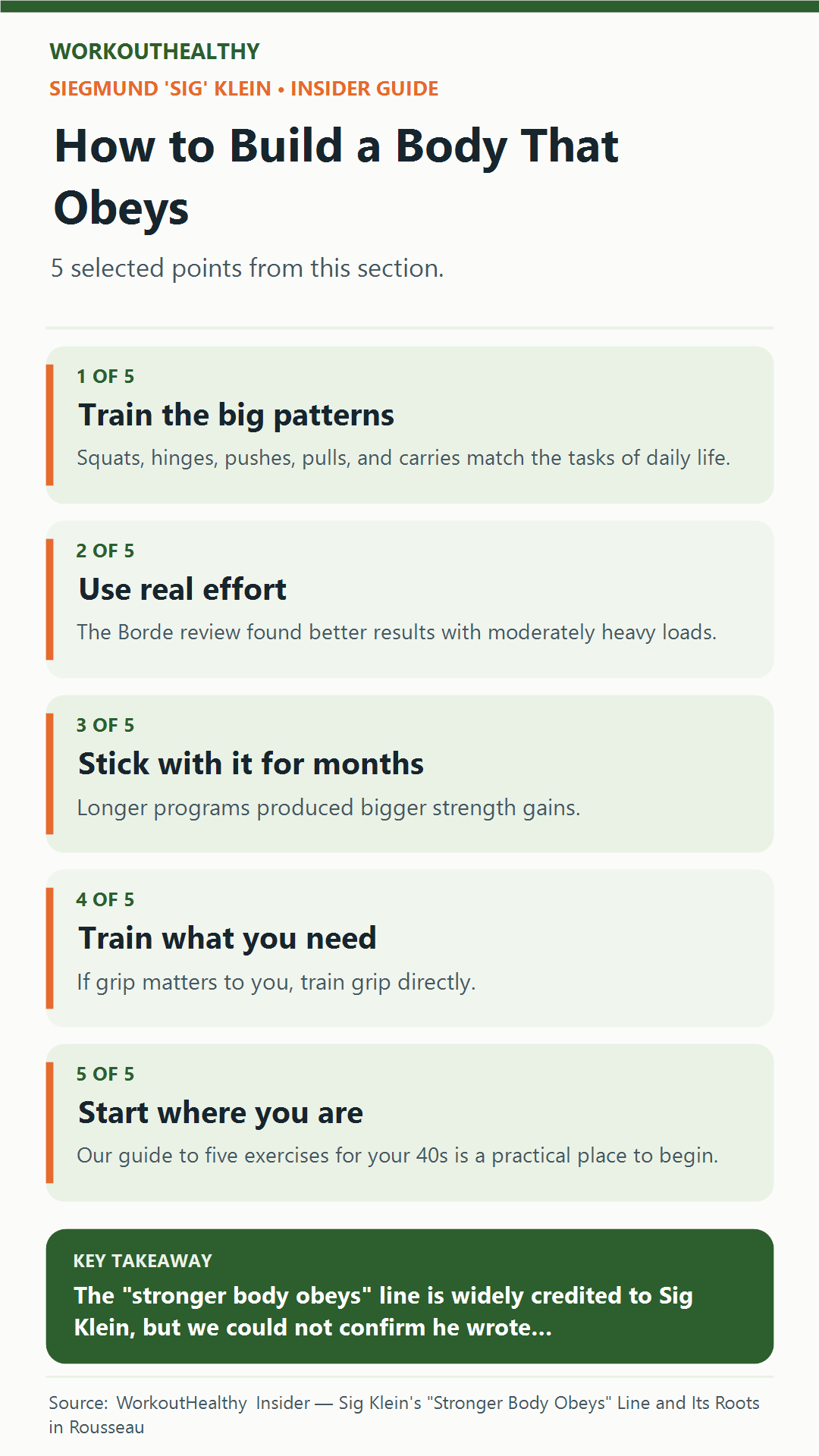
- Train the big patterns. Squats, hinges, pushes, pulls, and carries match the tasks of daily life.
- Use real effort. The Borde review found better results with moderately heavy loads.
- Stick with it for months. Longer programs produced bigger strength gains.
- Train what you need. If grip matters to you, train grip directly.
- Start where you are. Our guide to five exercises for your 40s is a practical place to begin.
- Load the hinge with care. See how to deadlift safely after 50.
For a real world view of lifelong movement, read what a 104 year old woman says keeps her healthy.
Common Mistakes
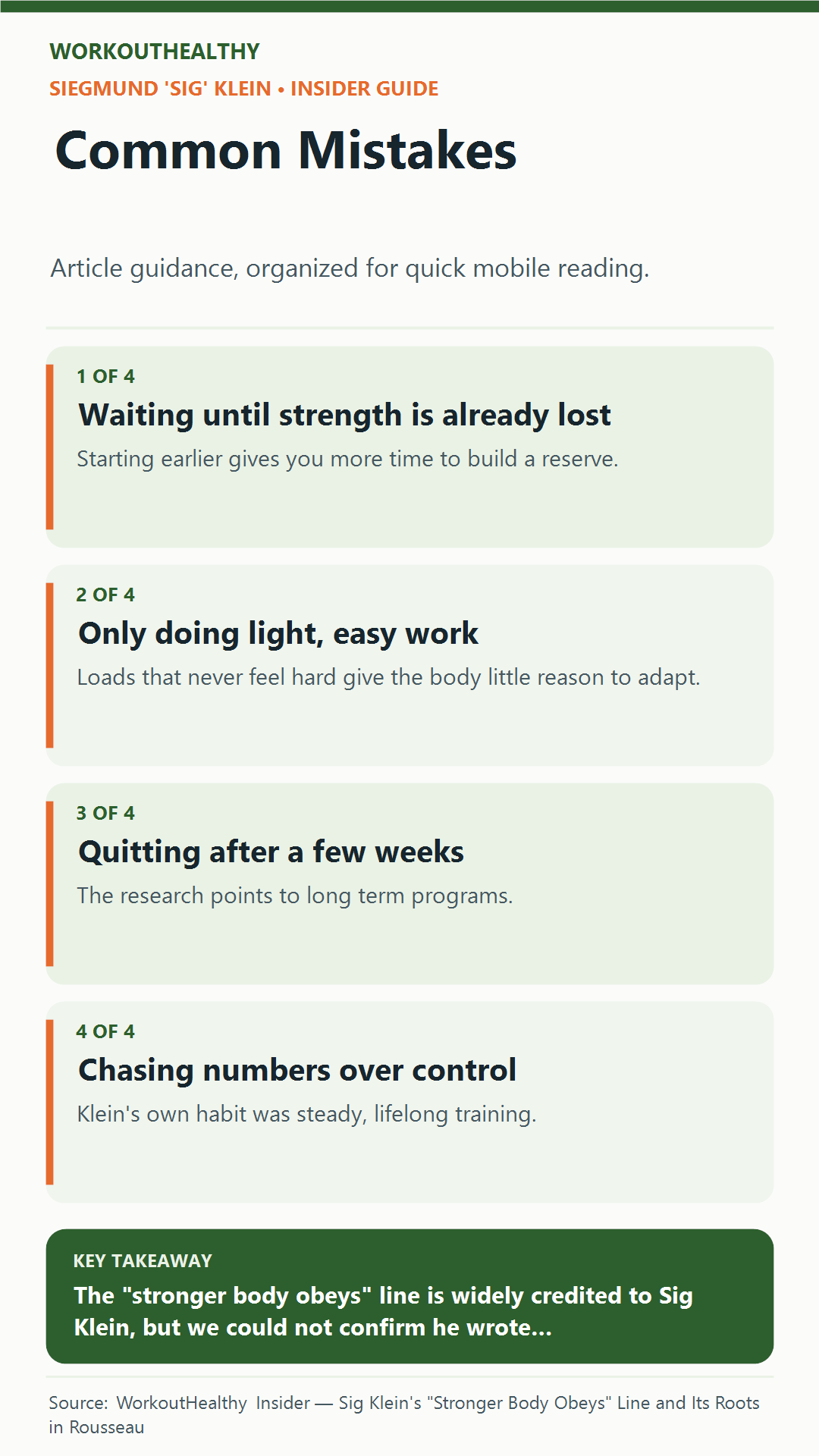
- Waiting until strength is already lost. Starting earlier gives you more time to build a reserve.
- Only doing light, easy work. Loads that never feel hard give the body little reason to adapt.
- Quitting after a few weeks. The research points to long term programs.
- Chasing numbers over control. Klein’s own habit was steady, lifelong training.
Who Should Be Careful
Older adults with heart disease, balance problems, osteoporosis, or recent surgery should get medical guidance first.
A physical therapist or qualified coach can help you choose safe starting loads and exercises.
The Bottom Line
The “stronger body obeys” line is widely credited to Sig Klein, but we could not confirm he wrote it.
A very similar sentence appears in Rousseau’s Emile from 1762.
Modern research supports the practical idea behind it, especially for older adults.
Build strength steadily, keep it for life, and your body will be far more willing to do what you ask.
Want more stories like this? Subscribe to WorkoutHealthy Insider for practical explanations behind popular fitness claims.
References
- Borde, R., Hortobágyi, T., & Granacher, U. (2015). Dose-response relationships of resistance training in healthy old adults: A systematic review and meta-analysis. Sports Medicine, 45(12), 1693 to 1720. https://doi.org/10.1007/s40279-015-0385-9
- Grgic, J., Garofolini, A., Orazem, J., Sabol, F., Schoenfeld, B. J., & Pedisic, Z. (2020). Effects of resistance training on muscle size and strength in very elderly adults: A systematic review and meta-analysis of randomized controlled trials. Sports Medicine, 50(11), 1983 to 1999. https://doi.org/10.1007/s40279-020-01331-7
- Rousseau, J.-J. (n.d.). Emile (B. Foxley, Trans.). Project Gutenberg. (Original work published 1762). https://www.gutenberg.org/ebooks/5427
- Wikipedia contributors. (n.d.). Siegmund Klein. In Wikipedia. Retrieved September 16, 2026, from https://en.wikipedia.org/wiki/Siegmund_Klein
This article is for general information only and is not medical advice. If you have an injury, ongoing pain, or a medical condition, talk to a doctor or physical therapist before you change how you train or eat.