
Exercise during chemotherapy can have a supportive role in maintaining fitness and strength and managing fatigue. The appropriate activity depends on the person’s treatment, symptoms and cancer care plan.
Balance problems, muscle weakness and bone loss need separate consideration. Evidence that an exercise program improves one outcome does not establish that it repairs all three or belongs in every patient’s routine.
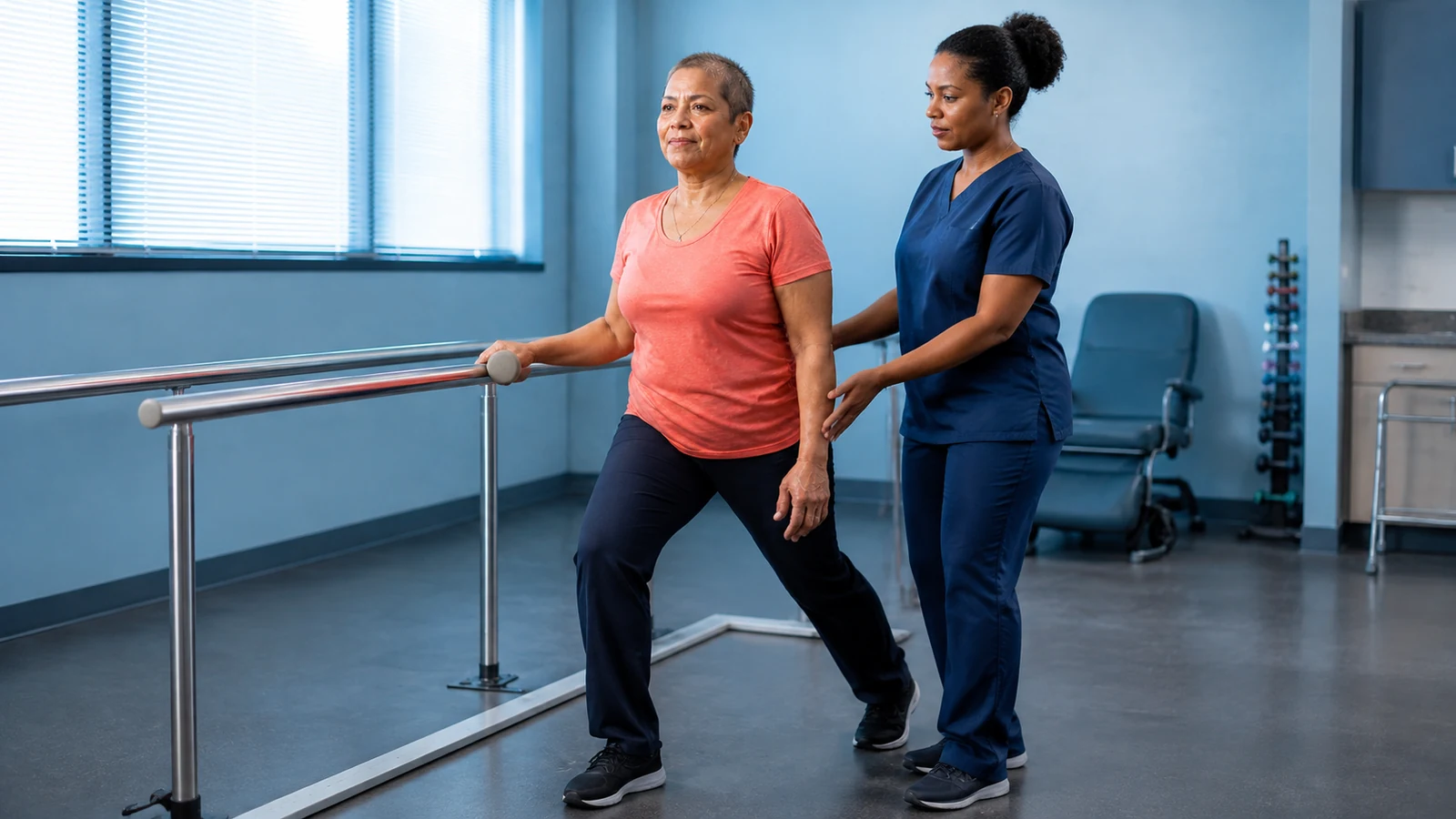
Image context: The featured picture illustrates supported activity. It does not identify a study participant, verify the observer’s professional credentials or demonstrate an exercise prescribed for the reader.
Start with a clear goal: Preserving daily function, addressing unsteadiness and managing bone health are different clinical questions. Ask your cancer care team which goal and activity plan apply to you.
What Exercise Guidance During Active Treatment Supports
For adults receiving active treatment aimed at cure, ASCO advises oncology teams to include regular aerobic activity and resistance work in care recommendations. The review found improvements in physical capacity, muscle strength, tiredness and other outcomes patients reported.
Breast, prostate, lung and colorectal cancers were most commonly studied. The guideline addresses advanced cancer as a special consideration, so its recommendation should not be turned into one identical program for every diagnosis or treatment stage.
The practical implication is to discuss activity as part of supportive care. It is not permission to change chemotherapy, replace prescribed treatment or copy a survivor’s exercise routine without checking whether it fits.
MD Anderson’s guidance describes walking and other aerobic activities alongside resistance exercise, such as weights or bands. It emphasizes that cancer type, treatment, side effects and prior fitness affect what a person can manage.
An exercise category is not a complete instruction. “Resistance exercise” still leaves the movement, support, load, repetitions and progression to be specified in an individual plan.
Keep the Treatment Setting Attached to the Study
Three frequently confused kinds of evidence are an exercise trial during chemotherapy, a comparison of survivors with persistent nerve symptoms, and a bone-health trial in a selected survivor population. They answer different questions.
| Study and setting | Actual comparison | Finding to keep with its limit |
|---|---|---|
| Courneya et al., 2007: 242 patients beginning breast-cancer chemotherapy | Usual care, supervised aerobic exercise or supervised resistance exercise during chemotherapy | Fitness and strength benefits differed by exercise group; the primary cancer-specific quality-of-life outcome did not improve significantly. |
| Winters-Stone et al., 2017: 512 women cancer survivors | Secondary analysis comparing women with and without persistent chemotherapy-related neuropathy symptoms | Worse function and more reported falls with symptoms; this was not a trial proving that a balance drill prevents falls. |
| Winters-Stone et al., 2013: 71 breast-cancer survivors with premature menopause | A year of impact plus resistance training versus flexibility exercise | No significant full-sample intention-to-treat bone effect; favorable hip and spine findings came from a restricted menopause subgroup. |
These differences matter more than whether a headline uses the word “exercise.” A supervised intervention, an observational comparison and a subgroup finding should not become one universal rebuilding promise.
Strength and Fatigue Are Not Interchangeable Outcomes
In the chemotherapy trial, resistance exercise improved muscular strength and lean body mass relative to usual care, while aerobic exercise improved aerobic fitness. Cancer-specific quality of life and fatigue changes favored exercise but were not statistically significant.
Adherence to supervised exercise was 70.2%. These findings describe selected participants and supported programs, not perfect attendance or a guarantee that a person will feel better after each session.
A strength gain can matter even when a questionnaire changes little. Equally, a favorable strength result should not be relabeled as proof of less fatigue, better balance or stronger bones.
When discussing a program, name the outcome that matters in everyday life. Being able to manage an ordinary task and achieving a new gym best are different goals.
Do not turn a study average into a demand to progress every week. A care plan can include adjustments and rest without making a patient responsible for reproducing a research result.
New Numbness or Unsteadiness Needs Assessment
The survivor study assessed falls over the previous year, not six months. Women reporting neuropathy symptoms had worse function and gait, but maximal leg strength was an exception to the between-group impairments.
That distinction matters: difficulty walking is not automatically explained by weaker muscles alone. The analysis did not test an exercise treatment, establish the cause of every fall or assign a balance program.
NCI explains that treatment-related nerve problems can affect sensation, movement and other functions. New tingling, numbness, weakness or balance problems should be discussed with the doctor or nurse, rather than treated as a cue to begin harder balance drills.
Its practical guidance includes asking for help with difficult tasks and preventing falls. That supports seeking an appropriate assessment and assistance, not using a single-leg stance to test whether it is safe to exercise alone.
A useful question is, “What support or rehabilitation assessment would make this activity appropriate for me?” It is more specific than asking whether all movement is good or bad.
The Bone Study Does Not Establish a Chemotherapy Impact Routine
The 2013 trial’s favorable bone results were restricted to survivors at least one year past menopause. The full randomized sample did not show a significant group-by-time bone effect in its intention-to-treat analysis.
Within that restricted analysis, hip density increased and spine loss slowed relative to the flexibility group. That is narrower than saying everyone retained more bone at both sites, and it does not establish fracture prevention.
The paper does not justify prescribing jumping, step-ups or impact exercise during active chemotherapy. Treatment stage, bone involvement and the actual clinical question cannot be removed from a program’s interpretation.
The American Cancer Society advises checking with the care team about activity, particularly with balance problems, weak bones, bone metastases or heart and lung disease. It also cautions about activities that stress vulnerable bones and about risks associated with treatment devices or infection.
A general message to stay active does not establish which direction, load or impact is suitable for a particular bone problem. Those details belong in the clinical plan.
Turn Broad Advice Into Clear Questions
The following discussion card is an original communication aid, not a medical clearance test or an exercise program. Use it to identify instructions that remain unclear in an existing plan.
| Topic | A concrete question | What to record |
|---|---|---|
| Purpose | Which daily function or symptom is this activity intended to address? | The agreed goal, without promising a particular improvement |
| Activity | Which named movements or activities are in my plan now? | The actual sheet, demonstration or program selected by the team |
| Treatment context | Do my symptoms, blood counts, bone health, devices or medicines change the instructions? | The team’s specific limits and review arrangements |
| Support | Should someone assist me, or should a rehabilitation professional assess this first? | Who is helping and how to arrange the assessment |
| Changes | What should prompt me to stop, contact the team or seek urgent help? | The team’s contact route and actual stopping instructions |
For example, “I have an exercise sheet, but my feet have become numb since it was issued” identifies a change to discuss. It does not require attempting the hardest movement first to prove that the sheet still fits.
Likewise, “I can walk around the house but feel unsteady on the stairs” describes a functional concern. A stair challenge or daily step competition would not diagnose its cause.
Record Context Without Grading Your Recovery
A short description can make follow-up conversations more useful: what you were doing, what changed and which instruction you were following. Include a fall, near-fall or new limitation instead of recording only completed workouts.
This is not a validated symptom score or a method for deciding your own restrictions. Follow the contact and urgent-care instructions supplied by the treating service.
ACS advises avoiding exercise when dizzy or unsteady and keeping the cancer care team informed about pain, injury, shortness of breath or unusually slow recovery. New or worsening symptoms should not become a reason to push harder for the sake of a target.
Avoid judging a treatment day against an exercise trial’s average. A useful plan addresses the person receiving care, rather than treating adherence or improvement as a measure of character.
Support Function Without Promising Three Repairs
The 2022 cancer-care review brings together studies on treatment effects, fatigue, quality of life and survival. Its varied populations and designs require interpretation; a broad positive conclusion is not a personal balance or bone-loading prescription.
Exercise has a supported role during chemotherapy, but the details should stay attached to the evidence and care plan. Strength, walking function, nerve symptoms, bone density and fractures are different outcomes.
Ask for a named activity, a clear purpose, suitable support and instructions for changes. That makes general exercise advice usable without turning a survivor study or an illustrative photograph into treatment instructions.
Medical disclaimer: This article provides general information about cancer exercise research, not personal medical advice, treatment or clearance. Follow your oncology and rehabilitation team’s instructions, and consult an appropriately qualified healthcare professional before changing activity during treatment.
References
Ligibel, J. A., et al. (2022). Exercise, diet, and weight management during cancer treatment: ASCO guideline. Journal of Clinical Oncology, 40(22), 2491 to 2507. Original guideline abstract.
Courneya, K. S., et al. (2007). [Three-arm chemotherapy exercise trial]. Journal of Clinical Oncology, 25(28), 4396 to 4404. Primary trial abstract.
Winters-Stone, K. M., et al. (2017). [Survivor neuropathy and function analysis]. Journal of Clinical Oncology, 35(23), 2604 to 2612. Primary study abstract.
Winters-Stone, K. M., et al. (2013). [Survivor bone-training trial]. Osteoporosis International, 24(5), 1637 to 1646. Primary trial abstract.
National Cancer Institute. Nerve problems (peripheral neuropathy) and cancer treatment. Official clinical information.
American Cancer Society. Physical activity when you have cancer. Official patient guidance.
Misiąg, W., et al. (2022). Physical activity and cancer care: A review. Cancers, 14(17), 4154. Research review.
Van Thomme, G. (2025). Exercise during cancer treatment: 5 things to know. MD Anderson Cancer Center. Clinical education article.