
The line often credited to Sig Klein says that a stronger body obeys while a weaker body commands. Its attribution needs a qualification: a close sentence appears in Jean-Jacques Rousseau’s Emile, while a dated Klein publication containing the popular wording has not been established here.
Klein’s own published training account offers a separate, verifiable lesson about maintaining a habit. Keeping those two source trails apart makes the quotation more useful and avoids turning a philosophical metaphor into a claim that exercise proves.
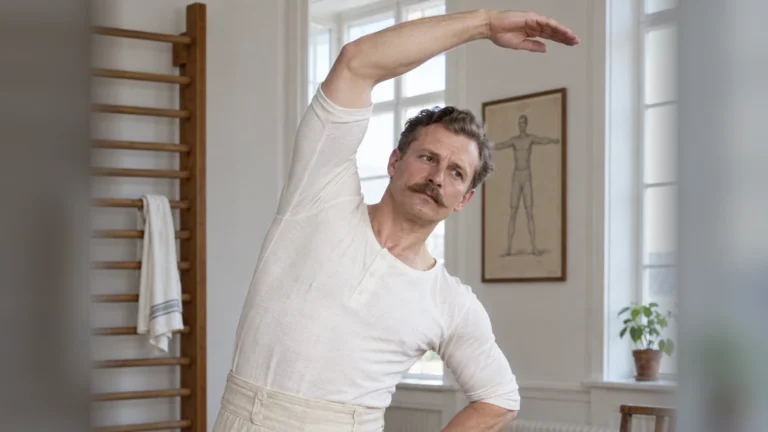
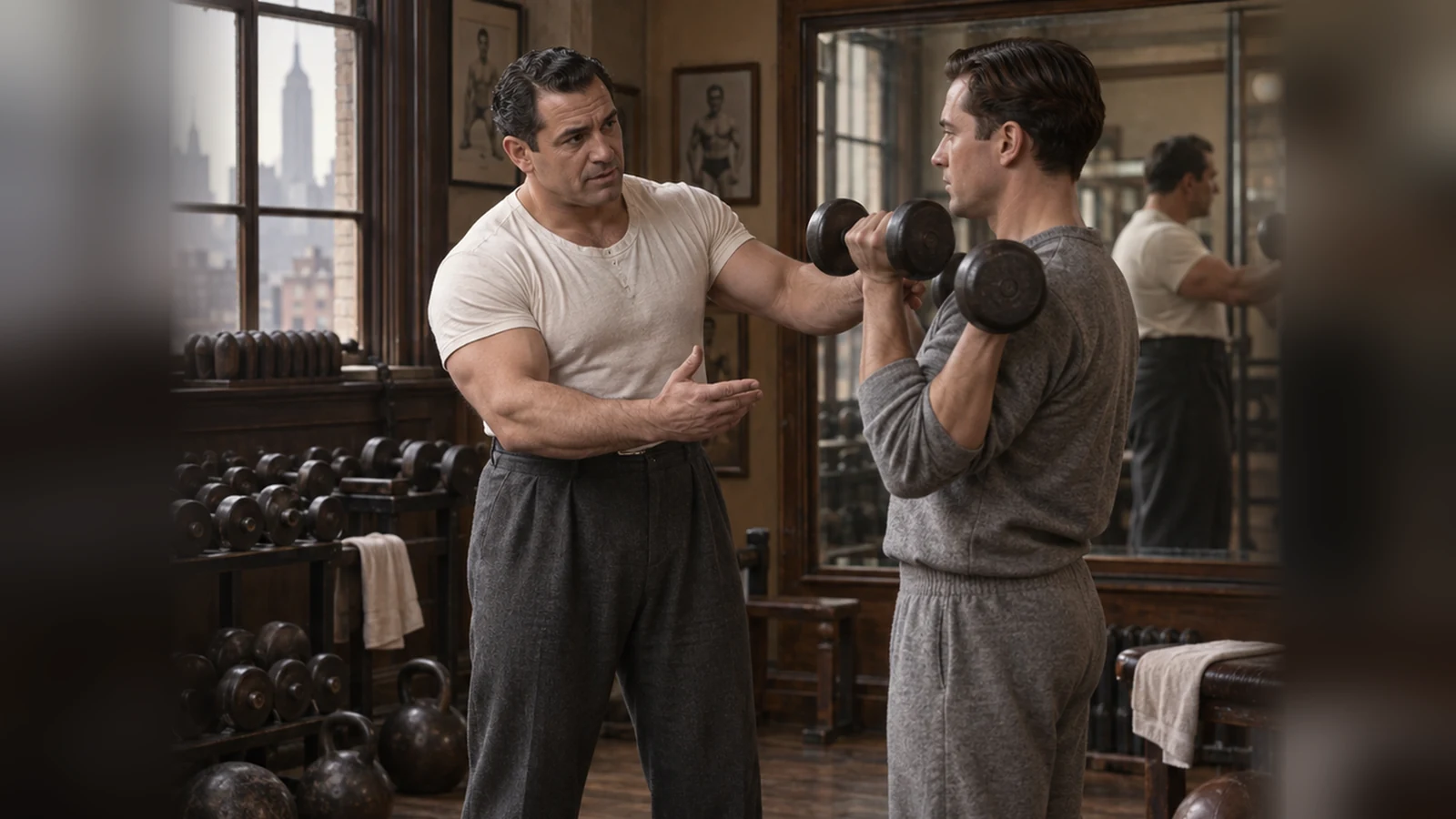
Image note: the featured gym scene is illustrative; it is not a verified photograph of Klein or evidence of his coaching methods.
Sig Klein and the quotation: the source ledger
Siegmund “Sig” Klein was a physical culture writer and gym owner. This source check concerns the saying attached to his name, rather than reconstructing his biography or prescribing his old routines.
| Question | Evidence available | Responsible conclusion |
|---|---|---|
| Did Klein write the popular stronger-body line? | No identified Klein book, magazine issue and page containing that wording is supplied by the material checked for this article. | The attribution remains unverified. That is not proof that he never repeated the idea. |
| Is there an earlier close text? | Book I of Rousseau’s Emile, in Barbara Foxley’s English translation, contains the weaker/stronger-body comparison. | Credit this wording to Rousseau through the named translator, with the book and section. |
| What does Klein’s own training account establish? | A USAWA reproduction credits his article to the February 1969 issue of Muscular Development. | It records his description of regular exercise at age 66; it does not establish authorship of the disputed line. |
| Do modern trials establish the metaphor? | Resistance-training reviews measure particular strength and muscle outcomes. | They answer an exercise question, rather than verifying a quotation or measuring whether a body “obeys.” |
The Rousseau passage and its context
Foxley’s translation of Emile, Book I, reads: “The weaker the body, the more imperious its demands; the stronger it is, the better it obeys.” The Project Gutenberg text lets you read the surrounding passage rather than relying on a quotation card.
Rousseau is discussing education, appetite and the relationship between body and mind. Nearby passages also express judgments about illness and medicine that should not be adopted as modern health guidance.
The popular stronger-body-first version reverses the order and changes the words. A paraphrase can preserve a recognizable idea without being a verbatim quotation from either Rousseau or Klein.
Finding the earlier passage establishes that the thought predates Klein. It does not establish the route by which a later writer encountered it, whether Klein adapted it, or who first circulated the current version.
What Klein’s 1969 account actually says
USAWA’s page “It’s Training Time Again!” reproduces writing credited to Klein and identifies the magazine issue. The webpage’s June 2010 posting date and the credited February 1969 article date refer to different publications of the text.
In that account, Klein says that he still exercises three times weekly at age 66, with sessions lasting about an hour. He describes lower intensity than in his earlier lifting years and acknowledges that enthusiasm does not always precede the workout.
This is a useful firsthand account as reproduced by the association, with an identified magazine source. We have not inspected the original magazine page, so the reproduction should be described as such.
The account supports a narrow observation about his own sustained habit. It cannot establish that three hour-long sessions are the right starting dose for another person or validate every physiological opinion in the essay.
What the strength research adds
The relevant modern question is whether resistance training changes measured physical outcomes in the populations studied. Neither of the reviews below tests the authorship or philosophy of the quotation.
| Review | What was examined | Findings and limits |
|---|---|---|
| Borde and colleagues, 2015 | 25 randomized studies in adults with a mean age of at least 65; strength and muscle measurements. | Strength improved, with smaller muscle-structure effects. The authors reported poor overall study quality and substantial variation between studies; their separate dose comparisons did not establish how all program variables interact. |
| Grgic and colleagues, 2020 | 22 randomized studies in adults aged 75 and older, assessing several strength and muscle outcomes. | Overall muscle strength and whole-muscle size improved. Pooled handgrip and muscle-fiber-size differences were not statistically significant. |
Read the Borde review abstract and Grgic review abstract for their stated methods and qualifications. These summaries do not convert a reported favorable load range into an individualized prescription.
A larger numerical effect in an older subgroup also does not, by itself, establish that being older causes a better response. Minimal reports of adverse events cannot guarantee that a program is safe for every reader.
Most importantly, the outcomes summarized here do not directly measure personal independence, illness, pain or freedom from assistance. Strength gains can be valuable while those broader questions remain separate.
A practical way to use the idea
Start by naming the task that matters to you, such as carrying a bag or rising from a chair. Then distinguish the task itself from a gym measurement that might help you work toward it.
For example, a heavier lift and an easier stair climb are different observations. Recording each separately avoids assuming that progress in one automatically proves progress in the other.
This is a planning distinction, not a self-test or rehabilitation program. A coach or physical therapist can help match training to your abilities and restrictions; our deadlifting after 50 guide addresses one particular training question.
The metaphor also should not become a judgment about people who need assistance. Disability, illness and dependence are not evidence of a weak character or insufficient effort.
How to check another version of the quote
- Copy the exact wording. A translation, paraphrase and direct quotation can look similar while making different attribution claims.
- Ask for the work and location. For a book, look for its edition, translator and section or page; for a magazine, request the issue and page.
- Separate the webpage date from the source date. A recent reproduction can point to an older publication without being the original page.
- State what remains unresolved. An earlier match does not prove copying, and an unsuccessful source search does not prove that someone never said the words.
If a dated Klein page containing the line becomes available, it could change the attribution assessment. Until then, the clearest description is an unverified Klein attribution with a close, identifiable passage in Rousseau.
References
Rousseau, J.-J. Emile, Book I (B. Foxley, Trans.). Project Gutenberg text. Original work published 1762.
Klein, S. (1969, February). It’s training time again! Muscular Development. Reproduction posted by USAWA on June 22, 2010.
Borde, R., Hortobágyi, T., & Granacher, U. (2015). Dose-response relationships of resistance training in healthy old adults: A systematic review and meta-analysis. Sports Medicine, 45, 1693 to 1720. PubMed record and abstract.
Grgic, J., Garofolini, A., Orazem, J., Sabol, F., Schoenfeld, B. J., & Pedisic, Z. (2020). Effects of resistance training on muscle size and strength in very elderly adults: A systematic review and meta-analysis of randomized controlled trials. Sports Medicine, 50, 1983 to 1999. PubMed record and abstract.
This article is for general information and is not medical advice or an individualized exercise plan. If you have an injury, pain, a medical condition or questions about appropriate training, speak with a qualified health professional.