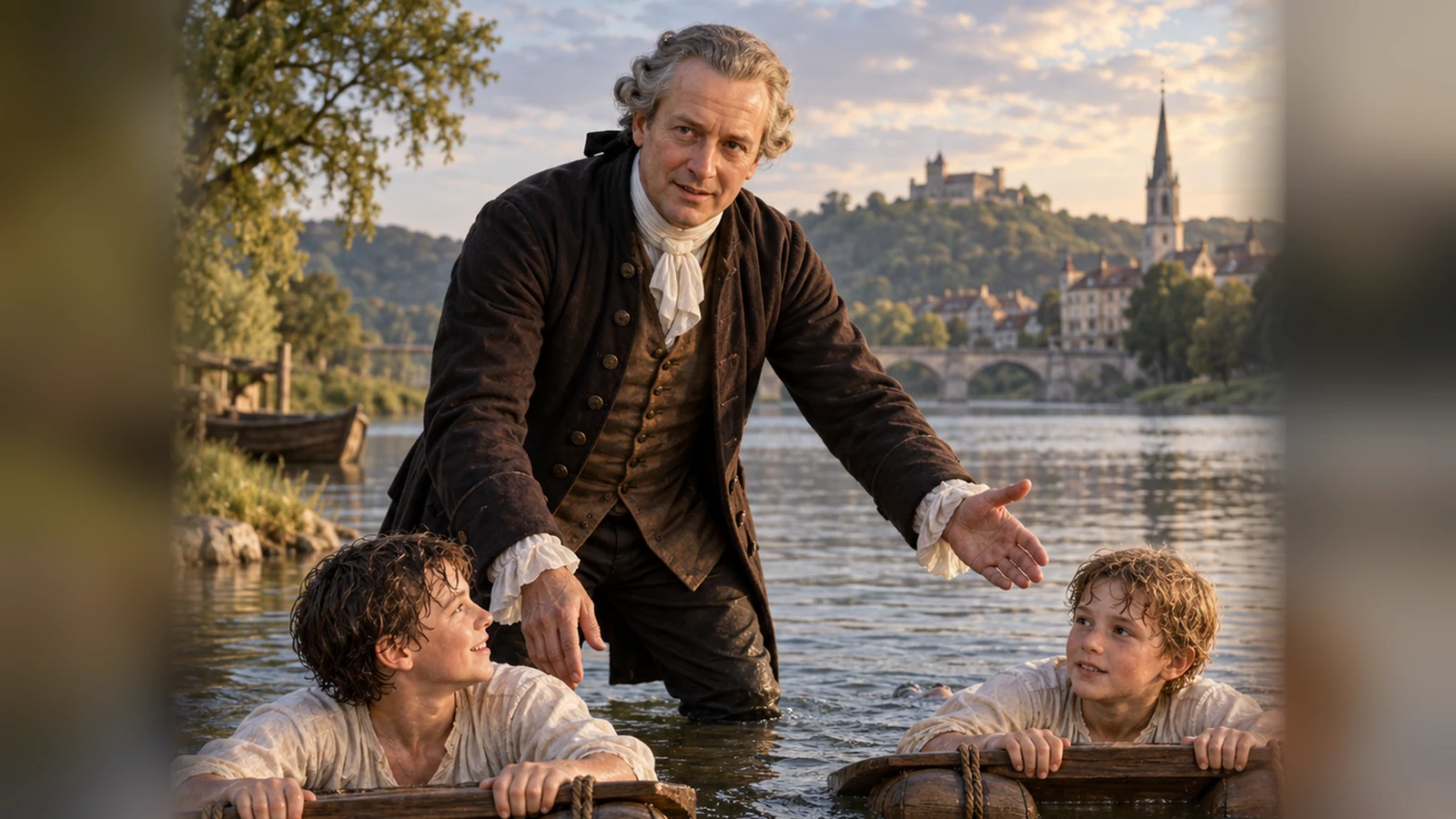

Swim lessons are one of the most common safety steps parents take today.
More than 200 years ago, a German teacher was already writing a whole book on how to learn to swim.
His name was Johann GutsMuths, and he is often called one of the founders of school physical education.
A popular post says he required every student to learn to swim because he saw it as a lifesaving skill.
Part of that is well documented. Part of it we could not confirm.
What We Can Confirm
GutsMuths taught at the Schnepfenthal school in Germany from 1785 until his death in 1839.
In 1793 he published Gymnastik für die Jugend, a landmark book on physical education.
Five years later, in 1798, he published a separate book on swimming.
Its title was Kleines Lehrbuch der Schwimmkunst zum Selbstunterrichte.
In English, that means “A Small Textbook of the Art of Swimming for Self Instruction.”
A modern German publisher of a reprint describes it as the earliest swimming school in the German language.
According to that description, the book explains techniques for swimming, diving, and jumping into the water.
It also gives readers a set of bathing rules.
What We Could Not Confirm
The sources we reviewed do not say that swimming was mandatory for every student at his school.
They also do not quote him calling swimming a lifesaving skill.
That may well have been part of his thinking, since his book included safety rules.
But the exact claim in the popular post should be treated as a summary, not a documented fact.
The same goes for claims about how his beginner lessons were structured step by step.
We did not find a reliable description of that, so we will not invent one.
Why a Book for Self Teaching Mattered
The phrase “for self instruction” in the title is telling.
It suggests the book was meant for readers who would learn on their own, without a teacher beside them.
A written method can reach far more people than one teacher at one school.
It also placed swimming alongside gymnastics as a skill worth teaching on purpose, rather than leaving it to chance.
That idea, that swimming deserves deliberate instruction, is the part of his legacy that clearly holds up.
Knowing how to swim is a skill you hope you never need in an emergency, and are glad to have if you do.
What Modern Research Says About Swim Lessons
The modern evidence on swim lessons and drowning is encouraging, with some limits.
A 2009 case control study by Brenner and colleagues looked at drowning in childhood.
For children aged 1 to 4, taking part in formal swimming lessons was associated with an 88% reduction in the risk of drowning.
The authors noted that their estimates were imprecise.
A case control study shows an association, not proof that lessons alone caused the lower risk.
Still, it is one of the stronger pieces of evidence that early lessons may help.
The Hidden Risk: Overconfidence
Swim lessons can create a false sense of security in adults.
A 2014 study by Morrongiello and colleagues followed parents as their children went through swim lessons.
As the lessons went on, parents increasingly believed their children could keep themselves from drowning.
As a result, they believed less active supervision was needed.
That is a dangerous conclusion for young children, who can get into trouble quickly in water.
Lessons are one layer of protection, not a replacement for close watching.
None of this research shows that lessons make any child drown proof.
It does not tell us whether GutsMuths’s 1798 methods would work well today.
And it mostly covers young children, so the benefit for older kids and adults is less clear from these studies.
How to Apply the Idea Today
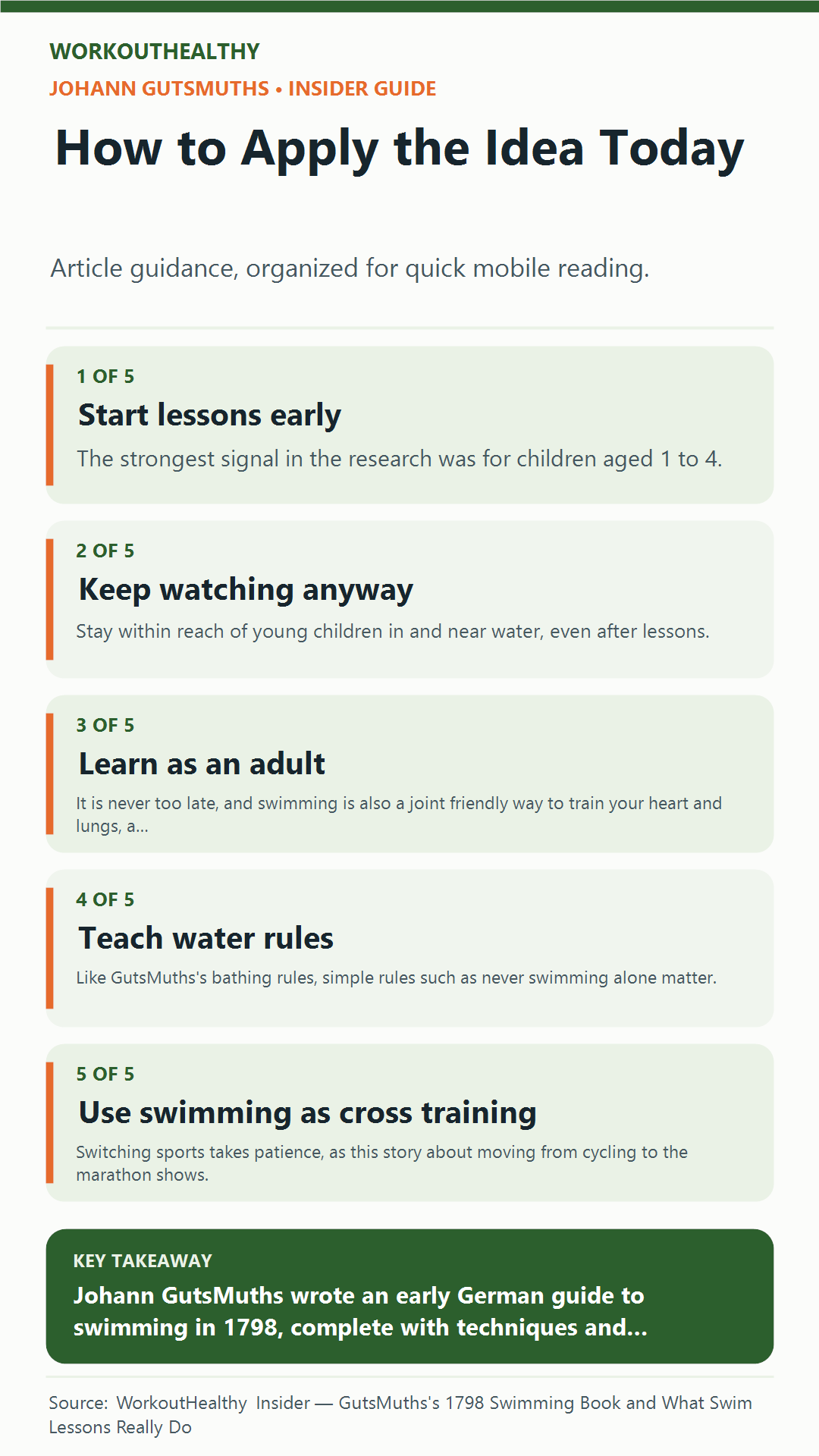
- Start lessons early. The strongest signal in the research was for children aged 1 to 4.
- Keep watching anyway. Stay within reach of young children in and near water, even after lessons.
- Learn as an adult. It is never too late, and swimming is also a joint friendly way to train your heart and lungs, a goal covered in our guide to raising your VO2 max.
- Teach water rules. Like GutsMuths’s bathing rules, simple rules such as never swimming alone matter.
- Use swimming as cross training. Switching sports takes patience, as this story about moving from cycling to the marathon shows.
Common Mistakes
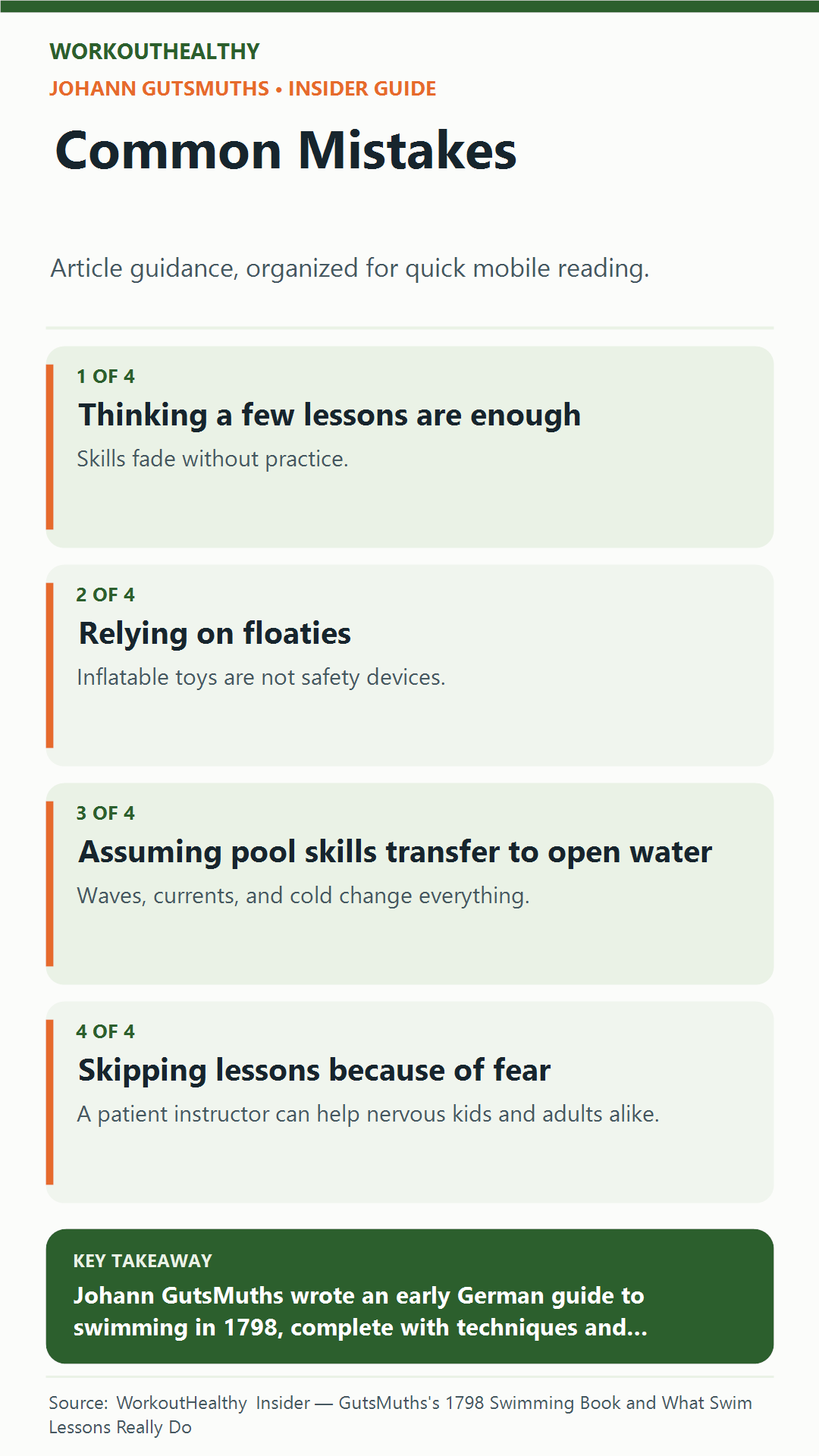
- Thinking a few lessons are enough. Skills fade without practice.
- Relying on floaties. Inflatable toys are not safety devices.
- Assuming pool skills transfer to open water. Waves, currents, and cold change everything.
- Skipping lessons because of fear. A patient instructor can help nervous kids and adults alike.
Swimming as Lifelong Exercise
Safety is the main reason to learn, but it is not the only one.
Once the basics are in place, swimming becomes a way to train for life.
The water supports your body weight, which many people with sore joints find more comfortable.
Laps can be easy or hard, so the same pool works for beginners and athletes.
That flexibility makes it easy to keep up as your fitness level changes.
Skills like diving and entering the water safely, which his book covered, still matter for anyone who swims.
Who Should Be Careful
People with seizure disorders or heart conditions should talk with a doctor before swimming and never swim alone.
Beginners should stay in shallow, supervised water until their skills are solid.
Anyone swimming in open water should choose areas with lifeguards and check conditions first.
Parents should ask their pediatrician when lessons make sense for their child.
The Bottom Line
Johann GutsMuths wrote an early German guide to swimming in 1798, complete with techniques and bathing rules.
We could not confirm that he made swimming mandatory for every student or called it lifesaving in those words.
Modern research does link formal lessons with lower drowning risk in young children, as long as adults keep watching.
Want more stories like this? Subscribe to WorkoutHealthy Insider for practical explanations behind popular fitness claims.
References
- Brenner, R. A., Taneja, G. S., Haynie, D. L., Trumble, A. C., Qian, C., Klinger, R. M., & Klebanoff, M. A. (2009). Association between swimming lessons and drowning in childhood: A case control study. Archives of Pediatrics & Adolescent Medicine, 163(3), 203 to 210. https://doi.org/10.1001/archpediatrics.2008.563
- Morrongiello, B. A., Sandomierski, M., & Spence, J. R. (2014). Changes over swim lessons in parents’ perceptions of children’s supervision needs in drowning risk situations. Health Psychology, 33(7), 608 to 615. https://doi.org/10.1037/a0033881
- GutsMuths, J. C. F. (1798). Kleines Lehrbuch der Schwimmkunst zum Selbstunterrichte. Verlag des Industrie Comptoirs.
- Arete Verlag. (n.d.). Kleines Lehrbuch der Schwimmkunst zum Selbstunterrichte (commented reprint of the 1798 edition, afterword by Michael Krüger). https://www.arete-verlag.de/produkt/kleines-lehrbuch-der-schwimmkunst-zum-selbstunterrichte/
- Wikipedia contributors. (n.d.). Johann Christoph Friedrich GutsMuths. In German Wikipedia. Retrieved September 16, 2026, from https://de.wikipedia.org/wiki/Johann_Christoph_Friedrich_GutsMuths
This article is for general information only and is not medical advice. If you have an injury, ongoing pain, or a medical condition, talk to a doctor or physical therapist before you change how you train or eat.