
About a thousand years ago, a physician from Baghdad turned health advice into a set of tables.
His name was Ibn Butlan, and his book became famous in Europe as the Tacuinum Sanitatis.
A popular post says he listed physical exercise as a required daily factor for health, alongside food and sleep.
That is close, but the wording in the book is a little different, and the difference is useful.
Who Ibn Butlan Was
Ibn Butlan was a physician and Nestorian Christian theologian born in Baghdad.
His birth date is uncertain, with estimates running from about 1001 to 1025.
He travelled through Syria and Egypt, spent time in Cairo, and visited Constantinople in 1054.
He eventually became a monk, and scholars believe he spent his last years in a monastery in Antioch.
He died on September 2, 1066.
He is also remembered for a heated public dispute with the physician Ibn Ridwan.
His other works include a satire called the Banquet of the Physicians.
A Health Guide in Table Form
The Arabic title of his health book is Taqwim al-Sihha, which means “Tabular Register of Health.”
That title explains the format.
Unillustrated manuscripts present a series of tables, with a narrative commentary on the facing pages.
The book was freely translated into Latin in the mid 13th century, in Palermo or Naples.
In the late 14th century, richly illustrated copies were produced in Lombardy.
Four complete illustrated manuscripts survive, in Vienna, Paris, Liège, and Rome.
The Six Things the Book Says You Need
The Tacuinum lists six elements essential for well being.
- Sufficient food and drink in moderation
- Fresh air
- Alternations of activity and rest
- Alternations of sleep and wakefulness
- Secretions and excretions of the humours
- The effects of states of mind
Similar lists of daily health factors appear in other medieval medical writing.
What stands out in Ibn Butlan’s version is the tidy, tabular way he laid them out.
What the Popular Version Gets Slightly Wrong
The book does put movement on the same list as food and sleep.
But the item is not simply “exercise.” It is the alternation of activity and rest.
In other words, the goal was balance, not maximum effort.
We could not confirm wording in the sources we reviewed that makes exercise a strict daily requirement.
The balance framing is arguably more useful anyway.
Health is not built by movement alone. It is built by how movement, rest, and sleep share the same 24 hours.
What Modern Research Says About Movement, Sitting, and Rest
Modern scientists have started studying the whole day in a similar way.
A 2015 study by Chastin and colleagues in PLOS ONE analyzed 1,937 adults from a large U.S. health survey.
The researchers treated sleep, sitting, light activity, and moderate to vigorous activity as parts of one 24 hour budget.
How people divided their day was linked with body mass index, waist size, triglycerides, glucose, insulin, and blood pressure.
It was not linked with HDL or LDL cholesterol.
The authors also found that the effects of adding or losing moderate to vigorous activity were not symmetrical.
Losing 10 minutes of that activity to sitting was linked with a much larger change in waist size than gaining 10 minutes.
They concluded that keeping up moderate to vigorous activity and not letting light activity slide into sitting may protect health.
Other research has looked at how activity and sitting interact.
A 2016 meta analysis by Ekelund and colleagues in The Lancet included data on sitting and death from 1,005,791 people.
People with lower activity levels had death rates 12 to 59 percent higher during follow up.
Among the most active quarter of people, daily sitting time was not linked with a higher risk of death.
The authors wrote that about 60 to 75 minutes a day of moderate activity seems to eliminate the extra risk linked to high sitting time.
Watching TV for 3 or more hours a day was a different story.
High activity reduced that extra risk but did not erase it.
What This Does Not Prove
Both studies are observational, so they show links rather than cause and effect.
Neither tested Ibn Butlan’s six factors as a system.
His ideas about humours are also outdated and should not guide modern medical care.
What holds up is the broad principle: daily movement and daily rest both matter.
How to Balance Activity and Rest Today
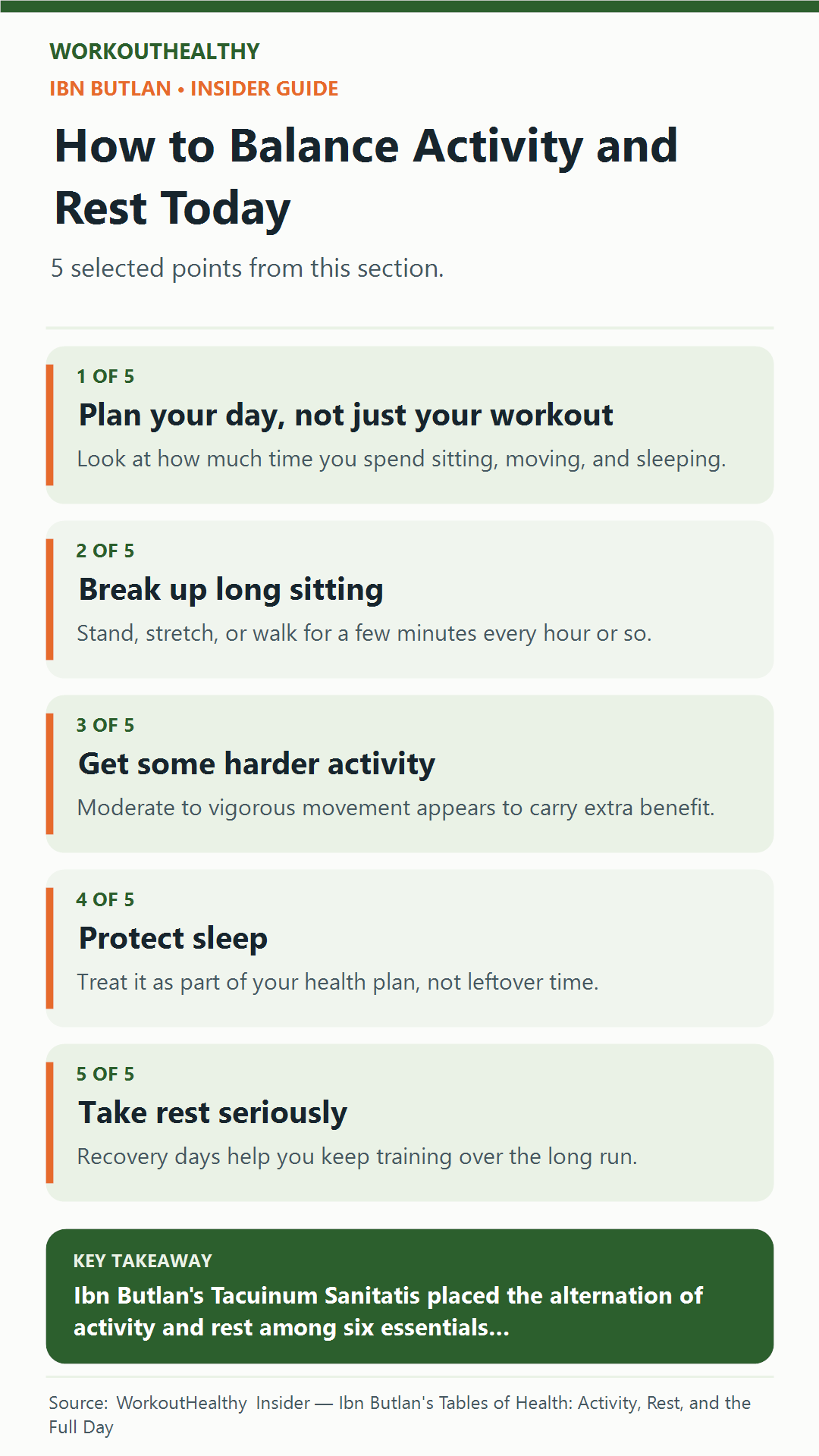
- Plan your day, not just your workout. Look at how much time you spend sitting, moving, and sleeping.
- Break up long sitting. Stand, stretch, or walk for a few minutes every hour or so.
- Get some harder activity. Moderate to vigorous movement appears to carry extra benefit.
- Protect sleep. Treat it as part of your health plan, not leftover time.
- Take rest seriously. Recovery days help you keep training over the long run.
- Get outside. Fresh air was on the list too, and a walk covers both.
A simple way to break up sitting is to spend a few minutes in a resting squat for mobility.
Short, hard efforts can also fit a busy day, as our look at whether a one minute wall sit can work like cardio explains.
Common Mistakes
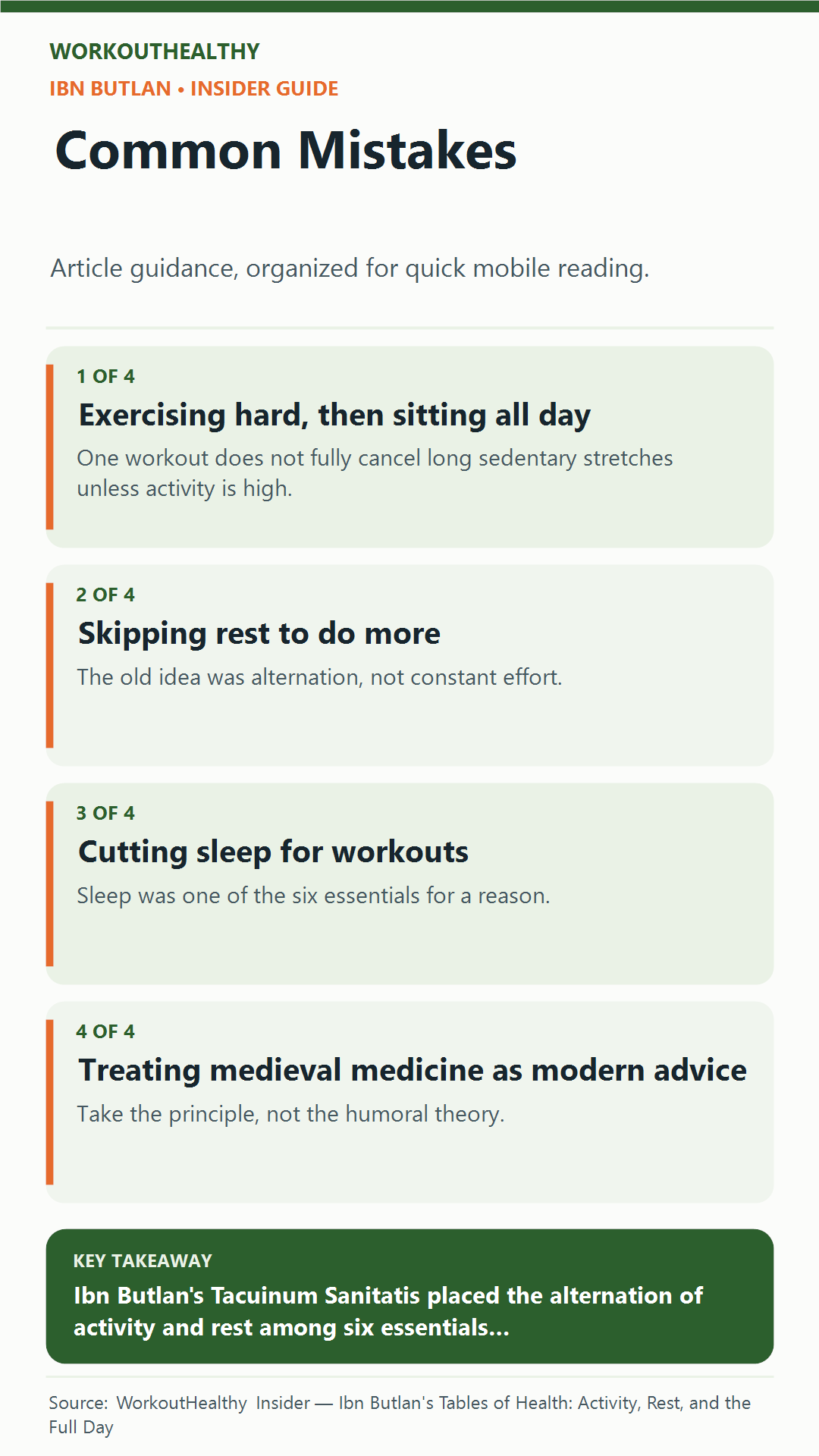
- Exercising hard, then sitting all day. One workout does not fully cancel long sedentary stretches unless activity is high.
- Skipping rest to do more. The old idea was alternation, not constant effort.
- Cutting sleep for workouts. Sleep was one of the six essentials for a reason.
- Treating medieval medicine as modern advice. Take the principle, not the humoral theory.
Who Should Be Careful
If you have a heart condition or another chronic illness, ask your doctor how much activity is right for you.
People who are very inactive should build up slowly rather than jumping to an hour a day.
The Bottom Line
Ibn Butlan’s Tacuinum Sanitatis placed the alternation of activity and rest among six essentials, next to food and sleep.
It framed movement as part of a balanced daily routine rather than a stand alone requirement.
Modern research supports looking at the full day, including sitting, activity, and sleep.
Move often, rest well, and let both have a place in your day.
Want more stories like this? Subscribe to WorkoutHealthy Insider for practical explanations behind popular fitness claims.
References
- Chastin, S. F. M., Palarea-Albaladejo, J., Dontje, M. L., & Skelton, D. A. (2015). Combined effects of time spent in physical activity, sedentary behaviors and sleep on obesity and cardio-metabolic health markers: A novel compositional data analysis approach. PLOS ONE, 10(10), e0139984. https://doi.org/10.1371/journal.pone.0139984
- Ekelund, U., Steene-Johannessen, J., Brown, W. J., Fagerland, M. W., Owen, N., Powell, K. E., Bauman, A., & Lee, I.-M. (2016). Does physical activity attenuate, or even eliminate, the detrimental association of sitting time with mortality? A harmonised meta-analysis of data from more than 1 million men and women. The Lancet, 388(10051), 1302 to 1310. https://doi.org/10.1016/S0140-6736(16)30370-1
- Ibn Butlan. (11th century). Taqwim al-Sihha [Tacuinum Sanitatis].
This article is for general information only and is not medical advice. If you have an injury, ongoing pain, or a medical condition, talk to a doctor or physical therapist before you change how you train or eat.