

Ancient Greek doctors did not just tell patients to walk more.
Some of their writings described different kinds of walks, each with its own effect.
A popular post says the Hippocratic tradition prescribed daily walking and moderate exertion as the foundation of good health.
That captures the spirit of the texts. The details are more specific, and a little stranger, than the summary suggests.
What “Hippocratic Tradition” Means
The Hippocratic Corpus is a large group of ancient Greek medical writings linked to the name of Hippocrates.
Many different authors wrote them, so they reflect a school of thought more than one man.
The texts most relevant to walking come from a work called Regimen.
Its second book discusses foods, drinks, and many kinds of exercise.
This article focuses on one piece of that advice: walking.
The texts treat it as more than a way to get from place to place.
The Walks Described in Regimen II
A 2016 article by Nomikos and colleagues in the American Journal of Sports Science and Medicine reviewed exercise in Hippocratic medicine.
It quotes Regimen II directly on walking.
“Walking is a natural exercise, much more so than the other exercises.”
The text then separates walks by timing.
Walks after dinner are described as helping to keep fat from building up around the belly.
Early morning walks are said to reduce the body and make the parts about the head light and bright.
Walks after gymnastic exercise are said to make the body pure and thin.
The reasoning behind these claims came from ancient ideas about heat, moisture, and body fluids.
Modern readers should treat the explanations as history, even when the advice sounds sensible.
Still, it is striking that a writer this old matched different walks to different times of day.
Walking after meals and walking to cool down after training are both common habits today.
Moderation and Gradual Build Up
The same review notes that the Hippocratic writer warned untrained people can feel pain after even slight exercise.
Trained bodies, by contrast, handle unusual effort better.
The authors describe the writer as favoring gradual increases in intensity and limited use of violent exercise.
That supports the popular post’s emphasis on moderate, consistent movement.
What About “Walking Is Man’s Best Medicine”?
This line is often credited to Hippocrates online.
We could not find it in the Hippocratic passages quoted in the sources we reviewed.
It fits the tone of Regimen II, but it is best treated as a modern paraphrase, not a verified quote.
What Modern Research Says
A 2022 meta analysis by Paluch and colleagues in The Lancet Public Health pooled data from 15 international cohorts.
The researchers split adults into four groups by how many steps they took each day.
The lowest group had a median of 3,553 steps a day. The highest group had a median of 10,901.
Compared with the lowest group, the second group had about a 40 percent lower risk of death during follow up.
The third group, at a median of 7,842 steps, had about a 45 percent lower risk.
The highest group had about a 53 percent lower risk.
Notice that the biggest jump came from leaving the lowest group, not from reaching the top.
A 2015 meta analysis by Hanson and Jones in the British Journal of Sports Medicine looked at outdoor walking groups.
It included 42 studies with 1,843 participants.
Walking groups lowered blood pressure, resting heart rate, body fat, body mass index, and total cholesterol.
They also improved aerobic fitness and six minute walk distance, and reduced depression scores.
No notable adverse side effects were reported in any of the included studies.
Where studies tracked it, average adherence was 75 percent, which matters for any habit meant to last years.
Evidence was less clear for waist size, fasting glucose, some mental health scores, and HDL cholesterol.
How Many Steps Are Enough?
The step-count study did not discover one number that every person must hit. Its pooled dose-response analysis found that the association with lower mortality risk tended to level off around 6,000 to 8,000 daily steps in adults 60 and older, and around 8,000 to 10,000 in adults younger than 60. Those are ranges where the curve flattened in these cohorts, not clinical thresholds or limits on walking.
For someone averaging 3,000 steps, an attainable increase may matter more than chasing 10,000 immediately. A person already walking 8,000 steps has less reason to add another 2,000 solely to satisfy a round number. The paper also found inconsistent evidence that stepping faster predicted lower mortality after accounting for total steps. That does not mean pace never matters for fitness; it means this analysis did not establish a simple speed rule beyond walking volume.
There is another distinction: a step counter records movement, not necessarily an intentional walk. Errands, stairs, household tasks and a planned outdoor route can all contribute. The study’s results cannot tell us whether one long walk is superior to several shorter bouts or whether a morning walk beats an evening one.
A Practical Four-Week Starting Point
For the first week, note your usual activity and take one comfortable 10-minute walk on most days. In the second week, add a few minutes to one or two walks if your feet and joints feel fine. In the third week, choose a reliable cue—after lunch, after work or with a friend—so the habit does not depend on motivation. In the fourth, decide whether you want more duration, a somewhat brisker pace, or a regular group walk.
This is a sample progression, not a treatment plan or a prescription from ancient medicine. If pain, dizziness or unusual breathlessness appears, scale back and seek medical guidance. Consistency and tolerable progression are more useful than trying to recreate the Hippocratic writer’s theories about bodily fluids.
What This Does Not Prove
The step count study pooled observational cohorts, so it shows a link, not proof that steps alone caused the lower risk.
Neither study tested the Hippocratic idea of timing walks to meals or mornings.
The ancient claims about “reducing” the body or lightening the head are not backed by these findings.
What does line up is the core message: regular, moderate walking is good for health.
How to Build a Daily Walking Habit
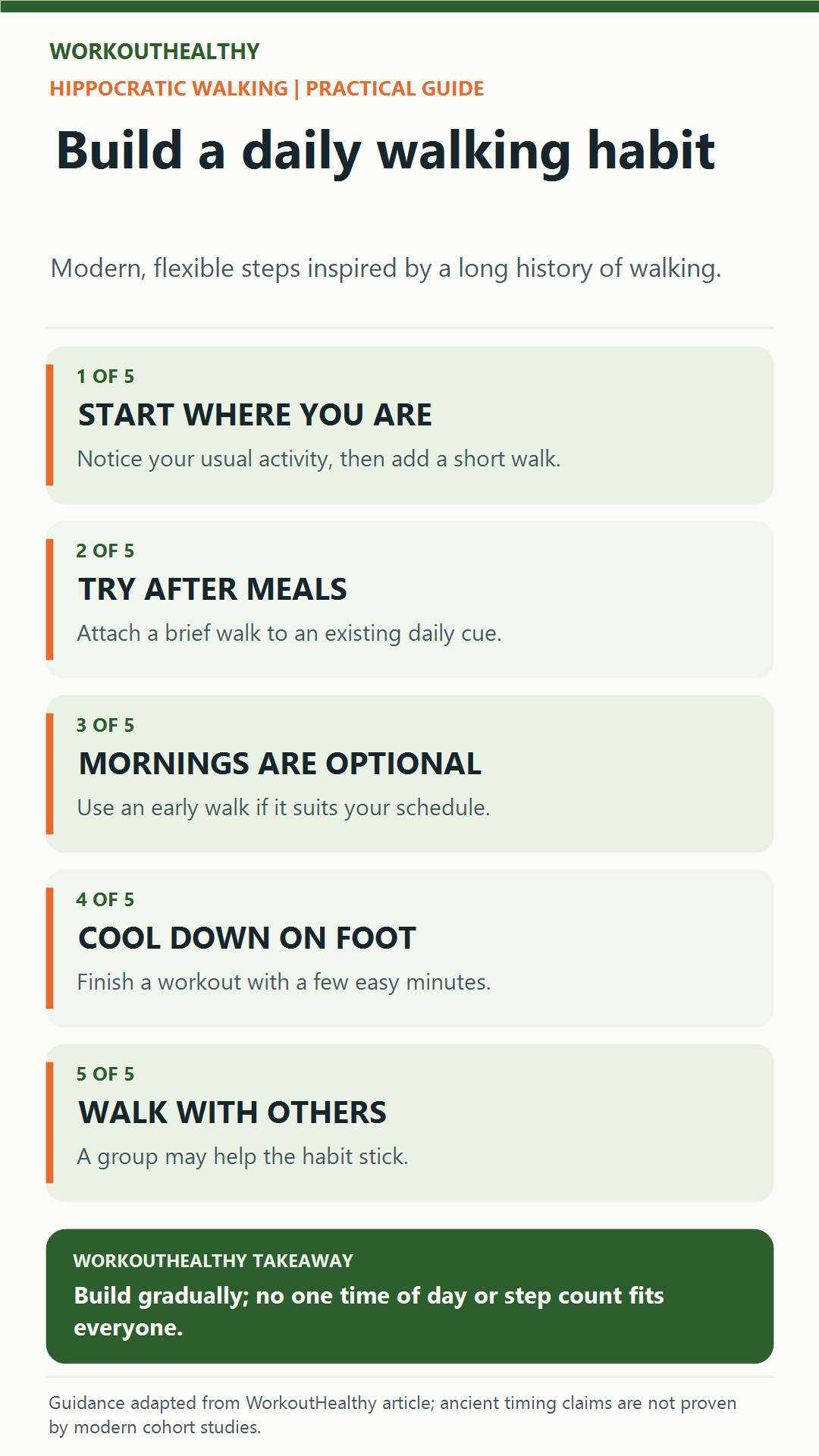
- Start where you are. Count your usual daily steps for a week, then add a short walk and build from there.
- Try a short walk after meals. It is an easy habit to attach to something you already do.
- Use mornings if they suit you. An early walk can be a calm way to begin the day.
- Cool down on foot. A few minutes of easy walking after a workout is a simple way to finish.
- Walk with others. Groups can help you stay consistent.
- Keep the pace comfortable. You should be able to talk while you walk.
On bad weather days, our guide to quiet home cardio with no equipment offers indoor options.
If your feet feel unsteady or sore on longer walks, our look at foot arch pressure and balance covers what the research shows.
Common Mistakes
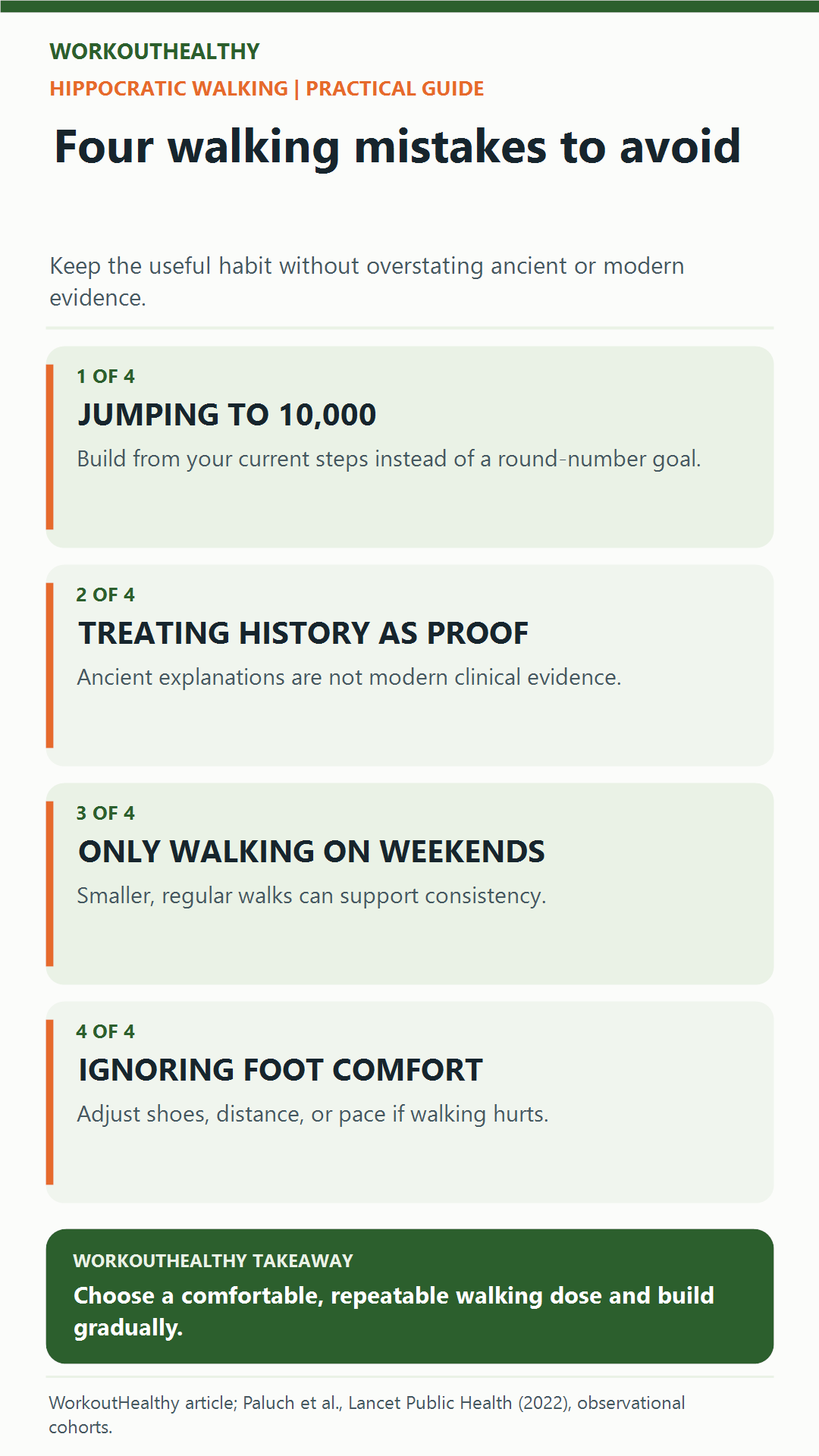
- Chasing 10,000 steps from day one. Big jumps can cause sore feet and shins.
- Treating ancient reasoning as science. The advice can be useful even when the explanation is outdated.
- Only walking on weekends. The texts and the research both point to regular movement.
- Ignoring footwear. Supportive shoes make daily walking more comfortable.
Who Should Be Careful
People with heart or lung conditions, balance problems, or foot pain should check with a doctor before increasing walking a lot.
If walking causes chest pain, unusual breathlessness, or leg pain that forces you to stop, get medical advice.
The Bottom Line
The Hippocratic Regimen II called walking a natural exercise and described walks after meals, in the morning, and after training.
Its explanations are ancient, but its preference for moderate, regular movement holds up.
Modern studies link more daily steps and group walking with better health.
Start small, walk most days, and build gradually over several weeks.
Want more stories like this? Subscribe to WorkoutHealthy Insider for practical explanations behind popular fitness claims.
References
- Hanson, S., & Jones, A. (2015). Is there evidence that walking groups have health benefits? A systematic review and meta-analysis. British Journal of Sports Medicine, 49(11), 710 to 715. https://doi.org/10.1136/bjsports-2014-094157
- Nomikos, N., Trompoukis, C., Lamprou, C., & Nomikos, G. (2016). The role of exercise in Hippocratic medicine. American Journal of Sports Science and Medicine, 4(4), 115 to 119. https://doi.org/10.12691/ajssm-4-4-6
- Paluch, A. E., Bajpai, S., Bassett, D. R., Carnethon, M. R., Ekelund, U., Evenson, K. R., Galuska, D. A., Jefferis, B. J., Kraus, W. E., Lee, I. M., Matthews, C. E., Omura, J. D., Patel, A. V., Pieper, C. F., Rees-Punia, E., Dallmeier, D., Klenk, J., Whincup, P. H., Dooley, E. E., … Steps for Health Collaborative. (2022). Daily steps and all-cause mortality: A meta-analysis of 15 international cohorts. The Lancet Public Health, 7(3), e219 to e228. https://doi.org/10.1016/S2468-2667(21)00302-9
This article is for general information only and is not medical advice. If you have an injury, ongoing pain, or a medical condition, talk to a doctor or physical therapist before you change how you train or eat.