
About the images: The person posing above and the consultation scene below are illustrations, not records of a patient’s recovery or demonstrations of a prescribed exercise. Your own surgical team’s instructions determine which movements and limits apply.
Exercise after breast cancer surgery can mean several different things: restoring shoulder movement, returning to daily activities or gradually rebuilding strength. Those goals do not all share one starting date.
A week-two label on an online workout cannot tell you which program fits your operation and recovery. Equally, evidence supporting early, tailored movement should not be turned into a blanket rule to avoid exercise.
This guide links the actual clinical exercise instructions, explains how their timing differs and compares four trials. Use it to understand a care-team-issued plan, rather than to combine several programs into a new routine.
Separate shoulder mobility from progressive strength training
Mobility work aims to restore how far and how comfortably the arm moves. Progressive resistance training adds an increasing strength challenge, while general activity such as walking has another role again.
An exercise name alone can be misleading. A supported shoulder movement, an unweighted arm movement and a loaded lift may look related on a screen while placing different demands on someone recovering from surgery.
The American Cancer Society’s guide distinguishes early movement from later strengthening. It says strength training usually begins around four to six weeks after surgery, with gradual progression and individual guidance.
That is the source’s general guidance, not a deadline or a prohibition against the earlier tailored interventions studied in trials. The kind of exercise, its limits and the person’s clinical plan remain part of the answer.
Find the clinical instructions that match your care plan
These three resources provide actual exercise instructions. Ask your surgical or rehabilitation team which resource, version and individual modifications they want you to follow.
| Clinical resource | What you will find | Timing and limits to keep with it |
|---|---|---|
| American Cancer Society | Written, illustrated arm and shoulder exercises, including wand work, shoulder blade movements and wall stretches. | Discuss exercises with the care team first; some movements depend on drain and suture restrictions. |
| Memorial Sloan Kettering | Mastectomy and reconstruction instructions, with an ordered movement sequence and illustrations. | The team sets each movement’s starting point and any range-of-motion restriction. |
| Breast Cancer Now | A clinician-developed first-week and second-week mobility program, with exercise videos and a linked leaflet. | Its second week adds advanced mobility movements; reconstruction requires advice before starting. |
Breast Cancer Now aims to restart its specified exercises the day after surgery, with its stated exceptions and care-team advice. That does not contradict a later start for a different movement or a different operation.
In particular, “advanced” in a shoulder-mobility sequence is not a synonym for permission to begin unrestricted weight training. Keep the exercise description attached to the timing statement.
Recognize movements in an assigned program
The following examples come from MSK’s guide, for people whose team has assigned those movements. They illustrate the actions; use the original sheet and your team’s instructions for the full sequence, repetitions and progression.
- Deep breathing: Sit comfortably, inhale slowly through the nose while the chest and belly expand, then exhale slowly through the mouth.
- Backward shoulder rolls: With relaxed arms, move both shoulders forward, upward, backward and downward in a circle. MSK describes smaller circles when the chest feels tight.
- Shoulder wings: Place hands on the chest or collarbones, lift elbows sideways within the assigned range limit, then lower them slowly. Without a restriction, MSK’s described upper limit is shoulder level.
These summaries do not establish that an exercise belongs in your plan. If an instruction or limit is unclear, have the team clarify it before copying a different version from another resource.
A useful check is to point to the exact movement on your prescribed sheet and ask for a demonstration. A similar name or a comfortable-looking pose is not enough to confirm that you are doing the intended exercise.
What four different trials actually tested
Studies can support rehabilitation without validating a particular online workout. Their populations, exercise delivery and outcomes need to stay visible alongside the result.
| Trial and participants | What was compared | Measured finding | What it cannot decide |
|---|---|---|---|
| Bendz and Fagevik Olsén, 2002: 230 women after breast cancer surgery. | Early physiotherapist-guided shoulder exercise versus written advice; both groups received the same exercise program at two weeks. | Earlier mobility recovery with the early program; no significant difference in lymphoedema between groups at two years. | A universal week-two loading plan, or a seroma benefit not reported in the abstract. |
| Min and colleagues, 2024: 56 people with early-stage breast cancer scheduled for partial or total mastectomy. | Tailored stretching and strength from postoperative day one, four supervised education sessions and daily home exercise, versus usual care. | Better shoulder recovery; reported full shoulder-strength recovery at one month in 19 of 28 versus 1 of 28 participants. | That every early exercise is suitable after every procedure, or that a video duplicates the tailored protocol. |
| PROSPER, 2022 report: 392 women at higher risk of shoulder problems. | Usual information leaflets with or without an early physiotherapist-supported program and three to six face-to-face appointments. | Better arm function at 12 months; no detected difference in adverse-event or lymphoedema rates. | Your personal exercise selection or clearance; 70% returned 12-month questionnaires. |
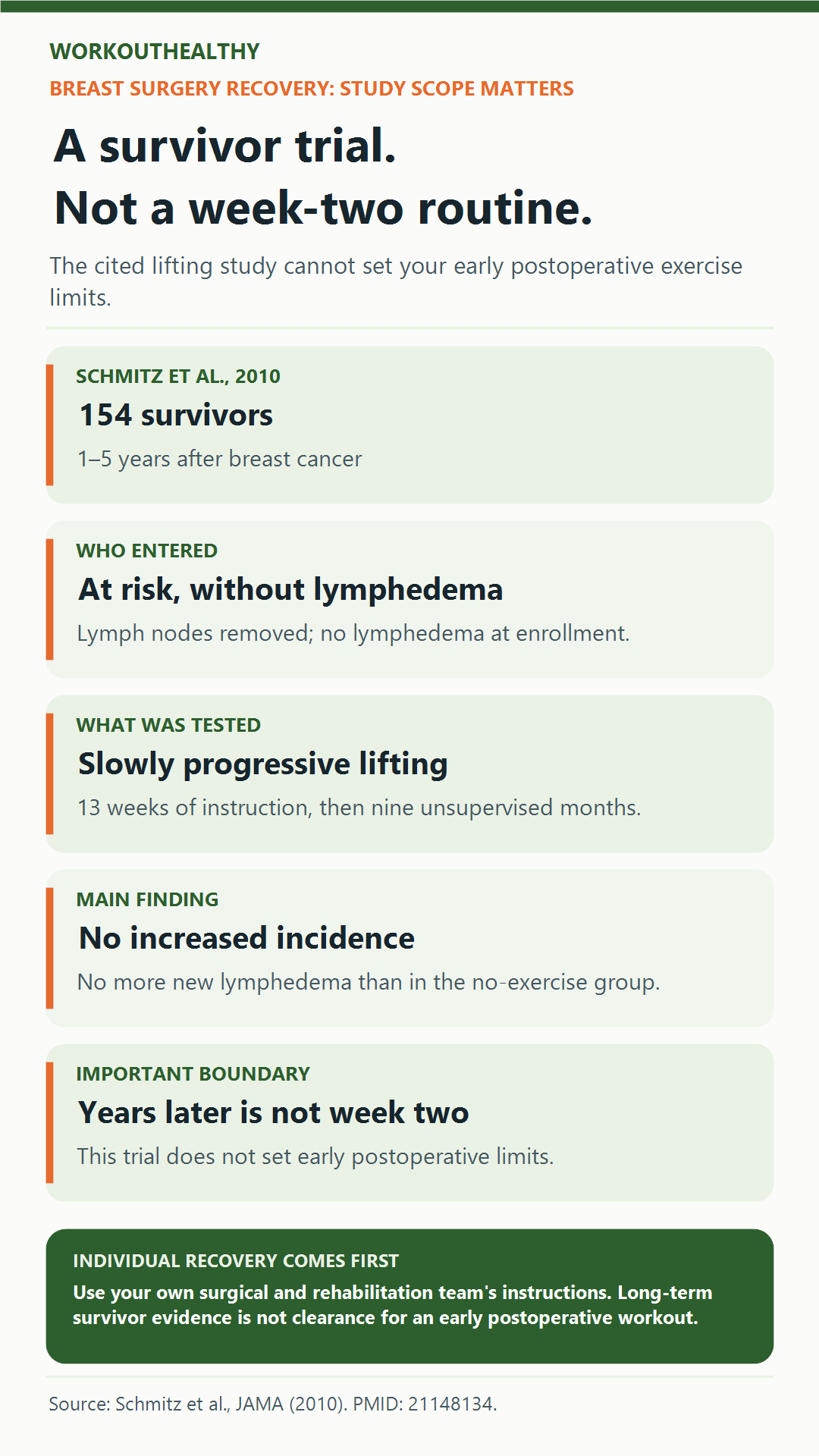
| Schmitz and colleagues, 2010: 154 survivors one to five years after breast cancer, at risk for lymphoedema but without it at entry. | Slowly progressive lifting, initially supervised for 13 weeks and then continued unsupervised for nine months, versus no exercise. | No increase in lymphoedema incidence with that program over a year. | What someone can lift two weeks after surgery, or treatment for existing lymphoedema. |
The 2024 trial is important because early exercise included strength work, not only stretching. Its program was adjusted to recovery and combined professional education with home practice.
It would misrepresent that design to say all beneficial exercise was continuously supervised. It would also misrepresent it to remove the tailoring and education, then treat its results as approval for any home routine.
PROSPER’s primary outcome was arm disability, rather than a test of the exact online video. Improved function and no detected complication difference support the studied approach, while follow-up losses and the selected population remain relevant.
Turn general guidance into clear individual instructions
Permission to move does not necessarily specify every exercise, load or direction. If your discharge instructions leave something unclear, ask the surgical or rehabilitation team to write down what they mean.
- Which program? Record the exact sheet or video your team recommends, including its date or version.
- Which movements now? Ask which named exercises are included, and which are being deferred.
- What limits? Have the team specify any range or lifting restrictions rather than estimating them from an image.
- How much and how often? Keep the prescribed repetitions, holds and frequency with that program.
- What changes the plan? Ask who will review progression and how you should contact them with concerns.
This is a way to record clinical instructions, not a test of whether a wound, drain or swollen arm is ready for exercise. Those assessments belong with the treating team.
For example, “My sheet lists shoulder wings, but I do not know my permitted height” identifies a specific question to resolve. It does not require trying the highest version first.

Keep new concerns separate from routine progression
Breast Cancer Now advises stopping its exercises and contacting the care team for wound-healing problems, seroma or pain that worsens during exercise or persists afterward. The ACS guide also calls for prompt contact about unusual or worsening swelling and other new symptoms during exercise.
Use the contact and stopping instructions supplied with your own plan. Do not use a trial’s average outcome, an online photograph or the absence of pain alone to clear yourself for a new movement.
If weight or everyday strength is unexpectedly declining during recovery, report that pattern too. Our unplanned weight and muscle loss guide explains how to describe changes without diagnosing their cause from home measurements.
What week two can usefully mean
Week two is a point on a calendar that can help identify a discussion or a particular program section. It is not a shared clinical definition of readiness for every exercise.
The useful comparison is the actual movement, the program’s intended patients and the limits attached to it. A clinical mobility guide, a tailored early-strength trial and a later-survivor lifting study should not be merged into one generic recovery schedule.
Find the instructions your team wants you to use, clarify uncertain movements and keep the progression plan together. That makes exercise guidance more usable while preserving the distinctions the research requires.
Research and clinical references
Watch the original source video
Outside the Doc Box titles its video Breast Cancer Exercise Program Week 2: Strength Exercises for Safe Healing After Cleared by Surgeon. Its description addresses mastectomy or DIEP flap reconstruction and explicitly asks viewers to obtain clearance from their healthcare team before exercise.
The video is retained as the context for the week-two question. The trial comparisons above do not constitute a review or endorsement of its individual exercise demonstrations.
Watch the original video on YouTube if the embedded player does not load.
Want more like this? Subscribe to WorkoutHealthy Insider for practical explanations behind popular fitness claims.
This article provides general information about postoperative exercise and research, not personal medical advice or clearance. Follow your surgical and rehabilitation team’s instructions, and consult an appropriately qualified healthcare professional before changing exercise during cancer treatment or recovery.