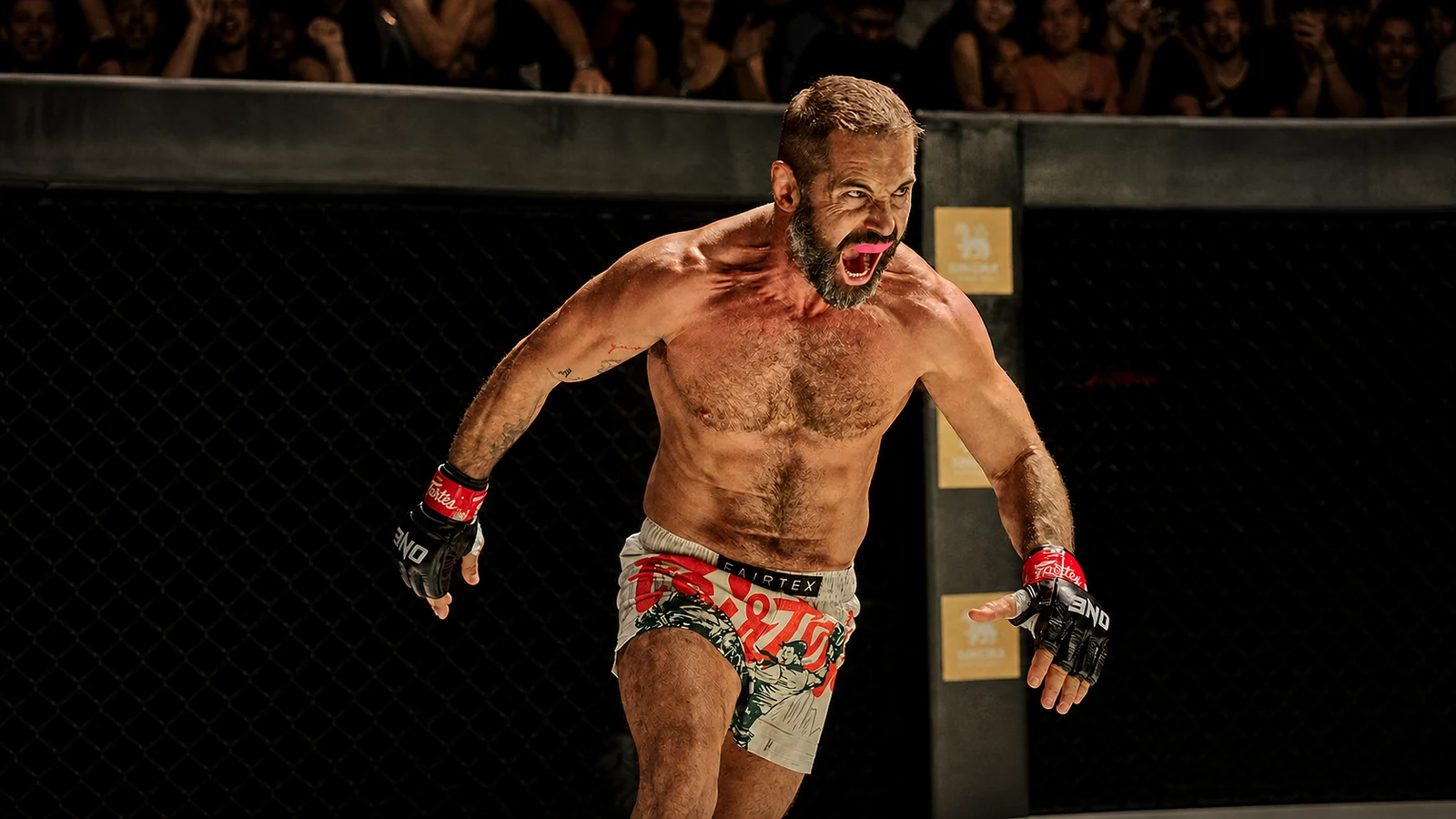

Daniel MacPherson did not fake his way through an MMA role.
For the upcoming sports drama Beast, the Australian actor went through real fight training rather than just learning to look the part.
MacPherson received the script in 2023 and began training in boxing, Muay Thai, and Brazilian Jiu Jitsu to prepare for the role of mixed martial arts fighter Patton James, according to reporting on the production.
He reportedly gained about 10 kilograms of muscle for the transformation, appearing alongside Russell Crowe in a role described as unrecognizable from his earlier work.
That level of preparation is unusual even by Hollywood transformation standards, and it says something about what it actually takes to look convincing in a full length fight sequence.
Who Is Daniel MacPherson
MacPherson was born in April 1980 and first became known playing Joel Samuels on the Australian soap Neighbours from 1998 to 2002, winning a Logie Award for Most Popular New Talent in 1999.
His career has since spanned television hosting, including six years co hosting Dancing with the Stars, and acting roles across British, Australian, and international productions such as The Bill, City Homicide, Strike Back, and The Shannara Chronicles.
He has also appeared in feature films including A Wrinkle in Time and Poker Face.
Beast represents a significant physical departure from most of his earlier roles, which rarely required this level of combat sport conditioning.
Starring opposite Russell Crowe, an actor with his own history of physically demanding roles, adds another layer of pressure to get the fight sequences right.
A film built around a former MMA fighter’s story lives or dies on whether audiences believe the central performance actually could compete.
What Beast Is About
Beast is a sports action thriller centered on Patton James, a mixed martial arts fighter, with MacPherson taking on the title role.
Films built around a single athlete’s rise, fall, or comeback have a long history in cinema, and the ones that resonate with audiences tend to share one trait: the lead actor’s physical performance has to hold up under scrutiny from viewers who actually understand the sport being portrayed.
That is a much higher bar for a combat sport like MMA than for many other athletic film roles, since fight fans notice bad technique immediately.
What Real Fight Training Actually Involves
Boxing, Muay Thai, and Brazilian Jiu Jitsu each demand different physical skills, and training in all three at once is a serious undertaking even for someone who is not preparing for a film role.
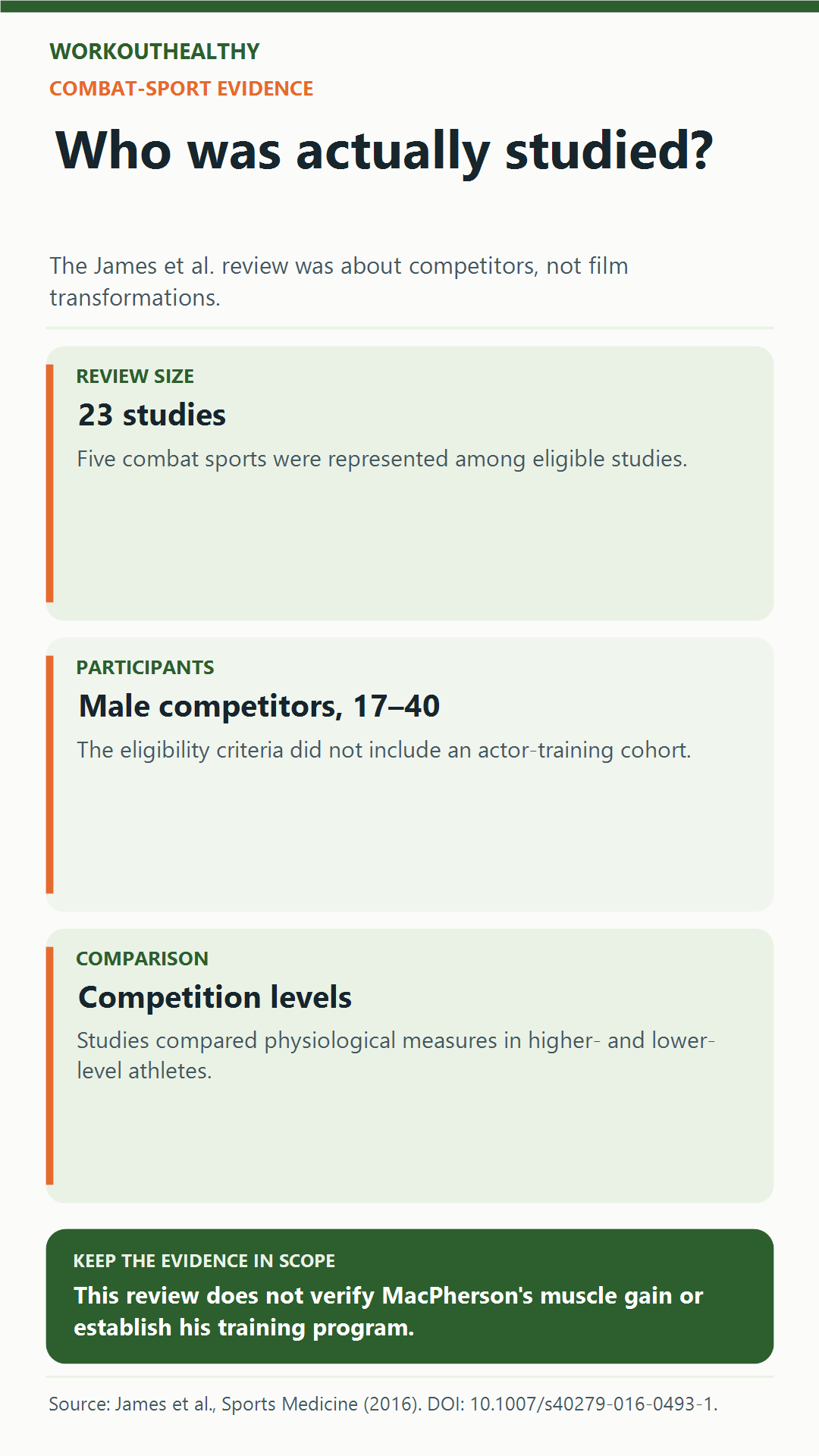
A systematic review published in Sports Medicine examined the physiological characteristics that distinguish successful mixed martial arts athletes across the existing combat sport research (James et al., 2016).
The researchers found that competitive MMA demands a rare combination of qualities: high anaerobic power for explosive striking and takedowns, solid aerobic conditioning to sustain multiple rounds, and significant grip and core strength for grappling exchanges.
Training three disciplines together, rather than specializing in just one, means building all of those qualities somewhat simultaneously, which is a genuinely demanding schedule even over a period of months.
Why This Kind of Preparation Reads as Authentic on Screen
Fight choreography can fake a lot of things, but it struggles to fake real conditioning, real technique under fatigue, and real contact.
An actor who has actually trained in these disciplines moves differently during a fight scene than one who has only rehearsed choreography.
Weight transfer, hip rotation on strikes, and defensive positioning all look different when the underlying skill is real rather than staged.
That authenticity is part of why productions increasingly invest in real training rather than relying entirely on stunt doubles and camera tricks, especially for a role built specifically around a character’s fighting ability.
A fight scene built on real technique reads differently on camera than one built purely on choreography, even to an audience that has never trained a day in their life.
The Real Physical Cost of Combat Sports Training
This level of preparation does not come without genuine physical risk, and that is worth being honest about rather than only celebrating the transformation.
A review published in Sports Health examined injuries commonly sustained by mixed martial arts athletes across amateur and professional levels (Jensen et al., 2016).
The researchers found that MMA carries meaningfully higher injury rates than many other combat sports, with head and facial injuries, joint sprains, and hand or wrist injuries among the most common.
That does not mean the training is reckless when done properly under professional coaching, which is standard practice for a major film production.
It does mean this is not a training style to copy casually without the same level of supervision and gradual progression.
What This Evidence Does Not Prove
Neither study was conducted on actors training for a film role, and the specific details of MacPherson’s own training program, including exact frequency, intensity, and supervision, have not been fully detailed in public reporting.
The 10 kilogram muscle gain figure comes from entertainment press coverage rather than a verified training log, so it should be read as a reported figure rather than an independently confirmed measurement.
The physiological and injury research cited here describes competitive MMA athletes broadly, not this specific production’s training program.
It is also worth noting that gaining muscle while simultaneously building combat sport skill and conditioning is a genuinely difficult combination to execute well, and most people attempting it without professional guidance and a realistic timeline are more likely to get hurt or plateau than to succeed.
The Trade Off Between Adding Muscle and Staying Conditioned
Building noticeable muscle mass and maintaining sharp cardiovascular conditioning for combat sports can work against each other if the training is not carefully balanced.
A heavy calorie surplus, useful for adding size, can make an athlete feel sluggish during high output cardio work like sparring rounds.
A production preparing an actor for both a bigger frame and a convincing fight performance has to manage that tension deliberately, usually by structuring different training blocks around different priorities rather than chasing both goals at maximum intensity every single week.
This is one of the more technically difficult transformations in the industry precisely because size and cardio conditioning are not the same adaptation, and pushing too hard on one can quietly undercut the other.
Common Mistakes People Make Training in Combat Sports
Trying to train multiple combat disciplines at full intensity from day one is a common mistake.
Beginners generally progress faster and get hurt less often by building a base in one discipline before layering in others.
Skipping proper instruction in favor of self taught technique is another frequent error.
Strikes and grappling positions performed with poor form raise injury risk sharply, both to the person training and to any training partner.
Ignoring recovery between hard sessions is a third common trap.
Combat sports place unusual stress on joints, and inadequate recovery time is a major driver of the injury rates seen in the research above.
Training without any protective gear, including mouthguards and hand wraps, is a mistake that raises the risk of exactly the kind of head, facial, and hand injuries the research identifies as most common.
How to Start Combat Sports Training Safely
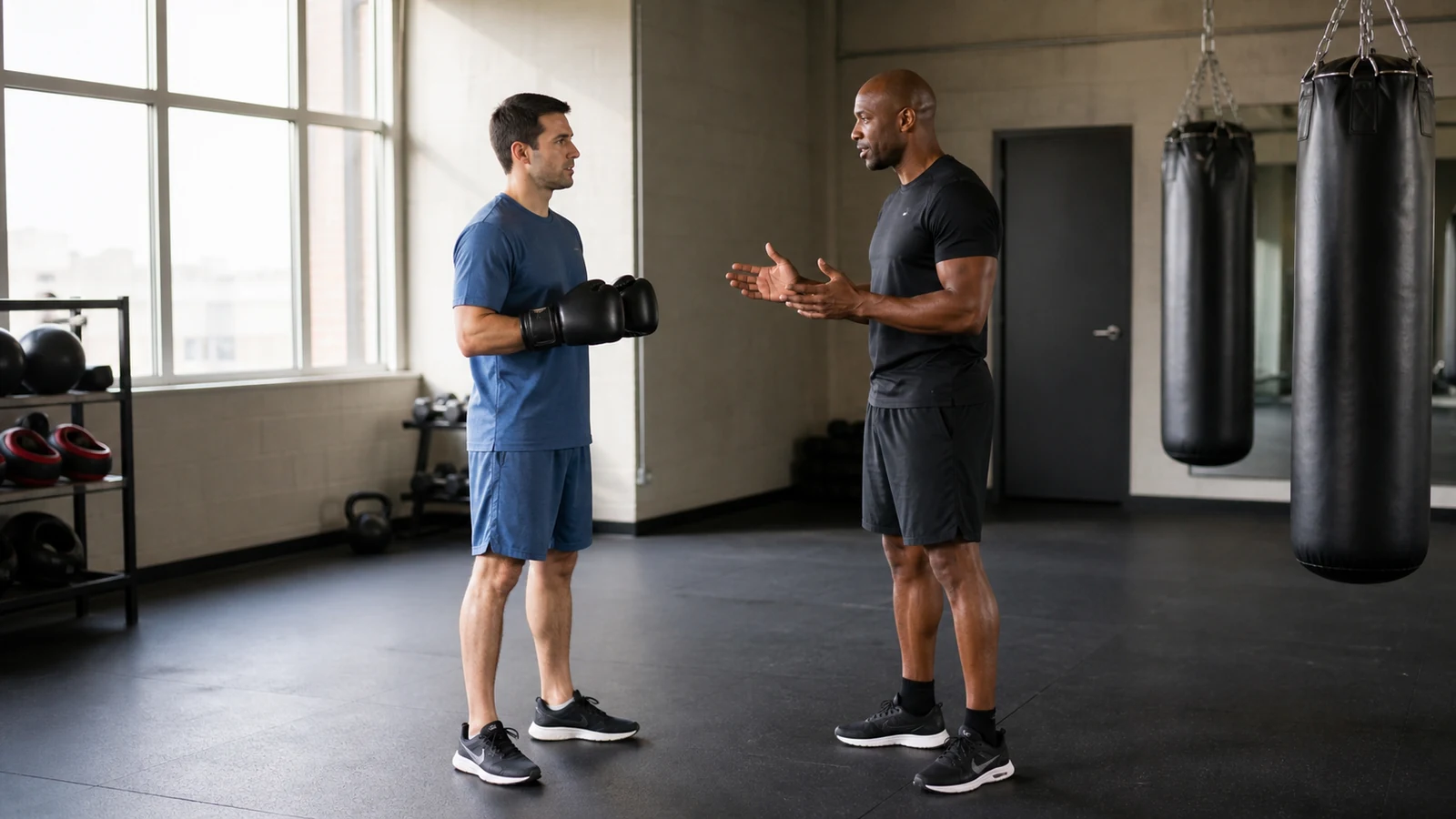
Find a reputable gym with certified, experienced instructors rather than trying to learn technique from videos alone.
Start with one discipline and build a foundation before adding others.
Boxing, Muay Thai, and grappling arts like Jiu Jitsu each take real time to develop even basic competency.
Invest in proper protective equipment from the start, including a mouthguard, hand wraps, and gloves appropriate for your training.
Build general strength and conditioning alongside skill training, not instead of it.
General fitness reduces fatigue related injury risk during longer sparring or grappling sessions.
Communicate clearly with training partners about intensity, especially early on.
Most reputable gyms expect new students to train at a controlled pace rather than full contact right away.
Give your body real rest between hard sessions, particularly sparring or live grappling days.
Two to three high intensity sessions a week is a reasonable starting point for most beginners.
Get a baseline medical checkup before starting, especially if you have any history of concussion, joint injury, or cardiovascular concerns.
Set a realistic timeline for skill development rather than comparing your own progress to a film transformation built around months of full time, professionally supervised training.
Most people training around a job and other responsibilities will progress more slowly, and that is completely normal.
If you are building the strength base for combat sports, foundational pressing work like the floor press can build upper body pushing strength with less shoulder strain than a standard bench press.
A personal trainer or strength coach can also help build a conditioning program that supports combat sport training without overloading your recovery.
References
- James, L. P., Haff, G. G., Kelly, V. G., & Beckman, E. M. (2016). Towards a determination of the physiological characteristics distinguishing successful mixed martial arts athletes: A systematic review of combat sport literature. Sports Medicine, 46(10), 1525-1551. https://doi.org/10.1007/s40279-016-0493-1
- Jensen, A. R., Maciel, R. C., Petrigliano, F. A., Rodriguez, J. P., & Brooks, A. G. (2016). Injuries sustained by the mixed martial arts athlete. Sports Health, 9(1), 64-69. https://doi.org/10.1177/1941738116664860
- Men’s Health. Train Like a Celebrity.
This article is for general educational purposes and is not medical advice. Talk to a doctor or qualified health professional before starting a new or high intensity training program, especially if you have any history of head injury, joint problems, or heart concerns.