
More than 300 years ago, an English writer argued that exercise could treat long term illness.
His name was Francis Fuller, and his book was called Medicina Gymnastica.
A popular post says Fuller paired regular exercise with massage to treat chronic ailments.
That is close to what his book says. The details are a little different, and they matter.
Who Francis Fuller Was
Francis Fuller lived from 1670 to 1706.
He was an English medical writer, often called Francis Fuller the Younger.
He did not write from pure theory.
He wrote as a former patient who believed his own serious illness had taught him what exercise could do.
He died young, at about 36, only a year or so after his book appeared.
What His Book Actually Says
The full title explains the goal.
It describes a treatise on the power of exercise and “the great necessity of it in the cure of several distempers.”
“Distempers” was an old word for diseases.
The second edition is dated 1705.
A library exhibit at Virginia Commonwealth University calls it “the first book in English on the power of exercise in treating disease.”
The book went through several editions. A later version appeared under the title Every Man his Own Physician.
A Book Born From His Own Illness
In the preface, Fuller says he did not pick the subject out of curiosity.
He wrote that it came from “the severest Experience,” a distemper he had suffered some years before.
He admitted his own case was unusual.
Still, he believed it taught him which kinds of motion could help other people.
That personal angle is part of why the book felt so practical.
He presented his advice as something tested on his own body, not just argued from books.
Riding, Walking, and Rubbing
Fuller’s favorite exercise was riding a horse.
He treated moderate riding as the best choice for people with lung disease, which his era called consumption.
He did not push long, punishing rides. He favored steady, moderate riding done regularly.
He also discussed walking, cold baths, and what he called chafing or friction.
Friction meant rubbing the body by hand or with cloth. It is the closest thing in his book to modern massage.
He wrote that it could be done “without any Pain at all, or rather with some Pleasure.”
He applied these methods to a range of long term complaints.
These included consumption, hysteric and hypochondriac disorders, and a kind of rheumatism he believed was seated in the nerves.
So the popular summary is fair in spirit. Fuller did combine movement with hands on rubbing for chronic problems.
But riding was the star of his plan, and his medical explanations belong to his time, not ours.
Hands on care can make you feel better today. Regular movement is what tends to keep you better next month.
What Modern Research Says
Today, exercise is one of the best studied treatments for long term pain.
A 2021 Cochrane review by Hayden and colleagues looked at exercise for chronic low back pain.
It included 249 trials.
The authors found moderate certainty evidence that exercise is probably effective for pain compared with no treatment, usual care, or placebo.
The average pain improvement was large enough to count as clinically important.
The benefit for daily function was smaller and did not reach the review’s threshold for a meaningful change.
Massage has a weaker record.
A 2015 Cochrane review by Furlan and colleagues looked at massage for low back pain.
Its authors wrote that they had “very little confidence” that massage is an effective treatment for low back pain.
That does not mean massage is useless. It means the studies are not strong enough to prove a lasting effect.
What This Does Not Prove
Neither review tested Fuller’s exact methods.
Horse riding and old style chafing are not the same as modern exercise therapy or massage.
Fuller’s main target, consumption, often meant tuberculosis. Exercise and rubbing do not cure that infection.
Modern research mostly supports his broad instinct, that regular movement helps many chronic conditions.
It does not support every specific claim he made.
How to Use Fuller’s Idea Today
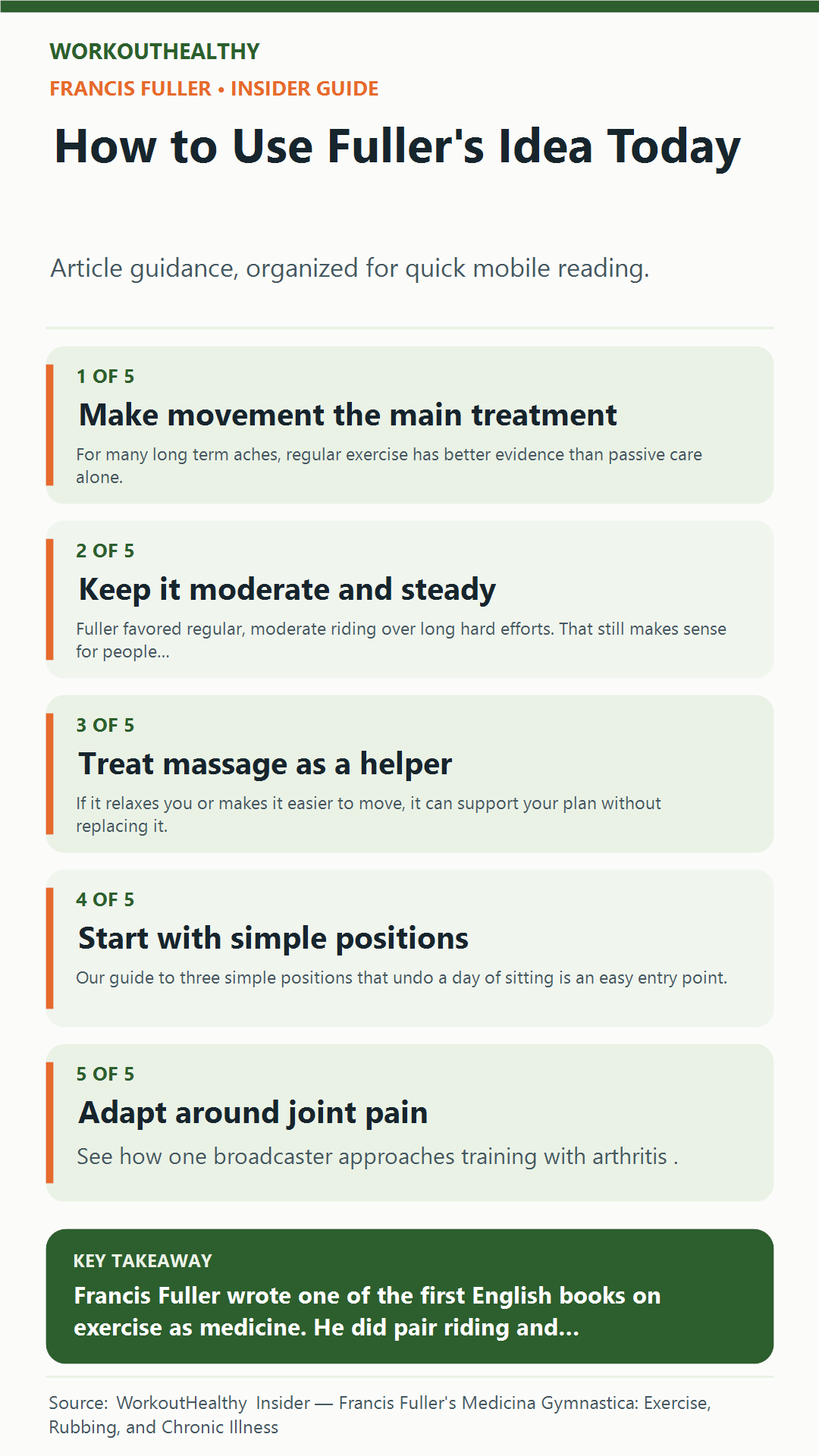
- Make movement the main treatment. For many long term aches, regular exercise has better evidence than passive care alone.
- Keep it moderate and steady. Fuller favored regular, moderate riding over long hard efforts. That still makes sense for people with ongoing symptoms.
- Treat massage as a helper. If it relaxes you or makes it easier to move, it can support your plan without replacing it.
- Start with simple positions. Our guide to three simple positions that undo a day of sitting is an easy entry point.
- Adapt around joint pain. See how one broadcaster approaches training with arthritis.
Common Mistakes
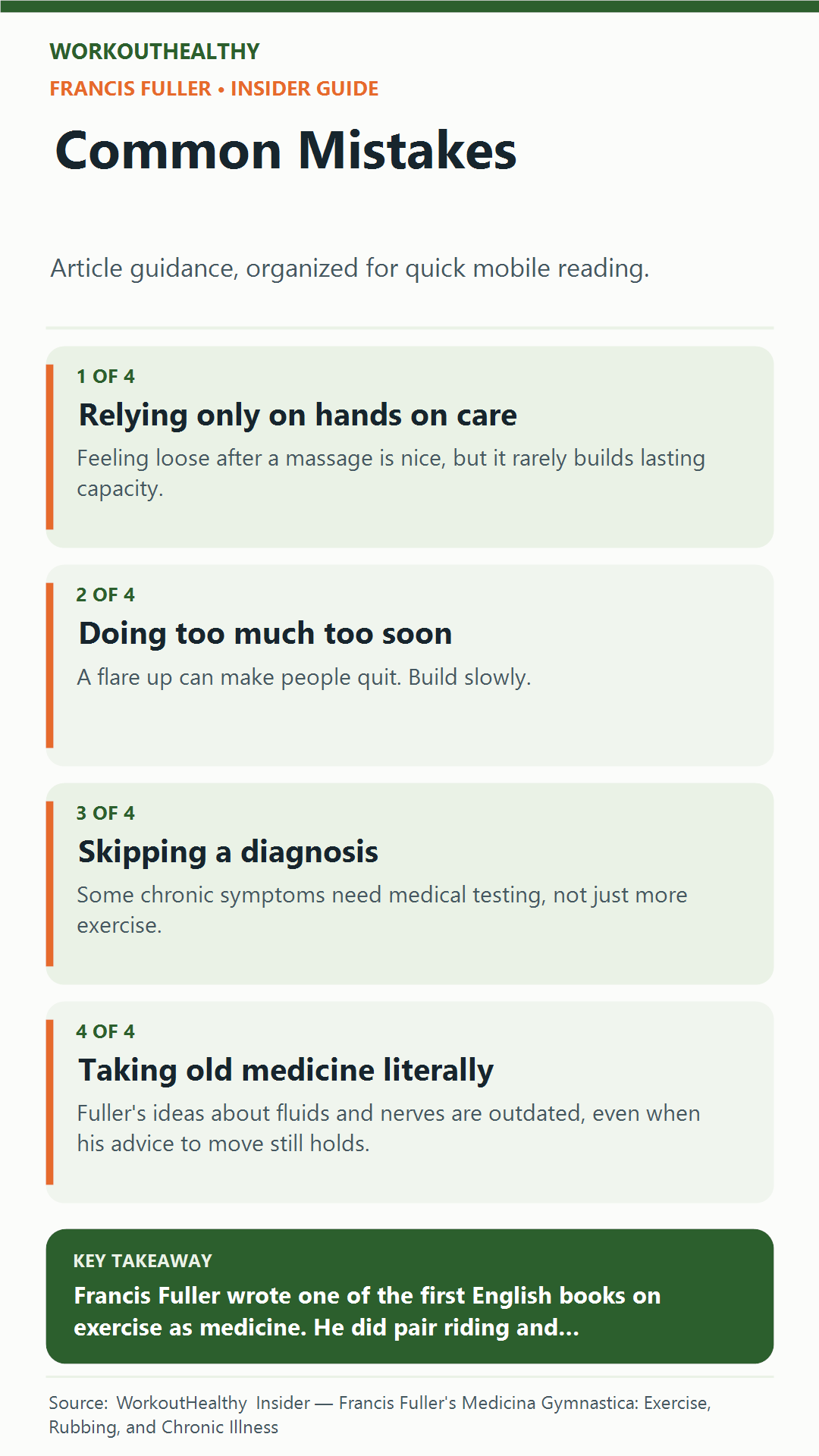
- Relying only on hands on care. Feeling loose after a massage is nice, but it rarely builds lasting capacity.
- Doing too much too soon. A flare up can make people quit. Build slowly.
- Skipping a diagnosis. Some chronic symptoms need medical testing, not just more exercise.
- Taking old medicine literally. Fuller’s ideas about fluids and nerves are outdated, even when his advice to move still holds.
Who Should Be Careful
People with heart or lung disease should get medical guidance before starting a new exercise plan.
For lung conditions, supervised programs can be a safer place to start. Our look at exercise and pneumonia risk covers related research.
Massage may not be right for people with blood clots, fragile skin, or certain bleeding problems.
The Bottom Line
Francis Fuller wrote one of the first English books on exercise as medicine.
He did pair riding and other exercise with rubbing for long term illness, shaped by his own hard experience as a patient.
Modern evidence backs exercise for chronic pain more firmly than it backs massage.
The most useful lesson is simple: let regular movement lead, and let hands on care support it.
Want more stories like this? Subscribe to WorkoutHealthy Insider for practical explanations behind popular fitness claims.
References
- Fuller, F. (1705). Medicina gymnastica: Or, a treatise concerning the power of exercise, with respect to the animal oeconomy; and the great necessity of it, in the cure of several distempers (2nd ed.). London. https://www.gutenberg.org/ebooks/63497
- Furlan, A. D., Giraldo, M., Baskwill, A., Irvin, E., & Imamura, M. (2015). Massage for low-back pain. Cochrane Database of Systematic Reviews, 2015(9), CD001929. https://doi.org/10.1002/14651858.CD001929.pub3
- Hayden, J. A., Ellis, J., Ogilvie, R., Malmivaara, A., & van Tulder, M. W. (2021). Exercise therapy for chronic low back pain. Cochrane Database of Systematic Reviews, 9(9), CD009790. https://doi.org/10.1002/14651858.CD009790.pub2
- VCU Libraries Gallery. (n.d.). Medicina gymnastica or every man his own physician. From the Library of Dr. Herman J. Flax. https://gallery.library.vcu.edu/exhibits/show/flaxcollectionofphysiatry/highlights-from-the-flax-lib/medicina-gymnastica-or-every-m
This article is for general information only and is not medical advice. If you have an injury, ongoing pain, or a medical condition, talk to a doctor or physical therapist before you change how you train or eat.