
Most lifters stop a set when the bar will not move.
Dorian Yates often kept going, with help.
A popular post says he relied on a training partner to force out a few extra reps past normal failure.
That matches how his training is usually described. The research on the method is more mixed than the legend.
What Forced Reps Are
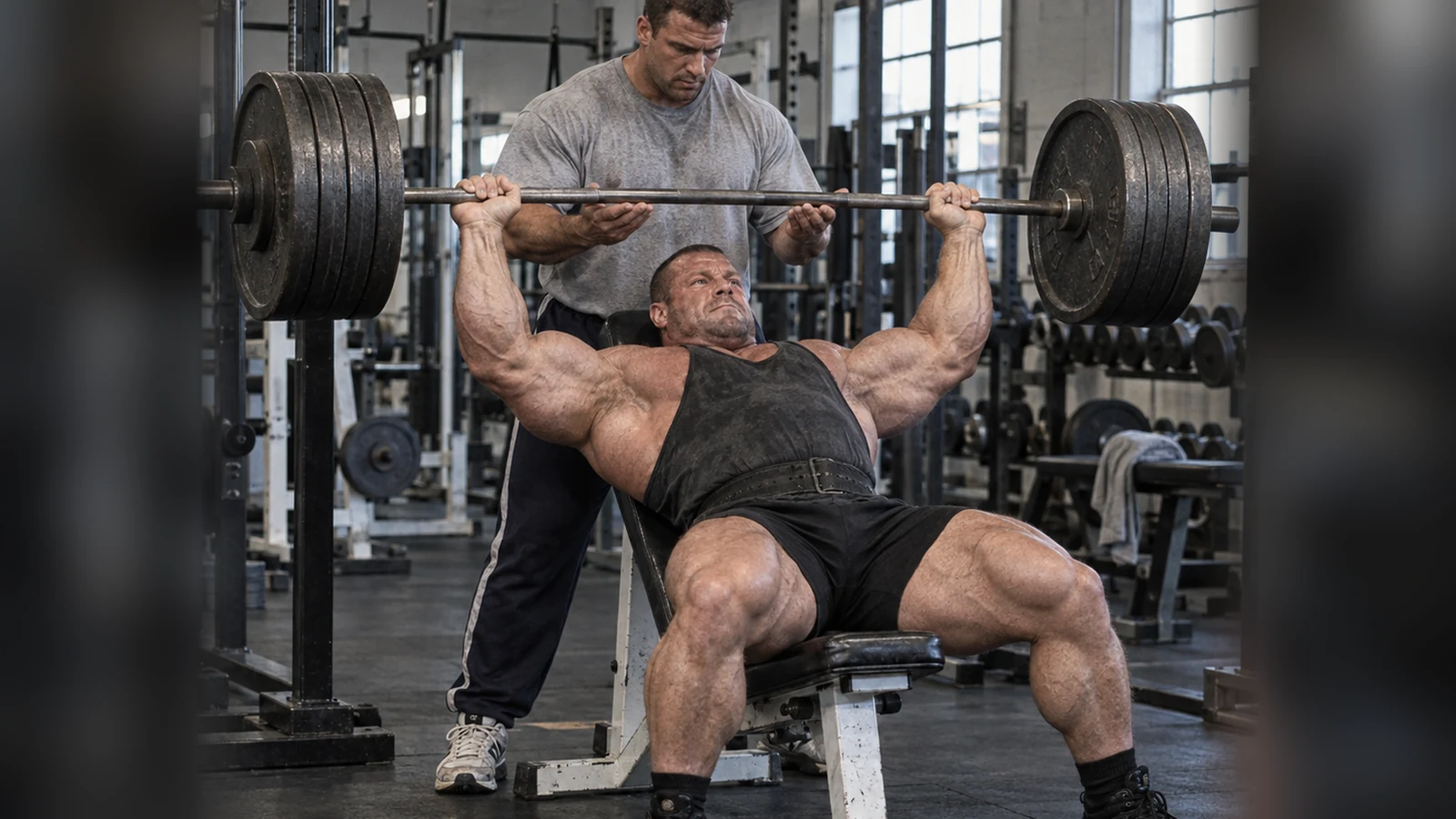
A forced rep is a rep you finish with a little help from a partner.
You lift on your own until you cannot complete another rep with good form.
Then your partner lifts just enough of the load to keep the bar moving.
You still push as hard as you can. The partner only covers the gap.
Forced reps come at the very end of a set, after you have already reached failure on your own.
The goal is to push the muscle past the point where it would normally quit.
Who Dorian Yates Is
Dorian Yates was born on April 19, 1962, in England.
He won six straight Mr. Olympia titles, from 1992 to 1997.
He trained at Temple Gym in Birmingham, which he bought in 1987.
His style followed high intensity training ideas that were shaped by Mike Mentzer.
That meant short workouts, few working sets, and extreme effort on each one.
He has been quoted as saying that if you feel able to attempt a second set, you did not give everything on the first.
Forced reps fit that mindset.
They are a way to squeeze the last bit of effort out of a single set.
Yates is still active today and continues to share his physique and training updates online.
What We Could Confirm About His Forced Reps
A 2025 Generation Iron article on his routine lists one working set for each exercise.
It says he often had a spotter assist him with a few forced reps.
It also says he added a couple of forced reps to make sure he trained to the utmost failure.
In a firsthand interview with Tim Ferriss, Yates described a partner offering slight assistance for one or two reps at the end of a set. He warned against a partner lifting too much of the weight.
That supports describing the method as a small amount of assistance at the end, not a partner doing the set.
A spotter can help you finish a rep. Only you can decide when the extra rep is worth the cost.
What One Study Found About Forced Reps
A 2003 study by Ahtiainen and colleagues compared forced reps with standard sets taken to failure.
It involved 16 male athletes doing leg exercises.
In the forced rep workout, the men started with a heavier load.
When they could not do more reps alone, they got help to finish the rest of the set.
Both workouts caused large short term rises in testosterone, cortisol, and growth hormone.
The forced rep workout caused larger hormone rises.
It also caused a bigger drop in maximal leg force.
Leg force was still lower three days later.
The authors described forced reps as creating a greater acute stress on the body.
That is useful to know. More stress means more recovery time before your next hard session.
What Research Says About Training to Failure
Forced reps are a way of going past failure, so failure research matters here too.
A meta-analysis by Grgic and colleagues pooled 15 studies of young adults.
It found no significant difference in strength gains between failure and non-failure training.
It also found no significant difference in muscle growth between the two.
When studies matched total training volume, the results were still similar.
In plain terms, you can build strength and size without hitting failure on every set.
What This Does Not Prove
- It does not prove forced reps build more muscle. Bigger hormone spikes after a workout are not the same as more growth over months.
- It does not show forced reps are useless. Few long term studies have tested them directly.
- It does not explain Yates’s results. Years of training, genetics, diet, and other factors all played a part.
How to Use Forced Reps Wisely
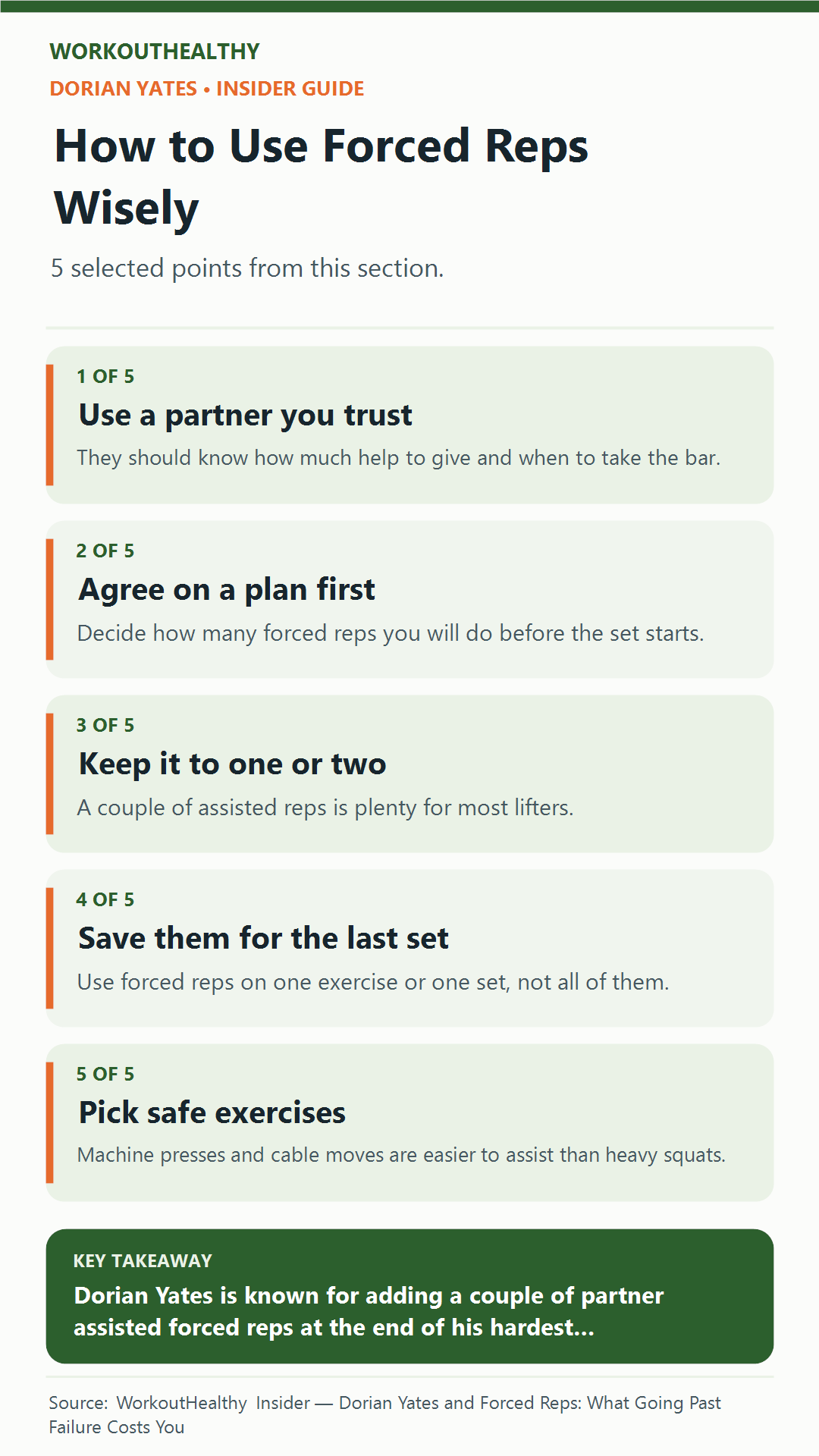
- Use a partner you trust. They should know how much help to give and when to take the bar.
- Agree on a plan first. Decide how many forced reps you will do before the set starts.
- Keep it to one or two. A couple of assisted reps is plenty for most lifters.
- Save them for the last set. Use forced reps on one exercise or one set, not all of them.
- Pick safe exercises. Machine presses and cable moves are easier to assist than heavy squats.
- Plan more rest. The Ahtiainen study showed force was still down days later.
If you want another way to raise effort without a partner, see how a 6 second hold can build tendon strength.
For a reality check on building size, read our look at whether building muscle is as simple as one coach claims.
If you are older, our strength plan for your 40s shows how to train hard with less risk.
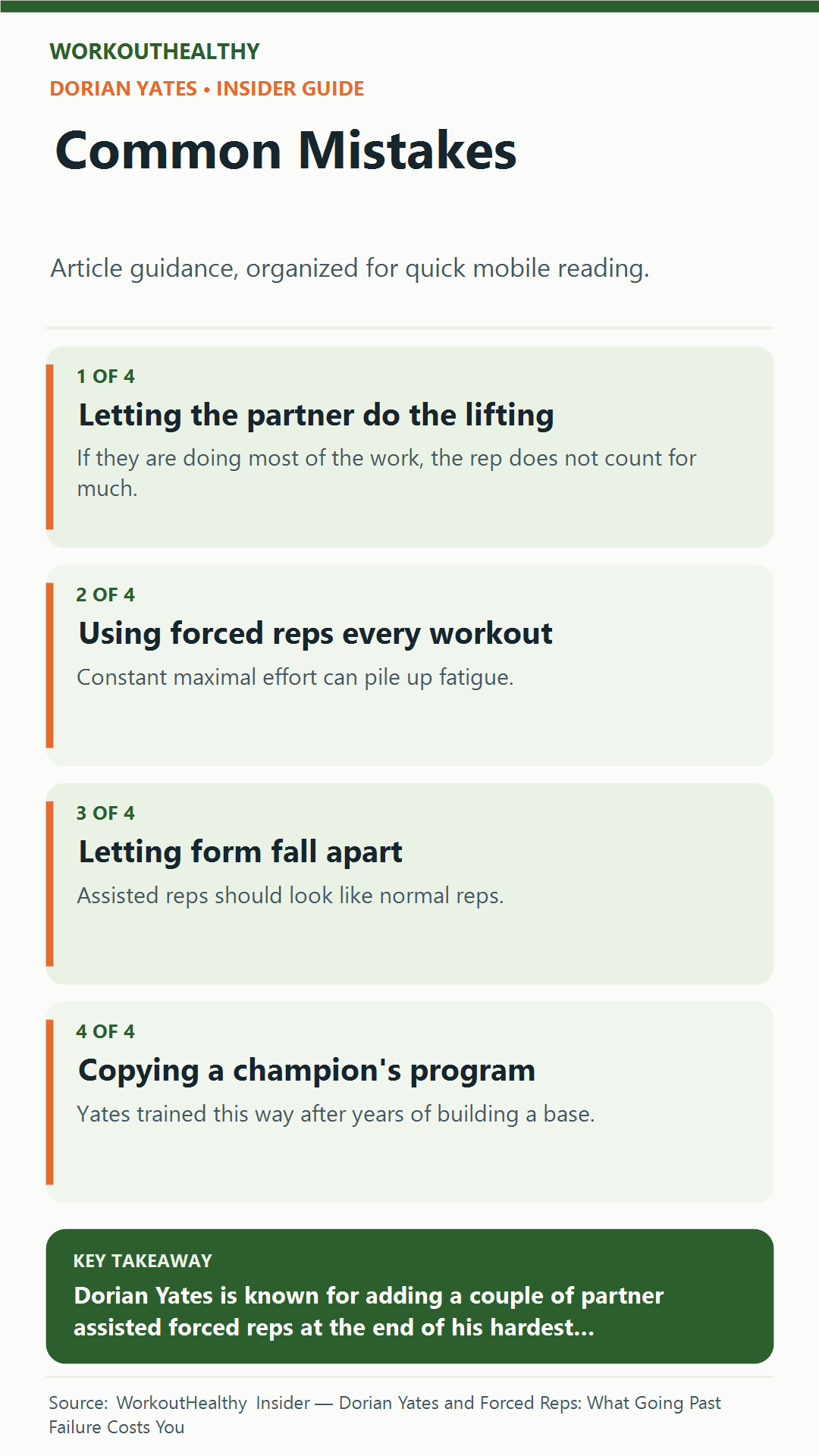
Common Mistakes
- Letting the partner do the lifting. If they are doing most of the work, the rep does not count for much.
- Using forced reps every workout. Constant maximal effort can pile up fatigue.
- Letting form fall apart. Assisted reps should look like normal reps.
- Copying a champion’s program. Yates trained this way after years of building a base.
Who Should Skip Forced Reps
Beginners should learn technique and steady progress before trying reps past failure.
People with joint pain, recent injuries, or heart conditions should talk to a doctor first.
Yates himself suffered torn biceps and triceps, and injuries helped end his career in 1997.
We cannot say those injuries came from forced reps. They are still a reminder that extreme effort carries risk.
The Bottom Line
Dorian Yates is known for adding a couple of partner assisted forced reps at the end of his hardest sets.
Research shows forced reps create more short term stress and fatigue than normal sets.
Going to failure is not required for growth.
If you try forced reps, use them sparingly, with a trusted partner, and give yourself extra recovery.
Want more stories like this? Subscribe to WorkoutHealthy Insider for practical explanations behind popular fitness claims.
References
- Ahtiainen, J. P., Pakarinen, A., Kraemer, W. J., & Häkkinen, K. (2003). Acute hormonal and neuromuscular responses and recovery to forced vs. maximum repetitions multiple resistance exercises. International Journal of Sports Medicine, 24(6), 410 to 418. https://doi.org/10.1055/s-2003-41171
- Grgic, J., Schoenfeld, B. J., Orazem, J., & Sabol, F. (2021). Effects of resistance training performed to repetition failure or non-failure on muscular strength and hypertrophy: A systematic review and meta-analysis. Journal of Sport and Health Science, 11(2), 202 to 211. https://doi.org/10.1016/j.jshs.2021.01.007
- Ferriss, T. (2018, June 5). The Tim Ferriss Show Transcripts: Dorian Yates (#235) [Interview with Dorian Yates]. Tim Ferriss.
- Ramos, T. (2025, February 6). Dorian “The Shadow” Yates’ complete bodybuilding workout routine. Generation Iron.
- Wikipedia contributors. (n.d.). Dorian Yates. In Wikipedia. Retrieved September 16, 2026, from https://en.wikipedia.org/wiki/Dorian_Yates
This article is for general information only and is not medical advice. If you have an injury, ongoing pain, or a medical condition, talk to a doctor or physical therapist before you change how you train or eat.