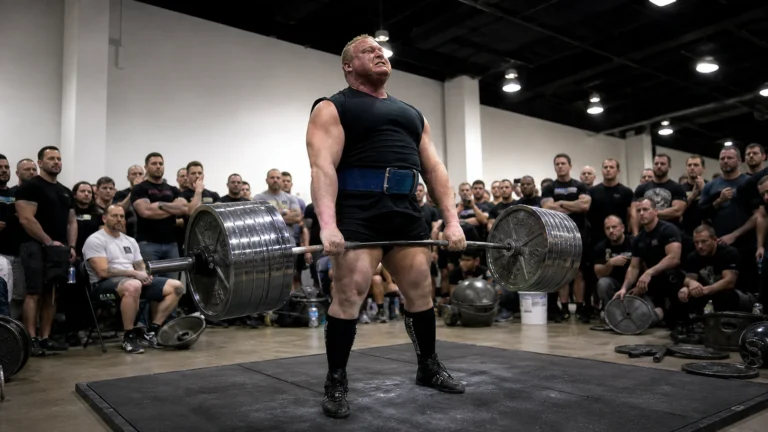

Bodybuilding coach Greg Doucette has built a following on telling people what they don’t want to hear about building muscle.
His message is that you don’t need a complicated program, a stack of supplements, or the latest training trend.
You need three things done consistently.
The Three Things He Points To
Doucette’s case comes down to eating enough calories to support growth, spreading enough protein through your day, and training in a way that keeps challenging your muscles over time.
He argues most people who feel stuck aren’t missing a secret. They’re missing consistency in these basics, week after week.
What the Research Actually Shows
A large 2018 review in the British Journal of Sports Medicine pooled data from 49 studies and more than 1,800 participants to look specifically at protein’s role in muscle growth during resistance training (Morton et al., 2018).
It found that added protein meaningfully improved muscle gains, but only up to a point.
Benefits leveled off at roughly 1.6 grams of protein per kilogram of body weight per day, and eating more than that didn’t add much further benefit.
That finding backs up the “enough protein” part of Doucette’s message directly.
More isn’t automatically better once you clear a fairly reachable daily target.
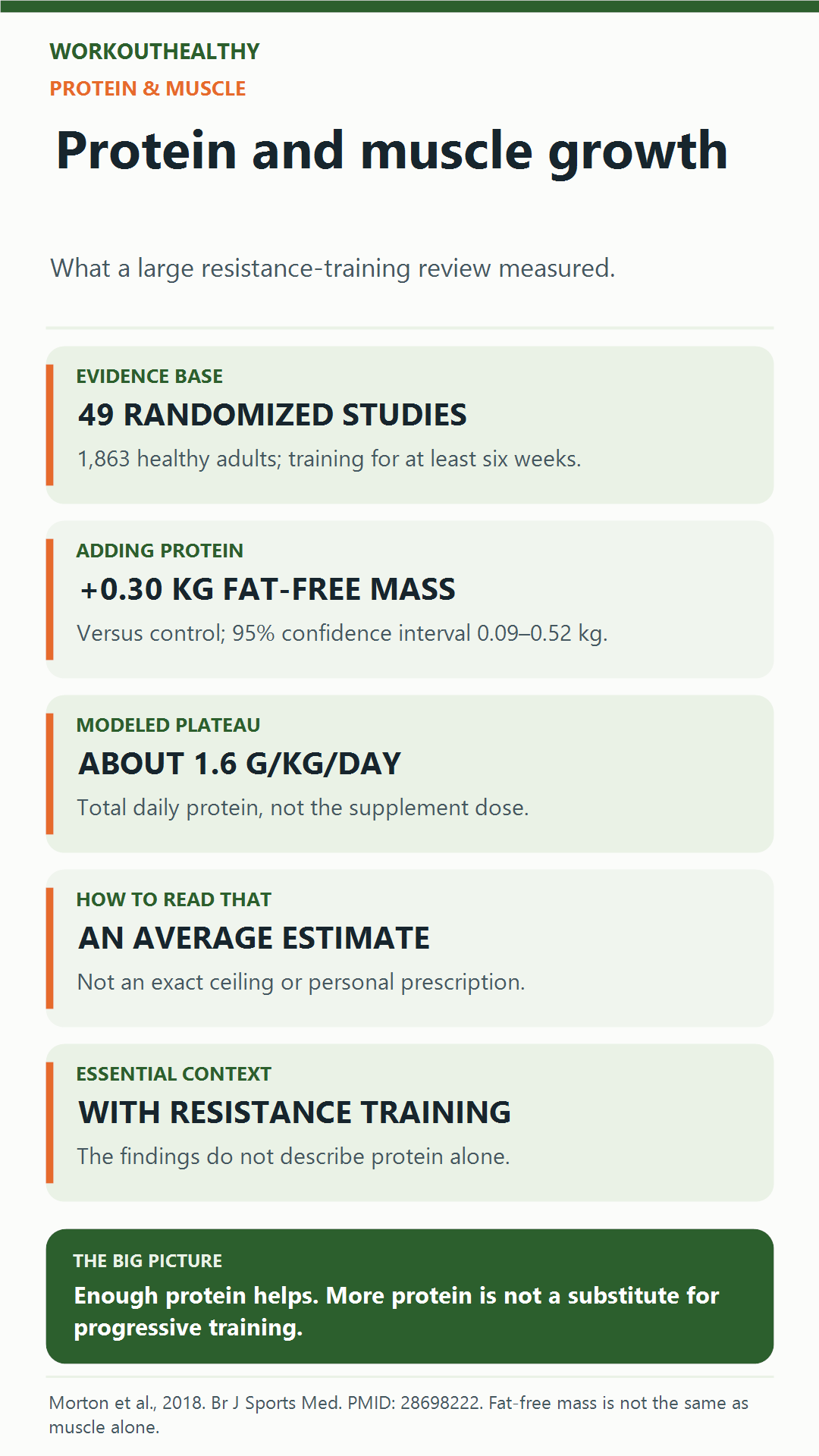
Protein has a ceiling. Once you’re past roughly 1.6 grams per kilogram of body weight a day, the research shows more isn’t doing much more for you.
A Second Study: How Much Training Actually Builds Muscle
Protein is only one of Doucette’s three basics.
A separate 2017 meta-analysis in the Journal of Sports Sciences looked directly at the progressive overload piece, specifically how much weekly training volume it takes to grow muscle (Schoenfeld, Ogborn, & Krieger, 2017).
The researchers pooled 15 studies covering 34 different training groups and sorted them by how many sets per muscle group people did each week.
The pattern was clear and it moved in one direction.
Groups doing fewer than 5 sets per muscle group per week gained about 5.4 percent more muscle over the study periods.
Groups in the moderate range, 5 to 9 sets a week, gained about 6.6 percent.
Groups doing 10 or more sets a week gained about 9.8 percent, roughly double the low volume group.
The researchers also modeled this as a continuous relationship rather than just three buckets.
Each additional weekly set was associated with about a 0.37 percent increase in muscle growth.
In plain terms, doing more working sets across the week, up to a point, reliably tracked with doing more building.
Why Progressive Overload Actually Works
The idea behind progressive overload is simple even if the biology is not.
A muscle adapts to the demands placed on it.
If a weight stops being difficult, your body has little reason to keep adding tissue to lift it.
Gradually adding weight, reps, or sets keeps asking the muscle to do something it isn’t fully adapted to yet.
That repeated, slightly uncomfortable challenge is what triggers the repair and growth process between sessions, not the workout itself.
This is also why the volume data above has a practical ceiling.
More sets create more of that stimulus, which is why the higher volume groups grew more.
But a muscle can only recover from and adapt to so much stress in a week before more sets stop helping and just add fatigue.
Where the Other Two Pieces Fit
Progressive overload, gradually asking your muscles to do more over time, is one of the most consistently supported principles in strength training research, since a muscle has little reason to grow if it’s never asked to work harder than it already can.
Eating enough total calories matters too, because a body running a large calorie deficit struggles to build new tissue no matter how well the training and protein are dialed in.
None of this is exciting advice, which is part of Doucette’s point.
The basics work because they’re what actually drives the biology, not because they’re the newest idea.
What This Evidence Does Not Prove
The Morton review is strong on protein specifically, but it can’t tell you exactly how much you personally need, since individual response varies and the studies it pooled used different training styles, populations, and lengths.
A ceiling around 1.6 grams per kilogram is a useful average, not a guarantee for any one person.
The Schoenfeld volume analysis has its own limits.
It’s built from comparisons across different studies rather than one single trial that randomly assigned the exact same people to different volumes.
That kind of pooled analysis is good at spotting a pattern, but it can’t fully rule out that other differences between the studies, like exercise selection or training experience, played a role too.
Neither study proves that calories, protein, and training volume are the only three things that matter.
Sleep, stress, training technique, and genetics all shape how someone responds.
Doucette’s basics describe the biggest, most controllable levers, not a complete list of every factor involved.
Common Mistakes People Make Chasing the Basics
The most common mistake is treating consistency as a phase instead of a habit.
People often nail their calories and training for two or three weeks, see slow progress, and switch to a new program before the current one has had time to work.
A second mistake is undereating protein while overestimating it.
Many people believe they eat enough protein without ever tracking a single day, and fall well short of even a modest per meal target most days of the week.
A third mistake is confusing being sore or tired with progressive overload. Soreness is not a reliable measure of a good workout.
What matters is whether the weight, reps, or sets on your main lifts are trending up over weeks, not how wrecked you feel afterward.
A fourth mistake is chasing a large calorie surplus to “make sure” muscle grows.
Eating far beyond what’s needed mostly adds fat rather than extra muscle, since the body can only build new tissue at a limited rate no matter how much extra food is available.
Who Should Be Cautious or Check With a Doctor First
Sharp increases in training volume are a common cause of tendon and joint overuse injuries, especially in people returning from a long break or new to structured lifting.
Anyone with a history of tendon pain should raise weekly sets gradually rather than jumping straight into a high volume program.
People with kidney disease or another condition that affects protein processing should talk to a doctor before significantly raising protein intake, since the safe upper range can differ from what’s typical for a healthy adult.
Teenagers who are still growing, and anyone managing a chronic health condition, should get individualized guidance before making a large, deliberate change to calorie intake in either direction, since needs at these life stages don’t always match general population averages.
More sets do not help forever. They help until your body can no longer recover from them, and that ceiling is exactly why programming is still a skill, not just a checklist.
What This Means for a Beginner
If you’re new to lifting, you don’t need a perfect plan on day one.
Eat enough food, get a reasonable amount of protein spread across your meals, and pick a program you’ll actually keep showing up for and gradually add weight or reps to.
Putting the Three Basics Into Practice
Start with calories by tracking your weight on the same scale, at the same time of day, for two full weeks without changing anything else.
If your weight is stable, you’ve found roughly where maintenance sits, and a modest surplus of a few hundred calories a day from there supports growth without piling on excess fat.
For protein, aim for a target close to the 1.6 grams per kilogram ceiling the research points to, and spread it across three or four meals rather than one large serving.
A rough per meal target of 25 to 40 grams of protein, depending on your body size, is a reasonable place to start.

For training volume, begin in the moderate range the Schoenfeld analysis found effective, around 10 to 12 sets per muscle group each week, split across two or more sessions.
Add one or two sets to a muscle group every couple of weeks as long as your recovery keeps up, rather than jumping straight to a high volume program.
Track your main lifts every session.
Small, steady increases in weight or reps over four to six weeks is the clearest sign progressive overload is actually happening.
If your numbers stall for two or three sessions in a row, that’s a normal signal to hold the current weight steady for a week rather than push through with worse form.
Watch your joints, not just your muscles, as you add volume. Muscle soreness that fades within a couple of days is expected.
Joint pain that lingers, or that shows up at the start of a session before you’ve even warmed up, means the volume increase went up faster than your body could handle.
For a closer look at related topics, see our article on why people lose weight and muscle mass together, our piece on what lifting weights does for you beyond muscle, our look at what Jay Cutler’s old high protein diet actually adds up to, and our breakdown of what training near failure actually does for muscle growth.
Watch the Original Video
Get the next evidence check. Subscribe to WorkoutHealthy Insider for practical explanations behind popular fitness claims.
References
Morton, R. W., Murphy, K. T., McKellar, S. R., Schoenfeld, B. J., Henselmans, M., Helms, E., Aragon, A. A., Devries, M. C., Banfield, L., Krieger, J. W., & Phillips, S. M. (2018). A systematic review, meta-analysis and meta-regression of the effect of protein supplementation on resistance training-induced gains in muscle mass and strength in healthy adults. British Journal of Sports Medicine, 52(6), 376 to 384. https://doi.org/10.1136/bjsports-2017-097608
Schoenfeld, B. J., Ogborn, D., & Krieger, J. W. (2017). Dose-response relationship between weekly resistance training volume and increases in muscle mass: A systematic review and meta-analysis. Journal of Sports Sciences, 35(11), 1073 to 1082. https://doi.org/10.1080/02640414.2016.1210197
This article is for general information only and is not medical advice. If you have an injury, ongoing pain, or a medical condition, talk to a doctor or physical therapist before you change how you train or eat.