

“A sound mind in a sound body” is one of the oldest lines in fitness.
The English philosopher John Locke used it to open one of his most influential books.
A popular post says Locke believed a sound mind depends on a sound body, so health must come first.
That is close, but Locke’s actual wording treats the two as partners.
Here is what he wrote, why he started with the body, and what modern research says about exercise and the mind.
What Locke Actually Wrote
Locke published Some Thoughts Concerning Education in 1693.
The book grew out of letters he wrote starting in 1684 to his friend Edward Clarke, who wanted advice on raising his son.
Its opening line is the one people remember.
“A sound mind in a sound body, is a short but full description of a happy state in this world. He that has these two, has little more to wish for; and he that wants either of them, will be little the better for anything else.”
Notice the balance. Locke says a person lacking either one will gain little from anything else.
So he did not say the mind depends entirely on the body.
He did, however, deal with the body first, before turning to learning and character.
Where the Phrase Came From
The phrase was not new with Locke.
Wikipedia’s article on the book notes that he was quoting the Roman poet Juvenal’s Satires.
Locke’s contribution was to place that ancient idea at the very start of a practical guide to raising children.
Why a Philosopher Started With Health
Locke is best known as a philosopher, but he was also trained in medicine.
Born in 1632 and dying in 1704, he studied medicine at Oxford and later worked under the physician Thomas Sydenham in London.
He received a bachelor of medicine degree in 1675.
His medical background helps explain why he put physical health ahead of lessons in his book.
Wikipedia’s article on the book says it covers topics from bed linens to diet to sleeping routines.
Those practical details show how seriously he took daily habits, not just big ideas.
Some of his health advice was harsh by modern standards, such as washing a child’s feet in cold water every day.
That kind of hardening advice is a separate topic, and it should not be copied without modern medical guidance.
What Research Says About Exercise and Mood
Modern science supports the heart of Locke’s line: the body and mind are closely linked.
A 2023 umbrella review in the British Journal of Sports Medicine, led by Ben Singh, pulled together 97 reviews.
Those reviews covered 1,039 trials and 128,119 participants.
Physical activity had medium sized effects on symptoms of depression, anxiety, and psychological distress compared with usual care.
Higher intensity activity was linked with greater improvements.
The authors noted that most of the included reviews had low quality ratings, which is a real limitation.
What Research Says About Exercise and Thinking
Exercise also appears to help thinking skills as we age.
A 2018 meta analysis by Joseph Northey and colleagues looked at exercise programs in adults older than 50.
Physical exercise improved cognitive function overall.
Aerobic exercise, resistance training, multicomponent training, and tai chi all showed significant effects.
Sessions of 45 to 60 minutes at moderate intensity or higher were linked with benefits.
The benefits appeared regardless of whether people started with normal thinking skills or some decline.
What This Does Not Prove
- It does not prove fitness guarantees mental health. Exercise helps, but it is not a cure for every condition.
- It does not replace treatment. Depression and anxiety may still need therapy or medicine.
- It does not prove Locke’s medical ideas were right. Many of his specific health tips reflect the 1600s.
- It does not rank body over mind. Locke himself treated both as necessary.
How to Put a Sound Body First Today
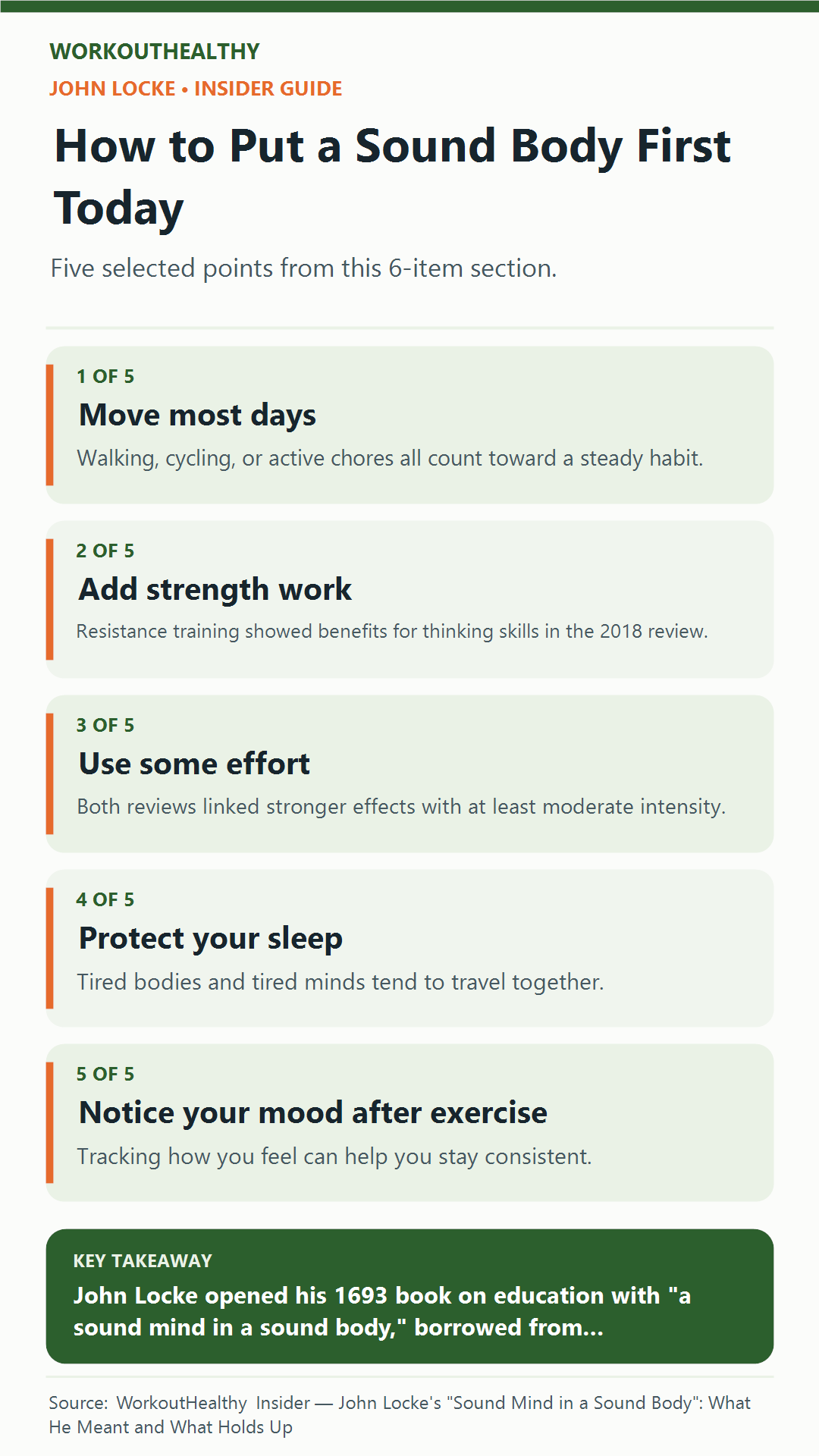
- Move most days. Walking, cycling, or active chores all count toward a steady habit.
- Add strength work. Resistance training showed benefits for thinking skills in the 2018 review.
- Use some effort. Both reviews linked stronger effects with at least moderate intensity.
- Protect your sleep. Tired bodies and tired minds tend to travel together.
- Notice your mood after exercise. Tracking how you feel can help you stay consistent.
- Get help when needed. If low mood lasts, talk to a doctor or mental health professional.
Staying active may also help protect against common illness, as our look at exercise and influenza and pneumonia risk explains.
For a real world example of body and mind aging well, read what a 104 year old woman says keeps you healthy.
If you are building strength in midlife, start with our strength plan for your 40s.
Common Mistakes When Chasing a Sharper Mind
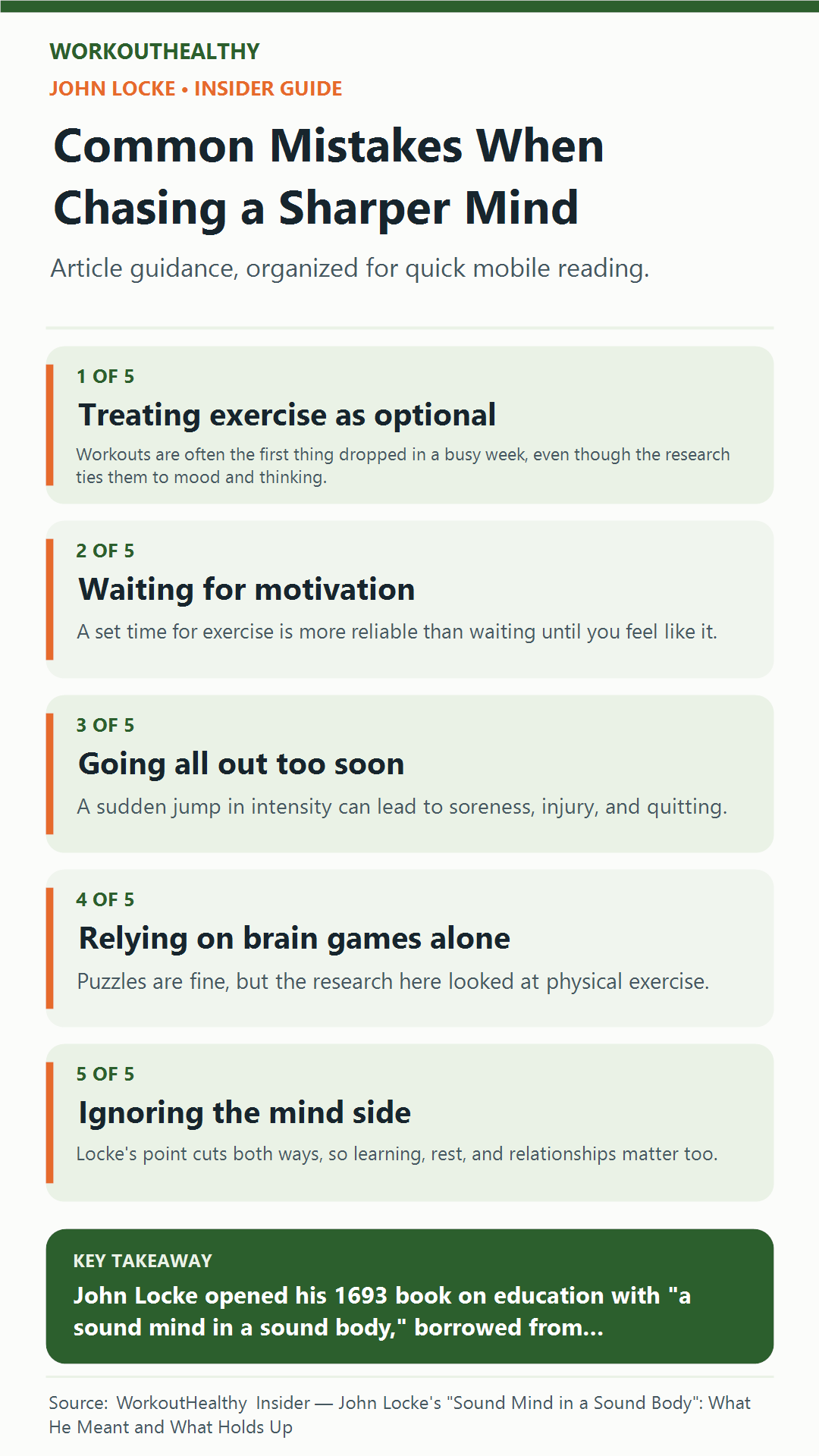
- Treating exercise as optional. Workouts are often the first thing dropped in a busy week, even though the research ties them to mood and thinking.
- Waiting for motivation. A set time for exercise is more reliable than waiting until you feel like it.
- Going all out too soon. A sudden jump in intensity can lead to soreness, injury, and quitting.
- Relying on brain games alone. Puzzles are fine, but the research here looked at physical exercise.
- Ignoring the mind side. Locke’s point cuts both ways, so learning, rest, and relationships matter too.
Who Should Be Careful
People with heart disease, diabetes, or other chronic conditions should check with a doctor before starting intense exercise.
Anyone with severe depression or thoughts of self harm should seek professional help right away, not rely on exercise alone.
The Bottom Line
John Locke opened his 1693 book on education with “a sound mind in a sound body,” borrowed from Juvenal.
He treated both as essential, and he dealt with physical health first.
Modern research supports the link, showing exercise can ease depression and anxiety and support thinking skills.
Caring for your body is one of the most practical ways to care for your mind.
Want more stories like this? Subscribe to WorkoutHealthy Insider for practical explanations behind popular fitness claims.
References
- Encyclopaedia Britannica. (n.d.). John Locke quotes. https://www.britannica.com/quotes/John-Locke
- Locke, J. (1693). Some thoughts concerning education.
- Northey, J. M., Cherbuin, N., Pumpa, K. L., Smee, D. J., & Rattray, B. (2018). Exercise interventions for cognitive function in adults older than 50: A systematic review with meta-analysis. British Journal of Sports Medicine, 52(3), 154 to 160. https://doi.org/10.1136/bjsports-2016-096587
- Singh, B., Olds, T., Curtis, R., Dumuid, D., Virgara, R., Watson, A., Szeto, K., O’Connor, E., Ferguson, T., Eglitis, E., Miatke, A., Simpson, C. E. M., & Maher, C. (2023). Effectiveness of physical activity interventions for improving depression, anxiety and distress: An overview of systematic reviews. British Journal of Sports Medicine, 57(18), 1203 to 1209. https://doi.org/10.1136/bjsports-2022-106195
- Wikipedia. (n.d.). Some thoughts concerning education. https://en.wikipedia.org/wiki/Some_Thoughts_Concerning_Education
This article is for general information only and is not medical advice. If you have an injury, ongoing pain, or a medical condition, talk to a doctor or physical therapist before you change how you train or eat.