
Wall ball workouts have become a gym staple.
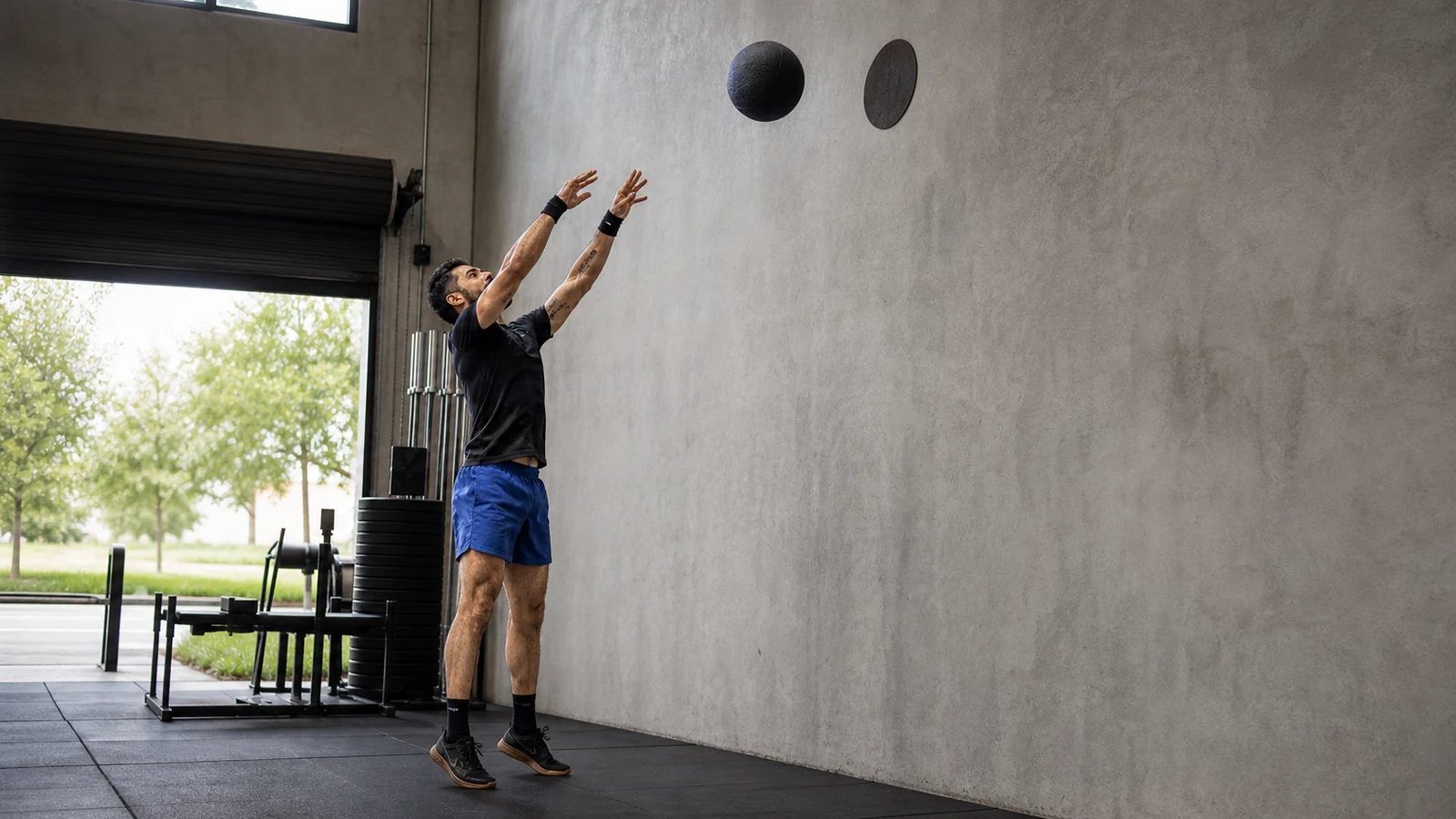
You squat down low, then launch a weighted ball at a target on the wall.
A SWEAT NOW video on YouTube promises this single move builds power, speed, and overall athletic performance.
That is a big claim for one exercise.
This article checks that claim against real exercise science research on ballistic throw training.
The focus here is medicine ball and wall ball throws specifically, using research that has not appeared in our other power training coverage.
Throw training sits inside a bigger category researchers call power training.
That category also includes jumps, sprints, and Olympic lifting variations.
Throws have one feature that sets them apart from most of those movements.
The object actually leaves your hands, so it never has to be caught and slowed.
What the Video Claims
The video is titled “Wall Ball Workout for Explosiveness.”
It promises to build power, speed, and athletic performance through wall ball throws.
The channel behind it is called SWEAT NOW, with the handle @dgratius-fit.
We checked what we could confirm about this channel before writing this article.
The channel’s own bio describes a mission of uplifting and helping people through fitness.
It does not list any coaching certification, degree, or sport science credential.
Our search for independent confirmation of a formal exercise science background came back empty.
That does not make the exercise itself wrong.
It just means the claims deserve their own evidence check, separate from the presenter’s authority.
What Real Research Shows About Measuring Power With a Throw
Researchers needed a simple way to measure explosive upper body power outside a lab.
Stockbrugger and Haennel built and tested a seated medicine ball throw for exactly that purpose (Stockbrugger & Haennel, 2001).
Athletes in the study threw a medicine ball for distance while seated, which removes the legs from the movement.
Throw distance held up well across repeated testing sessions.
It also correlated with other established measures of power, including vertical jump performance.
That matters, because it shows a throw is not just a random party trick.
It is a real, measurable expression of explosive power.
This is one reason coaches use ball throws to track an athlete’s power over time, not only to build it.
What Real Research Shows About Who Throws Hardest
A follow up study from the same researchers asked a sharper question.
What actually predicts how far someone can throw a medicine ball (Stockbrugger & Haennel, 2003)?
The researchers compared athletes with a background in jump training to athletes without one.
Jump trained athletes produced more power on the same seated throw test.
That result stands out, because the seated version removes the legs entirely.
It suggests explosive ability carries over between the lower body and the upper body.
Power looks like a whole body trait, not a separate skill for each limb.
This connects wall ball training to other explosive movements, including the box jump work covered in our box jump research review.
Both movements likely draw on some of the same underlying explosive capacity.
What Real Research Shows About the Body’s Power Ceiling
Every person has a personal limit on how much power their muscles can produce.
A large two part review examined what actually sets that limit (Cormie, McGuigan, & Newton, 2011).
Part of the answer is muscle fiber type.
Fast twitch fibers contract quickly and produce more power per pound of muscle.
Another part of the answer is the nervous system.
A trained nervous system can recruit more muscle fibers at once, and recruit them faster.
Tendon stiffness plays a role too, since stiffer tendons return stored energy more quickly.
None of this is specific to one exercise.
It is the underlying biology that a wall ball throw, a jump, and a sprint all draw from.
What Real Research Shows About Training the Power System
A companion review from the same research team looked at how training actually changes that power ceiling (Cormie, McGuigan, & Newton, 2011).
Heavy strength training mainly raises how much force a muscle can produce.
Ballistic training, like throws and jumps, mainly raises how fast that force gets applied.
The review found that combining both approaches tends to produce the biggest power gains.
Training that matches the speed of a target skill tends to transfer best to that skill.
A wall ball throw is fast and ballistic, so it should mainly build fast, ballistic power.
On its own, it is not a strong tool for building maximum strength.
What Real Research Shows About Ballistic Training Versus Strength Training
One controlled trial compared these two approaches directly (Cormie, McGuigan, & Newton, 2010).
Trained men followed either a ballistic jump squat program or a traditional heavy squat program for ten weeks.
It is worth being precise here.
This study used loaded jump squats, not medicine ball throws, so it is not a perfect stand in for wall balls.
Both training styles still fall under the same broad idea of ballistic versus non ballistic power work.
The ballistic group made bigger gains in jump height and other power measures.
The strength group made bigger gains in maximum squat strength.
Each method mostly improved the exact quality it trained.
That pattern supports using both ballistic throws and heavier lifting in the same program, instead of picking only one.
Watch the video
The Mechanism
A wall ball throw uses what researchers call the stretch shortening cycle.
You drop into a squat, which stretches your leg and hip muscles under load.
Those muscles store some elastic energy, similar to a stretched rubber band.
You then reverse direction fast, releasing that stored energy into the throw.
This differs from a jump landing in one key way.
The ball actually leaves your hands.
A throw only counts as true ballistic training once the object actually leaves your hands. That single detail changes how your muscles are allowed to work.
Because nothing gets caught at the end, your muscles never have to slow the load down.
That lets you accelerate through the whole movement, all the way to release.
Training like this appears to build rate of force development, meaning how fast you can turn on muscle force (Cormie et al., 2011).
Faster force production is useful in any sport that involves jumping, sprinting, or changing direction quickly.
What This Evidence Does Not Prove
This research base has real limits worth stating clearly.
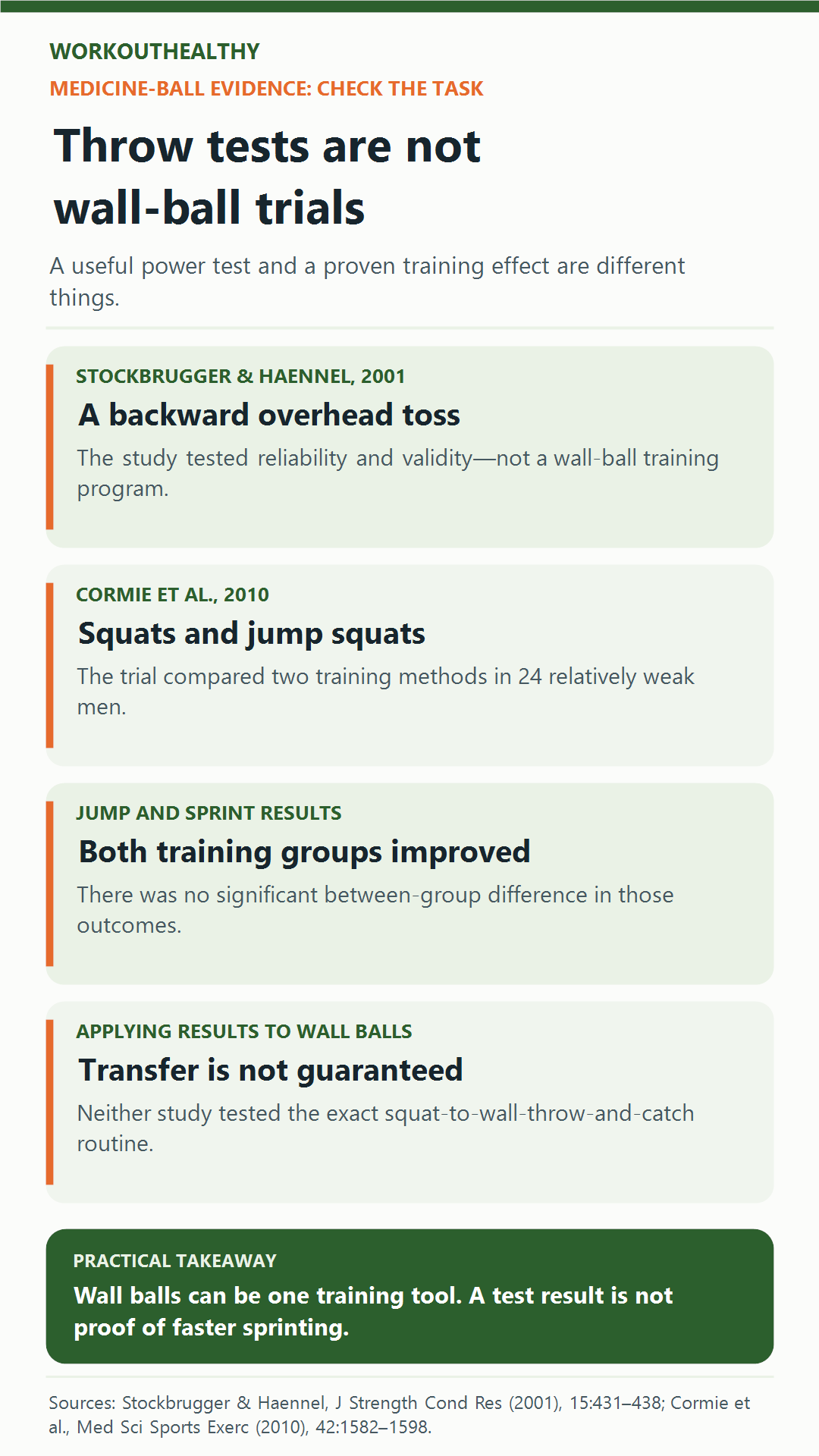
None of the studies above tested a wall ball throw against a target, specifically.
The core studies used a seated throw or loaded jump squats instead.
Wall ball training may behave somewhat differently once catching a rebound is added.
The 2001 and 2003 studies also measured throw performance as a test, not as a standalone training method.
They show a throw can measure power well.
They do not directly prove that practicing throws builds speed or overall athletic performance.
Most of the underlying studies used trained or athletic participants, not general gym goers.
Results could look different in beginners or in older adults.
The video’s combined promise of power, speed, and athletic performance was never tested as one single outcome in any study cited here.
Speed on a sprint or a field depends on many factors beyond upper body throw power.
Those factors include technique, sprint specific practice, and overall strength.
A wall ball throw is best treated as one useful piece of a bigger training picture, not a complete speed program by itself.
Common Mistakes
Choosing a ball that is too heavy is a common error.
A heavy ball slows the throw down, which works against the entire point of power training.
Skipping full hip extension is another mistake.
Throwing mostly with the arms wastes most of the body’s real power potential.
Some people also chase high rep counts on this movement.
Power training works best in short sets with real recovery, not long fatiguing sets.
Poor catch mechanics off a rebounding wall ball can strain the low back or shoulders.
Watching the ball’s full path back to your hands helps prevent an awkward, unprepared catch.
Training through real fatigue is another mistake worth naming directly.
Once form breaks down, added reps mostly build risk instead of power.
Using the same ball weight forever is a smaller, but still real, mistake.
Power output should be reassessed every few weeks, then the load adjusted from there.
Who Should Be Extra Careful
People with an existing shoulder injury should be cautious with catching a rebounding ball.
The repeated catch and reverse motion can aggravate issues like a rotator cuff strain.
People with low back pain or a disc injury should also check with a professional first.
The squat to throw pattern loads the spine quickly, under real speed.
Complete beginners to explosive training should not start here.
Building a base of basic squat strength and control first is safer and more effective.
Anyone returning from a recent injury should get individual guidance before adding ballistic throws back in.
People with wrist or hand pain should also be cautious, since catching a heavy ball repeatedly loads those joints.
Pregnant athletes should check with their own care provider before adding fast, ballistic training of any kind.
None of this means these groups can never train explosively.
It means the exercise should be scaled, supervised, or delayed until it is safe.
A Practical Takeaway
Used well, wall ball and medicine ball throws are a legitimate power training tool.
The research above supports using them for a small number of quality reps, not high volume.
A common approach is 3 to 5 reps per set, with 60 to 90 seconds of rest between sets.
Stop the set once the throw clearly slows down.
A useful starting ball weight is light enough that speed, not effort, is the limiting factor.
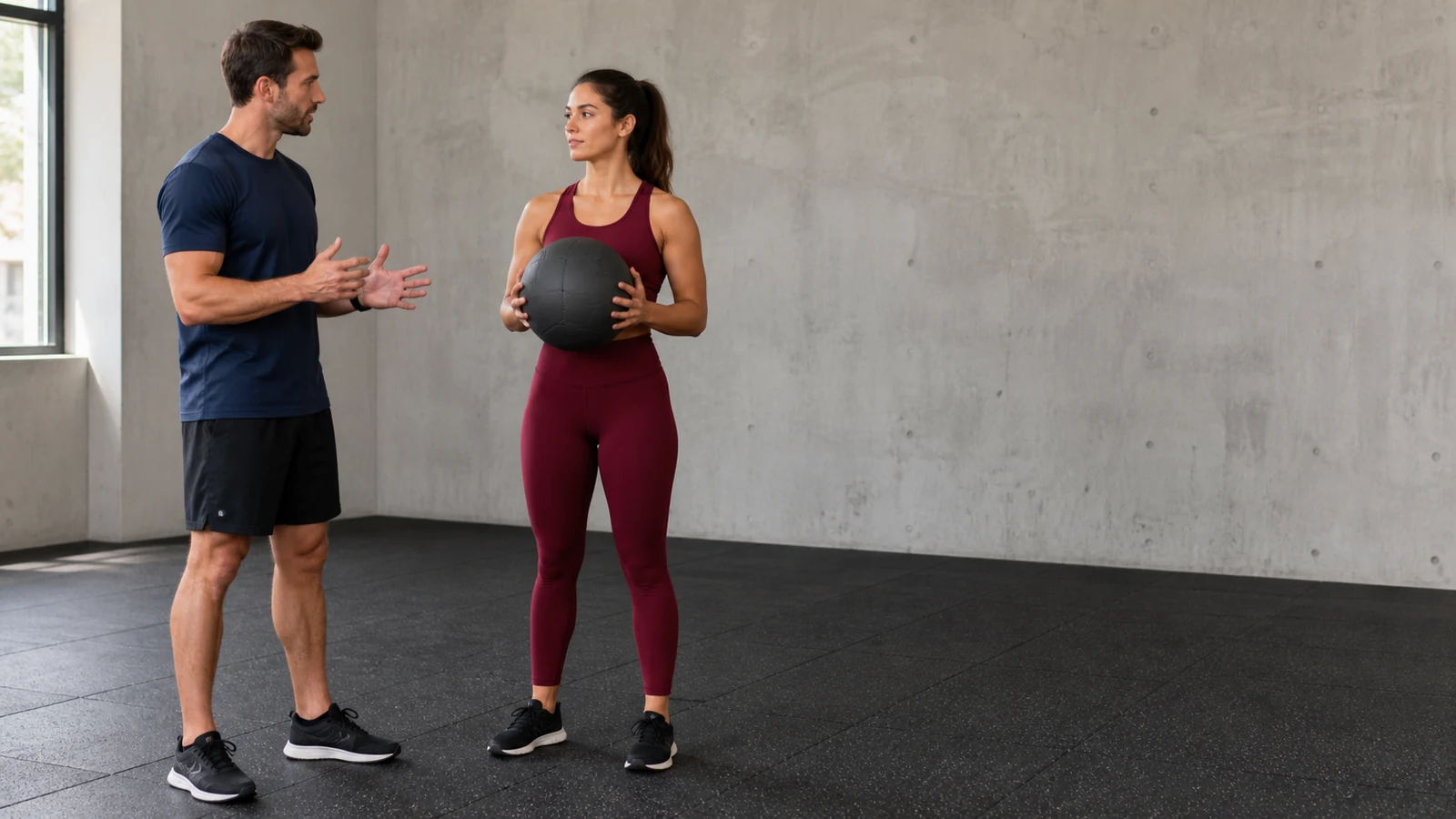
For most healthy adults, that often lands somewhere between 4 and 12 pounds.
Heavier loads may suit stronger, more experienced lifters chasing a specific power goal.
The moment a throw starts slowing down, most of its real power benefit is already gone.
Two to three sessions a week is usually enough for this kind of training.
Pair it with heavier strength work on other days, based on the research covered above.
If pressing strength is part of your routine, our comparison of the floor press and bench press is a useful next read.
Readers who prefer explosive, higher intensity training may want to see how other WorkoutHealthy Insider readers weigh training styles.
For another simple, low equipment power and conditioning option, our piece on calories burned jumping rope is worth a look too.
Want more like this? Subscribe to WorkoutHealthy Insider for practical explanations behind popular fitness claims.
References
Cormie, P., McGuigan, M. R., & Newton, R. U. (2010). Adaptations in athletic performance after ballistic power versus strength training. Medicine & Science in Sports & Exercise, 42(8), 1582 to 1598. https://doi.org/10.1249/mss.0b013e3181d2013a
Cormie, P., McGuigan, M. R., & Newton, R. U. (2011). Developing maximal neuromuscular power: Part 1, biological basis of maximal power production. Sports Medicine, 41(1), 17 to 38. https://doi.org/10.2165/11537690-000000000-00000
Cormie, P., McGuigan, M. R., & Newton, R. U. (2011). Developing maximal neuromuscular power: Part 2, training considerations for improving maximal power production. Sports Medicine, 41(2), 125 to 146. https://doi.org/10.2165/11538500-000000000-00000
Stockbrugger, B. A., & Haennel, R. G. (2001). Validity and reliability of a medicine ball explosive power test. Journal of Strength and Conditioning Research, 15(4), 431 to 438. https://doi.org/10.1519/00124278-200111000-00006
Stockbrugger, B. A., & Haennel, R. G. (2003). Contributing factors to performance of a medicine ball explosive power test: A comparison between jump and nonjump athletes. Journal of Strength and Conditioning Research, 17(4), 768 to 774. https://doi.org/10.1519/00124278-200311000-00023
This article is for general information only and is not medical advice. If you have an injury, ongoing pain, or a medical condition, talk to a doctor or physical therapist before you change how you train or eat.