
Many runners deal with a tendon that hurts every time they train.
The pain often sits at the back of the heel or just below the kneecap.
An ongoing ache can be chronic tendinopathy, but a clinician should rule out other causes rather than diagnose it from pain location alone.
It builds up slowly over weeks or months, and it rarely gets better with rest alone.
Treatment usually starts with an accurate diagnosis and a progressive exercise plan. An injection is not routine care for every painful tendon.
A recent video from the hospital system Cone Health introduced sports medicine physician Dr. Brian Gottwalt, whose work centers on exactly this kind of care.
This article looks at what real, published research actually says about diagnosing and treating tendinopathy in runners, from the ultrasound scan to the exercises that do the real healing.
For most runners with chronic tendinopathy, the tendon does not need less work. It needs the right amount of load, applied consistently, while a clinician rules out anything more serious.
What Causes Tendinopathy in Runners
Tendinopathy is not really inflammation in the classic sense.
It is a breakdown in the tendon’s internal structure that happens when load outpaces the tissue’s ability to adapt and repair.
Tendons are built to store and release energy with every stride.
A runner’s Achilles tendon can handle forces several times body weight on a single push off.
Problems start when training volume, intensity, or a sudden change outpaces the tendon’s capacity to recover between sessions.
Common triggers include a fast jump in weekly mileage, added hill or speed work, and a return to running after time off.
Achilles and patellar tendinopathy are two examples that can affect runners, though pain in those areas has other possible causes too.
Both develop the same basic way: repeated load without enough recovery time between sessions.
How Doctors Diagnose It: The Role of Musculoskeletal Ultrasound
A doctor usually starts with a history and a physical exam.
They ask about recent training changes, footwear, and exactly where the pain sits.
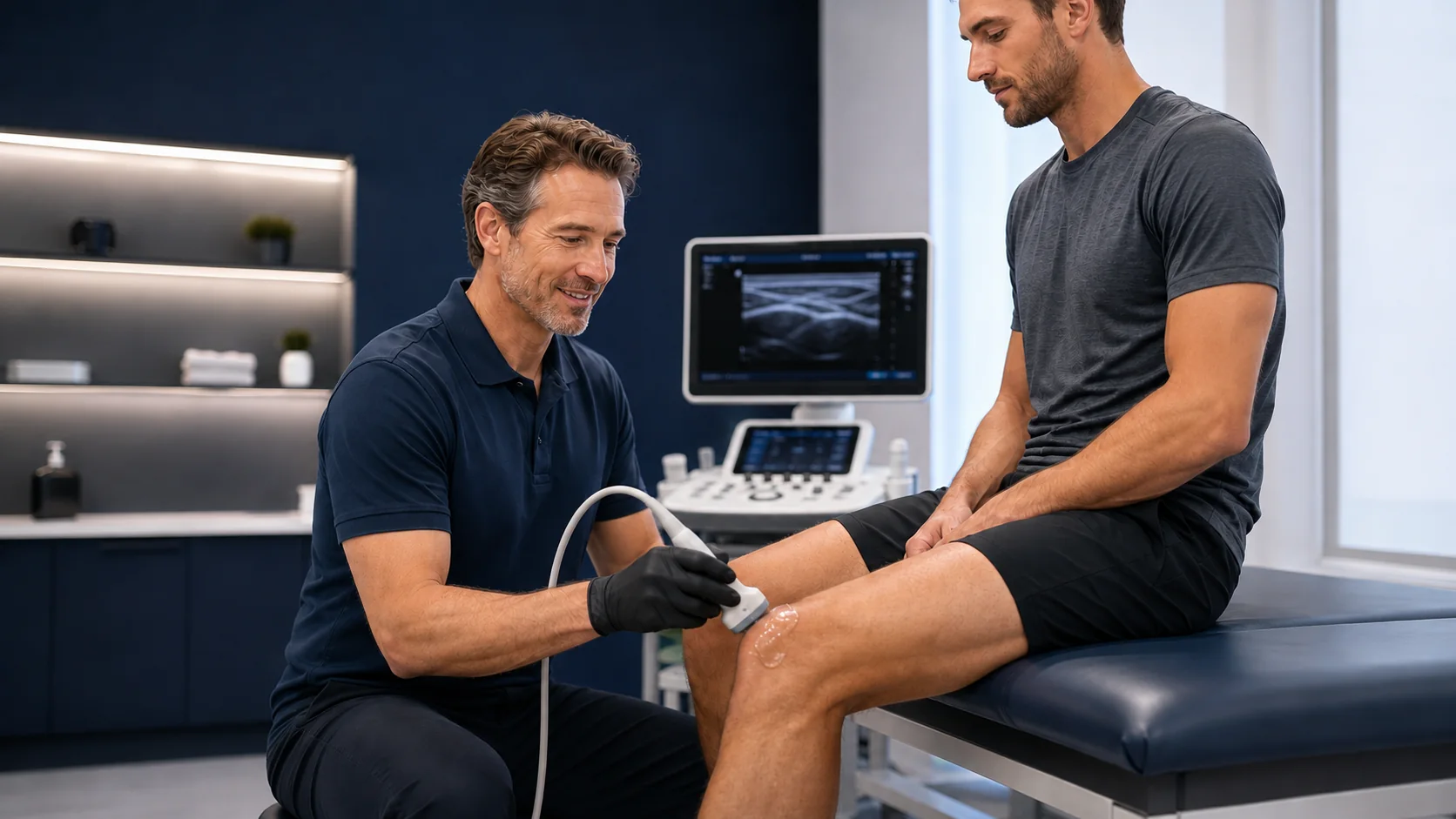
Many sports medicine clinics now add musculoskeletal ultrasound to that exam.
This is a real time imaging scan that shows the tendon’s structure while a patient moves the joint.
Ultrasound can reveal tendon thickening, disorganized fibers, and abnormal blood vessel growth inside the tissue.
It also helps rule out a partial tear, which changes the treatment plan considerably.
Ultrasound has a practical advantage over an MRI scan in a clinic visit: it is fast, and it lets the physician watch the tendon move in real time.
A 2018 review in the Orthopaedic Journal of Sports Medicine looked specifically at how doctors use ultrasound to guide treatment, not just diagnosis (Daniels et al., 2018).
That review found that ultrasound guided injections were consistently more accurate than injections guided by touch and landmarks alone (Daniels et al., 2018).
In the shoulder, for example, ultrasound guided injections hit the intended target around 92 percent of the time, compared with about 72 percent for landmark guided injections in the same review (Daniels et al., 2018).
Placement accuracy matters when an injection is appropriate, but the shoulder accuracy finding cannot by itself prove better outcomes for a runner’s Achilles or patellar tendon.
Why Loading Based Exercise Works
Exercise sounds like an odd treatment for a tendon that already hurts from overuse.
The key is controlling the type and amount of load, not avoiding load altogether.
Tendon cells respond to mechanical stress by rebuilding collagen and organizing it along the actual lines of force.
A 2009 model published in the British Journal of Sports Medicine describes tendon pathology as a continuum rather than one fixed state (Cook & Purdam, 2009).
Early on, a tendon can still respond well to load management and targeted exercise.
Later stages involve more structural disorganization, but appropriate loading remains part of treatment even then (Cook & Purdam, 2009).
This continuum model helps explain why two runners with the same diagnosis can respond differently to the same program.
It also explains why the goal of treatment is not zero tendon load, but the right dose of load, applied consistently over time.
The Study Behind Eccentric Loading
The most influential study on tendon loading came from a Swedish research group in 1998.
Håkan Alfredson and colleagues tested a 12 week heavy load eccentric calf raise program in 15 recreational athletes with chronic Achilles tendinosis (Alfredson et al., 1998).
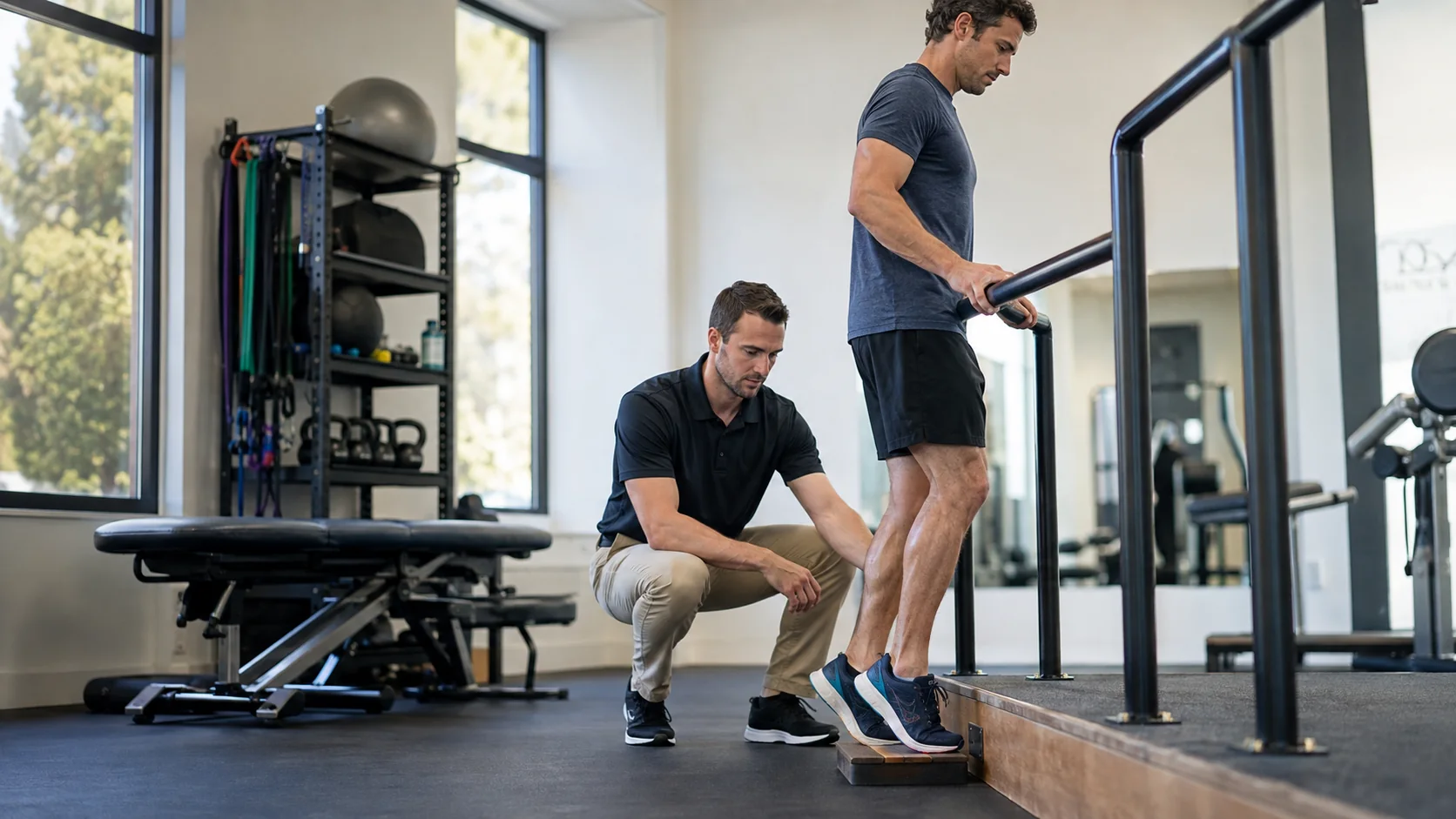
An eccentric contraction is the lengthening phase of a movement, like slowly lowering the heel below a step after rising onto the toes.
Every one of the 15 patients in the eccentric loading group returned to their pre injury running level after 12 weeks (Alfredson et al., 1998).
A separate comparison group treated with rest, anti inflammatory medication, and standard physical therapy did not improve.
Every person in that comparison group eventually needed surgery (Alfredson et al., 1998).
That is a striking difference for a 12 week program, and it is why heavy, slow, eccentric loading became the starting point for tendon rehab protocols still used today.
Later research has refined the original protocol. Progressive loading is a central option for many chronic tendon problems, but the exercise and dose must fit the tendon, symptoms, and person; the small Achilles study cannot establish a universal rule.
What a Second Study Found About Injections
Loading exercise is not the only treatment option, and image guided injections are part of many treatment plans.
A large systematic review published in The Lancet in 2010 pooled results from 41 randomized controlled trials covering 2,672 patients with various forms of tendinopathy (Coombes et al., 2010).
For lateral elbow tendinopathy, the review found that corticosteroid injections could reduce pain in the short term compared with no intervention (Coombes et al., 2010).
That short term benefit did not hold up.
In the pooled lateral elbow comparison, no intervention was favored over corticosteroid injection at intermediate and long term follow up. Evidence for other tendons and other injections was more limited, so the elbow result should not be presented as a direct trial of runners’ Achilles or patellar tendons (Coombes et al., 2010).
The authors reported variable effects across sites and treatments, reinforcing the need to discuss expected short and long term outcomes for the specific tendon with a clinician.
This is one reason many sports medicine physicians today use corticosteroids carefully, and often reach for other options when a running injury is genuinely chronic rather than a fresh flare up.
What This Evidence Does Not Prove
None of this research proves that every runner with tendon pain needs an injection, or even needs imaging.
Most cases of tendinopathy improve with a well built loading program and patience, without any injection at all.
The studies described here also do not prove that eccentric exercise is the only loading method that works.
Other approaches, including heavy slow resistance training, have shown similar benefits in more recent research on patellar tendinopathy specifically.
The original Alfredson study was also small, with just 15 patients in the treatment group, so it describes a strong early signal rather than a guarantee for every person.
None of the research reviewed here suggests a runner should self diagnose tendinopathy or choose an injection without a clinician’s exam first.
A trained eye and, often, a scan still matter for ruling out a tear, bursitis, nerve involvement, or a stress fracture that can feel similar at first.
Common Mistakes Runners Make During Recovery
Total rest is one of the most common mistakes.
A tendon that stops bearing any load can actually get weaker, which makes the eventual return to running harder, not easier.
Jumping straight back into full mileage once pain briefly improves is another common mistake.
Tendon pain can ease before the tissue has actually finished adapting, and a fast return often triggers a relapse.
Some runners also stack every possible treatment at once, adding new shoes, a new stretching routine, and a new supplement in the same week.
That makes it almost impossible to know what is actually helping, or what might be making things worse.
A related mistake is ignoring the difference between normal muscle soreness and tendon pain that gets worse the next morning.
If pain during a loading exercise stays mild and settles back to baseline by the next morning, most tendon rehab programs treat that as an acceptable dose to keep going.
Pain that spikes sharply, or that is clearly worse the next day, is a signal to back off instead.
Finally, many runners only ever train the painful tendon and skip the rest of the body.
Cross training with strength work, and mixing running with other kinds of training, can reduce the repetitive load that caused the problem in the first place.
That trade off is part of why debates about running versus weightlifting keep coming up among runners weighing how to balance their weekly training.
Who Should See a Doctor or Physical Therapist
Tendon pain that lasts more than two weeks despite easing up on training deserves a professional evaluation.
So does any pain that is sharp, sudden, or comes with swelling, bruising, or a feeling that the tendon gave way.
A sudden snap or pop, followed by an inability to rise onto the toes, needs urgent care, since it can signal a tendon rupture rather than tendinopathy.
Pain that wakes a person up at night, or pain that keeps getting worse despite rest, is also a reason to get checked rather than wait it out.
A physician or physical therapist can rule out other causes, order imaging when it is actually needed, and build a loading program matched to the specific tendon and stage of injury.
Runners managing diabetes, a history of tendon rupture, or long term corticosteroid or fluoroquinolone antibiotic use should get evaluated sooner, since those factors raise tendon risk.
A Step by Step Rehab Progression You Can Follow
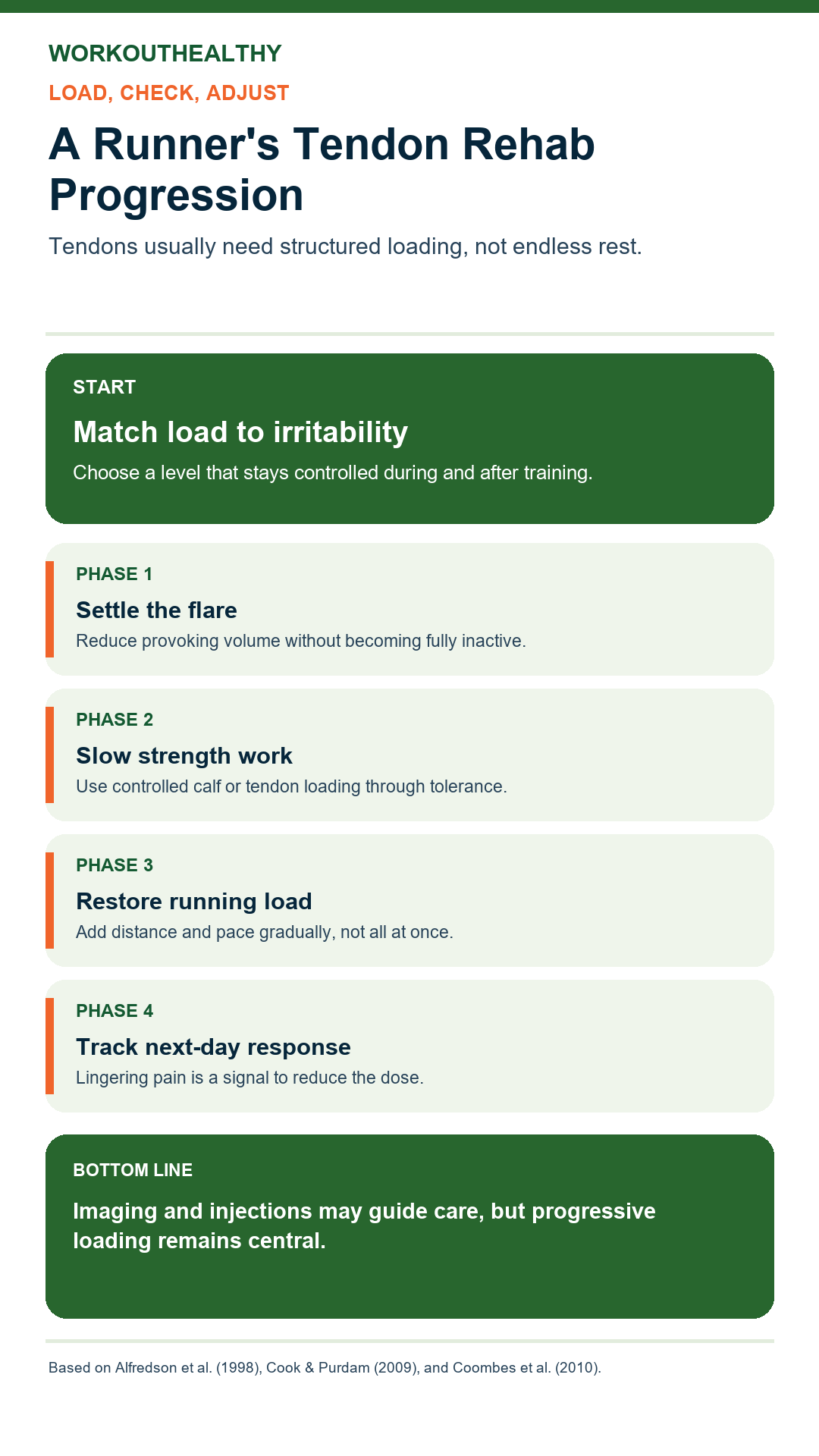
A typical evidence informed rehab progression moves through four phases, and most people spend several weeks in each one.
Phase one uses isometric holds, meaning a muscle contraction with no movement, such as holding a mid range calf raise for 30 to 45 seconds.
Isometric holds are often used early because some evidence suggests they can ease tendon pain in the short term without adding much mechanical load.
Phase two introduces the heavier, slower loading that the original Alfredson protocol popularized.
The classic version uses three sets of 15 slow eccentric heel drops, performed twice a day, with the knee straight in one set and slightly bent in another to target different parts of the calf (Alfredson et al., 1998).
Extra weight is added gradually as the exercise becomes easier, typically using a loaded backpack once bodyweight alone feels too light.
Phase three adds energy storage exercises, which train the tendon to handle the quick, springy loading that running actually requires.
Low box jumps, skipping, and bounding drills belong here, introduced only once heavy, slow loading is well tolerated without a pain flare.
Our guide to how jump training affects the body is useful background before adding this kind of work to a rehab plan.
Phase four is the actual return to running, and it works best as a gradual ramp rather than an on off switch.
A walk run progression, where running intervals slowly replace walking intervals over several weeks, gives the tendon time to adapt to real running loads.
The same gradual, mileage aware approach in our guide to building up walking volume safely applies just as well to easing back into running mileage.
Throughout every phase, the same pain rule from earlier still applies: mild, tolerable pain that settles by the next morning is generally fine, and pain that spikes or lingers is a signal to back off.
A physical therapist can tailor the progression and monitor symptoms; the studies cited here do not establish that supervised care is always faster than a well designed home program.
Watch the Original Video
Want more research backed breakdowns like this one? Subscribe to WorkoutHealthy Insider for practical explanations behind popular fitness claims.
References
This article is for general information only and is not medical advice. If you have an injury, ongoing pain, or a medical condition, talk to a doctor or physical therapist before you change how you train or eat.