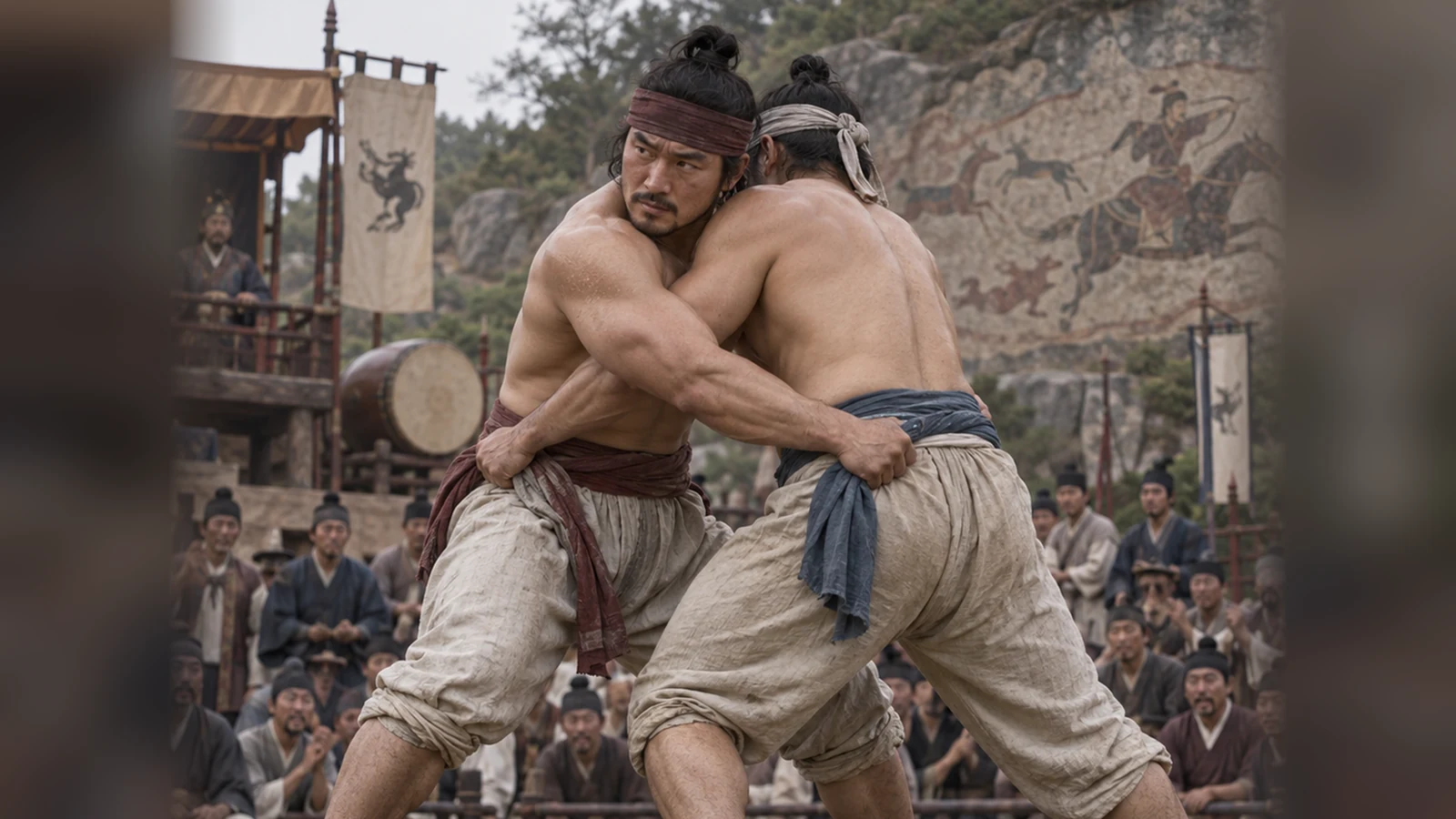

Korea has its own style of wrestling, and it is far older than the modern sport.
It is called ssireum, and its roots reach back at least to the Goguryeo kingdom.
A popular post says ancient ssireum wrestlers threw much larger opponents by shifting their weight and turning the torso.
The ancient record is thinner than that claim suggests. The technique itself is very real.
The Oldest Picture of Ssireum
Goguryeo was an ancient Korean kingdom that lasted from 37 BCE to 668 CE.
Its lands reached beyond the modern Korean peninsula, which is why some of its tombs now sit inside China.
The earliest evidence of ssireum dates to this period.
The best known image comes from a tomb called Gakjeochong, often translated as the Tomb of the Wrestlers.
It sits near the city of Ji’an in China’s Jilin province and dates to about the 5th century CE.
Its wall painting shows two wrestlers locked together while an older man with a grey beard and a staff watches.
Descriptions of the mural note that one wrestler appears to have features of people from west of China.
That detail hints at cultural contact across Central Eurasia.
The bigger body pushes. The smarter body turns.
What the Mural Can and Cannot Tell Us
A painting shows a moment. It does not explain a technique.
We could not find an ancient source that describes Goguryeo wrestlers throwing bigger men by turning the torso.
That description comes from how ssireum is practiced and explained today.
It is reasonable to think older wrestlers used similar ideas, since the basic physics of grappling has not changed.
Still, it is safer to present the torso turning method as a feature of the tradition, not as a documented Goguryeo detail.
How Ssireum Works Today
Modern wrestlers grip each other by a cloth belt called a satba, which wraps around the waist and thigh.
A wrestler wins by making any part of the opponent’s body above the knee touch the ground.
Unlike sumo, pushing someone out of the ring only restarts the bout.
Professional matches are usually best of three, with four weight classes.
In 2018, ssireum was added to UNESCO’s Intangible Cultural Heritage lists after a joint application by South Korea and North Korea.
Traditionally, festival champions could win a bull, a prize of real value in farming villages.
The Turning Technique
Ssireum wrestlers aim to turn the opponent’s torso about 45 to 90 degrees during a throw.
A common approach is to shift the opponent’s weight onto one leg, then drive that weight back toward the floor.
Once most of a person’s weight sits on one leg, that leg becomes easy to attack.
Turning the torso moves the upper body away from the base of support, and balance fails.
One Korean news feature on the sport notes that throws and trips let skill overcome differences in body size.
That matches the core idea in the popular post, even if the ancient sources do not spell it out.
What Research Says About Balance in Grappling
Research on ssireum itself is limited, so studies on judo, another grip based throwing sport, are a useful guide.
A 2026 systematic review by Marotta and colleagues looked at core training in judo athletes.
From 195 screened records, seven studies were included.
International level judo athletes showed greater trunk extensor strength and less trunk angular displacement.
The authors concluded that a strong core might improve balance and control of movement during competition.
A 2023 study by Jaworski and colleagues measured standing balance in young judo athletes and their non training peers.
In both the 11 to 12 and 13 to 14 age groups, the non training children showed larger, longer sway of their center of pressure.
That suggests judo training went along with steadier balance.
However, balance scores were not significantly linked to how well the young athletes placed in their tournament.
So good balance may be a base for grappling, but it does not decide who wins on its own.
How to Build the Same Skills
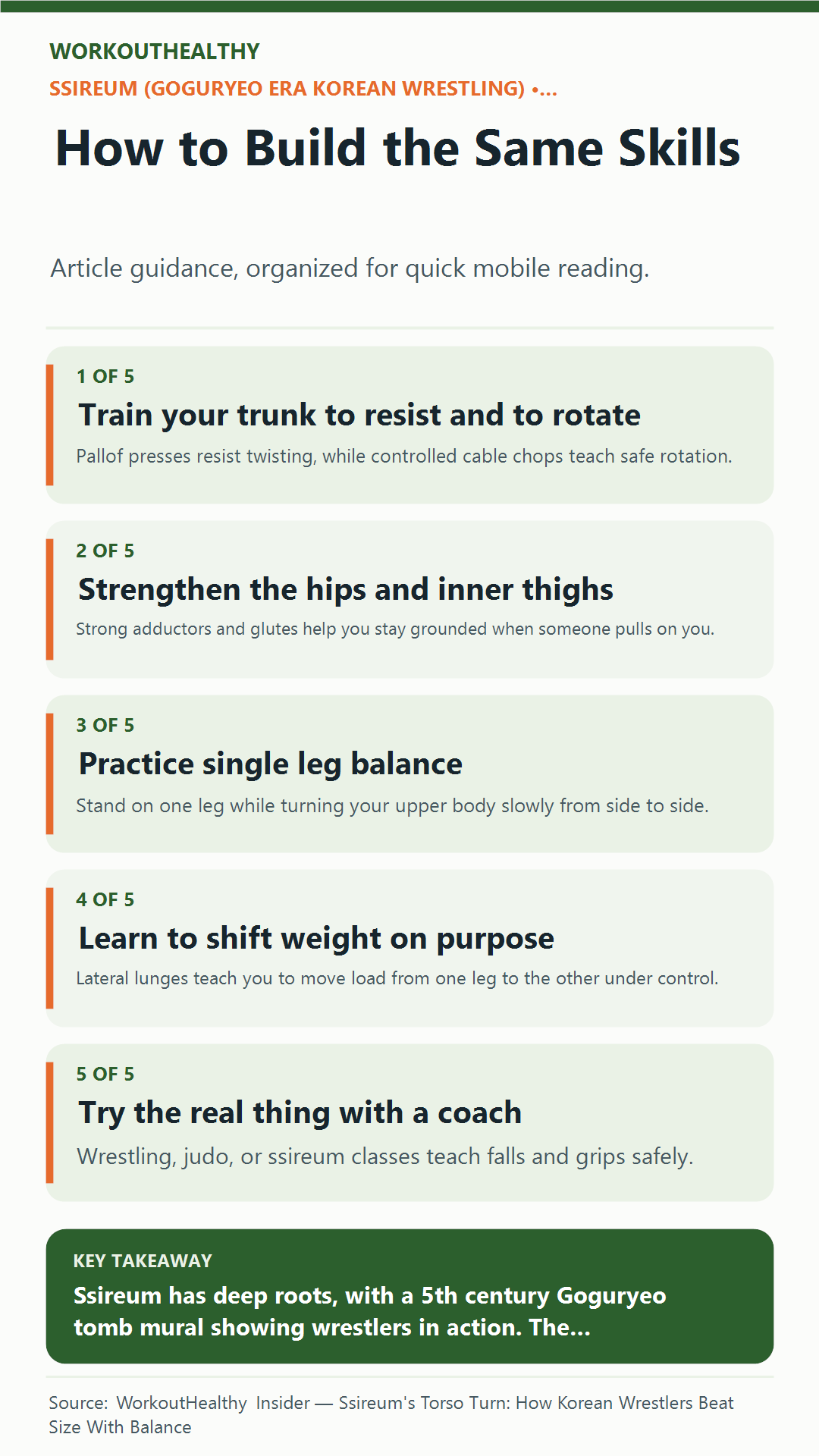
- Train your trunk to resist and to rotate. Pallof presses resist twisting, while controlled cable chops teach safe rotation.
- Strengthen the hips and inner thighs. Strong adductors and glutes help you stay grounded when someone pulls on you.
- Practice single leg balance. Stand on one leg while turning your upper body slowly from side to side.
- Learn to shift weight on purpose. Lateral lunges teach you to move load from one leg to the other under control.
- Try the real thing with a coach. Wrestling, judo, or ssireum classes teach falls and grips safely.
For trunk work, see which move won when two physical therapists ranked 10 core exercises.
Our guide to inner thigh and adductor training covers the muscles that help hold a wide, stable stance.
Common Mistakes
- Twisting under heavy load. Rotation should be trained with light resistance and control first.
- Standing tall in a clinch. A high center of mass makes you much easier to turn and tip.
- Skipping grip strength. Belt wrestling depends on holding on, so train your grip with carries and hangs.
- Relying on size alone. Bigger athletes still lose when their weight is caught on one leg.
Who Should Be Careful
Throws load the spine, hips, knees, and shoulders in quick, twisting motions.
People with back pain or past knee or shoulder injuries should get medical advice before starting a grappling sport.
Always learn how to fall before you practice being thrown.
Match with partners of similar size and skill when you are new to the sport.
The Bottom Line
Ssireum has deep roots, with a 5th century Goguryeo tomb mural showing wrestlers in action.
The weight shifting, torso turning technique is real and central to modern ssireum.
Ancient sources do not describe it in detail, so it is best treated as part of a living tradition.
Research on grappling supports the bigger lesson. Balance, trunk control, and timing can offset a size gap.
Want more stories like this? Subscribe to WorkoutHealthy Insider for practical explanations behind popular fitness claims.
References
- Jaworski, J., Lech, G., Witkowski, K., Bujas, P., Szczepanik, K., & Piepiora, P. (2023). Influence of training and selection on postural stability and its relationship with sport level in judo practitioners aged 11 to 14 years. Frontiers in Psychology, 13, 1053426. https://doi.org/10.3389/fpsyg.2022.1053426
- Marotta, N., Lopresti, E., Longo, U. G., Demeco, A., Lippi, L., Zangari, F., Ammendolia, V., Vecchio, M., Vetrano, M., Invernizzi, M., de Sire, A., & Ammendolia, A. (2026). Role of core training in judo athletes: A systematic review. Journal of Clinical Medicine, 15(5), 1897. https://doi.org/10.3390/jcm15051897
- M. J. (2026, September 12). A bull on the line: How ssireum became a Chuseok tradition. News Culture. https://www.nc.press/news/articleView.html?idxno=626316
- Art and Archaeology. (n.d.). Goguryeo tomb murals: Wrestling scene. http://www.art-and-archaeology.com/korea/goguryeo/gk01.html
- Wikipedia contributors. (n.d.). Ssireum. In Wikipedia. Retrieved September 16, 2026, from https://en.wikipedia.org/wiki/Ssireum
This article is for general information only and is not medical advice. If you have an injury, ongoing pain, or a medical condition, talk to a doctor or physical therapist before you change how you train or eat.