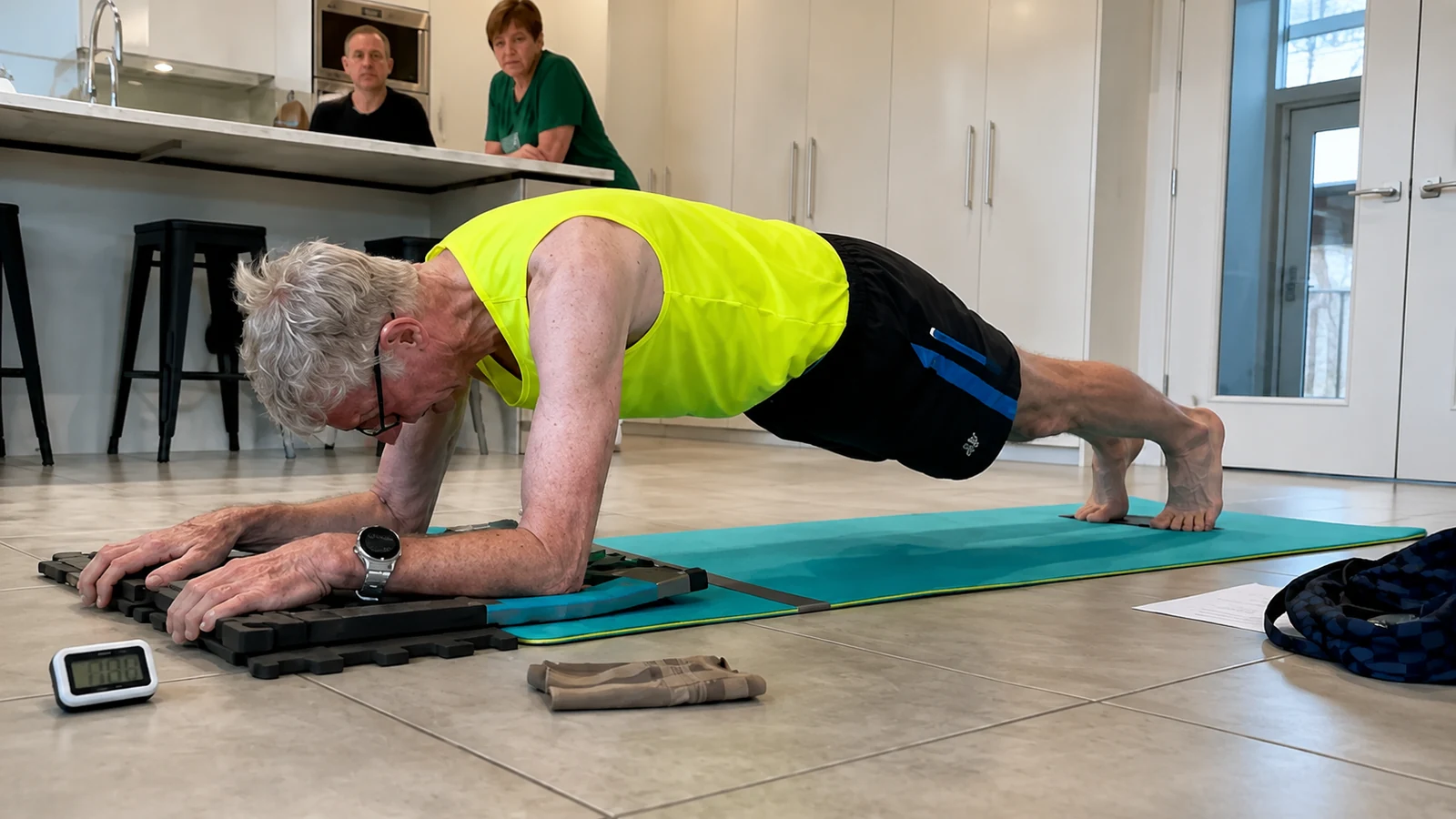

Maynard Williams got down onto his forearms and toes at 78 years and 135 days old.
The rule he had to satisfy was simple: hold a straight line for three minutes.
He did not stop at three minutes.
He kept the position for just under 31 minutes, roughly ten times what Guinness World Records actually required.
On 6 April 2025, that hold made him the oldest man ever verified to perform an abdominal plank.
The Record: 78 Years, 135 Days, Verified
Guinness World Records lists the title as “Oldest person to perform an abdominal plank (male).”
The official record credits Williams, of New Zealand, with the achievement at 78 years and 135 days old, confirmed on 6 April 2025.
Williams was born on 23 November 1946, and the math behind his age lines up with that date almost exactly.
Guinness’s rules for this category require a straight line from shoulders to ankles, supported on forearms and toes, held for a minimum of three minutes.
That is the qualifying bar. Williams cleared it by a wide margin.
This is not the article about the longest plank ever held.
That is a separate Guinness category entirely, a pure endurance record chasing hours, not a specific age.
Williams’s record belongs to a different family of titles, the ones built around a birthday number rather than a stopwatch ceiling.
The challenge here was never outlasting every other plank ever recorded.
It was proving that a 78 year old body could still clear a fixed, unforgiving standard built for adults of any age.
Thirty Minutes Against a Three Minute Bar
Guinness’s own coverage of the attempt is specific about the numbers.
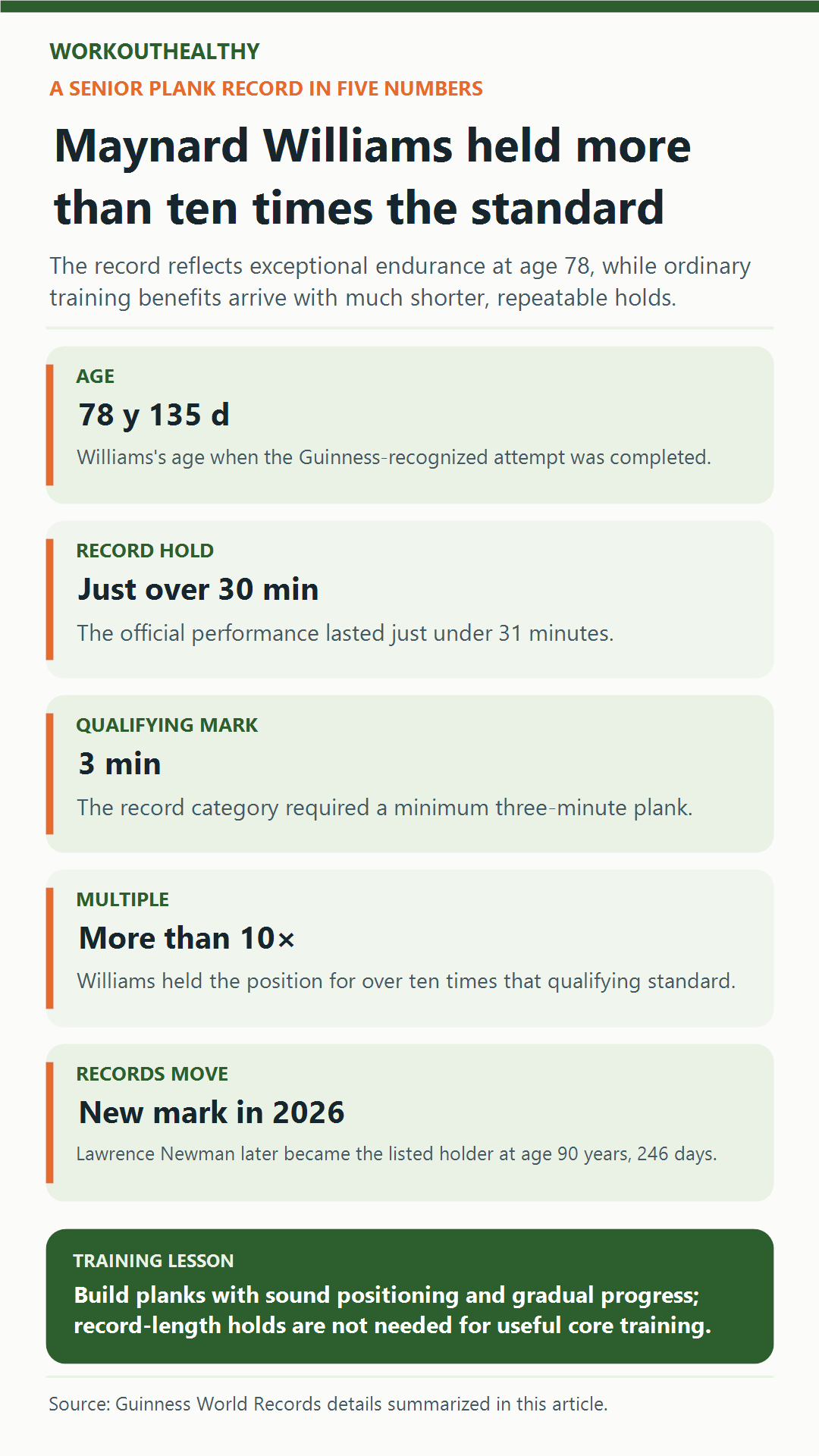
The qualifying standard for this record is three minutes.
Williams held his plank for just over 30 minutes, close to ten times the minimum.
That detail matters more than it might first appear.
A record built around a fixed qualifying time rewards two very different kinds of athletes.
Some competitors clear the bar and stop, satisfied with a technical pass.
Others treat the minimum as a floor, not a target.
Williams’s margin puts him firmly in the second group, and it says something about how he trained.
For context, a widely cited normative database built trunk stabilization endurance benchmarks from healthy adult test subjects, and typical hold times in that data land in the range of one to two minutes, not thirty (McGill et al., 1999).
Williams was not just clearing an age-specific bar. He was operating well past what general population norms treat as a strong trunk endurance score at any age.
Not a Beginner’s Hobby
Williams came to planking relatively late.
According to Guinness’s own reporting, he only started taking the exercise seriously after competing in a local gym challenge about a year before his record attempt.
What he brought to it instead was a long background as a distance runner.
“Being a distance runner, I’m used to pushing myself hard both mentally and physically,” Williams said, describing how that experience carried into his plank training.
He built a genuinely structured program around the attempt.
His routine reportedly combined circuit training, upper and lower body resistance work, cardio conditioning, and weighted plank variations.
He filmed his own practice sessions and used mirrors to check his form in real time.
He also tracked training load with a smartwatch, specifically to avoid overtraining at an age where recovery takes longer.
The record was never really about the three minute bar. It was about what a 78 year old body can still be trained to do when someone treats the training seriously.
Why Core Endurance Is a Real Age Marker
A plank looks passive from the outside.
Inside the body, it asks the deep spinal stabilizers, the abdominals, the shoulders, and the glutes to fire continuously against gravity.
None of those muscles work near their peak force during a plank, but they cannot rest either.
Trunk endurance specifically, not just trunk strength, tends to decline with age, and that decline is not just cosmetic.
A systematic review in the journal Sports Medicine analyzed 20 studies on trunk muscle strength in older adults (Granacher et al., 2013).
The review found that trunk and core focused training produced meaningful gains in both strength and functional balance performance in seniors.
The same review linked weaker trunk muscles to worse balance outcomes and higher fall risk in the populations studied.
A body that can hold a strict plank for 30 minutes is, by that logic, demonstrating exactly the kind of trunk endurance the research ties to staying steady on your feet later in life.
What a 9 Week Program Can Actually Change
Williams did not build his plank endurance overnight, and the research on older adults backs up why that timeline matters.
A controlled study published in the journal Gerontology put a group of adults with an average age around 70 through a 9 week core instability training program (Granacher et al., 2013).
Compared with a control group, the training group saw trunk muscle strength gains ranging from 21 to 53 percent, depending on the specific muscle group tested.
The same group also showed real improvements in spinal mobility, dynamic balance, and general functional mobility.
Nine weeks is a short window in absolute terms.
It is long enough, according to that data, to meaningfully change how a person in their seventies moves.
Williams trained for roughly a year before his attempt, which is far more time than that study’s participants had to work with.
The Bigger Picture: Structured Training in Later Life
Williams’s plank did not happen in isolation from the rest of his training.
The National Strength and Conditioning Association’s position statement on resistance training for older adults reviews decades of evidence on exactly this kind of structured, progressive program (Fragala et al., 2019).
The statement concludes that well-designed resistance and stability training can meaningfully preserve strength, mobility, and independence well into later life, and that older adults tolerate progressive loading far better than outdated caution once assumed.
It also emphasizes that the training needs to be structured, not incidental, with attention to recovery and gradual progression rather than sporadic effort.
Williams’s circuit training, resistance work, and smartwatch-monitored recovery line up closely with that guidance, whether or not he ever read the position statement himself.
Common Mistakes People Make Training a Plank
Most people training a plank are not chasing anything close to 30 minutes, and that is the right instinct.
A few mistakes still show up constantly, at any age.
Sagging hips are the most common one.
Once the lower back arches, the deep core mostly stops doing the work and the lower spine absorbs it instead.
Holding the breath is another frequent error.
A held breath spikes blood pressure and tires the body faster than steady, controlled breathing does.
Chasing time over form is probably the most damaging habit of all.
A plank held with a collapsing midsection for two minutes teaches worse movement patterns than a strict, controlled plank held for 20 seconds.
Guinness’s own judges for this record enforce exactly that standard, which is part of why a genuinely verified attempt takes real preparation rather than raw willpower on the day.
What This Record Does Not Prove
A verified Guinness record proves one specific thing.
On a specific day, Maynard Williams held a strict plank for just under 31 minutes, well past the three minute qualifying mark, under Guinness’s rules.
It does not prove that most people in their late seventies could do anything close to that with a few weeks of effort.
Williams brought decades of endurance training as a runner into this specific challenge, plus roughly a year of dedicated, structured plank work.
It also does not prove that a 30 minute plank is a sensible target for the average older adult, or for anyone at all.
Guinness’s three minute qualifying standard already sits well beyond what most exercise guidelines recommend for a training goal, let alone ten times that number.
And like most single-day feats, this one does not capture what training actually looked like on Williams’s hard weeks, his rest weeks, or the ordinary days when nothing about it felt remarkable.
Records Like This One Get Broken
Guinness’s own record listings are living pages, not permanent plaques.
As of this article, the “oldest person to perform an abdominal plank (male)” title has already moved on from Williams.
Guinness’s current listing credits Lawrence Newman, of the United States, with the record at 90 years and 246 days old, set on 4 March 2026 in New York.
That does not erase what Williams did in April 2025.
It is a reminder that every record in this space is a snapshot, not a ceiling, and that somebody else is very often already training for the next one.
Who Should Check With a Doctor First
Anyone with uncontrolled high blood pressure, a heart condition, or a diagnosed disc or spinal issue should talk to a doctor before attempting an extended plank hold of any real length.
A held plank raises blood pressure temporarily, and that effect is worth discussing with a physician for anyone managing cardiovascular risk.
Anyone recovering from abdominal or spinal surgery needs individualized clearance before adding sustained isometric core work back into a routine.
People new to plank training in their sixties, seventies, or beyond should also have their form checked by a qualified professional before extending hold times, since a sagging or overarched position under fatigue is where most strain actually happens.
None of that rules out planking at any age. It just means building up to it deliberately, the way Williams did.
Building Plank Endurance Safely After 60
Nobody needs anywhere near 30 minutes to get real value out of plank training, at any age.
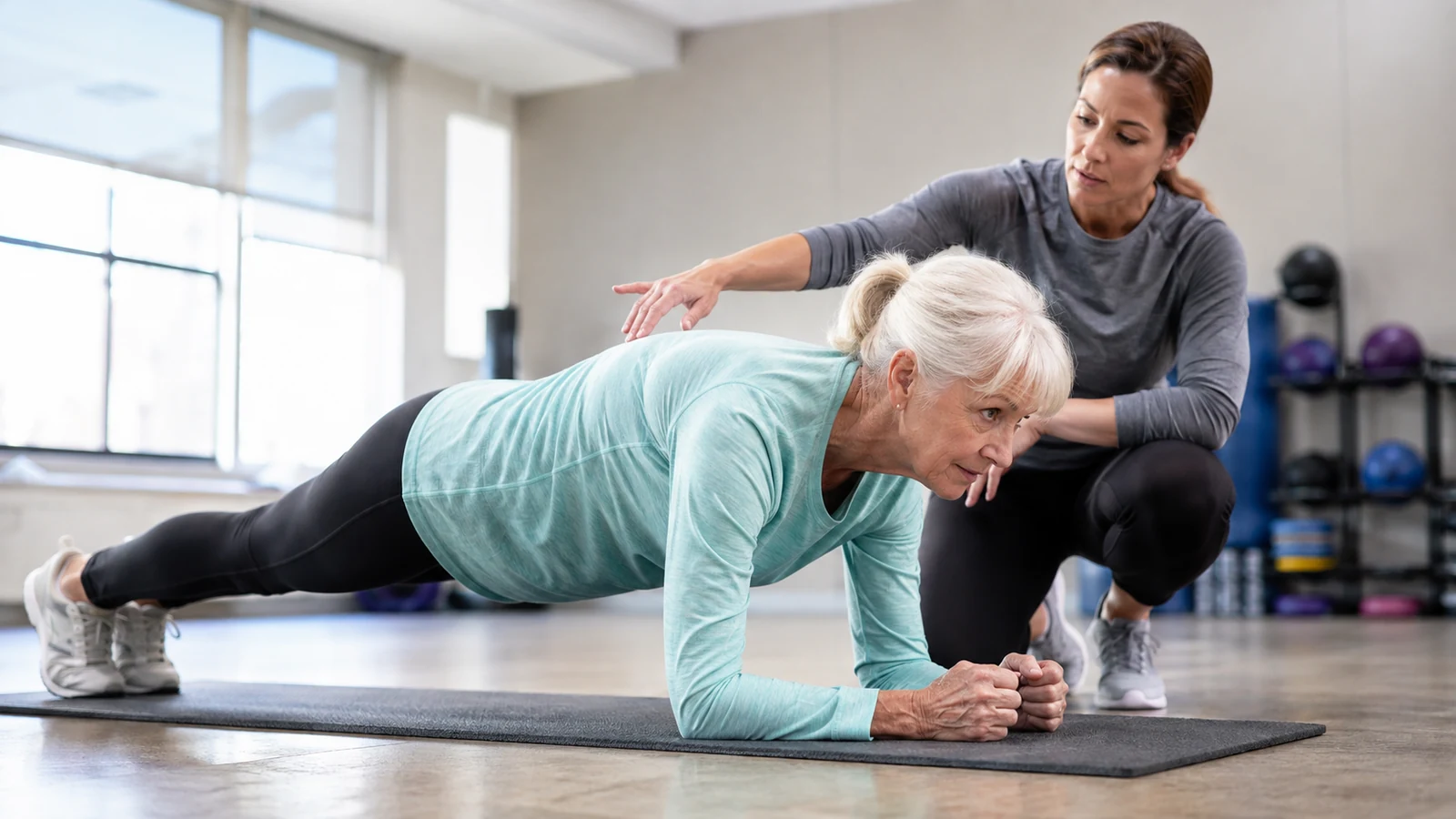
Step 1: Master a strict 20 to 30 second hold first.
A straight line from shoulders to ankles, with normal breathing and no sagging hips, matters far more than the number on a clock.
Step 2: Progress in small, boring increments.
Adding 10 to 15 seconds every week or two lets the deep stabilizers adapt without breaking form to chase a bigger number.
Step 3: Build general strength and cardio alongside the plank itself.
Williams’s own program mixed circuit training, resistance work, and cardio around his plank practice, not just isolated hold attempts.
Step 4: Use a mirror or a recording to check form.
Williams filmed his own sessions specifically to catch technique breakdowns before they became habits, a low cost tool anyone can use.
Step 5: Track effort, not just time.
Older adults exploring balance and core focused training for the first time may find a gentler entry point in what research actually shows about Pilates for older adults, which builds many of the same stabilizing muscles without the direct floor loading.
Step 6: Respect recovery.
Williams used a smartwatch specifically to avoid overtraining, a real risk when someone is motivated enough to chase a record.
Williams is far from the only later-in-life Guinness title built on this kind of patient, structured training.
Edith Connor set her own Guinness record after starting strength training in her sixties, and DonnaJean Wilde set a push-up world record built on pacing rather than raw speed.
None of these records argue that age stops mattering.
They argue that consistent, well-structured training keeps mattering for a lot longer than most people assume.
Watch the Record
Guinness World Records filmed and verified Williams’s attempt directly.
You can see the record’s current listing on the official Guinness World Records verification page.
Curious how far a record like this actually holds up under scrutiny? Subscribe to WorkoutHealthy Insider for practical explanations behind popular fitness claims.
References
Fragala, M. S., Cadore, E. L., Dorgo, S., Izquierdo, M., Kraemer, W. J., Peterson, M. D., & Ryan, E. D. (2019). Resistance training for older adults: Position statement from the National Strength and Conditioning Association. Journal of Strength and Conditioning Research, 33(8), 2019–2052. https://doi.org/10.1519/JSC.0000000000003230
Granacher, U., Gollhofer, A., Hortobágyi, T., Kressig, R. W., & Muehlbauer, T. (2013). The importance of trunk muscle strength for balance, functional performance, and fall prevention in seniors: A systematic review. Sports Medicine, 43(7), 627–641. https://doi.org/10.1007/s40279-013-0041-1
Granacher, U., Lacroix, A., Muehlbauer, T., Roettger, K., & Gollhofer, A. (2013). Effects of core instability strength training on trunk muscle strength, spinal mobility, dynamic balance, and functional mobility in older adults. Gerontology, 59(2), 105–113. https://doi.org/10.1159/000343152
McGill, S. M., Childs, A., & Liebenson, C. (1999). Endurance times for low back stabilization exercises: Clinical targets for testing and training from a normal database. Archives of Physical Medicine and Rehabilitation, 80(8), 941–944. https://doi.org/10.1016/S0003-9993(99)90087-4
This article is for general information only and is not medical advice. If you have an injury, ongoing pain, or a medical condition, talk to a doctor or physical therapist before you change how you train or eat.