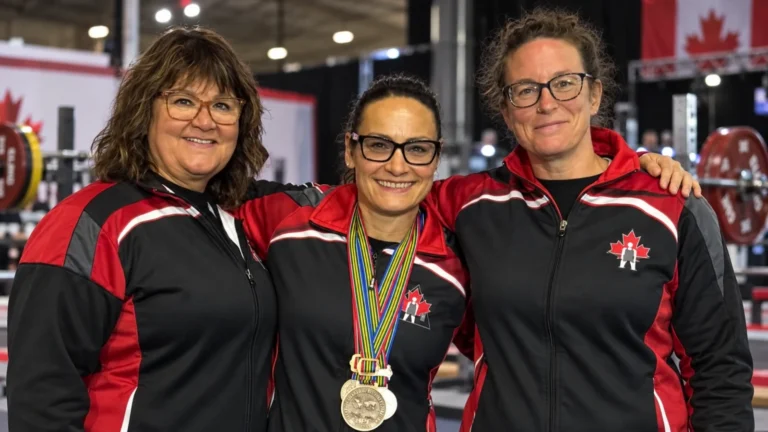

A new YouTube workout promises something big for older adults.
It claims a gentle, standing only routine can build muscle, strength, and balance without ever getting down on the floor.
That is an appealing promise for anyone who finds getting up off the ground the hardest part of exercise.
Here is what real research on light and moderate resistance training in older adults actually supports.
Falls are not a minor issue for this age group.
They are one of the leading causes of injury and lost independence among older adults.
That is exactly why a workout that promises both strength and balance deserves a closer look.
What the Video Claims
The video comes from the channel Tai Chi for Health Life.
It presents a standing workout built entirely around light resistance moves.
No floor exercises are required at any point in the routine.
It is framed as gentle enough for older adults, including people who are brand new to strength training.
The video claims the moves build muscle, build strength, and build balance all at once.
Those are the claims worth checking against the actual science.
What the Research Actually Shows
Standing, light resistance training for older adults is one of the most studied areas in exercise science.
The National Strength and Conditioning Association published a detailed position statement on this exact topic in 2019.
It was written by Fragala and six co authors, who reviewed decades of resistance training research in older adults (Fragala et al., 2019).
Their conclusion was clear.
Resistance training helps older adults keep muscle mass, maintain strength, and protect the physical function that daily independence depends on.
That includes ordinary tasks like climbing stairs, carrying groceries, and standing up from a chair without help.
The position statement also found that resistance training does not require heavy weights or a full gym to produce real benefit.
Resistance training for older adults does not need to be heavy or complicated to produce real, measurable benefit.
A separate line of research looks specifically at falls, which are a leading cause of injury in older adults.
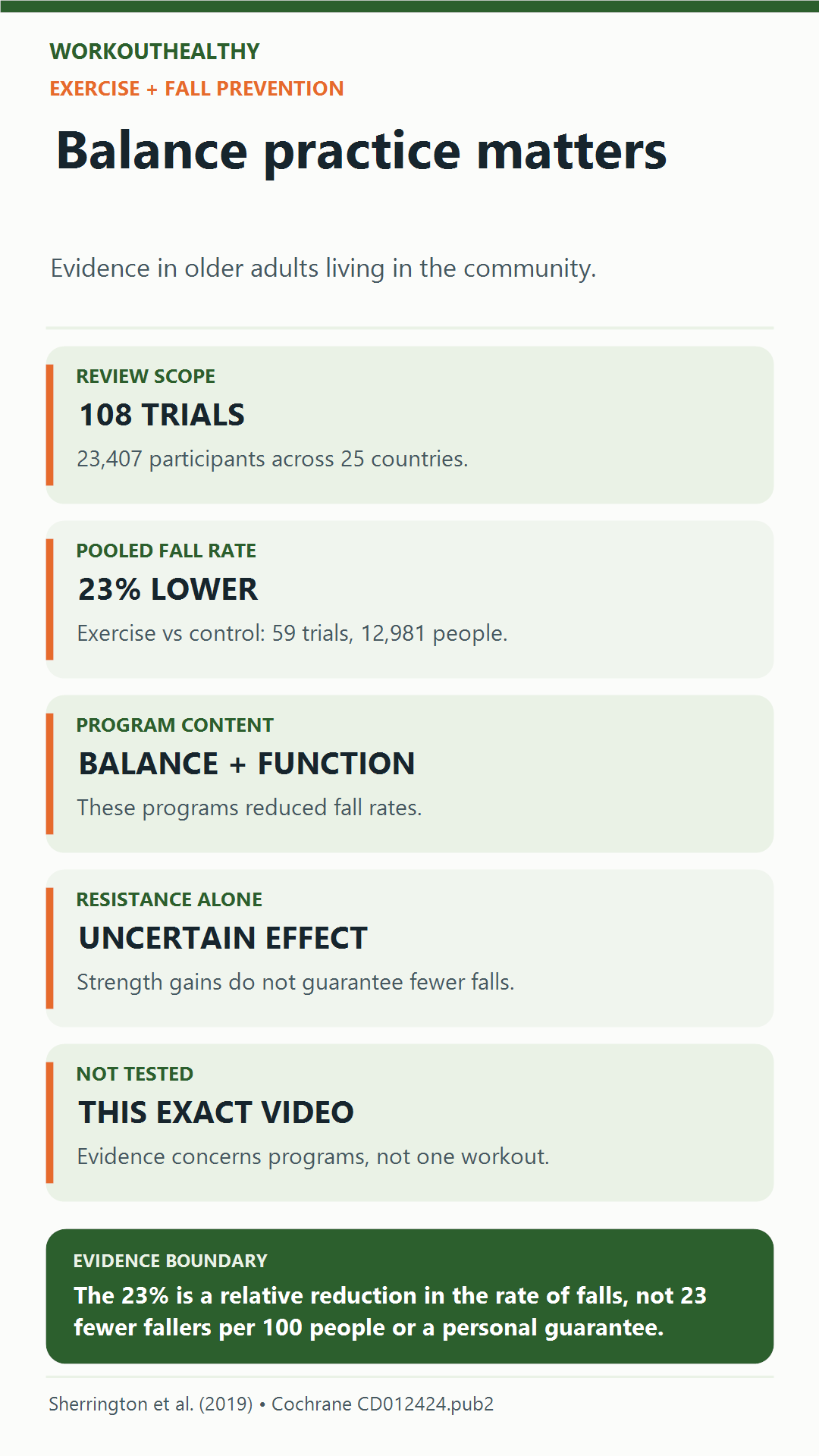
A major Cochrane review pooled data from 108 randomized trials involving more than 23,000 older adults (Sherrington et al., 2019).
It found that exercise programs reduced the overall rate of falls by about 23 percent compared to no exercise.
Programs built around balance and functional movement showed the strongest effect of any single category.
Programs that combined balance work with resistance training showed even larger reductions in fall rates.
That combination is close to what the video describes, standing work that challenges balance while adding light resistance.
We covered a related angle in our piece on whether lifting weights keeps your brain young, since the benefits of resistance training reach further than muscle alone.
Why Standing Resistance Work Helps Balance
Standing exercises work differently than seated or machine based training.
They force the body to control its own posture the entire time.
Every rep challenges the small stabilizing muscles around the ankles, hips, and core.
Those are the exact muscles that keep an older adult steady on uneven ground.
They also matter when reaching for something on a high shelf or turning quickly to answer the door.
Seated resistance machines skip most of this work.
They isolate a single muscle group but remove the balance challenge that standing exercise provides for free.
This helps explain why the Cochrane review found balance and functional exercise to be the strongest category for reducing falls (Sherrington et al., 2019).
A workout that keeps someone on their feet, moving through real positions, is training balance and strength at the same time.
Can Lighter Weights Really Build Muscle?
The word gentle raises an obvious question.
Can light weights actually build meaningful muscle in an older adult?
A 2016 meta analysis in the Scandinavian Journal of Medicine and Science in Sports looked directly at this question (Csapo & Alegre, 2016).
Researchers compared moderate load training against heavy load training in older adults.
Heavy loads produced somewhat larger strength gains overall.
But moderate loads still produced strength and muscle mass gains that were real and meaningful.
The gap between the two approaches was smaller than many people assume.
For someone who is new to training, has joint pain, or feels intimidated by heavy weights, that is good news.
A gentle, standing routine built around light resistance can still produce genuine strength and muscle gains over time.
Consistency matters more than the exact amount of weight used on any given day.
The gap between moderate loads and heavy loads was smaller than most people expect, which is real news for anyone easing into strength training later in life.
What Sarcopenia Has to Do With This
Age related muscle loss has a name in exercise science, sarcopenia.
It begins gradually, often starting in a person’s thirties, and speeds up after age fifty.
Sarcopenia is a major reason why simple tasks get harder with age, not just general tiredness.
The NSCA position statement identifies resistance training as one of the most effective tools available against this process (Fragala et al., 2019).
A standing routine that challenges the legs, arms, and core on a regular basis works directly against that decline.
Our guide on losing weight and muscle mass covers the broader picture of why this matters at any age.
Catching this early, rather than after a fall or a hospital stay, is the entire point of a preventive routine like this one.
What This Evidence Does Not Prove
None of this research tested the exact video discussed here.
No study measured this specific routine, this exact set of exercises, or this particular instructor’s method.
The research backs the broader category of standing, light to moderate resistance training, not one specific video.
The Cochrane review also found that resistance training alone, without a dedicated balance component, had a less certain effect on fall rates (Sherrington et al., 2019).
Balance benefits come more reliably from programs that include real balance practice, not resistance work by itself.
Most of the studies behind these findings tracked programs lasting months, not a single workout session.
Watching one video one time is unlikely to produce the same results as a program followed consistently for weeks or months.
Individual results also vary based on starting fitness, existing health conditions, and how closely someone follows proper form.
Common Mistakes People Make
Skipping a warm up is one of the most common mistakes in any standing resistance routine.
Cold muscles and joints are more prone to strain, especially in older adults.
Holding the breath during effort is another frequent error.
That habit can spike blood pressure in a way that is unsafe for people with heart conditions.
Using momentum to swing a weight up, instead of controlled muscle effort, cuts the strength benefit and raises injury risk.
Standing on an unstable surface without any support nearby is a mistake too, especially early on.
A sturdy chair or countertop within reach should be part of every beginner’s setup.
Progressing too quickly, by adding weight or reps before the current level feels easy, is another common trap.
Ignoring real pain, as opposed to normal muscle fatigue, is the mistake most likely to cause a lasting setback.
Only training the arms, while skipping the legs and core, misses most of what standing resistance work is good for.
Rushing through each rep without a full, controlled range of motion also shrinks the benefit of every set.
Not tracking progress at all makes it hard to know when it is actually time to add a little more challenge.
Who Should Check With a Doctor First
Anyone with a history of falls in the past year should talk to a doctor before starting a new standing routine.
The same goes for anyone with dizziness, vertigo, or a diagnosed balance disorder.
People recovering from a recent surgery, especially hip or knee surgery, need medical clearance first.
Osteoporosis changes which movements are safe, so a doctor’s input matters here too.
Heart conditions and uncontrolled blood pressure are also reasons to check in before starting.
Anyone currently using a cane, walker, or other mobility aid should ask a physical therapist how to adapt standing exercises safely.
Diabetes with any nerve damage in the feet is another reason to get individual guidance first.
Some medications for blood pressure or anxiety can cause lightheadedness that changes how safe standing exercise feels.
That advice holds true no matter how gentle a workout looks on screen.
A Simple Way to Start
Start with body weight movements before adding any resistance at all.
A sturdy chair or counter nearby gives a safety net for balance work.
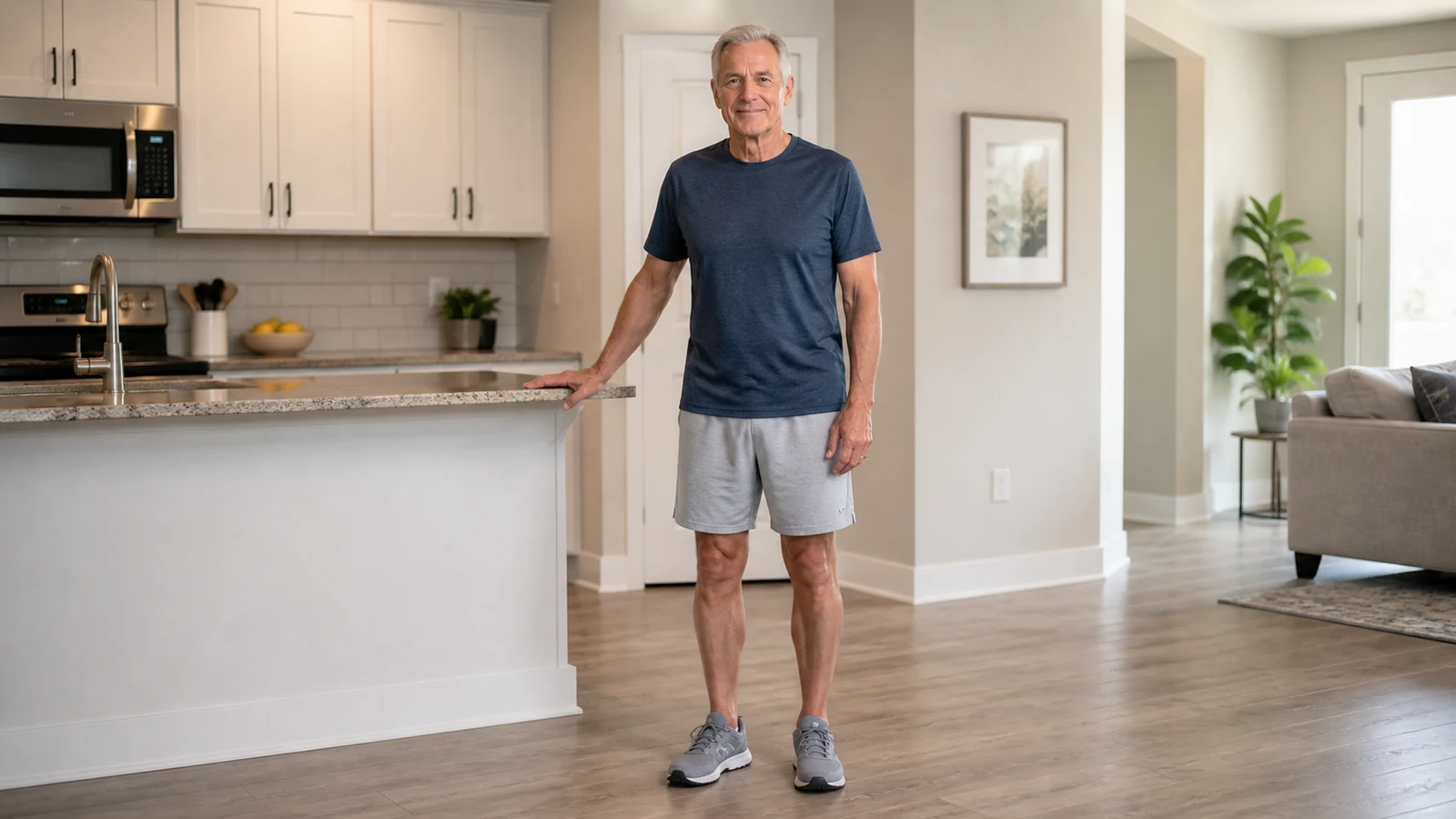
Light dumbbells, one or two pounds to begin, or a resistance band are reasonable starting tools.
Two to three sessions a week, with a rest day between them, matches what the research supports (Fragala et al., 2019).
Form matters more than weight at every stage of this process.
A common starting structure is one set of eight to twelve repetitions per exercise, moving toward two sets as strength builds.
Add repetitions first, then a little more weight, once the current level starts to feel easy.
Stop any exercise right away if it causes sharp pain, chest pain, or sudden dizziness.
Our article on Edith Connor looks at a woman who started strength training in her sixties and still built real, competitive muscle over the following decade.
Her story is a reminder that a late start does not close the door on real strength gains.
Getting stronger now is easier than trying to rebuild lost strength after a fall or an injury.
Pairing a standing resistance routine with regular walking rounds out a simple, sustainable plan.
Our guide on how many miles to walk each day covers that other half of the equation.
Small, steady sessions, done consistently for months, are what the actual research points to.
Watch the Original Video
Want more like this? Subscribe to WorkoutHealthy Insider for practical explanations behind popular fitness claims.
References
Csapo, R., & Alegre, L. M. (2016). Effects of resistance training with moderate vs heavy loads on muscle mass and strength in the elderly: A meta analysis. Scandinavian Journal of Medicine & Science in Sports, 26(9), 995 to 1006. https://doi.org/10.1111/sms.12536
Fragala, M. S., Cadore, E. L., Dorgo, S., Izquierdo, M., Kraemer, W. J., Peterson, M. D., & Ryan, E. D. (2019). Resistance training for older adults: Position statement from the National Strength and Conditioning Association. Journal of Strength and Conditioning Research, 33(8), 2019 to 2052. https://doi.org/10.1519/JSC.0000000000003230
Sherrington, C., Fairhall, N. J., Wallbank, G. K., Tiedemann, A., Michaleff, Z. A., Howard, K., Clemson, L., Hopewell, S., & Lamb, S. E. (2019). Exercise for preventing falls in older people living in the community. Cochrane Database of Systematic Reviews, 2019(1), CD012424. https://doi.org/10.1002/14651858.CD012424.pub2
This article is for general information only and is not medical advice. If you have an injury, ongoing pain, or a medical condition, talk to a doctor or physical therapist before you change how you train or eat.