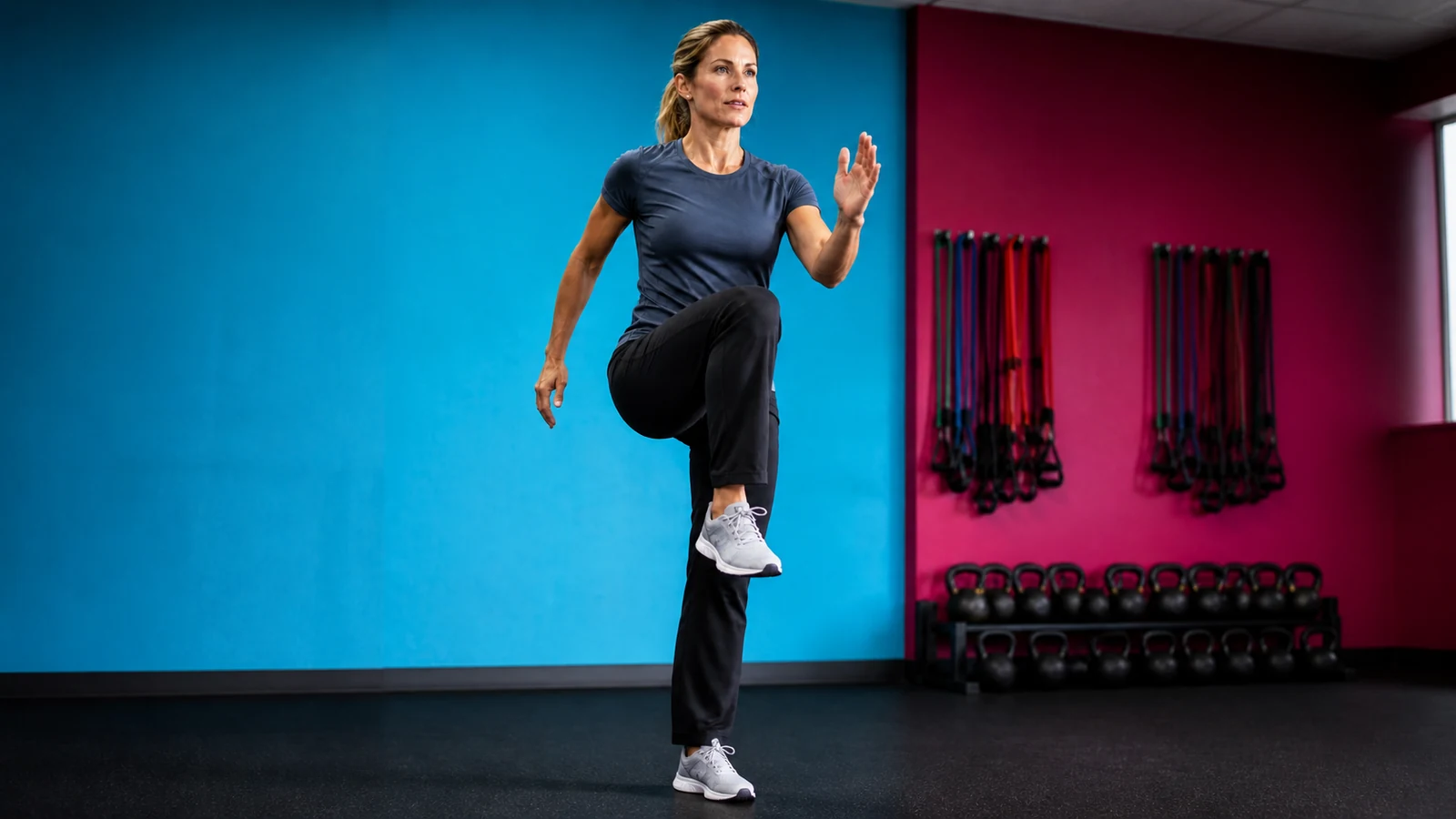

A viral fitness video promises five exercises that build real stamina.
The catch is that none of them are supposed to hurt your joints.
That sounds almost too good to be true if you deal with knee pain, hip stiffness, or arthritis.
So we looked at the actual research behind low impact stamina training to see what holds up.
What the Video Claims
The video comes from Alyssa Kuhn’s channel, Arthritis Adventure.
Kuhn frames five specific exercises as a way to build stamina without the joint pain that comes from high impact cardio.
Her audience is largely people managing arthritis or general joint sensitivity.
The core claim is that you do not need running, jumping, or other high impact moves to build real cardiovascular endurance.
Instead, lower impact movement patterns can raise your heart rate and build stamina while sparing your joints from repeated pounding.
That is a testable idea.
It turns out there is a real body of research on exactly this question.
The Mechanism: Why Low Impact Can Still Train Your Heart
Your cardiovascular system does not know the difference between a treadmill run and a stationary bike ride.
It only responds to how hard and how long your heart and muscles are working.
Cardiorespiratory fitness is the capacity of your heart, lungs, and blood vessels to deliver oxygen during sustained effort.
Researchers usually measure it with VO2 max, which is the maximum amount of oxygen your body can use during exercise.
A simpler stand in is a timed walking test, since farther distance in the same time usually means better fitness.
Impact and cardiovascular load are two separate things.
Impact refers to the force that travels through a joint when your foot or body strikes a surface.
Cardiovascular load refers to how much work your heart and lungs are doing.
You can raise cardiovascular load a great deal with very little impact, which is exactly what cycling, swimming, and elliptical training are built to do.
What the Real Research Actually Shows
A 2025 systematic review pooled five randomized trials covering 459 people with knee osteoarthritis (Su et al., 2025).
Aerobic exercise raised VO2 max by about 0.90 milliliters per kilogram per minute on average.
People also walked roughly 47 meters farther on a standard six minute walk test after training.
Those numbers sound modest.
Remember that they came from people already managing real joint pain, not healthy young athletes.
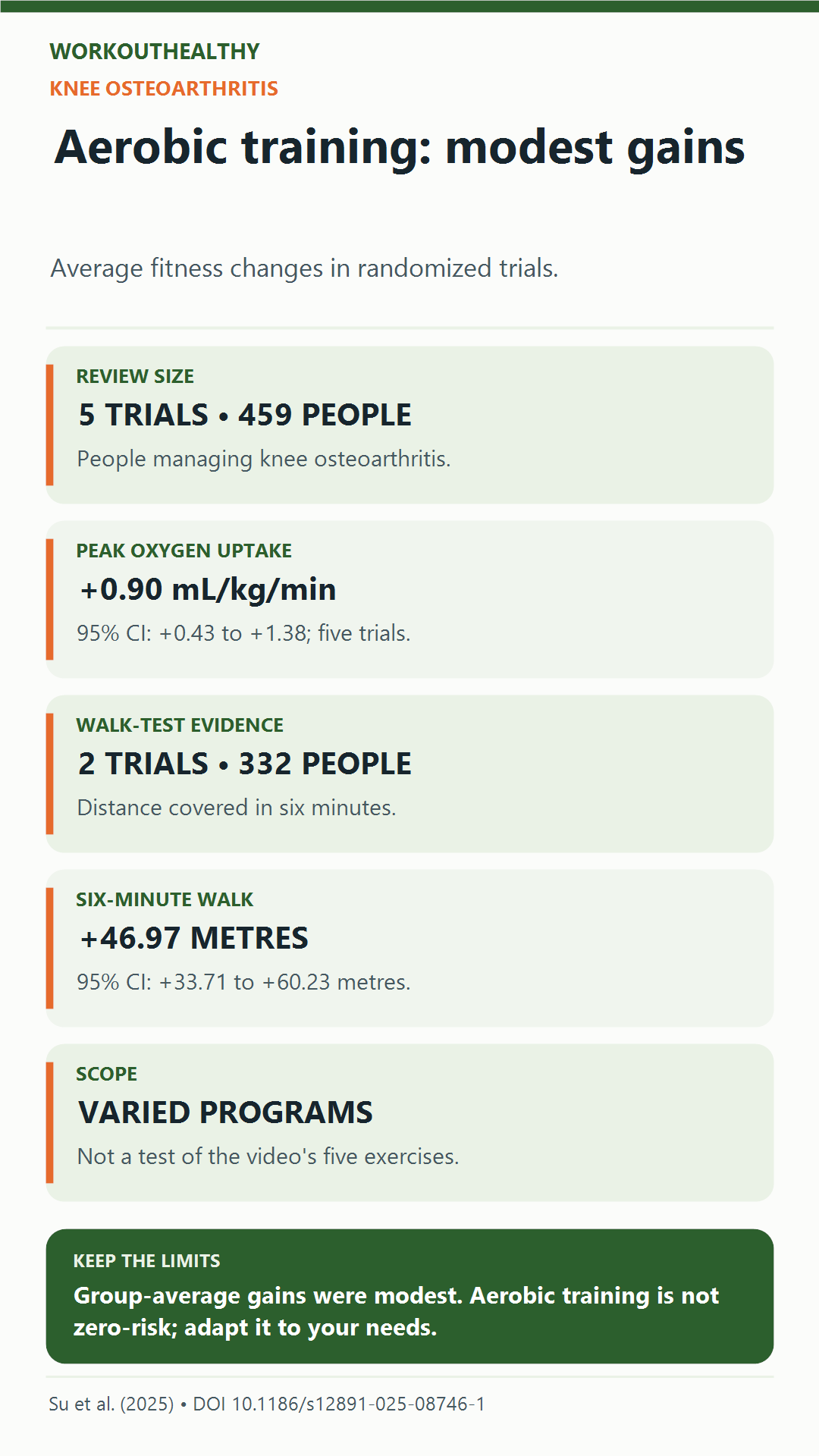
Pain scores and disability scores improved too, though not by enough to call the changes life altering on their own.
Aerobic exercise raised fitness and walking distance even in people already living with joint pain.
A separate 2025 network meta-analysis widened the lens considerably (Yan et al., 2025).
It combined 217 randomized trials covering 15,684 people with knee osteoarthritis.
Aerobic exercise came out ahead of most other exercise categories for reducing pain and improving function.
That kind of scale is rare in exercise research.
It is not one small study telling a hopeful story.
It is a synthesis of over two hundred separate trials pointing the same direction.
Building this kind of stamina also lines up with broader patterns in daily movement and long term health, including the pattern described in our look at daily step counts and mortality risk.
Does It Actually Protect Your Joints?
The video’s second claim is really a safety claim, not just a fitness claim.
It suggests these movements will not hurt your joints the way running or jumping might.
The same 2025 network meta-analysis speaks directly to this (Yan et al., 2025).
Across those 217 trials, the researchers tracked adverse safety events for every exercise type studied.
None of the exercise categories, including aerobic training, caused more adverse events than assignment to a non-exercise control group.
In plain terms, supervised aerobic exercise did not appear to damage joints more than staying sedentary did.
That is an important distinction worth sitting with.
The finding is not that low impact cardio strengthens or protects cartilage.
The finding is that it did not cause more harm than doing nothing at all.
That is still meaningful for anyone who has avoided cardio out of fear it will wreck their knees.
Swimming and Cycling, Head to Head
Kuhn’s video does not list every exercise by name, but swimming and cycling are common low impact staples.
A controlled trial put that exact comparison to the test (Alkatan et al., 2016).
Researchers randomly assigned 48 sedentary older adults with osteoarthritis to twelve weeks of swimming or cycling.
Swimming produced roughly a 40 percent drop in joint pain by the end of the program.
Joint stiffness fell by about 30 percent in that same group.
Cycling produced very similar gains in strength, walking distance, and grip strength.
The researchers found no meaningful difference between the two activities overall.
Both groups improved by a comparable amount.
That result matters in a practical sense.
It suggests you likely do not need one single perfect low impact exercise.
Several different low impact options can get you to a similar place.
What This Evidence Does Not Prove
None of this research tested the specific five exercise routine shown in the video.
These studies looked at general categories like aerobic training, swimming, and cycling.
They did not test any single creator’s exact exercise list as a packaged program.
There is also a real nuance buried inside the cardiorespiratory research.
Weightbearing aerobic exercise like walking produced better cardiovascular gains than non-weightbearing options like cycling or water aerobics in the Su et al. (2025) review.
The likely reason is that weightbearing movement recruits more muscle mass at once.
That does not make cycling or swimming useless.
It means the largest cardio gains may still lean toward some weightbearing movement, for people whose joints can tolerate it.
The osteoarthritis trials also cannot tell us much about rheumatoid arthritis, gout, or other inflammatory joint conditions.
Those conditions behave very differently and were not the population studied in this research.
Finally, none of this proves a joint becomes structurally stronger over time.
It shows that supervised aerobic exercise did not cause more harm than inactivity, which is a real but more modest claim than “protects your joints.”
Common Mistakes People Make When Building Stamina This Way
The biggest mistake is treating “low impact” as a synonym for “low effort.”
Stamina still requires a genuine training stimulus to improve.
Cycling at a pace so easy it barely raises your heart rate will not build meaningful fitness.
Another common mistake is skipping any strength work entirely and relying on cardio alone.
Weaker muscles around a joint tend to transfer more force directly into that joint.
A third mistake is doing far too much, far too fast, once early soreness disappears.
Joint tissue adapts more slowly than motivation does.
People also frequently ignore basic setup on machines like stationary bikes or ellipticals.
Low impact is not the same thing as low effort.
A bicycle seat set too low can quietly overload the front of the knee.
Handlebars set too far away can add unnecessary strain through the shoulders and low back.
Finally, some people quit the moment a single session feels harder than expected.
Some day to day fluctuation in how sessions feel is completely normal during real training.
Who Should Check With a Doctor First
Anyone with a diagnosed joint condition should loop in a doctor or physical therapist before starting something new.
That is especially true for rheumatoid arthritis, gout, or a joint injury from the last few months.
People recovering from a joint replacement need an individualized timeline from their surgical team.
For a real example of how carefully that staging can look, see our full breakdown of Misty Copeland’s hip replacement recovery.
Anyone with new or worsening joint swelling should get it checked before adding more training volume.
People with existing heart conditions should get medical clearance before starting a new cardio program.
None of these cautions mean exercise is unsafe for these groups.
They mean the plan should be personalized rather than copied directly from a video.
How to Actually Build Stamina Without Hurting Your Joints
Start each session with a warm up of five to ten minutes at an easy pace.
Pick one primary low impact mode, such as a stationary bike, an elliptical, a pool, or a rowing machine.
Aim for an effort level where talking stays possible but a full conversation feels a little hard.
That range is often called moderate intensity, and it is where most of this research was conducted.
Begin with two to three sessions a week at fifteen to twenty minutes each.
Add roughly ten percent more time every one to two weeks if your joints feel fine the next day.
Pair that cardio work with two short strength sessions targeting the hips, quads, and glutes.
Stronger muscles around a joint absorb more force, so the joint itself takes on less.
Track how a joint feels the day after training, not only during the session itself.
Soreness that fades within a day is a normal training response.
Pain that lingers, sharpens, or shows up with swelling is a signal to scale back and reassess.
Rotate between two or three low impact modes across the week to spread out repetitive stress on any one joint.
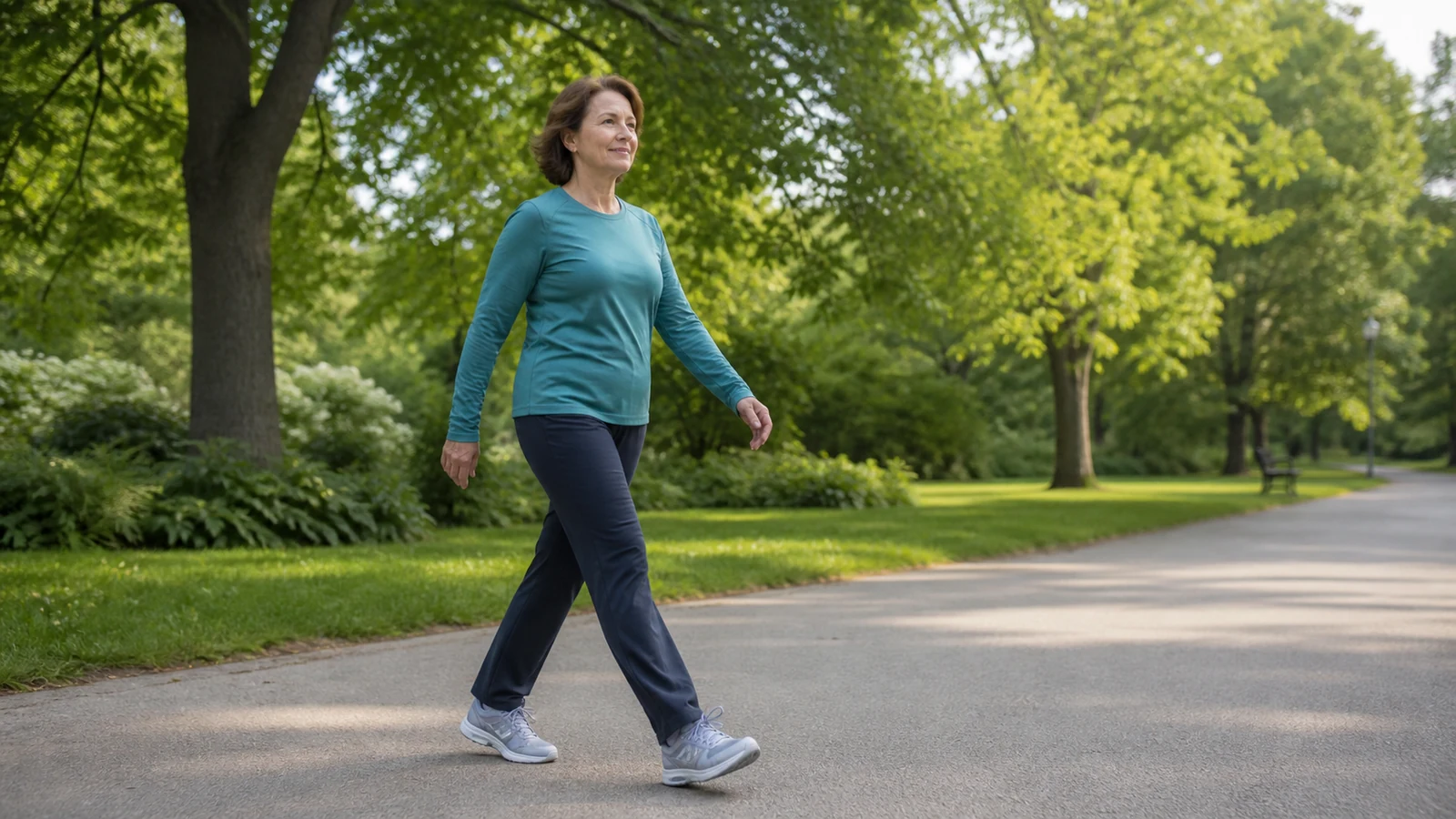
Alternating a stationary bike with a structured daily walking routine is a simple way to do this.
A basic stair climb self-test, repeated every few weeks, can give you a rough sense of whether your stamina is actually improving.
Progress on this kind of plan is rarely a straight line, and a slower week here and there is expected.
Consistency over months is what produced the gains seen in the research above, not any single perfect workout.
Watch the Original Video
Want more like this? Subscribe to WorkoutHealthy Insider for practical explanations behind popular fitness claims.
References
Alkatan, M., Baker, J. R., Machin, D. R., Park, W., Akkari, A. S., Pasha, E. P., & Tanaka, H. (2016). Improved function and reduced pain after swimming and cycling training in patients with osteoarthritis. The Journal of Rheumatology, 43(3), 666 to 672. https://doi.org/10.3899/jrheum.151110
Su, S., Yu, C. C. W., Zhou, E. F. M., Liu, J. Y., & Fu, S. N. (2025). Effect of aerobic exercise on cardiopulmonary fitness among people with knee osteoarthritis: A systematic review and meta-analysis. BMC Musculoskeletal Disorders, 26(1), Article 549. https://doi.org/10.1186/s12891-025-08746-1
Yan, L., Li, D., Xing, D., Fan, Z., Du, G., Jiu, J., Li, X., Estill, J., Wang, Q., Belal, A. A., Tian, C., Li, J. J., Li, S., Liu, H., Liu, X., Ren, Y., Yang, Y., Chen, J., Hu, Y., … Wang, B. (2025). Comparative efficacy and safety of exercise modalities in knee osteoarthritis: Systematic review and network meta-analysis. BMJ, 391, Article e085242. https://doi.org/10.1136/bmj-2025-085242
This article is for general information only and is not medical advice. If you have an injury, ongoing pain, or a medical condition, talk to a doctor or physical therapist before you change how you train or eat.