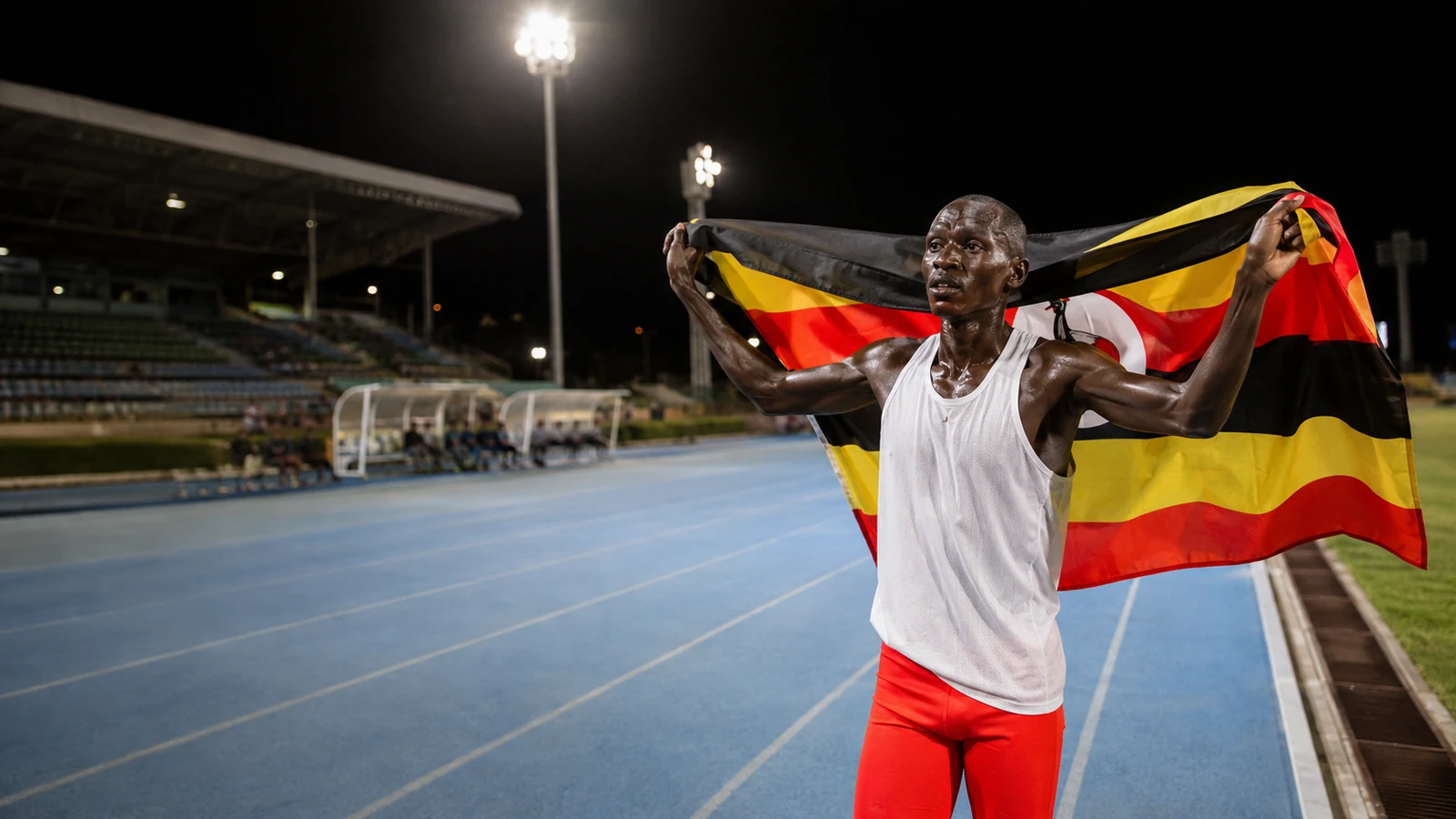

On October 7, 2020, Joshua Cheptegei stepped onto the Turia Stadium track in Valencia, Spain.
He was chasing a number that had not moved in fifteen years.
By the time he crossed the finish line, he had run 10,000 meters in 26 minutes and 11.00 seconds.
That is a world record, and as of today it still stands.
The Record: 26:11.00, Verified by World Athletics
The claim behind this article came from a workbook entry flagged as not yet independently rechecked.
So we went to the source that actually governs the record.
Track and road running world records are ratified by World Athletics, the sport’s global governing body.
That is a different organization than Guinness World Records, which tracks a much wider range of feats but does not set the official standard for competitive athletics marks.
World Athletics’ own record listings confirm the number directly.
Cheptegei ran 26:11.00 for the men’s 10,000 meters at the NN Valencia World Record Day meeting, held at the Turia Stadium in Valencia, Spain, on October 7, 2020.
The result broke the previous world record of 26:17.53, held by Ethiopia’s Kenenisa Bekele since August 26, 2005, when he ran it at the Memorial Van Damme meeting in Brussels, Belgium.
Cheptegei’s run beat that mark by roughly six and a half seconds.
That mark had survived fifteen years, three Olympic cycles, and an entire generation of distance runners trying to catch it.
Two World Records in Twenty-Three Days
The 10,000m record was not an isolated result.
Just over three weeks earlier, on August 14, 2020, Cheptegei had already broken the men’s 5,000m world record at the Herculis meeting in Monaco.
He ran 12:35.36, taking that record down too.
Two world records, at two different distances, inside the same month, is an unusual concentration of form even by elite standards.
Both records were checked directly against World Athletics’ current listings as of this writing.
Cheptegei still holds both.
Neither the men’s 5,000m nor the men’s 10,000m world record has changed hands since 2020.
A review of every running world record broken through 2026 does not list either distance.
Six years on, both of Cheptegei’s track records are still the numbers everyone else in the event is trying to reach.
The Pace Math Behind 25 Laps
A 10,000 meter track race is 25 laps of a standard 400 meter oval.
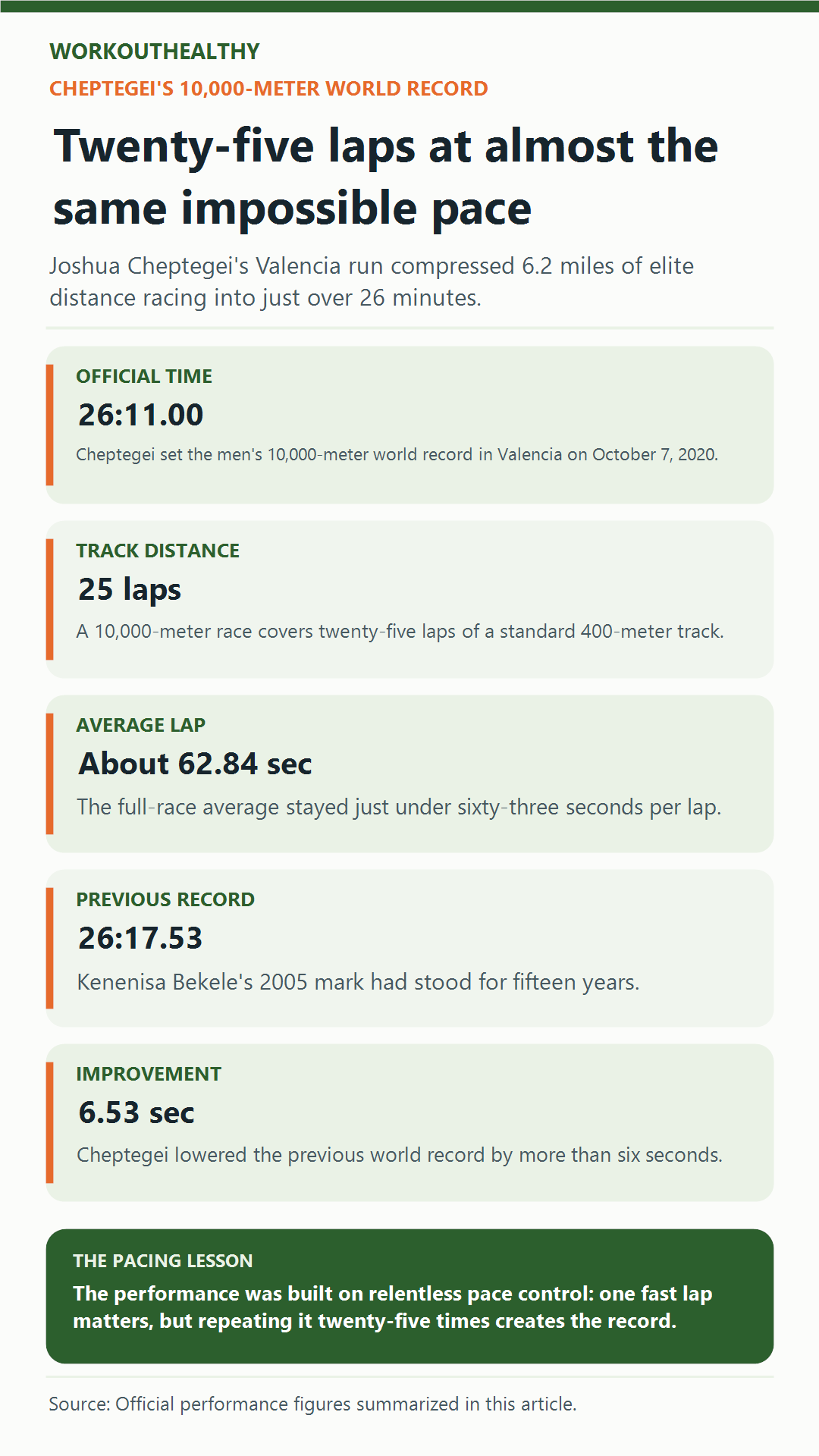
Running 26:11.00 for the full distance means averaging just under 63 seconds per lap.
Not for one lap, and not for a fast opening third before fading.
For all 25 laps in a row.
World Athletics described the effort as roughly 63-second laps held with remarkable evenness across the full 6.2 miles.
That kind of pacing control is not an accident of talent alone.
It requires a runner who knows exactly what their body can sustain and has the discipline not to spend it too early.
The Pacers and the Lights That Helped Set the Pace
NN Valencia World Record Day was not a normal race.
It was built around the record attempt from the start, with a rotating team of pacemakers whose only job was to hold the target pace lap after lap.
The organizers also used Wavelight, a track-side LED system that projects a moving light around the inside rail at a preset speed.
Cheptegei could see the light and his pacemakers running roughly seven meters ahead of him, both marking exactly where 26:11 pace needed him to be at every point on the track.
That setup does not diminish the run.
Pacers and pacing lights are standard, fully legal tools at record-attempt meetings, and every outright world record on the track uses some version of external pacing help.
What the technology removes is guesswork.
Instead of relying purely on internal pacing judgment built from feel, Cheptegei had a constant external check on whether he was on schedule, ahead, or falling behind.
That still left him to do the actual work of hitting the target for six straight miles, which the lights and the pacers could show him but could not do for him.
What Fifteen Years of an Unbroken Record Actually Means
Bekele’s 26:17.53 did not fall because nobody tried.
Distance running had an entire generation of Olympic and World Championship medalists attempt it between 2005 and 2020.
None of them got closer than a few seconds, and most never got that close at all.
A record surviving fifteen years in an event this competitive says something about how far ahead of the field Bekele’s run really was.
It also raises the obvious question of what changed for Cheptegei to finally beat it.
Running Economy: The Efficiency Question
Raw aerobic capacity, often measured as VO2 max, gets most of the public attention in endurance sport.
Among elite distance runners, running economy often matters just as much.
Running economy describes how much oxygen a runner’s body needs to hold a given pace.
Two athletes can post similar VO2 max scores and still race very differently if one of them simply needs less oxygen to run the same speed.
A study published in Medicine & Science in Sports & Exercise compared the running economy of African and Caucasian distance runners and found the African runners used meaningfully less oxygen at the same submaximal speeds (Weston et al., 2000).
That kind of efficiency does not show up in a highlight reel.
It shows up in a runner’s ability to hold 63-second laps without the cost climbing lap after lap.
The Altitude Backdrop
Cheptegei grew up and trains in Uganda, a country whose distance running tradition sits inside a broader East African training culture built at elevation.
Researchers have spent decades trying to untangle exactly how much of that region’s dominance in distance events comes from altitude exposure, genetics, culture, or economic incentive (Larsen & Sheel, 2015).
The honest answer is that no single factor explains it alone.
What is better established is the physiological mechanism altitude training can trigger.
A landmark study in the Journal of Applied Physiology tested a “living high, training low” model, where athletes slept at moderate altitude but did their hardest sessions at lower elevation (Levine & Stray-Gundersen, 1997).
That combination produced measurable gains in sea-level performance compared to training entirely at low elevation.
The proposed mechanism centers on the body producing more red blood cells in thinner air.
That can improve how efficiently oxygen reaches working muscle once an athlete returns to sea level.
That backdrop, built over years, does not appear anywhere on a results page.
It is part of what makes a time like 26:11.00 possible at all.
Lactate Threshold: Training the Engine That Holds the Pace
Holding an even pace for over 26 minutes depends heavily on lactate threshold, the intensity at which the body can no longer clear lactate as fast as it accumulates.
Push past that threshold too early in a race and pace collapses well before the finish.
An early and still influential study in the Journal of Applied Physiology found that an athlete’s lactate threshold, not VO2 max alone, was one of the strongest predictors of distance running performance (Allen et al., 1985).
Elite training plans build entire blocks of work specifically around raising that threshold.
A higher threshold means faster paces feel sustainable rather than desperate.
That is the physiological floor underneath the pacing discipline described above.
Talent gets a runner to the starting line.
Threshold work is a large part of what lets them hold 63 seconds a lap for six miles instead of two.
What This Record Does Not Prove
A verified world record confirms exactly one thing directly: that on one specific day, under governing-body-certified timing and conditions, one athlete ran 10,000 meters in 26:11.00.
It does not prove the number is a hard ceiling for human performance.
Records like it get broken, and the 10,000m record itself changed hands multiple times across the twentieth century before Bekele and then Cheptegei took their turns.
It also does not mean every claim attached to a viral post about the run is automatically accurate.
The workbook entry behind this article listed the record’s current status as unrefreshed, which is exactly why this article checked World Athletics directly rather than repeating the claim as written.
What This Means for Anyone Training Their Own Endurance
Almost nobody reading this needs to run a 63-second lap, let alone 25 of them in a row.

The underlying lessons still translate to a much more ordinary training goal.
An even pace beats a fast start followed by a slow fade, at any speed and any distance.
That is the same pacing principle WorkoutHealthy found behind DonnaJean Wilde’s hour-long push-up world record, just applied to a very different sport.
Runners training toward their own personal best often benefit from practicing goal pace in short segments well before race day, rather than discovering it for the first time once fatigue sets in.
Aerobic base work, the easy mileage that builds the engine over months, matters more than any single hard workout.
A rough field check on that aerobic base does not require a lab.
A simple stair climb test has become a popular, low-cost way to get a general read on cardiovascular fitness, though it is a screening tool and not a diagnosis.
Not everyone chasing better endurance needs to run at all.
WorkoutHealthy’s own reader survey found a strong preference for weightlifting over running among commenters, and building an aerobic base does not require picking one to the exclusion of the other.
Anyone starting a new running program, especially after a long break or with an existing joint or heart condition, should talk to a doctor before ramping up mileage or pace.
A coach or trainer can also help build a threshold and pacing plan that fits an individual’s own baseline.
That is one of the more common reasons working with a personal trainer pays off for someone serious about a specific endurance goal.
Nobody needs Cheptegei’s genetics to benefit from Cheptegei’s method. An even pace, built on a real aerobic base, is the same principle whether the goal is a world record or a personal best five kilometers.
Watch the Record
Want the real story behind more records like this one? Subscribe to WorkoutHealthy Insider for practical explanations behind popular fitness claims.
References
Allen, W. K., Seals, D. R., Hurley, B. F., Ehsani, A. A., & Hagberg, J. M. (1985). Lactate threshold and distance-running performance in young and older endurance athletes. Journal of Applied Physiology, 58(4), 1281–1284. https://doi.org/10.1152/jappl.1985.58.4.1281
Larsen, H. B., & Sheel, A. W. (2015). The Kenyan runners. Scandinavian Journal of Medicine & Science in Sports, 25(S4), 110–118. https://doi.org/10.1111/sms.12573
Levine, B. D., & Stray-Gundersen, J. (1997). “Living high-training low”: Effect of moderate-altitude acclimatization with low-altitude training on performance. Journal of Applied Physiology, 83(1), 102–112. https://doi.org/10.1152/jappl.1997.83.1.102
Weston, A. R., Mbambo, Z., & Myburgh, K. H. (2000). Running economy of African and Caucasian distance runners. Medicine & Science in Sports & Exercise, 32(6), 1130–1134. https://doi.org/10.1097/00005768-200006000-00015
This article is for general information only and is not medical advice. If you have an injury, ongoing pain, or a medical condition, talk to a doctor or physical therapist before you change how you train or eat.