Bruce Springsteen’s ability to perform long concerts is not a mystery routine built from one viral quote.
A detailed New Yorker profile reported that he had followed roughly the same exercise pattern for three decades: treadmill running and weight training with a trainer.
The profile also described concerts lasting more than three hours without a break and quoted Springsteen comparing performance to sprinting while screaming for several minutes at a time.
That evidence supports a story about long-term preparation, not agelessness or a guaranteed formula.
A three-hour show is built from years of routine, then tested one song at a time.
What is verified
The New Yorker reported that Springsteen ran on a treadmill and trained with weights under a trainer’s guidance.
The article said the basic regimen had stayed similar for about thirty years at the time of publication.
It also described the physical demands of his shows in concrete terms.
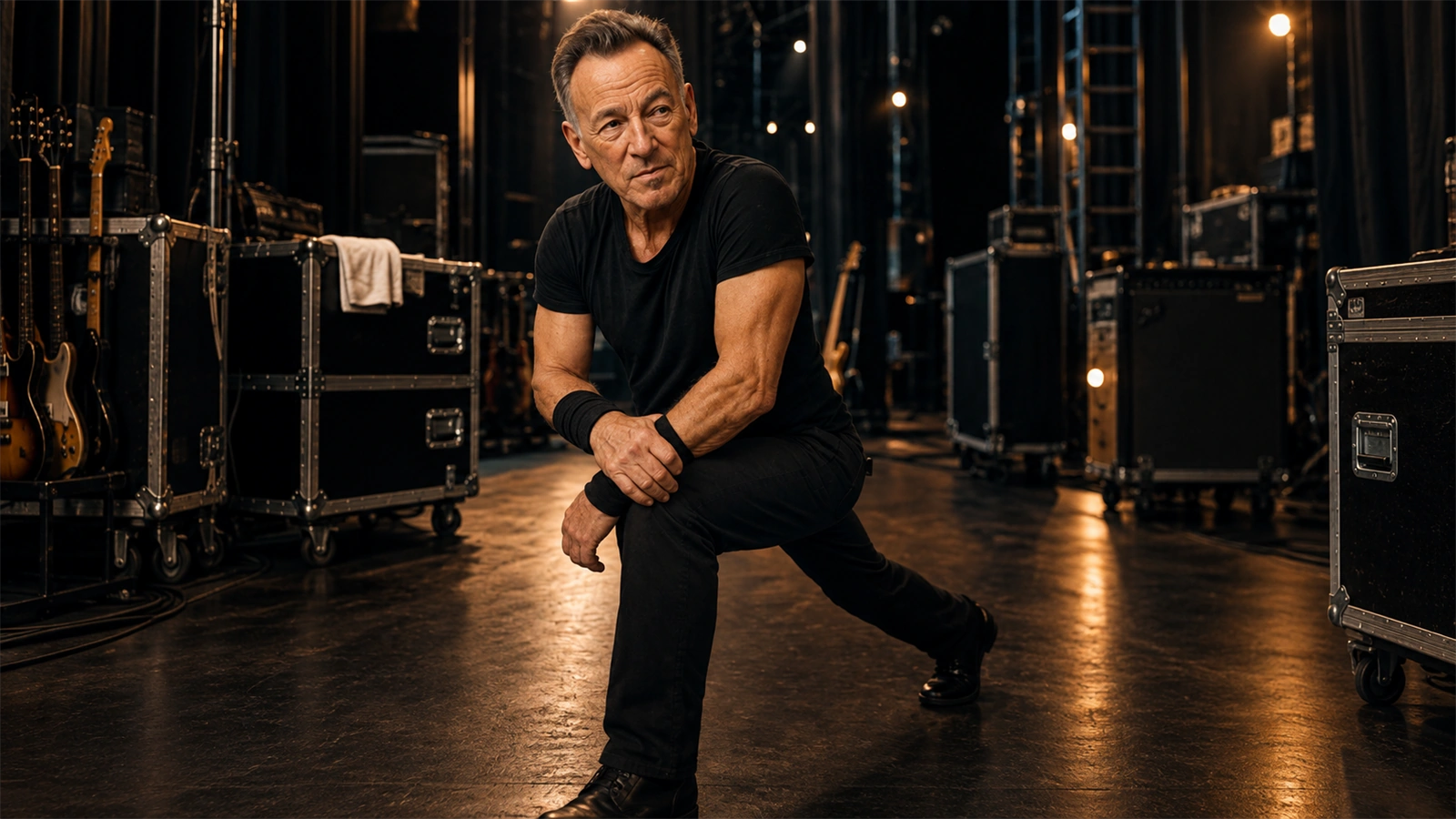
Springsteen danced, kicked, climbed, jumped, moved across the stage, and performed for more than three hours.
That is stronger evidence than a caption that claims he trains daily without naming a source or defining the training.
Public reporting does not provide a complete current program with exact sets, loads, mileage, or recovery rules.
It would be wrong to invent those details or imply that a routine from one period has remained unchanged forever.
The reliable core is still meaningful: aerobic work and strength training supported a long performance career.
Why a concert is an endurance event
A concert is not steady-state cardio performed at one predictable effort.
It alternates between bursts of movement, sustained singing, instrumental work, crowd interaction, and brief lower-intensity moments.
Singing adds a breathing demand that a treadmill session does not fully reproduce.
Heat, lights, travel, irregular schedules, and repeated shows add stress outside the visible performance.
The performer must also make skilled decisions while tired.
Remembering lyrics, communicating with the band, and reading the crowd all continue after physical fatigue appears.
This mixture makes the show closer to intermittent endurance activity than to one continuous sprint.
Springsteen’s description of sprinting while screaming captures the intensity of individual songs, while the full concert requires pacing across the entire night.
The body needs both a high ceiling for hard moments and a large base for recovery between them.
What the treadmill contributes
Treadmill running provides a controllable way to build aerobic capacity without relying on weather or daylight.
Easy sessions can improve the ability to sustain movement and recover between harder efforts.
Faster intervals can train the transition from comfortable work to the breathless demand of an energetic song.
Incline changes can increase effort without requiring the same speed.
The treadmill also allows precise repetition, which is useful when a performer is preparing around rehearsals and travel.
It does not perfectly simulate a stage.
Running is linear, while performing includes lateral movement, changes of direction, kneeling, climbing, and upper-body work.
That is why treadmill fitness should be a base rather than the whole plan.
People who need a gentler entry point can use the principles in our article on low-impact walking as cardio.
The useful variable is the training response, not whether the machine looks dramatic.
Why the weights still matter
Strength training gives a performer reserve capacity for repeated movement, instrument handling, and awkward stage positions.
When basic tasks use a smaller percentage of maximum strength, they are often easier to repeat.
Leg and hip strength support jumping, climbing, and getting up from low positions.
Upper-back and shoulder strength can help manage a guitar across a long set.
Trunk training helps transfer force while the arms and legs are moving in different directions.
The goal is not necessarily maximum size or a powerlifting total.
Extra mass can create its own endurance cost when every show requires hours of movement.
A practical plan usually favors a small number of compound patterns with enough volume to maintain strength.
It also leaves energy for rehearsal and the sport-specific work of performing.
Our guide to losing weight without sacrificing muscle explains why resistance training remains important when body composition changes.
Training for the actual job
General fitness matters, but the final preparation must resemble the demands of the performance.
That means rehearsing full songs while standing and moving, not only playing seated.
Longer rehearsals teach pacing, hydration, footwear, and transitions between high-energy sections.
Set-list order becomes a physical planning tool because several demanding songs in a row create a different load.
Stage dimensions and props also affect movement.
A performer can be fit in the gym and still need time to adapt to heat, lights, and vocal demand.
The best conditioning plan therefore supports rehearsal instead of competing with it.
Hard leg training immediately before a long rehearsal may create fatigue without adding useful capacity.
Scheduling matters as much as the exercise list.
The gym builds capacity. Rehearsal teaches the body where that capacity must be spent.
The WorkoutHealthy capacity score
A performer can review readiness through four categories scored from zero to two.
Aerobic base asks whether easy movement feels comfortable and recovery between songs is quick.
Strength reserve asks whether stage positions and equipment feel manageable without straining.
Specific rehearsal asks whether recent practice has matched the expected show length and movement.
Recovery margin asks whether sleep, travel, and spacing between shows allow fatigue to fall.
A total of seven or eight suggests the plan covers the main demands.
A total of four or less points to a weak link that should be addressed before adding more intensity.
This is a WorkoutHealthy planning framework, not a score used by Springsteen or his trainer.
Its value is that it prevents one impressive workout from hiding poor recovery or a lack of specific rehearsal.
How the plan should change with age
Aging does not remove the need for challenge, but it often changes the cost of recovering from it.
Warmups may need more time, and hard sessions may need more space.
Strength remains valuable because muscle and power help protect function.
Aerobic work remains valuable because the show still demands repeated movement and breathing control.
The adjustment is usually in volume, sequencing, and recovery rather than abandoning training.
Fewer high-cost sessions can be paired with more easy movement and mobility work.
Painful movements can be modified while preserving the pattern or goal.
Travel days may become recovery days instead of hidden opportunities for another workout.
Long careers are supported by this willingness to adapt without confusing adaptation with quitting.
How to manage a multi-show week
A concert should not be treated as an isolated workout when another date is waiting 24 or 48 hours later. The useful question is not how hard a performer can push tonight; it is how much work can be absorbed while preserving enough energy, mobility, and voice for the next show.
Harder strength sessions usually belong earlier in the week or farther from performance night. Travel days are better suited to easy aerobic work, mobility, and short movement breaks that counter hours of sitting. That structure protects consistency without turning every day into another test.
Food, fluids, and sleep do much of the unglamorous work. A three-hour set can mean sustained heat, sweat, repeated accelerations, and little opportunity for a conventional meal. Replacing fluids and carbohydrates afterward, then returning to a normal protein-rich meal, supports the next day’s recovery better than chasing a complicated supplement routine.
The morning after a show, useful signals include unusual resting heart rate, heavy legs, poor sleep, joint pain, or a voice that feels strained. Those clues can justify an easier day. Ignoring them because the previous performance felt successful is how accumulated fatigue becomes a problem.
Even a rotating set list does not erase the physical load. The exact songs may change, but standing, moving, projecting, and maintaining stage energy remain. The practical lesson is to train for repeatability: finish each demanding day with enough reserve to perform well again.
What this story does not prove
Springsteen’s routine does not prove that treadmill running and weights guarantee three-hour performance stamina.
It does not show that his current training is identical to the program reported years ago.
The public evidence does not provide enough detail to prescribe his sets, loads, or weekly schedule to someone else.
A concert also includes vocal, musical, psychological, and logistical demands that exercise cannot replace.
His longevity should not be used to dismiss health changes or the need for medical care.
The verified lesson is about the value of long-term aerobic and strength preparation for a physically demanding craft.
The accurate takeaway
Bruce Springsteen has used treadmill running and weight training to support a career built around unusually physical shows.
The strongest public profile describes a routine maintained over decades and concerts that demand repeated bursts across several hours.
The practical lesson is to train the qualities your work requires, then rehearse the work itself.
Build aerobic capacity, keep useful strength, and protect the recovery that lets both show up on stage.
No single secret is needed when the routine is durable enough to last.
Get the next evidence check.
Five practical fitness stories worth your time, every Friday.
One email a week. No product pitches. Unsubscribe in one click.
Medical disclaimer: This article is for general information only and is not medical advice. If you have an injury, ongoing pain, or a medical condition, talk to a doctor or physical therapist before you change how you train or eat.