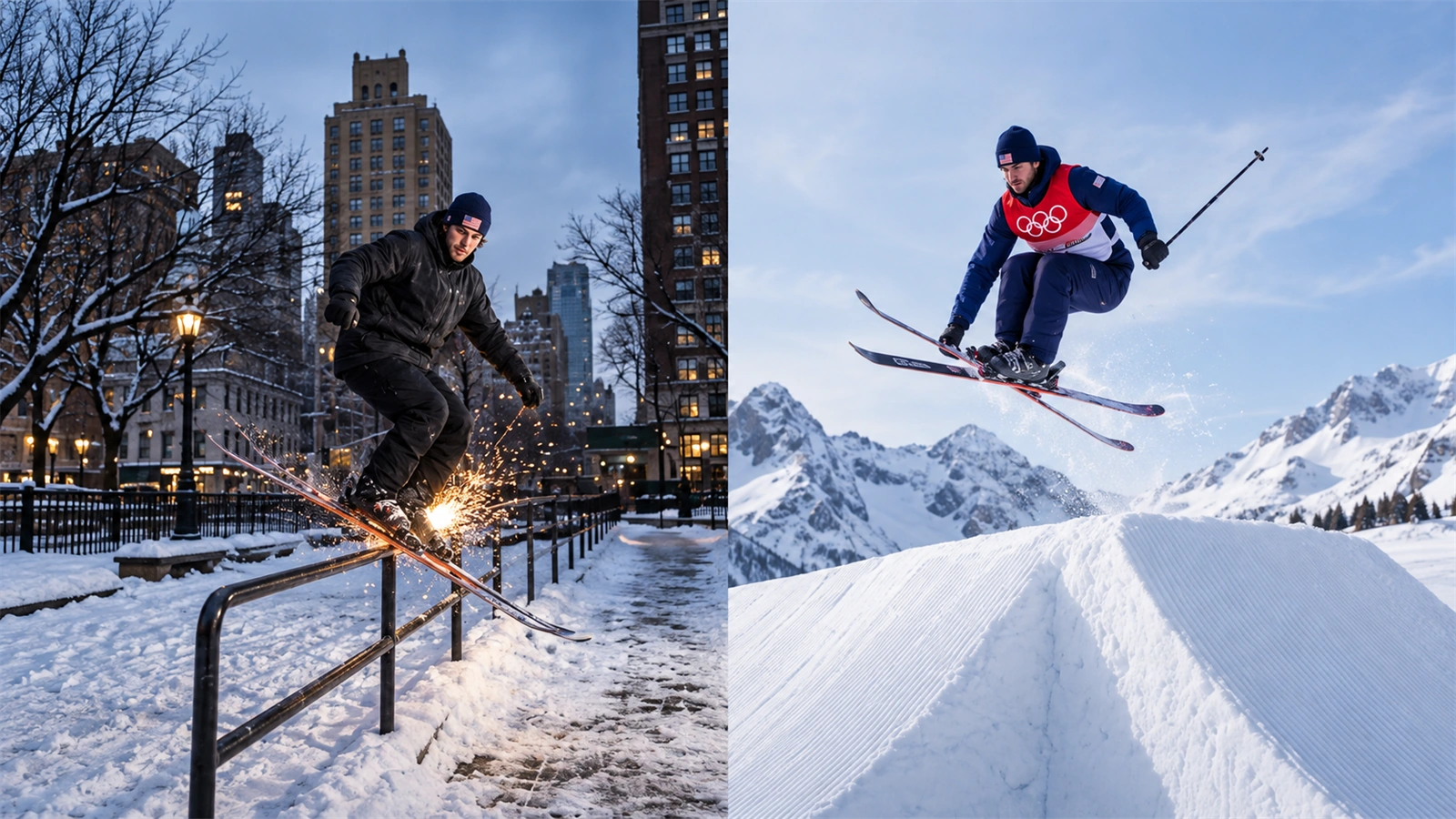
Alex Hall won the silver medal in men’s freeski slopestyle at the 2026 Winter Olympics. Team USA lists him as a three-time Olympian and a two-time Olympic medalist, following his 2022 slopestyle gold with another podium finish four years later.
That achievement gives the viral story a strong ending, but not every detail in the story is documented. Reliable athlete profiles describe Hall’s urban skiing, creative approach, and habit of scouting features on Google Maps. They do not verify a system that used artificial intelligence to calculate airtime, landing forces, and ideal trick selection.
The 2026 Silver Medal Is the Verified Result
Hall entered the 2026 Games as an established Olympic champion rather than an unknown prospect. He earned silver in slopestyle and finished 26th in big air, according to his Team USA profile. Those different results are a useful reminder that even the world’s best freestyle skiers cannot control every event, landing, or judging outcome.
Slopestyle combines rails, jumps, transitions, technical difficulty, execution, and originality. A medal run must survive changing snow, speed, visibility, course design, and pressure. The athlete is not simply repeating one laboratory movement. He is making fast decisions inside a sequence that rewards both precision and invention.
Hall’s medal therefore supports a story about preparation and adaptability. It does not prove that one piece of technology predicted his performance.
Creativity Has Always Been Central to His Skiing
U.S. Ski & Snowboard describes Hall as a skier known for innovation and an unusual approach to features. He has competed at the highest level while continuing to film outside traditional contests. That mix matters because a competition course can encourage standardized tricks, while street and backcountry settings force the skier to see possibilities in ordinary structures and natural terrain.
Hall has said that urban skiing and contest skiing feed each other. Street sessions can sharpen problem solving, line choice, balance, and imagination. Competition training can add repetition, air awareness, and the ability to perform a difficult sequence on demand.
This is a stronger explanation for his style than a claim that a computer chose the perfect trick. Data may inform preparation, but the signature quality viewers recognize is human creativity.
Google Maps Scouting Is Real
One technology claim does have direct support. U.S. Ski & Snowboard reports that Hall and other urban skiers use Google Maps to search for promising rails, walls, stairs, and other features. Satellite and street-level images can reduce wasted travel and help a crew identify locations before snow and access conditions change.
That use of technology is practical, but it is not artificial intelligence calculating an Olympic medal run. A map can help find a feature. It cannot determine whether the landing is safe, whether a property can be used, how snow should be built around it, or what movement will look original on camera.
The scouting example shows how elite athletes often use ordinary tools in sophisticated ways. The advantage comes from pairing information with experience, not from surrendering judgment to an algorithm.
The AI Optimization Story Could Not Be Verified
No reliable interview, federation profile, or Olympic report reviewed for this article described Hall using an AI system to optimize airtime and landing force. There may be sensors, video tools, or performance analysis inside modern freeski programs, but that broad reality does not verify a specific personal method.
Terms such as AI, machine learning, and biomechanics are often added to athlete stories because they make preparation sound futuristic. Sometimes the technology is real. In that case, a credible account should identify the tool, the people using it, the measurement, and the decision it changed.
Without those details, the safest conclusion is limited: Hall uses video, maps, coaches, repetition, and experience like other elite skiers, while the precise AI claim remains unsupported.
Video Feedback Is Useful Without Being Magic
Freestyle skiers can learn from slow-motion video, multiple camera angles, and comparisons across attempts. Footage can reveal takeoff position, ski alignment, rotation timing, grab duration, and the point at which the athlete begins to open for landing.
A coach and athlete still have to interpret what they see. Two jumps with similar airtime may require different corrections because speed, wind, edge pressure, body position, and confidence were different. A number is not a complete diagnosis.
This principle also applies in the gym. Tracking weight and repetitions can guide progress, but the log does not capture every factor affecting a session. Our guide to low and high repetitions explains why training decisions depend on goals, fatigue, and execution rather than one universal number.
Landing Skill Is Built Through Progression
A successful landing begins before the athlete leaves the snow. Approach speed, takeoff direction, body position, rotation, and visual orientation all shape what happens at contact. Strength matters, but it cannot rescue every poorly prepared landing.
Elite skiers build difficult tricks through progressions. They may rehearse the movement on trampolines, use airbags or foam pits, practice simpler versions on snow, and increase difficulty only when awareness and consistency are adequate. Coaches can adjust the feature, speed, or cue while the athlete develops confidence.
Even a well-planned progression carries risk. Freeskiing involves height, speed, and hard surfaces. Technology can improve feedback and reduce some uncertainty, but it cannot make a dangerous sport predictable.
Strength Supports the Skill, but Does Not Replace It
Skiers need leg and trunk strength to produce force, manage repeated landings, and maintain position as terrain changes. They also need power, coordination, mobility, aerobic fitness, and enough local muscular endurance to keep technique together across training runs.
The gym is supporting work. A larger squat does not automatically create better rail balance or aerial awareness. Strength becomes useful when it can be expressed through the specific positions and timing of the sport.
That is why a balanced plan may include heavy lifting, jumps, single-leg work, trunk training, conditioning, and sport practice across different days. Our evidence review of cardio and strength training explains how the two qualities can coexist when workload is planned instead of piled together randomly.
Urban Skiing Trains Decisions That a Gym Cannot
An urban feature was not designed as a ski course. The athlete and film crew must judge its shape, approach, runout, snow build, traffic, permissions, and escape options. Those constraints reward careful observation before a trick is attempted.
The process can develop a visual library of movements and features. Hall can then bring a less conventional line or transition into a contest because he has practiced seeing the course differently. That creative transfer is difficult to quantify, but it is repeatedly visible in his skiing and supported by his official athlete profile.
Recreational athletes should not copy urban attempts. Public rails and stairways add collision, access, legal, and surface hazards. Creativity is worth practicing in an appropriate park with coaching and a progression suited to current ability.
Competition Results Are Not a Clean Technology Test
If an algorithm truly selected an ideal trick, one competition would still be a poor test of its value. Judges compare difficulty, execution, amplitude, variety, and overall impression. Weather and course speed can change between runs, while one small error can alter the score.
Hall’s silver in slopestyle and 26th place in big air happened at the same Olympics. That contrast does not mean preparation worked in one event and failed in the other. It shows the normal variability of high-skill competition.
Fans often want one cause for a medal. Performance is better understood as an interaction among years of skill, physical preparation, equipment, coaching, course fit, decisions, health, and the quality of a few crucial attempts.
What Ordinary Athletes Can Actually Borrow
- Use video for one clear question. Review a lift, jump, or drill for a specific position instead of collecting clips without a decision.
- Progress the environment. Learn on a forgiving setup before adding speed, height, or complexity.
- Train general qualities. Strength, power, conditioning, and mobility support skill but should not crowd out practice.
- Keep room for creativity. Once the basics are stable, controlled variation can improve problem solving and enjoyment.
- Question precise technology claims. Look for the named tool, measurement, and original source.
The transferable lesson is not to buy an AI system. It is to combine feedback with judgment and to build difficult skills through repeatable stages.
The Accurate Alex Hall Story Is Strong Enough
Alex Hall returned to the Olympic podium in 2026 with a silver medal in slopestyle. His official profiles support a long relationship with urban skiing, filming, creative trick design, and map-based scouting.
The available evidence does not support the more dramatic claim that artificial intelligence calculated his airtime, landing forces, and ideal Olympic performance. Presenting that detail as fact distracts from the work that can be documented.
Hall’s real advantage is a broad skill base built across contests and unconventional terrain. Technology can help him find, record, and review opportunities. The athlete still has to imagine the line, develop the trick, manage the risk, and land when the score counts.
Get the next evidence check.
Five practical fitness stories worth your time, every Friday.
One email a week. No product pitches. Unsubscribe in one click.
References
- Team USA. Alex Hall athlete profile and Olympic results.
- U.S. Ski & Snowboard. Alex Hall athlete biography.
- NBC Olympics. Alex Hall at the 2026 Winter Olympics.
Medical disclaimer: This article is for general information only and is not medical advice. If you have an injury, ongoing pain, or a medical condition, talk to a doctor or physical therapist before you change how you train or eat.