The viral version of Sophia Bush’s leg workout is more dramatic than the public evidence supports.
The strongest traceable report is a Shape feature about Bush performing weighted hamstring curls with trainer Ben Bruno, not a fully documented high-volume squat program.
That still makes a useful training story because hamstring curls performed with added resistance can be hard, specific, and easy to progress.
A real exercise done well teaches more than an invented celebrity routine with perfect-looking details.

What is actually verified
Shape reported that trainer Ben Bruno shared video of Bush doing weighted hamstring curls and described the movement as difficult.
The exercise used external resistance while Bush flexed the knee, which places the hamstrings under direct work.
The report did not publish a complete leg-day log, a weekly split, a set count, or a progression plan.
That missing context matters because one clip cannot show the total dose that produced a person’s results.
It also cannot prove how often the exercise was used or what movements came before and after it.
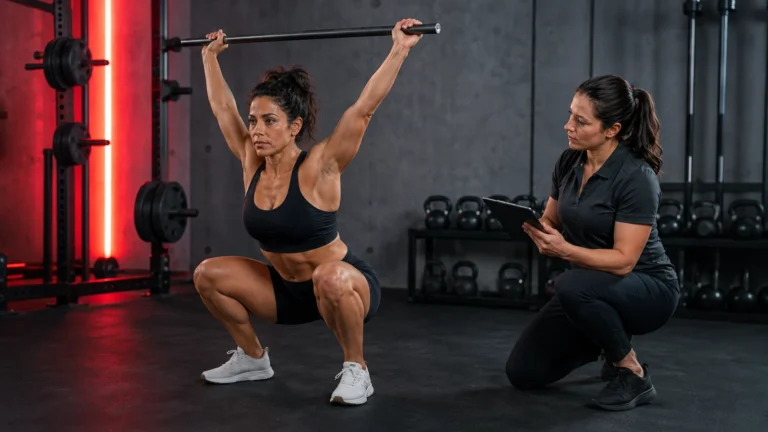
The Facebook image shows a deep barbell squat, but its own caption labels the visual as an illustration rather than the actual event.
Readers should treat the picture as editorial art, not documentary proof that Bush performed that exact squat.
The reliable core is narrower and more useful: Bush was publicly shown completing a challenging, trainer-led hamstring exercise.
Why the weighted curl is demanding
The hamstrings cross the knee and help bend it, which is the main action in a curl.
They also cross the hip and help extend it during movements such as deadlifts, bridges, and sprinting.
A weighted curl isolates the knee-flexion role more directly than most compound lifts.
That focus can make a moderate load feel intense because fewer muscle groups share the work.
The hardest part is maintaining hip position while the lower leg moves.
If the hips rise, the back arches, or momentum swings the load, tension leaves the target area.
Slow lowering makes the exercise harder without requiring a dramatic increase in weight.
A controlled pause near peak flexion also exposes whether the lifter owns the position or is simply moving through it.
This is why a short clip of a curl can show genuine effort even when it lacks the visual scale of a heavy squat.
What a balanced leg day still needs
Hamstring curls are useful, but they do not train every lower-body function.
A balanced session normally includes a knee-dominant movement such as a squat, split squat, or leg press.
It also includes a hip-dominant movement such as a Romanian deadlift or hip thrust.
Calf work and single-leg stability may be added when they match the person’s goals and available time.
The curl then fills a specific gap by loading knee flexion.
People sometimes assume a compound lift makes every isolation exercise unnecessary.
That is too simple because muscles can perform more than one joint action.
A person who only hinges may train the hamstrings heavily at the hip while underloading their role at the knee.
Adding curls can create a more complete stimulus without turning the workout into a marathon.
The article on protecting muscle during weight loss explains why preserving resistance work matters when calories are reduced.
Effort is not the same as quality
A hard set can be productive, but visible strain alone does not prove the exercise is well chosen.
Good effort keeps the intended movement recognizable as fatigue rises.
The final repetitions may slow down, yet the hips, spine, and range of motion should remain controlled.
If a person must shorten every rep or use a violent swing, the set has moved beyond useful fatigue.
Stopping one or two repetitions before form breaks is often enough for progress.
This approach makes training easier to repeat and reduces the need to recover from unnecessary joint stress.
Intensity techniques can have a place, but they should not replace basic progression.
Adding one clean repetition, using a slightly heavier load, or improving tempo are all measurable wins.
The celebrity clip is most useful when it reminds viewers that focused work can look difficult without becoming chaotic.
The goal is not to make every repetition ugly. The goal is to keep the right muscles working as the set becomes hard.
Recovery after hard lower-body work
Leg training can create soreness because large muscle groups perform substantial work through long ranges of motion.
Soreness is not a required sign of success, and chasing it can make the next session worse.
Recovery starts with enough time between hard sessions for the same muscle groups.
Many recreational lifters do well with at least forty-eight hours before repeating demanding hamstring work.
Training history, total volume, sleep, and other activities can lengthen or shorten that window.
Protein and sufficient total calories support repair, while carbohydrates can help restore training fuel.
Easy walking or cycling may feel better than complete inactivity after a hard session.
Our guide to low-impact walking as cardio shows why gentle movement can still contribute without adding jumping stress.
Sharp pain, swelling, or weakness that changes normal movement is different from ordinary soreness.
Those signs deserve a pause and, when persistent, professional evaluation.
The WorkoutHealthy rep-quality score
A simple way to evaluate an isolation exercise is to score four features from zero to two.
Target control earns two points when the intended joint moves while the rest of the body stays stable.
Range earns two points when the lifter uses a repeatable, comfortable path without cutting every hard rep short.
Tempo earns two points when the load is lowered under control instead of dropped.
Repeatability earns two points when the same setup can be reproduced in the next session.
A score of seven or eight suggests the load is appropriate and the progression is working.
A score of four or less suggests the weight, setup, fatigue level, or exercise choice needs adjustment.
This is a WorkoutHealthy coaching framework, not a medical test or a score used by Bush’s trainer.
Its purpose is to move attention away from facial expressions and toward the quality of the actual repetitions.
That shift makes a celebrity workout clip useful without pretending it contains a secret routine.
How to apply the lesson safely
Begin with a curl variation that lets you keep the hips stable and the knees comfortable.
A machine curl is often easiest to load, while a slider or stability-ball curl works well at home.
Perform two or three sets of eight to fifteen controlled repetitions.
Choose a load that leaves one to three clean repetitions in reserve.
Write down the load, repetitions, and variation so the next session has a clear target.
Add repetitions before adding weight when the exercise has small weight jumps.
Pair the curl with one squat pattern and one hip hinge instead of adding several exercises that duplicate the same job.
New lifters should keep the session modest enough that normal walking and stairs remain comfortable afterward.
Consistency across months matters more than creating one punishing leg day.
When to swap the curl variation
An exercise can be useful and still be wrong for a particular body or training phase.
Swap the variation when setup discomfort prevents the hamstrings from doing the work.
A prone machine may bother the front of the hips, while a seated curl may feel better because the torso is supported.
A home slider curl can be scaled by shortening the range or using one leg only after the two-leg version is controlled.
Change the movement if the same joint pain returns despite a lighter load and cleaner setup.
Do not change it simply because progress feels slow for one week.
Keep a useful variation long enough to compare several sessions, then judge it by control, comfort, and measurable progress.
This keeps exercise selection practical instead of turning every new social clip into a program change.
What this story does not prove
The public clip does not prove that weighted curls created Bush’s appearance or fitness.
It does not reveal her full program, nutrition, injury history, or the private advice of her trainer.
It does not prove that a beginner should copy the exact resistance or variation shown.
The barbell squat in the Facebook art should not be treated as a verified event.
It is also wrong to assume visible effort means an exercise is unsafe.
Difficulty depends on load, setup, technique, and the person performing it.
The honest conclusion is smaller: a documented hamstring exercise demonstrates focused lower-body work, and the broader programming must be built from general training principles.
The accurate takeaway
Sophia Bush was publicly featured performing weighted hamstring curls with trainer Ben Bruno.
That verified detail is enough to discuss hamstring function, rep quality, balanced leg training, and recovery.
It is not enough to publish a mystery celebrity circuit as fact.
Use the clip as a reminder that precise isolation work can be demanding when the setup and control are honest.
Build the rest of the session around your own goals and recovery.
Get the next evidence check.
Five practical fitness stories worth your time, every Friday.
One email a week. No product pitches. Unsubscribe in one click.
Medical disclaimer: This article is for general information only and is not medical advice. If you have an injury, ongoing pain, or a medical condition, talk to a doctor or physical therapist before you change how you train or eat.