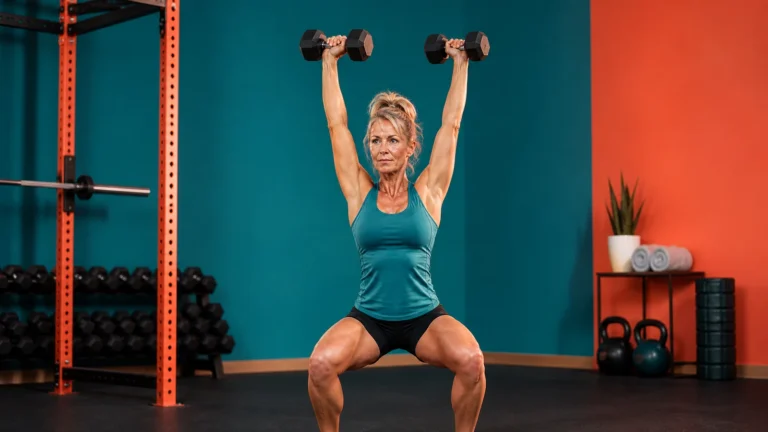

Paul Budline starts most days the same way.
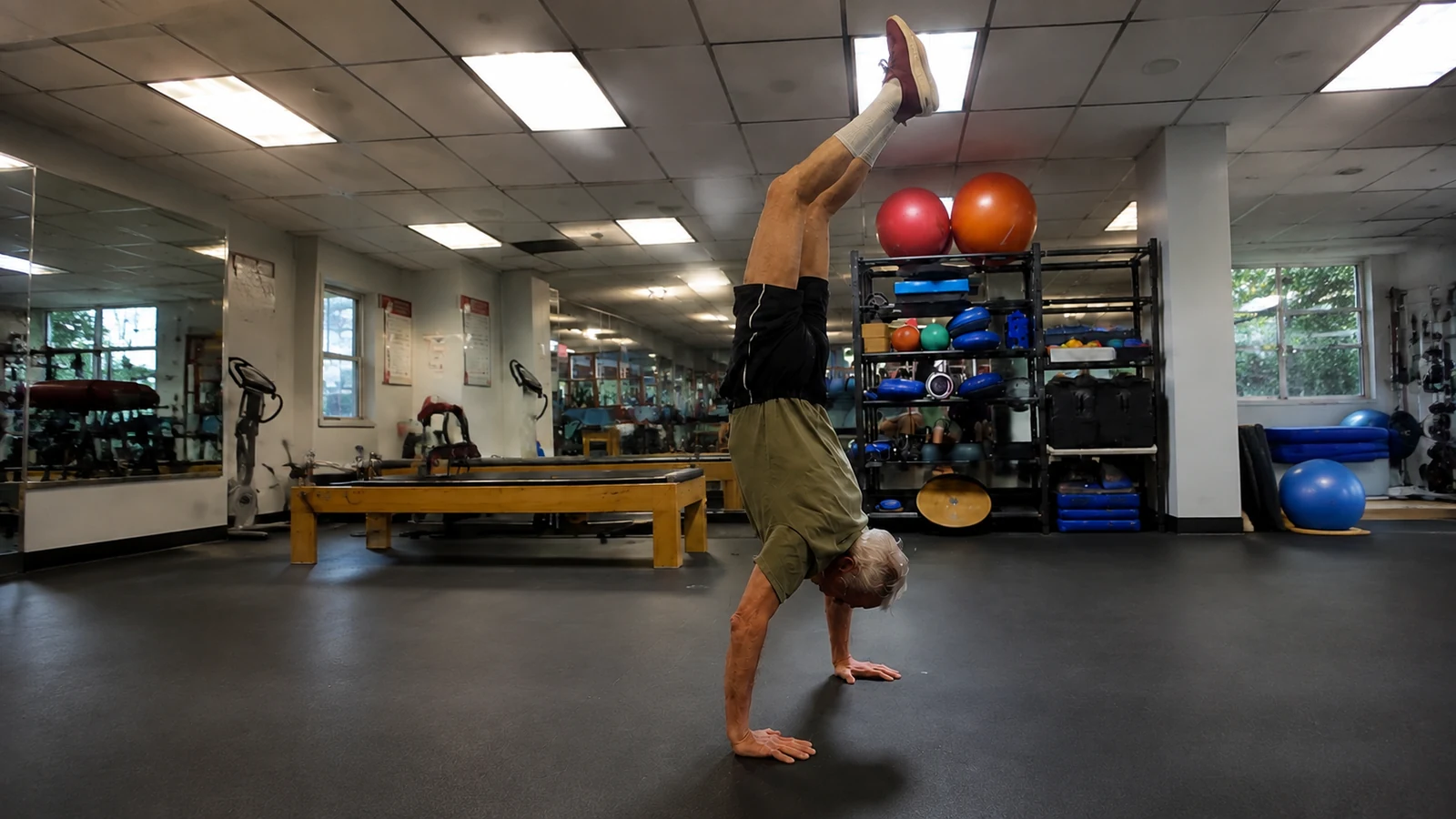
He walks into his gym in Princeton, New Jersey, plants both hands on the floor, and kicks up into a handstand.
He has done this almost every day since he was a teenager.
On May 5, 2025, that daily habit became a Guinness World Record.
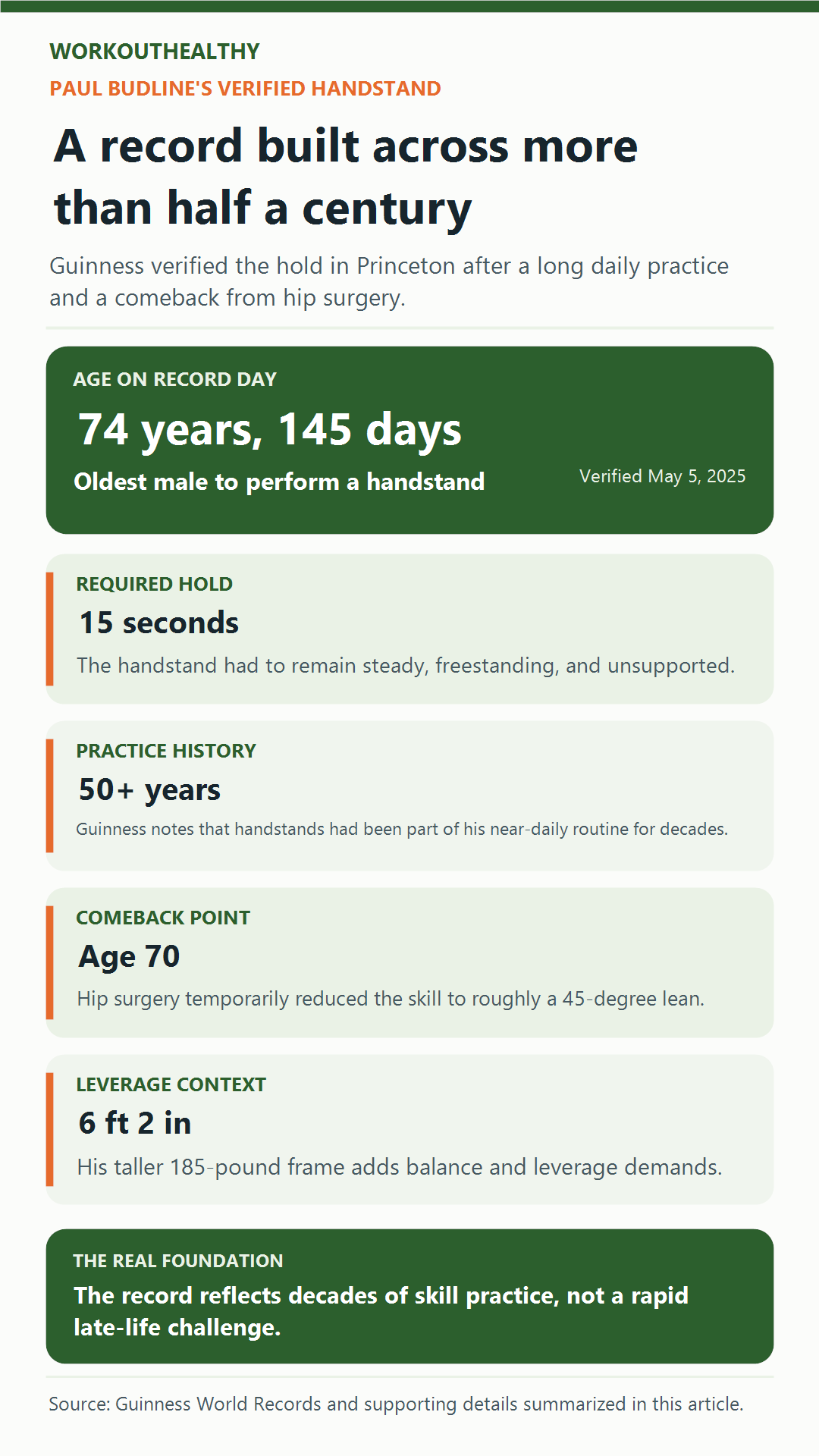
Budline was 74 years and 145 days old when Guinness verified him as the oldest person to perform a handstand.
He beat the previous record holder by nearly four years.
The Record: Verified by Guinness
Guinness World Records lists the title as “Oldest person to perform a handstand (male),” record number 96843.
The official listing credits Budline, of the United States, with the record on May 5, 2025, at 74 years and 145 days old.
The attempt took place in Princeton, New Jersey, at the gym where Budline trains.
Guinness’s rules for this record require a steady, unsupported handstand held for at least 15 seconds.
Guinness’s own record page notes that Budline “has been doing handstands everyday for over 50 years and wanted to break this record.”
That detail matches what Budline has told other outlets, and it is what this article independently traced back to Guinness’s own site before writing anything further.
Why This Record Almost Never Happened
Four years before the record, Budline had hip surgery at age 70.
According to Muhlenberg College’s alumni magazine, the surgery briefly took his handstand away entirely.
Budline told the magazine, “I totally lost the ability to do a handstand and could barely get my legs to a 45-degree angle.”
He described the moment as feeling hopeless.
He kept trying anyway, every day, until the handstand came back.
Losing a fifty year habit at 70 and rebuilding it from a 45 degree lean is not a small comeback. It is closer to relearning the skill from scratch, inside a body that had just been through joint surgery.
Not a Gymnast’s Body
Budline is 6 feet 2 inches tall and weighs about 185 pounds.
Those are not the proportions most coaches look for in handstand training.
A taller frame generally has to control more leverage and a higher center of mass than the compact builds typical of competitive gymnasts.
Budline has said as much himself, noting that his height and weight are not ideal for the skill.
He set the record anyway, which says less about a rare body type and more about five decades of repetition.
Before college, Budline competed as a marathoner.
He also set his school’s high jump record, clearing 6 feet 5 inches.
He graduated from Muhlenberg College in 1972 with a degree in economics and now works as a freelance video editor.
His daily routine still includes weight training and 40 minutes on a stationary bike at maximum resistance, on top of the handstand itself.
What Holding a Handstand Actually Asks of the Body
A held handstand looks static from the outside.
Inside the body, it is a constant, moment to moment balancing act.
The body’s center of mass has to stay stacked almost exactly over two small points of contact, the hands.
Any drift forward or backward has to be corrected within a fraction of a second, or the position collapses.
That correction leans heavily on proprioception, the body’s internal sense of where its own joints and muscles are positioned without looking.
Proprioception is known to decline with age, and that decline shows up consistently in fall risk research.
A 2025 study in the journal Biology tested how well older adults could reproduce specific muscle activation levels without visual feedback (Oleksy et al., 2025).
The researchers found real gaps between the effort participants intended to produce and what their muscles actually did.
Those gaps were also linked to greater postural sway, a measurable sign of less stable balance.
The study’s authors concluded that this kind of proprioceptive drift can meaningfully raise fall risk in older adults.
A held handstand asks that exact system to work at its sharpest, at an age when it typically works less precisely.
The Wrist Is Often the Real Limiter
Ask people who train handstands seriously what actually stops them, and the wrist comes up constantly.
A 2025 cross-sectional survey in the Journal of Functional Morphology and Kinesiology looked at chronic pain among 321 adult handstand practitioners (Martonovich et al., 2025).
More than half of the survey’s respondents, 56.7 percent, reported chronic wrist pain.
The researchers described the wrist as being pushed into a role it was not built for, bearing the body’s full weight in a hyperextended position it rarely holds during normal walking or lifting.
Interestingly, the study found no strong link between pain and how often someone trained, whether they warmed up, or whether they used a wrist brace.
The authors suggested that training intensity and technique may matter more than simple training volume.
For a 74 year old wrist, that loading pattern is not a minor detail.
Wrist mobility and tissue tolerance both tend to change with age.
A joint asked to bear full bodyweight in an extended position deserves real preparation, not an assumption that decades of practice made it immune to strain.
What This Record Does Not Prove
A verified world record proves one specific thing.
Paul Budline held a steady, unsupported handstand for at least 15 seconds on May 5, 2025, under Guinness’s rules.
It does not prove that most 74 year olds could do the same with enough effort.
Budline built this capacity across roughly five decades of near daily practice, not a few months of training.
It also does not prove that his exact training program is optimal, safe, or appropriate for someone starting cold at his age.
Guinness’s record page does not publish a detailed training log, so specifics about his weekly volume and progression are not independently verifiable beyond what he has told outlets directly.
Records like this one also get broken.
Guinness’s own site carries a standard note that listings are not always updated the moment a newer attempt is confirmed, so it is worth holding the exact figures loosely rather than treating them as a permanent ceiling.
Who Should Be Cautious Here
Inverted, weight bearing skills are not a casual place to experiment without preparation.
Anyone with a wrist injury, carpal tunnel symptoms, or a diagnosed connective tissue condition should have that wrist assessed before loading it in a handstand position.
Anyone with uncontrolled high blood pressure, glaucoma, a recent eye procedure, or a heart condition should ask a doctor before attempting any inverted hold.
Inversion changes blood flow and pressure in ways a flat position does not.
Budline’s own comeback started after hip surgery, and he described genuinely losing the skill before slowly rebuilding it under his own judgment.
That is not a template to copy without medical guidance.
Anyone recovering from a joint replacement or major surgery should follow their own surgeon and physical therapist’s plan first, the same way Misty Copeland’s hip replacement recovery worked through defined phases before any advanced movement returned.
Building Toward a Handstand Safely, at Any Age
Nobody needs to chase a Guinness record to get real value from this kind of training.
The National Strength and Conditioning Association’s position statement on resistance training for older adults notes that structured strength and balance work can meaningfully preserve mobility and independence later in life (Fragala et al., 2019).
That statement also points to closed chain, standing based training as one of the more effective tools for lowering fall risk in older adults.
A handstand progression, approached patiently, touches exactly that kind of training.
Step 1: Build wrist tolerance first.
Gentle daily wrist circles, weight bearing holds on flat hands, and gradual range of motion work should come before any inverted loading.
Step 2: Practice against a wall.
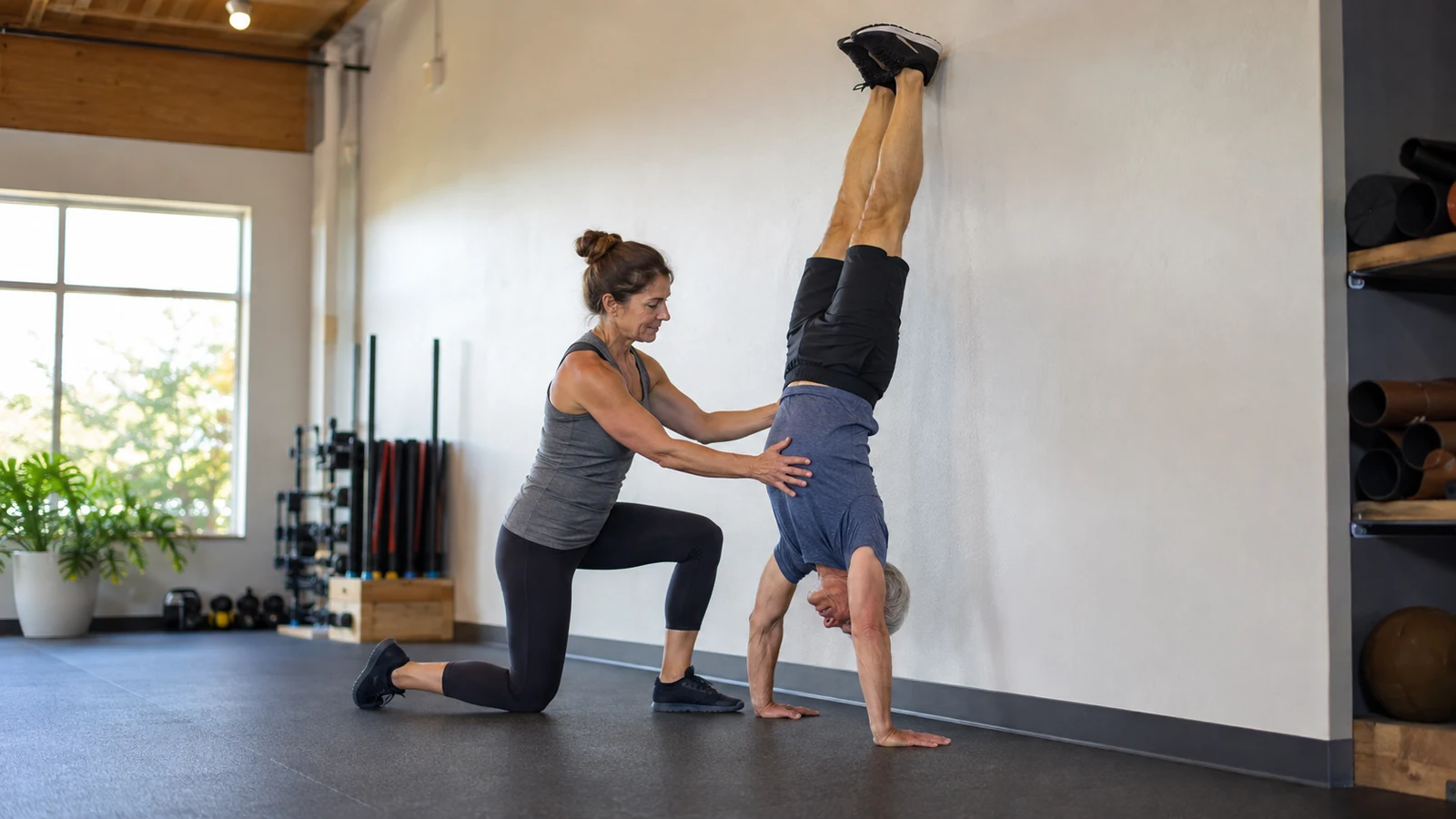
A wall supported handstand lets the shoulders and core learn the position without asking the balance system to solve everything at once.
Step 3: Train the kick up separately from the hold.
Controlled, slow entries reduce the risk of an uncontrolled fall compared with a fast, committed kick.
Step 4: Add short freestanding attempts only once the wall version feels stable.
A few seconds at a time is a reasonable early target, not a full 15 second hold.
Step 5: Train balance on the ground too.
Single leg stands, tandem walking, and general proprioceptive work carry over to the handstand and support everyday stability at the same time.
Step 6: Progress by weeks, not days.
Budline’s own record took decades to build.
Guinness’s own listing describes daily practice sustained over half a century, not a rapid ramp up.
Older adults exploring balance focused training for the first time may find a more approachable starting point in what research actually shows about Pilates for older adults, which builds many of the same stability skills without the inversion.
Budline is far from the only later in life Guinness record in this space.
Edith Connor set her own Guinness record after starting strength training in her sixties, and DonnaJean Wilde set a push up world record at 59.
Both are proof that a late start does not lower the ceiling on what later life training can build.
For Budline, the handstand was never a performance. It was simply how his day started, and fifty years of that small daily habit is the actual foundation the record sits on.
Watch the Record
Guinness World Records filmed Budline’s verified attempt inside the mirrored gym where he trains.
You can see the record itself on the official Guinness World Records verification page.
Want more world records explained like this one? Subscribe to WorkoutHealthy Insider for practical explanations behind popular fitness claims.
References
Fragala, M. S., Cadore, E. L., Dorgo, S., Izquierdo, M., Kraemer, W. J., Peterson, M. D., & Ryan, E. D. (2019). Resistance training for older adults: Position statement from the National Strength and Conditioning Association. Journal of Strength and Conditioning Research, 33(8), 2019–2052. https://doi.org/10.1519/JSC.0000000000003230
Martonovich, N., Maman, D., Mahamid, A., Alfandari, L., & Behrbalk, E. (2025). The wrist as a weightbearing joint in adult handstand practitioners: A cross-sectional survey of chronic pain and training-related factors. Journal of Functional Morphology and Kinesiology, 10(4), Article 372. https://doi.org/10.3390/jfmk10040372
Oleksy, Ł., Mika, A., Sopa, M., Stolarczyk, A., Adamska, O., Zyznawska, J., Buryta, R., Ciepiela, P., Witkowski, J., & Kielnar, R. (2025). Proprioceptive control of muscle activation in aging: Implications for balance and fall risk. Biology, 14(6), Article 703. https://doi.org/10.3390/biology14060703
This article is for general information only and is not medical advice. If you have an injury, ongoing pain, or a medical condition, talk to a doctor or physical therapist before you change how you train or eat.