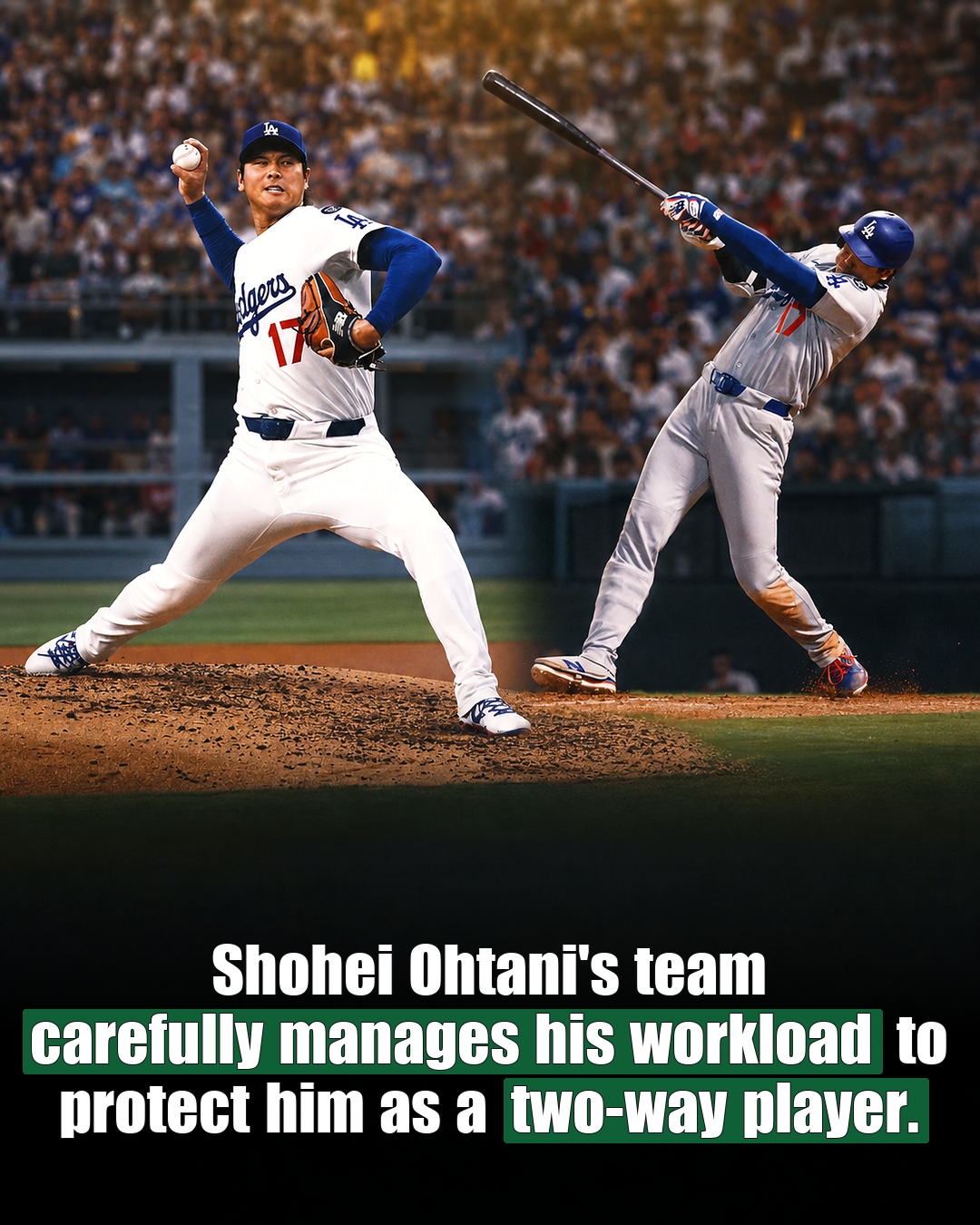

Shohei Ohtani is being asked to do something almost no other player in modern baseball is asked to do: pitch and hit at an elite level, in the same career, often in the same week.
That dual role puts unusual strain on his body, particularly his throwing arm and shoulder.
Managing that strain has become one of the more closely watched storylines in the sport, especially after Ohtani has already gone through two major elbow surgeries.
His workload is less a fixed formula than an ongoing, season by season adjustment, and it offers a real window into how elite athletes and their medical teams actually think about balancing performance against injury risk.
A Body Asked to Do Two Jobs at Once
Ohtani plays for the Los Angeles Dodgers as both a starting pitcher and one of the most productive hitters in the league, a combination that has not been attempted at this level of success since Babe Ruth roughly a century earlier.
Pitching puts repeated, high force stress on the elbow’s ulnar collateral ligament, the same ligament reconstructed in Tommy John surgery.
Hitting adds its own volume of swings, at bats, and travel on top of that.
Ohtani underwent his first Tommy John surgery in 2018, early in his major league career.
In September 2023, he had a second elbow surgery, this time performed by Dr. Neal ElAttrache, after tearing the ligament again.
He did not pitch at all during the 2024 season, playing only as a designated hitter while his elbow recovered.
That year, he still helped lead the Dodgers to a World Series title, hitting at an MVP level without throwing a single competitive pitch.
The Careful Return to Pitching
Ohtani returned to the mound in 2025, more than a year and a half after his second surgery.
His first pitching appearance as a Dodger came in June 2025 against San Diego, a single inning of work rather than a full start.
His innings and pitch counts built up gradually from there over the course of the season, rather than jumping straight back to a normal starter’s workload.
By late August 2025 he was working closer to a full starter’s role, including a five inning, nine strikeout outing against Cincinnati that August.
He continued as both a pitcher and a full time hitter through the rest of that season, helping the Dodgers win a second consecutive World Series and taking home his second straight unanimous National League MVP award.
The 2026 season has continued to build on that return.
Through mid season he carried an ERA under 2.00 across 14 starts, a strong number that suggests his stuff has come back at a high level, alongside continued, deliberate management of exactly how much he pitches.
That management has not meant a completely uninterrupted schedule.
Reports in late August 2026 pointed to some uncertainty around an upcoming start, a reminder that even a carefully built plan for a two way player gets adjusted in real time, not locked in at the start of a season.
Why This Is So Hard to Plan Around
Coaches and team medical staff have described the balancing act as an ongoing adjustment rather than a fixed formula, and the description fits what the underlying science says about pitching injuries.
A ten year prospective study following youth pitchers found that pitch count and the amount of fatigue a pitcher reported during an outing were both strongly linked to serious arm injury risk, including elbow injuries that required surgery.
Pitchers who reported pitching while fatigued had a significantly higher risk of injury than pitchers who stopped before fatigue set in (Fleisig et al., 2011).
That research was built on youth pitchers, not major leaguers, but the underlying mechanism, cumulative stress on the elbow ligament building up with volume and fatigue, does not disappear with age or skill level.
It is one of the reasons teams increasingly manage even healthy major league pitchers with pitch limits and rest schedules rather than letting them throw as much as they feel able to.
For a player recovering from two prior UCL reconstructions, that kind of careful, incremental buildup is not just a performance strategy.
It is directly tied to protecting a surgically repaired ligament from failing a third time.
What the Evidence Says About Coming Back From Elbow Surgery
Ohtani’s situation, a second UCL reconstruction in a major league pitcher, is well studied territory, even if two way players are rare.
A study of major league pitchers who underwent Tommy John surgery found that the large majority returned to pitch in the majors again, with a return to play rate above 80 percent among the pitchers studied.
The same research found that performance after surgery, measured by standard pitching statistics, was broadly comparable to performance before the injury for most pitchers who did return (Erickson et al., 2014).
That is a genuinely encouraging body of evidence for pitchers recovering from this specific injury.
It also comes with an important caveat: that research looked at pitchers recovering from a first surgery, and outcomes after a second reconstruction, like Ohtani’s, are generally understood in sports medicine to carry more uncertainty and a longer, more cautious recovery timeline.
That gap in the research is part of why Ohtani’s medical team has leaned toward a slower, more conservative buildup than a typical first time return, even as his results on the field have looked close to his pre-surgery form.
What This Evidence Does Not Prove
The youth pitching research does not prove exactly how much a major league pitcher like Ohtani can safely throw in a given week or season.
Fleisig’s study tracked youth pitchers, whose bodies, mechanics, and workloads differ in real ways from a fully grown professional, so the specific pitch count thresholds from that research do not translate directly to Ohtani’s situation.
What does translate is the broader mechanism, fatigue and cumulative volume raising injury risk, which shows up across age groups and skill levels in the wider sports medicine literature.
The Tommy John return to play research has a similar gap.
Erickson’s study looked at pitchers recovering from a first UCL reconstruction, and Ohtani’s second surgery puts him in a less studied, generally higher risk category that the existing published research does not describe in as much detail.
Public reporting on his current workload also has real limits, since teams do not usually disclose the full detail of a player’s internal medical and training plan.
What is publicly known, gradual innings buildup and continued caution even as performance has looked strong, is consistent with sound sports medicine practice, even without access to the full picture his medical team is working from.
How This Compares to General Guidance
Almost nobody reading this is managing a major league throwing workload, but the underlying principles apply to anyone returning to a demanding physical activity after a significant injury or surgery.
General sports medicine guidance consistently recommends a gradual, staged return to full activity after any ligament reconstruction, rather than jumping back to a previous training volume all at once.
Pain and fatigue are treated as real signals to slow down, not obstacles to push through.
The bigger, more universal lesson from Ohtani’s situation is that workload management is not a one time decision made at the start of a comeback.
It is an ongoing process that gets adjusted as new information comes in, the same pattern any recreational athlete recovering from a joint injury should expect to follow with their own care team.
Who Should Talk to a Doctor First
Anyone recovering from a ligament reconstruction, including a Tommy John procedure, an ACL repair, or a similar joint surgery, should follow a structured, medically supervised return to play program rather than self directed rehab.
Anyone experiencing recurring pain, instability, or swelling in a joint that has previously been surgically repaired should see a doctor promptly, since these can be early signs of a new injury rather than normal soreness.
Overhead throwing athletes at any level, including recreational and youth players, who notice consistent arm fatigue, discomfort, or a drop in performance during a season should be evaluated by a sports medicine doctor before continuing to play through it, given how strongly fatigue is linked to serious arm injury in the research above.
Anyone considering a return to high demand physical activity after any major surgery should have a clear, staged plan built with their surgeon or physical therapist, rather than a self set timeline based on how they feel on a given day.
A Practical Look at Managing a Comeback From Injury
Build the return in phases with defined milestones, not a single return date.
Ohtani’s 2025 comeback moved from a single inning to a full workload over months, not weeks.
Track fatigue and effort level, not just pain.
The research above links reported fatigue during pitching, not just pain, to elevated injury risk, which means effort level deserves attention even on days that do not hurt.
Expect the plan to change.
Coaches and medical staff managing Ohtani’s workload have described it as a continuous adjustment, and the same flexibility matters for anyone rebuilding capacity after a joint injury.
Separate performance goals from health goals during the early stages of a comeback.
Ohtani’s return prioritized building volume safely before chasing his prior performance level, similar to other well documented athletic comebacks built around patience rather than urgency.
Work with a full care team rather than going it alone.
Surgeons, physical therapists, and strength coaches each play a different role in a safe return, a team based approach that shows up across major recoveries, including other athletes rebuilding after major joint surgery.
References
Fleisig, G. S., Andrews, J. R., Cutter, G. R., Weber, A., Loftice, J., McMichael, C., Hassell, N., & Lyman, S. (2011). Risk of serious injury for young baseball pitchers: A 10-year prospective study. The American Journal of Sports Medicine, 39(2), 253-257.
Erickson, B. J., Gupta, A. K., Harris, J. D., Bush-Joseph, C., Bach, B. R., Abrams, G. D., San Juan, A. M., Cole, B. J., & Romeo, A. A. (2014). Rate of return to pitching and performance after Tommy John surgery in Major League Baseball pitchers. The American Journal of Sports Medicine, 42(3), 536-543.
This article is for general educational purposes and is not a substitute for personalized medical advice. Anyone recovering from a joint surgery or managing a throwing related injury should work directly with a qualified surgeon, physical therapist, or sports medicine doctor.