
Jeremy Allen White plays a chef who is barely holding it together.
Off screen, White’s own body has become part of the conversation around The Bear.
Fans and fitness outlets have spent two seasons speculating about how the actor stays so lean while playing a character who survives on stress and espresso.
Some of that speculation has settled on boxing style conditioning as the explanation.
Here is what is actually confirmed about White, his physique, and the training question everyone keeps asking.
Who Jeremy Allen White Is Right Now
White is best known for playing Carmy Berzatto on FX’s The Bear, a role that has won him back to back Primetime Emmy Awards.
He built an earlier following as Lip Gallagher on Shameless, a role he held for eleven seasons.
His career has expanded well beyond both shows recently.
In 2025 he starred as Bruce Springsteen in the film Deliver Me From Nowhere, taking vocal lessons and learning guitar for the part.
He has projects lined up through 2026, including voicing a character in The Mandalorian and Grogu and playing a journalist in Aaron Sorkin’s The Social Reckoning.
He is also set to appear in the A24 thriller Enemies alongside Austin Butler.
None of that explains the physique chatter on its own. That started with The Bear.
The Physique That Started the Conversation
Carmy is written as a chef, not an athlete.
Even so, White’s lean, visibly conditioned frame on the show became a recurring talking point in entertainment and fitness coverage during the second and third seasons.
A widely shared Men’s Health roundup of celebrity workouts specifically named White and pointed to boxing style conditioning as the likely explanation for his look.
That framing has repeated across social media and fan discussion ever since.
The specific workout details in that report could not be independently confirmed for this article.
What we can confirm, from White’s own documented history, is a different but very real physical transformation project.
The Transformation We Could Actually Verify
In 2023, White played wrestler Kerry Von Erich in The Iron Claw, a biographical drama about the Von Erich wrestling family.
To prepare, White trained directly with former WWE wrestler Chavo Guerrero, who worked with the cast as the film’s wrestling consultant.
The production required the actors to perform full length wrestling matches in front of a live audience, shot in single takes.
Kerry Von Erich’s own brother, Kevin Von Erich, later praised the cast’s preparation, saying the work was “a lot more difficult than it looks” and that the actors handled it well.
That is a documented case of White undergoing serious, sport specific physical training for a role.
It is a different project from The Bear, built around wrestling movement rather than boxing, but it shows the same pattern fitness outlets have picked up on with his lean look on the FX show.
For his cooking scenes in The Bear, White’s real preparation was culinary, not athletic. He and co-star Ayo Edebiri both attended classes at the Institute of Culinary Education to learn real kitchen technique before filming.
Why Boxing Style Training Produces That Kind of Look
Whether or not boxing specifically was White’s method, the style of training fitness writers keep pointing to has a real physiological basis worth explaining.
Boxing conditioning typically combines short, intense rounds of punching, footwork, and bodyweight work with brief rest periods, repeated over and over.
That structure is a form of high intensity interval training, often shortened to HIIT.
HIIT sessions ask the body to work near its limit for a short burst, recover briefly, then repeat.
Because the intensity stays high and rest stays short, the total workout can be shorter than a traditional steady pace cardio session while still demanding a lot from the cardiovascular system.
That combination tends to favor a lean, conditioned look rather than a heavily bulked one, since the training emphasizes output and endurance over maximal load.
What the Research Says About This Style of Training
A 2014 systematic review and meta-analysis published in the British Journal of Sports Medicine compared high intensity interval training against standard moderate intensity continuous training.
The researchers, led by Kassia Weston, found that HIIT nearly doubled the improvement in cardiorespiratory fitness compared with steady state training over similar study periods.
That review focused on people managing lifestyle related health conditions, not actors preparing for a role, so its findings describe a specific population rather than everyone.
Still, the underlying mechanism applies broadly. Pushing the heart and lungs repeatedly to a high effort level, even in short bursts, is an efficient way to build cardiovascular fitness.
Boxing training layers footwork, hand speed, and core rotation on top of that cardiovascular demand.
That combination works a large number of muscle groups across a single session, which can support a lean, evenly conditioned appearance over time when paired with consistent training and reasonable nutrition.
A lean, conditioned look usually reflects consistent effort and structure over months, not one dramatic workout secret.
What White Has and Has Not Said Publicly
White has talked openly in interviews about the physical demands of specific roles, including the wrestling training for The Iron Claw.
He has not given a detailed public breakdown of a boxing specific workout tied to The Bear, based on available interviews.
That gap matters. Much of the boxing framing appears to come from outside fitness commentary rather than White’s own description of his training.
That distinction matters, since the boxing claim is not something White has confirmed himself.
It is entirely possible some form of circuit or combat inspired conditioning is part of his routine, since that style of training is common among actors preparing for physically demanding schedules.
Without a direct, on the record explanation from White, though, the honest answer is that the specific method remains unconfirmed.
How This Compares to General Fitness Guidance
A movie star’s training budget looks nothing like most people’s daily schedule.
Actors preparing for a physically demanding role often have hours a day, a private trainer, and a nutritionist on call.
Most people do not have that kind of time or support, and they do not need it to see real benefits from this style of training.
Federal physical activity guidelines in the United States recommend adults get at least 150 minutes of moderate intensity activity a week, or 75 minutes of vigorous activity, along with two days of strength training.
A boxing style circuit, done two or three times a week, can realistically fit inside that general recommendation.
The lesson from White’s situation is not that everyone needs a Hollywood level commitment.
It is that a structured, intense, and consistent routine, even a modest one, tends to outperform sporadic, unstructured workouts over time.
What This Evidence Does Not Prove
None of this research proves that Jeremy Allen White specifically trained with boxing for The Bear.
It also does not prove that boxing training alone can produce any specific actor’s exact physique.
Body composition depends on genetics, nutrition, sleep, stress, and total training volume, not just one style of cardio.
The HIIT research cited here studied cardiorespiratory fitness outcomes, not muscle definition or body fat percentage directly.
Improved fitness and a leaner appearance often travel together, but they are not the same measurement.
Anyone hoping to look like a specific actor should treat that as motivation, not a guarantee tied to one workout style.
Common Mistakes People Make Chasing This Look
People often assume boxing workouts alone will produce dramatic body changes within weeks.
Real conditioning changes typically take months of consistent training, not days.
Another common mistake is skipping proper instruction on punching form and footwork.
Poor mechanics in boxing drills can strain the shoulders, wrists, and lower back, especially for beginners moving quickly through combinations.
Some people also drop strength training entirely once they start boxing style cardio.
That trade-off can leave muscle mass behind over time, since interval cardio alone does not provide the same stimulus as resistance training.
Nutrition gets overlooked too. A lean, conditioned look depends heavily on consistent eating habits, not just the workout itself.
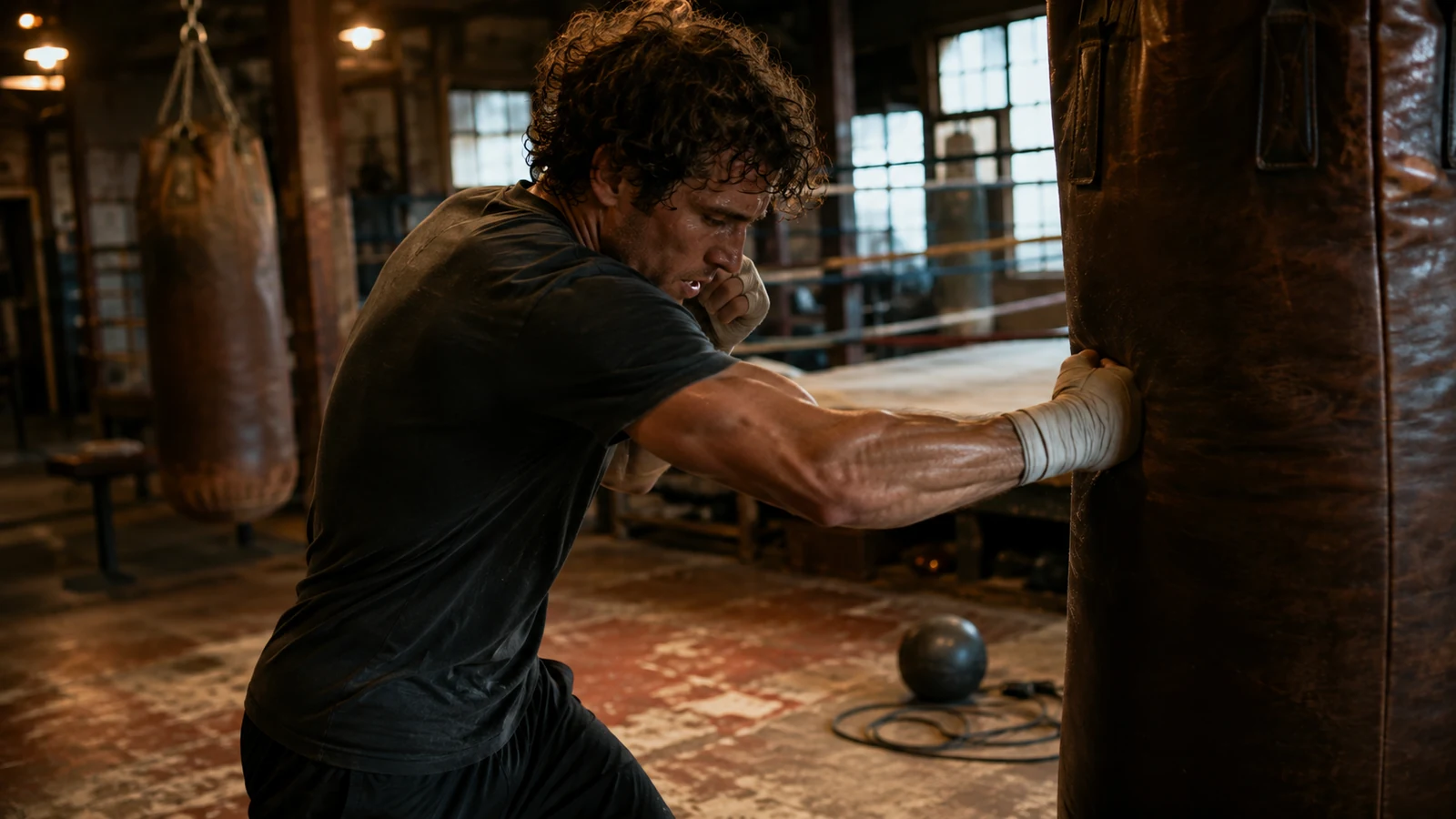
How to Try a Boxing Inspired Circuit Yourself
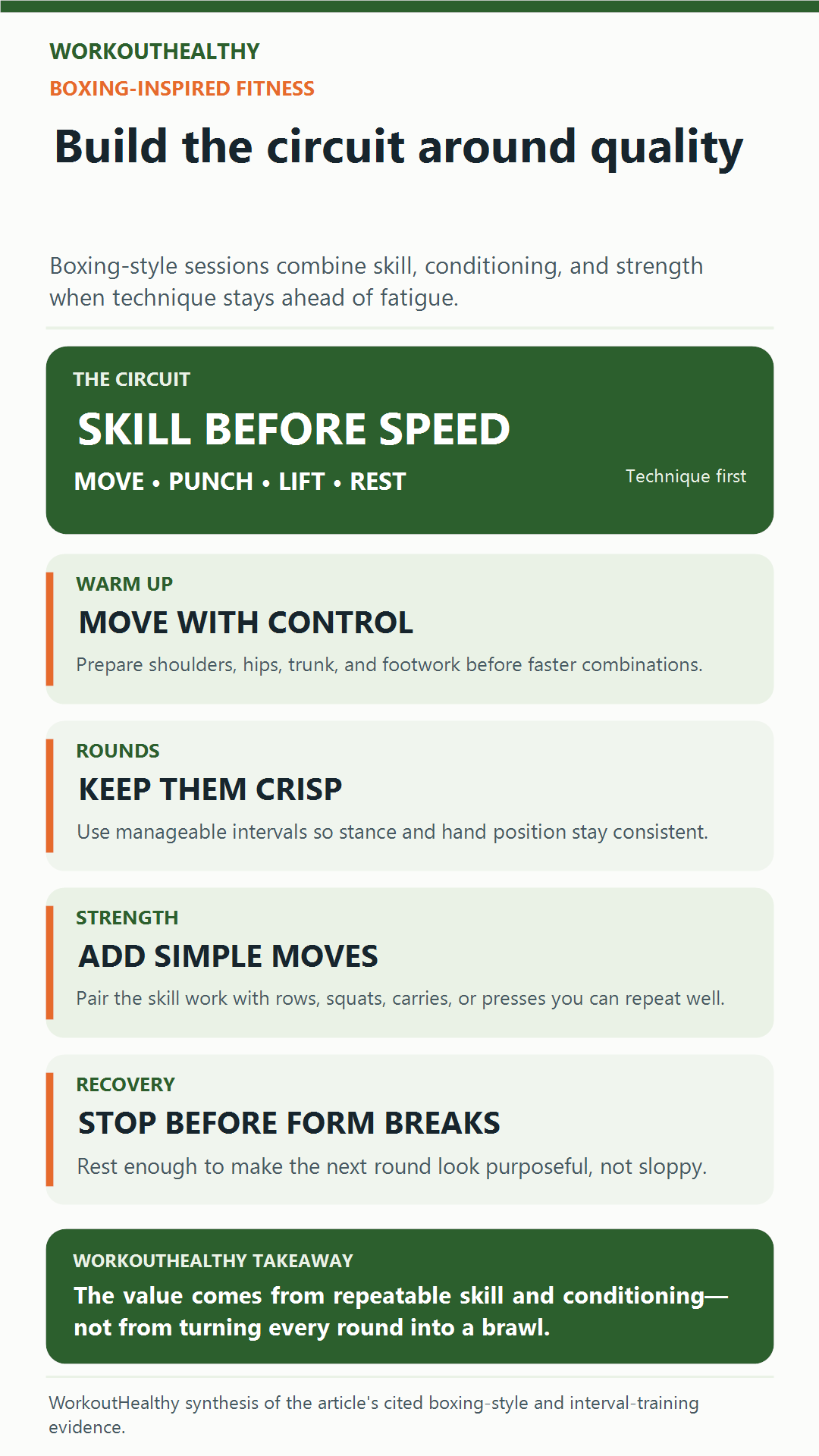
Start with a proper warm-up that includes light cardio and dynamic stretching for the shoulders and hips.
Learn basic punches, like the jab and cross, from a qualified coach or a reputable instructional source before adding speed.
Structure a session around short work intervals, such as two or three minutes of shadowboxing or bag work, followed by one minute of rest.
Repeat that pattern for six to ten rounds, depending on your current fitness level.
Add bodyweight strength moves between some rounds, like push ups, squats, or mountain climbers, to build muscular endurance alongside conditioning.
Keep two or three dedicated strength training sessions each week separate from boxing conditioning, so muscle mass does not get neglected.
Prioritize sleep and a steady, protein forward diet, since recovery and nutrition drive body composition changes more than any single workout style.
Progress gradually. Add rounds or intensity only after your current routine feels manageable, not exhausting by the final round.
Our breakdown of whether box jumps can build muscle covers a related question about how explosive, athletic training styles affect body composition.
If boxing style cardio interests you but you are new to structured training, our guide on deciding whether you need a personal trainer can help you figure out whether in-person coaching is worth it for learning proper form.
George Foreman’s own return to competitive boxing decades after retiring, which we cover in our fact check of his comeback training, is a useful reminder that boxing conditioning can be adapted at very different ages and fitness levels.
References
Weston, K. S., Wisløff, U., & Coombes, J. S. (2014). High-intensity interval training in patients with lifestyle-induced cardiometabolic disease: a systematic review and meta-analysis. British Journal of Sports Medicine, 48(16), 1227 to 1234. https://doi.org/10.1136/bjsports-2013-092576
Men’s Health. Best Celebrity Workouts collection (referenced for the boxing-style training claim discussed in this article; the outlet’s original article could not be independently re-accessed at the time of writing).
Wikipedia contributors. Jeremy Allen White. Retrieved 2026 from en.wikipedia.org.
This article is for general information only and is not medical or fitness advice. Details about Jeremy Allen White’s personal training methods are based on public reporting and could not all be independently verified. Talk to a qualified coach or your doctor before starting a new exercise program, especially a high intensity style like boxing conditioning.