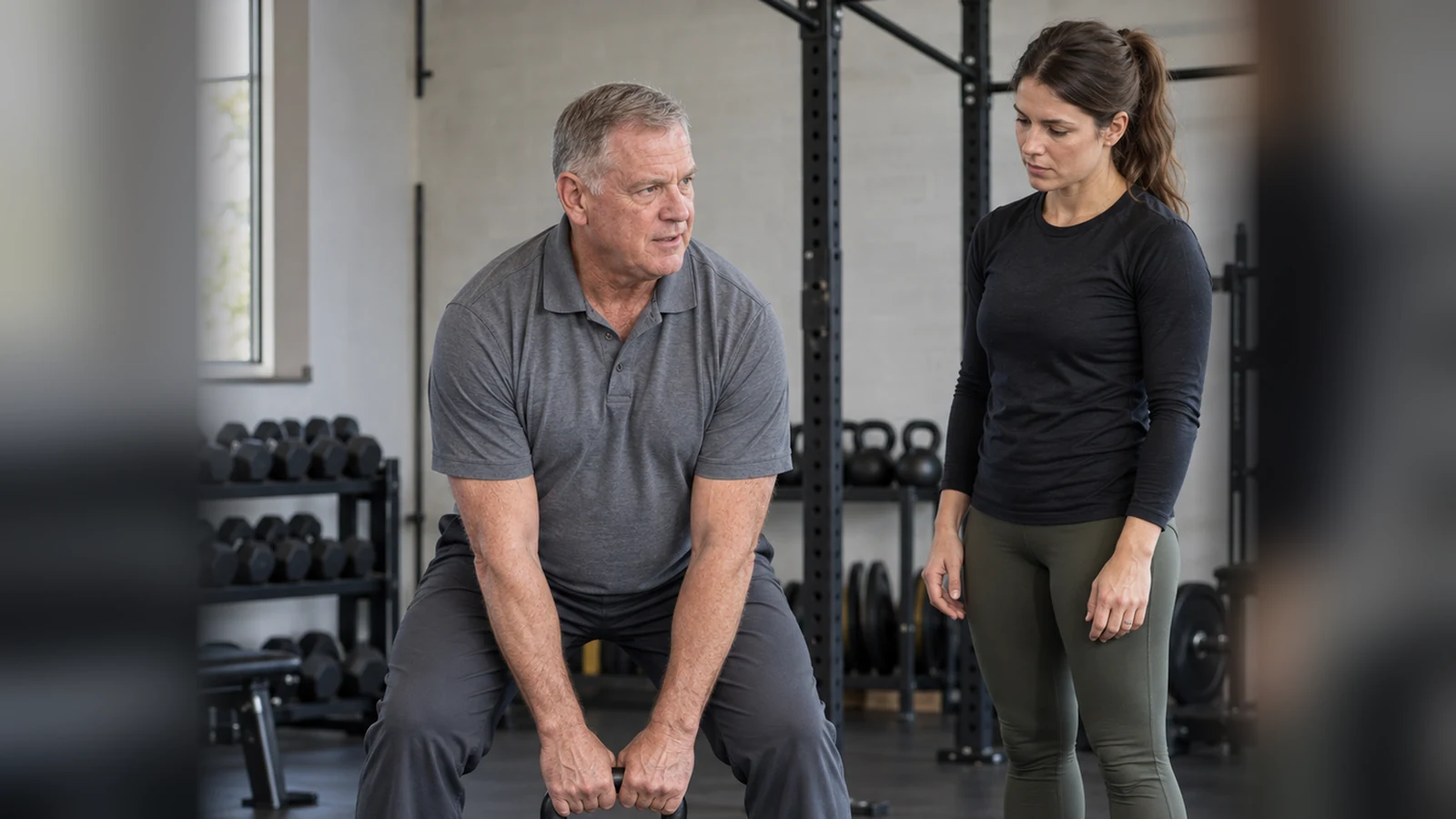

A strength workout does not have to be long, loud, or exhausting to work.
That is the core of Easy Strength, a 2011 book from Dragon Door Publications linked to strength coaches Dan John and Pavel Tsatsouline.
A popular post says the approach proves busy people can get stronger with less volume if every rep stays high quality.
That is close, but the details are worth getting right.
What the Program Actually Asks
Dan John has described the method in his own writing, including a Medium article called “Even Easier Strength.”
You pick five lifts and do them every workout.
The main rule is blunt: “Never miss a rep, in fact, never even get close to struggling.”
He also describes a “Rule of Ten” for full body lifts, which limits total reps per lift in a session.
The five lifts are usually drawn from basic patterns: press, pull, hinge, squat, and loaded carry.
Members of the StrongFirst forum summarize a common version as two sets of five, five days a week, for about 40 days.
They also stress that the whole thing is meant to feel easy.
Where the Idea Came From
Dan John writes that the program grew out of Pavel’s “40 Day Workout” challenge.
He says he tried it himself and broke his incline bench press record on the 22nd workout.
That is one lifter’s report, not a controlled study, but it shows why the method caught on.
Was It Built for Busy People?
This is where the popular version stretches things.
The book’s full title is Easy Strength: How to Get a Lot Stronger Than Your Competition, and Dominate in Your Sport.
That points mainly at athletes who already spend lots of time on their sport.
For them, strength work has to fit around practice without draining them.
We could not confirm that the program was designed specifically for busy people.
Still, the same logic fits anyone with a tight schedule. Short sessions that leave you fresh are easier to repeat.
The best short workout is the one you finish feeling like you could do it again tomorrow.
Why Easy Reps Can Still Build Strength
Strength is partly a skill.
Your nervous system learns to recruit muscle and move a load more smoothly with repeated practice.
Clean, repeatable reps give it lots of good examples to learn from.
Easy sessions also leave you fresh for the next day, so you can practice again soon.
A brutal workout can feel productive. Yet if it leaves you sore for days, you may train less often.
The Easy Strength approach trades that big single effort for many small, steady ones.
What Research Says About Low Volume and Frequency
A 2020 review by Patroklos Androulakis-Korakakis and colleagues asked how little training trained men need to gain strength.
It found that a single set done one to three times per week was enough to raise one rep max strength.
Across five studies in the meta-analysis, one rep max rose by about 12 kilograms overall.
Squat gains averaged about 17.5 kilograms, and bench press gains about 8.3 kilograms.
The authors pointed to one set of 6 to 12 reps at roughly 70 to 85 percent of max, two to three times a week.
Their protocol used hard effort, which is different from the easy feel of Dan John’s plan.
But it shows that big time investments are not required to get stronger.
Easy Strength spreads a small amount of work across many days.
A 2018 meta-analysis by Jozo Grgic and colleagues looked at 22 studies on training frequency and strength.
Higher frequencies were linked to greater strength gains overall.
But when total volume was equal, frequency itself did not make a significant difference.
In other words, frequent sessions help mostly because they let you do more total quality work.
That fits the Easy Strength idea of many short, crisp practice sessions.
What This Does Not Prove
No study we found tested the Easy Strength program itself.
The research supports low volume and frequent practice in general, not this exact template.
Results also vary by person. One StrongFirst forum member wrote that their strength “went backwards every time.”
And the review on minimal doses studied trained men, so it tells us less about women and beginners.
How to Use the Idea on a Busy Schedule
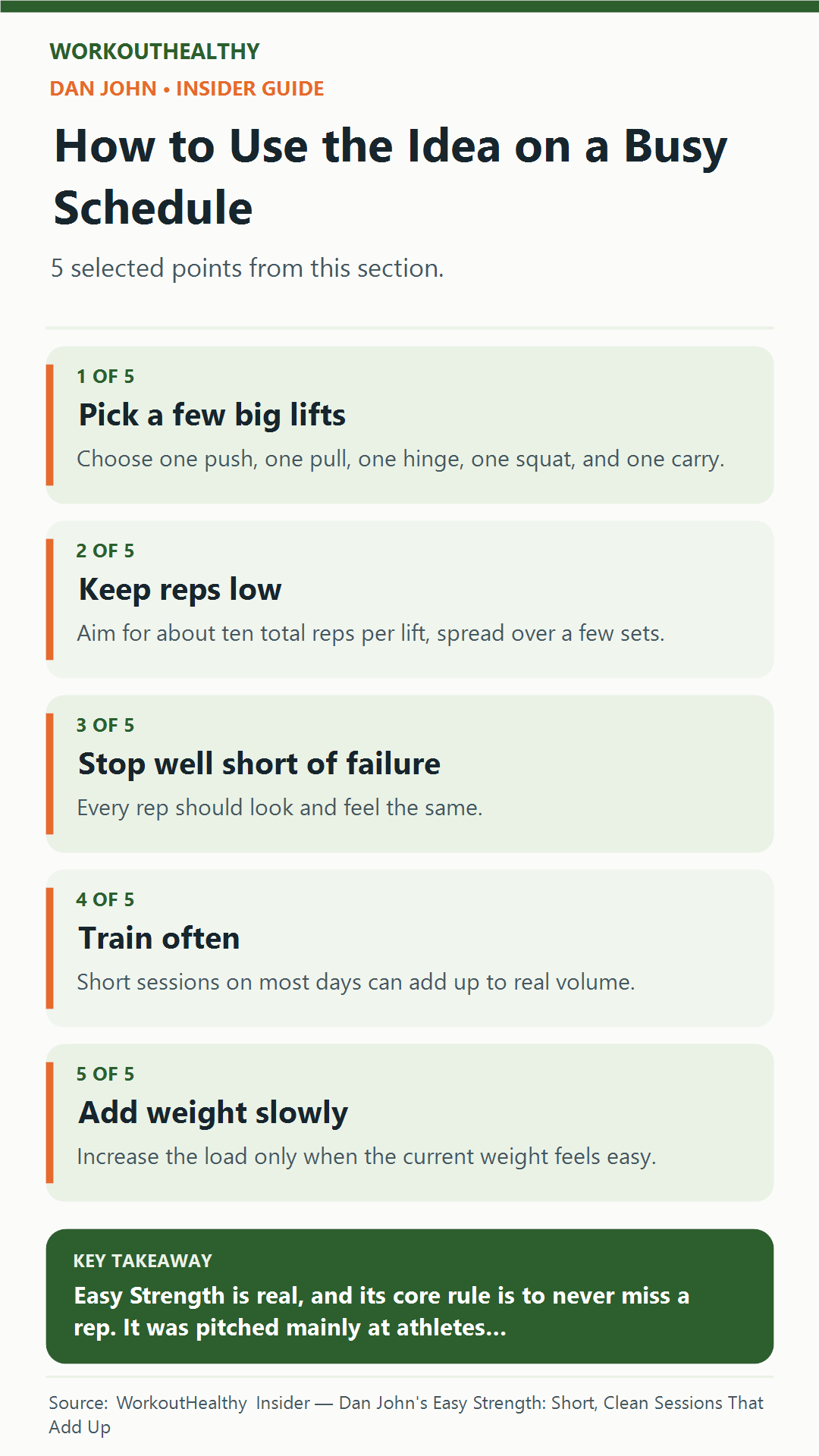
- Pick a few big lifts. Choose one push, one pull, one hinge, one squat, and one carry.
- Keep reps low. Aim for about ten total reps per lift, spread over a few sets.
- Stop well short of failure. Every rep should look and feel the same.
- Train often. Short sessions on most days can add up to real volume.
- Add weight slowly. Increase the load only when the current weight feels easy.
- Take breaks. After a few weeks, test your lifts and then rest or change the plan.
For more ideas on staying strong with little time or gear, see how to keep your strength while traveling.
And if you are over 40, our strength plan for your 40s covers smart lift choices.
Common Mistakes
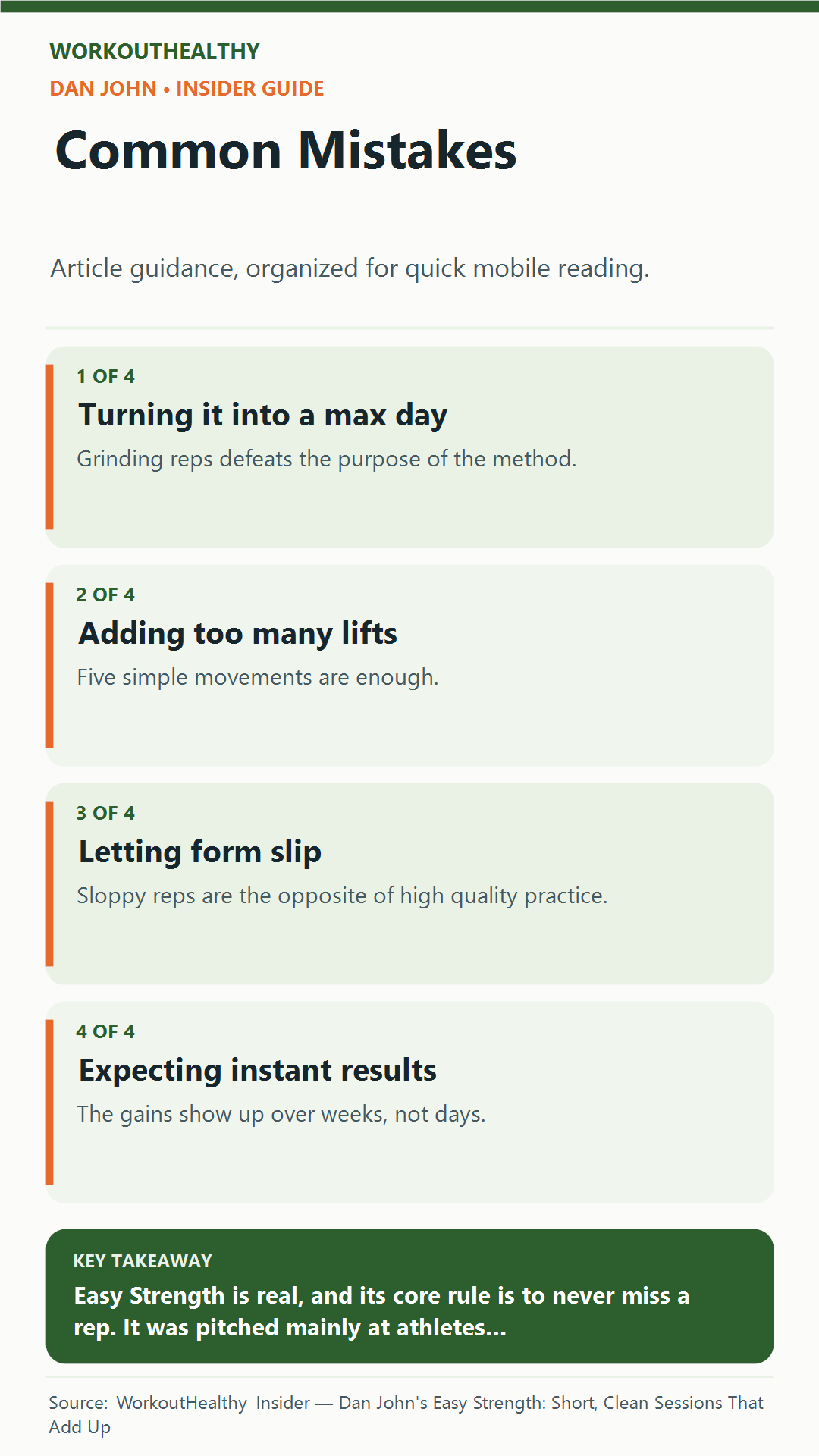
- Turning it into a max day. Grinding reps defeats the purpose of the method.
- Adding too many lifts. Five simple movements are enough.
- Letting form slip. Sloppy reps are the opposite of high quality practice.
- Expecting instant results. The gains show up over weeks, not days.
Who Should Be Careful
Lifting most days can bother sore joints if the lifts never change.
People new to barbells should learn technique with a qualified coach first.
If you have high blood pressure, heart disease, or an old injury, check with your doctor before starting.
The Bottom Line
Easy Strength is real, and its core rule is to never miss a rep.
It was pitched mainly at athletes, but its short, crisp sessions suit busy people too.
Research backs the idea that small doses and frequent practice can build strength.
Keep your reps clean, your sessions short, and your progress steady.
Want more stories like this? Subscribe to WorkoutHealthy Insider for practical explanations behind popular fitness claims.
References
- Androulakis-Korakakis, P., Fisher, J. P., & Steele, J. (2020). The minimum effective training dose required to increase 1RM strength in resistance-trained men: A systematic review and meta-analysis. Sports Medicine, 50(4), 751 to 765. https://doi.org/10.1007/s40279-019-01236-0
- Grgic, J., Schoenfeld, B. J., Davies, T. B., Lazinica, B., Krieger, J. W., & Pedisic, Z. (2018). Effect of resistance training frequency on gains in muscular strength: A systematic review and meta-analysis. Sports Medicine, 48(5), 1207 to 1220. https://doi.org/10.1007/s40279-018-0872-x
- John, D. (n.d.). Even easier strength. Medium. https://medium.com/@danjohn84123/even-easier-strength-d7fc672eb9d
- John, D., & Tsatsouline, P. (2011). Easy strength: How to get a lot stronger than your competition, and dominate in your sport. Dragon Door Publications.
This article is for general information only and is not medical advice. If you have an injury, ongoing pain, or a medical condition, talk to a doctor or physical therapist before you change how you train or eat.