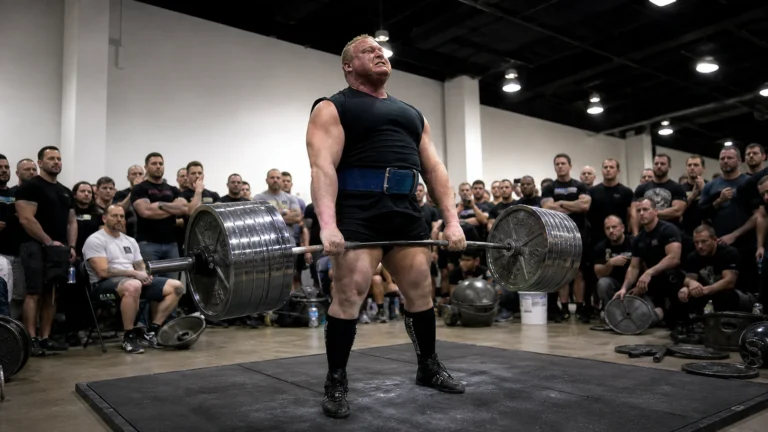
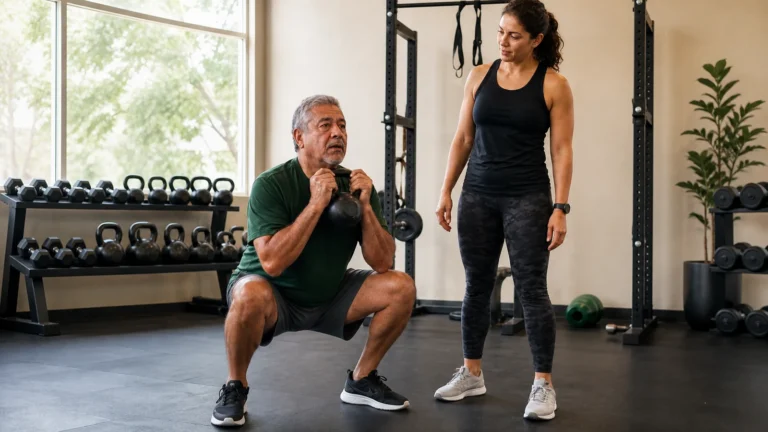
Keeping strength while you travel takes far less work than building it.
Research on reduced training suggests one hard session a week, sometimes a single set per exercise, can hold most of what you built for months.
So the goal on a trip is not to replicate your program. It is to keep effort high in a much smaller dose.
That one reframe changes how you use a hotel gym, a bare room, or a suitcase with no equipment in it.
Why is holding strength so much easier than building it?
Building strength requires progressive overload, which means the work has to keep getting harder over time.
Holding strength only requires that you keep reminding the body the current level is still needed.
The clearest test of that came from a study that trained young and older adults three days a week for 16 weeks, then cut them back for 32 weeks (Bickel et al., 2011).
Young adults who dropped to one session a week with a single set per exercise kept the strength and the muscle size they had gained.
The ones who dropped to one session a week with three sets per exercise actually kept adding a little fiber size.
Older adults did not hold their fiber size on the same reduced dose, but they did retain most of the strength.
A later review of the maintenance literature reached a similar conclusion from a different angle (Spiering et al., 2021).
Frequency and volume can fall a long way. Intensity is the variable that has to stay.
That is the entire travel strategy in one line: fewer sessions, fewer sets, same effort.
The word doing the work in that sentence is effort.
A reduced dose only maintains anything if the sets you keep are still taken close to the point where the reps get ugly.
Three easy circuits in a hotel room are not a smaller version of your program. They are a different activity that happens to make you sweat.
Worth naming one limit as well. Maintenance research is about strength and muscle size, not about skill in a specific barbell lift.
If you compete or you are chasing technique in a heavy squat or clean, expect the movement to feel foreign for a session or two even when the strength is still there.
The mistake people make on the road is not doing too little. It is doing a pile of easy work and calling it a workout.
How long can you go before anything actually slips?
Longer than most people assume.
A meta-analysis pooling 103 studies of training cessation found that declines in muscular performance only became statistically significant somewhere around the third to fourth week off (Bosquet et al., 2013).
Submaximal strength faded fastest in that analysis. Maximal power held up best.
Adults over 65 and previously untrained people lost more than trained recreational athletes did.
That gives you a rough map for how seriously to treat any given trip.
| Time away | What is realistically at risk | What to do about it |
|---|---|---|
| 2 to 7 days | Essentially nothing | Walk a lot, train only if it is convenient |
| 1 to 2 weeks | Very little strength, some conditioning feel | One or two short maintenance sessions |
| 3 to 6 weeks | Measurable strength decline begins | One hard session per week, treated as fixed |
| Over 6 weeks | Real losses, larger past 65 | Plan it as a training block, not a trip |
A long weekend needs no plan at all.
A three week assignment does.
What does a hotel gym usually actually have?
Most of them follow the same template, and knowing it in advance stops you improvising at six in the morning.
You can generally count on a treadmill or two, some kind of bike or elliptical, a mat, and a rack of fixed dumbbells.
The dumbbells are the whole story, and they usually stop well below what your normal working sets need.
Nicer properties sometimes add an adjustable bench, a cable stack, or a functional trainer.
You will almost never get a barbell, a squat rack, or a pull-up bar rated for a full-size adult hanging from it.
None of that is a problem once you accept that the light dumbbells are the tool and your job is to make them feel heavy.
Four adjustments do most of that work: raise the reps, slow the lowering phase, take the set closer to failure, and move to one limb at a time.
A pair of 30 pound dumbbells is a joke for a two leg squat and a genuinely hard set for a rear foot elevated split squat.
If there is no bench, press from the floor rather than skipping the press entirely.
Our breakdown of what changes between the floor press and the bench press covers the shorter bottom range and why the setup matters more than the number on the dumbbell.
If the room has a cable stack or a functional trainer, use it for the pulling work and let the dumbbells handle everything else.
Cables give you a real load number, which is the one thing bands and body weight cannot offer you.
Rows are the pattern most hotel gyms handle badly.
A single arm dumbbell row with your free hand braced on a bench, a chair, or the frame of a machine covers it well enough for a maintenance week.
How do you make bodyweight hard without adding load?
Four levers, and they stack on top of each other.
Tempo. Lower for three to four seconds on every single rep.
A push up set that used to take 20 seconds now takes 60, and the muscle spends three times as long producing force.
Pauses. Stop for two full seconds in the hardest position, then start again from a dead stop.
That removes the elastic rebound that makes bodyweight sets feel easier than they should.
One limb at a time. A split squat, a single leg hip hinge, or a staggered push up roughly doubles the load on the working side.
This is the biggest jump available to you without any equipment at all.
Range. Put your hands on two chairs so the chest can travel below them, or let the back knee drop farther in a split squat.
More range at the same body weight means more work per rep.
All four exist to get you to a genuinely hard set, not to pile up comfortable reps.
Stop one or two reps short of failure and the set counts. Stop at 20 easy reps and it mostly does not.
Be honest about where this approach runs out.
Pushing, squatting, and hinging are easy to make hard with body weight alone. Pulling is not, because you need something to hang from or pull against.
What is worth packing?
Almost nothing, which is the appeal.
One long loop band and one shorter light band cover the gap bodyweight leaves, which is horizontal and vertical pulling.
Together they weigh a few ounces and fold into a shoe.
Anchor them in a door hinge, around a bed leg, or under your own feet, and you have rows, pulldowns, presses, and lateral raises.
Bands have two real weaknesses and you should know both going in.
They give you no objective number, so you cannot tell whether this week was harder than last week.
Their resistance is also lightest exactly where a stretched muscle usually works hardest, at the bottom of the movement.
For a maintenance week, neither weakness matters much. For a two month posting, both do.
Suspension straps are the other reasonable option if you already own a pair, though a solid door is usually the only anchor a hotel room offers.
What does a 20 minute maintenance session look like?
This is the whole program for a trip.
Once a week holds most of what you have. Twice is comfortable insurance.
Alternate lower body and upper body so one rests while the other works, and keep rest to roughly 60 seconds.
| Order | Movement | Sets and reps | Effort target |
|---|---|---|---|
| 1 | Rear foot elevated split squat, back foot on the bed | 2 sets of 8 to 12 each leg | Stop 2 reps short of failure |
| 2 | Push up, feet elevated or hands on chairs | 2 sets of 8 to 15 | Lower for 3 seconds every rep |
| 3 | Single leg Romanian deadlift | 2 sets of 8 to 10 each leg | Slow and balanced, never rushed |
| 4 | Band row or single arm dumbbell row | 2 sets of 10 to 15 | Pause 1 second at the top |
| 5 | Overhead press, band or dumbbells | 2 sets of 8 to 12 | Stop 2 reps short of failure |
| 6 | Hard plank or hollow hold | 2 sets of 20 to 40 seconds | Stop when the low back gives way |
That is 12 hard sets across every major movement pattern.
It sits close to the reduced dose that held strength for 32 weeks in the maintenance research above, which is the point.
If the room is too small for all six, cut it to the first four and you still have a defensible session.
On the days you do not train, walking is the easiest win a trip hands you.
Cities push your step count up without any planning at all, and our piece on how many miles to walk in a day gives you a realistic number to aim at.
How do you restart when you get home?
Do not deload everything.
That is the most common mistake after a trip, and it quietly costs people two useful weeks.
Take your first session back at roughly 80 to 90 percent of the loads you last used, keep the same rep targets, and stop two reps short on every set.
If those sets move well, go straight back to your normal loads in the next session.
If they grind, repeat the reduced loads once and then carry on progressing.
Expect some soreness, and expect that soreness to mislead you.
After a week away, most of it comes from movements you simply did not perform, not from strength you lost.
Build one or two easier days into the first week back so the fatigue does not stack up.
Resist the urge to punish yourself for the time off with extra volume.
An unusually hard first week back tends to produce a sore, discouraging second week rather than faster progress.
Our look at what rest days actually do explains why that gap protects the quality of the next session instead of wasting it.
The one case that deserves a genuine ramp is a layoff longer than a month, especially past 65, where connective tissue and technique both need time to catch up.
A trip is only a setback if you treat the week you get back as a fresh start.
The bottom line
Travel does not cost you strength.
Believing you need your full program to keep it does, because that belief is what makes people skip the small session that would have been plenty.
One hard session a week, six movements, twenty minutes, effort kept high.
That is the whole job.
Get the next evidence check.
Five practical fitness stories worth your time, every Friday.
One email a week. No product pitches. Unsubscribe in one click.
References
Bickel, C. S., Cross, J. M., & Bamman, M. M. (2011). Exercise dosing to retain resistance training adaptations in young and older adults. Medicine & Science in Sports & Exercise, 43(7), 1177 to 1187. https://doi.org/10.1249/MSS.0b013e318207c15d
Bosquet, L., Berryman, N., Dupuy, O., Mekary, S., Arvisais, D., Bherer, L., & Mujika, I. (2013). Effect of training cessation on muscular performance: A meta-analysis. Scandinavian Journal of Medicine & Science in Sports, 23, e140 to e149. https://doi.org/10.1111/sms.12047
Spiering, B. A., Mujika, I., Sharp, M. A., & Foulis, S. A. (2021). Maintaining physical performance: The minimal dose of exercise needed to preserve endurance and strength over time. Journal of Strength and Conditioning Research, 35(5), 1449 to 1458. https://doi.org/10.1519/JSC.0000000000003964
Medical disclaimer: This article is for general information only and is not medical advice. If you have an injury, ongoing pain, or a medical condition, talk to a doctor or physical therapist before you change how you train or eat.