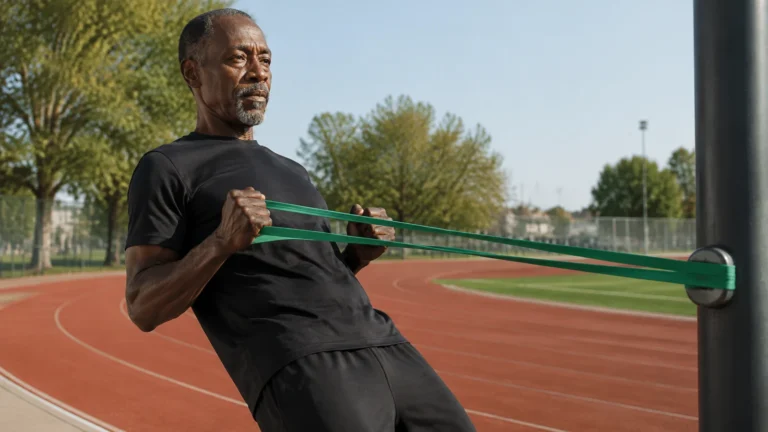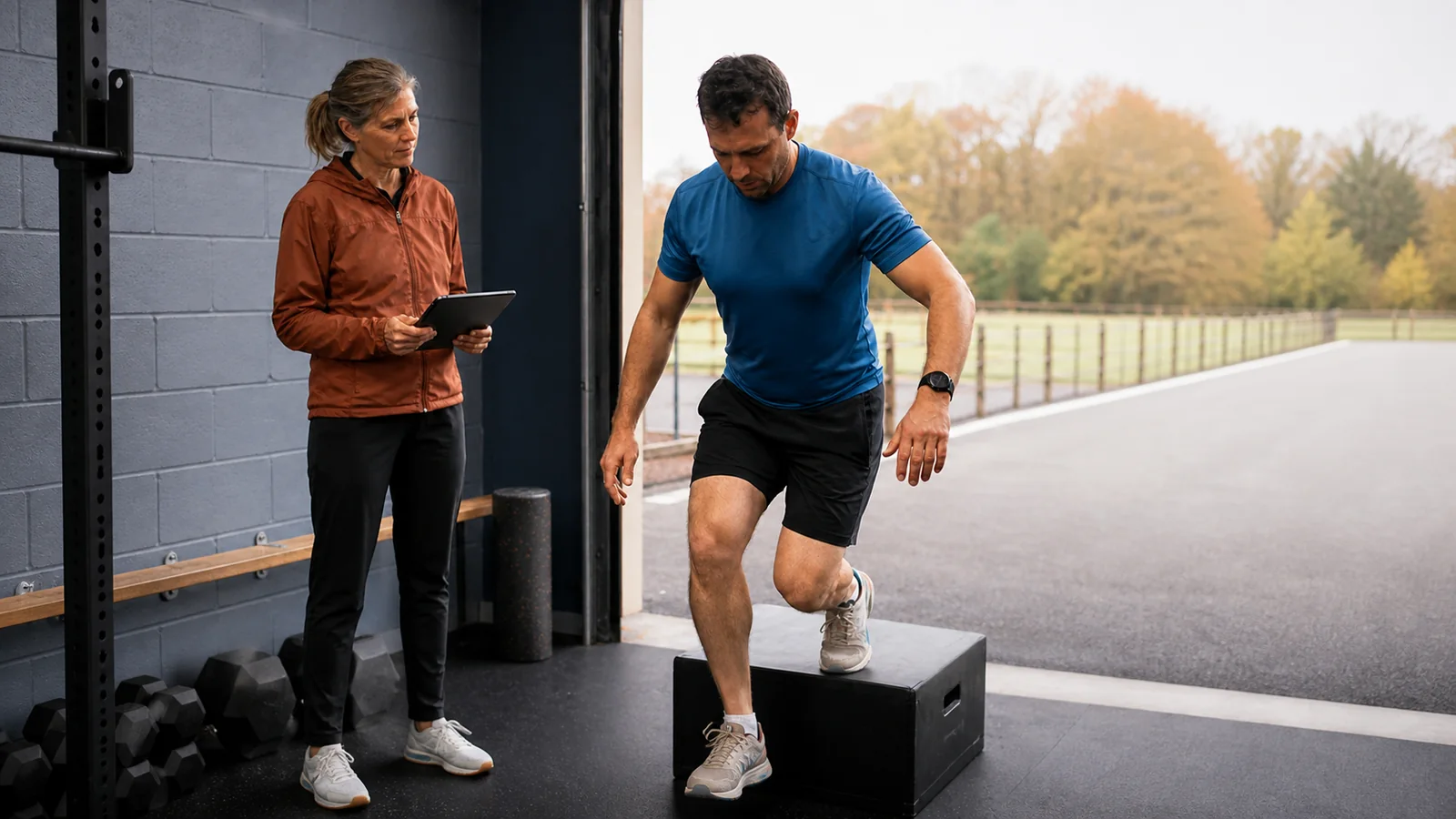

Most runners get hurt at some point.
Cyclists, swimmers, and triathletes are not far behind them.
Endurance sports rarely injure people the way a fall or a collision does.
Instead the damage builds up slowly, one training session at a time.
A YouTube channel called Givin It A Tri Endurance Coaching put out a video promising the ultimate guide to preventing these injuries.
We wanted to know what the actual research says, separate from any single coach’s opinion.
What the Video Claims
The video comes from Givin It A Tri Endurance Coaching, a channel built around triathlon, running, cycling, and swim training advice.
The channel describes itself as coaching for everyday endurance athletes who want to train smarter and stay consistent.
We could not find any published coaching certification, degree, or license listed on the channel’s public pages.
That does not make the advice wrong.
It means we treated the video as a starting point for research, not as a citable source on its own.
The video frames injury prevention around training load, recovery, and listening to early warning signs from the body.
That general framing lines up with sports medicine research.
We could not verify the specific numbers or examples used inside the video itself, so this article checks the underlying science instead.
What Real Research Shows About How Common These Injuries Really Are
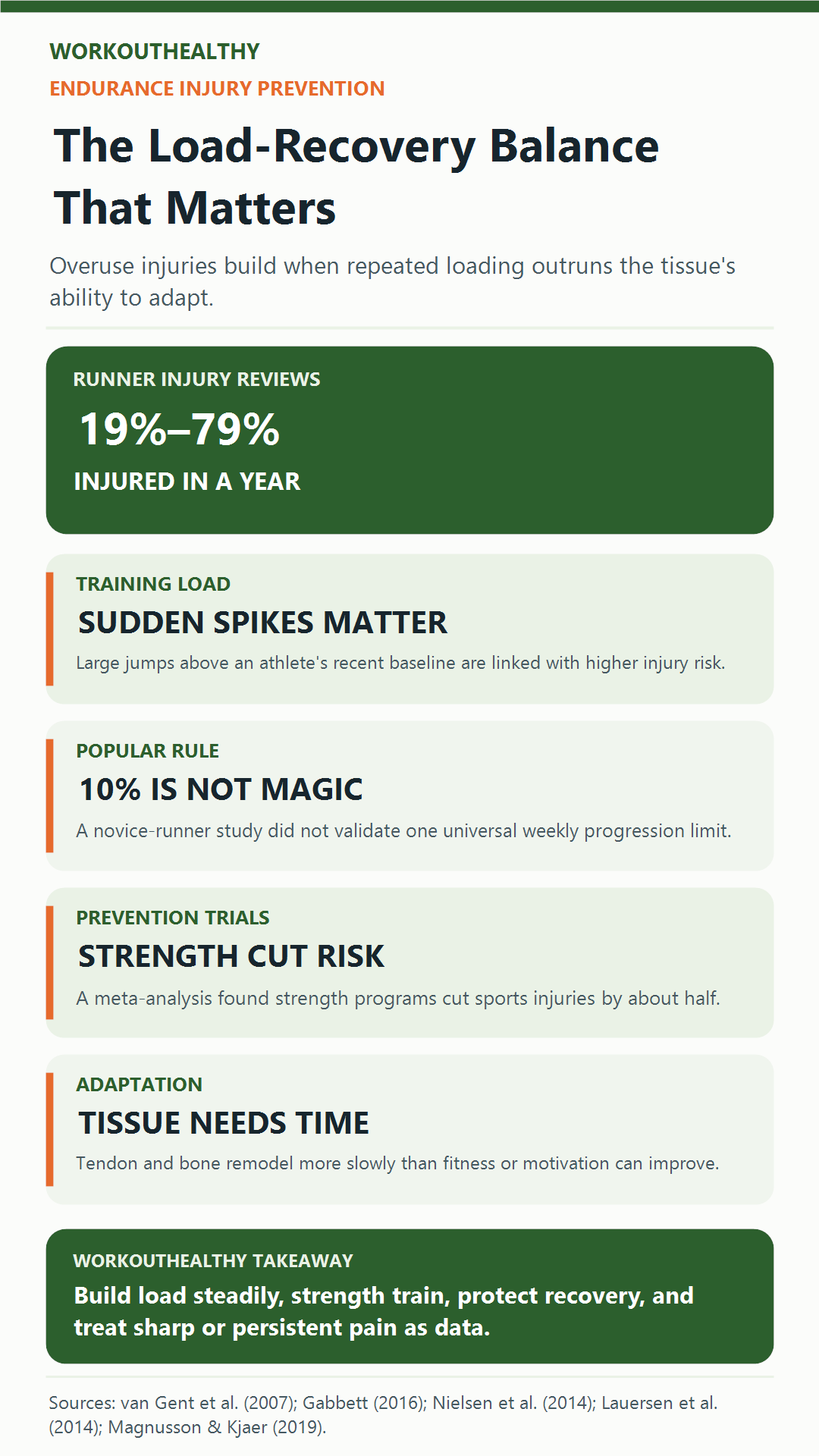
A systematic review of long distance runners found that anywhere from 19 percent to 79 percent of them get hurt in a given year (van Gent et al., 2007).
That is a huge range.
It exists because studies define injury differently and follow different types of runners over different lengths of time.
That wide range shows injury is a meaningful risk, not that it is inevitable for most endurance athletes.
The knee was the single most commonly injured area in that review.
Shin, Achilles tendon, and foot injuries followed close behind.
The review focused on lower-extremity running injuries; it should not be read as a precise breakdown of every crash or single-event injury.
They came from repeated loading that outpaced what the tissue could recover from.
What Real Research Shows About Training Load and Injury Risk
Sports scientist Tim Gabbett studied why the athletes who train hardest are not always the ones who get hurt most (Gabbett, 2016).
His 2016 paper argued that abrupt workload changes may be linked with injury risk, while a consistent training history may be protective in some settings.
Gabbett called this the training injury prevention paradox.
Athletes who build a large base of consistent training, then add load gradually, tend to get hurt less than athletes who jump around in volume.
A separate study on elite rugby players measured this with something called the acute to chronic workload ratio (Hulin et al., 2016).
That ratio compares one recent week of training to an athlete’s rolling average over the past month.
In that rugby cohort, a high recent-to-usual workload ratio was associated with greater injury risk. The ratio alone cannot reliably predict whether an individual endurance athlete will get hurt.
A training log is a context tool, not an injury forecast. A sudden increase is worth examining alongside symptoms, sleep, and the athlete’s history.
That idea, not any single magic number, is the part of workload research that has held up best over time.
What Real Research Shows About the 10 Percent Rule
Many runners have heard some version of the rule that says never raise weekly mileage by more than 10 percent.
Researchers actually tested this rule directly in novice runners preparing for a race (Nielsen et al., 2014).
Runners who followed a graded program built around something close to that 10 percent guideline still got injured at rates similar to runners who did not follow it.
The type of injury tracked more closely with individual factors than with the pace of the ramp up in that particular study.
That does not mean gradual progression is worthless.
It means the exact 10 percent figure is not a proven threshold, even though it gets repeated constantly as if it were.
What Real Research Shows About IT Band Syndrome
Iliotibial band syndrome is one of the most common overuse injuries in runners and cyclists.
A systematic review found that most cases stem from repeated bending and straightening of the knee under load, not from any single traumatic event (van der Worp et al., 2012).
Weak hip muscles, especially the ones that stabilize the pelvis while running, showed up repeatedly as a contributing factor.
Training errors, like sudden mileage increases or too much downhill running, also came up often across the studies reviewed.
The review found no single cause that explained every case.
Instead it painted a picture of several smaller factors stacking on top of each other until the tissue could not keep up anymore.
What Real Research Shows About Strength Training as Injury Prevention
A large meta-analysis pooled data from randomized controlled trials testing different injury prevention strategies (Lauersen et al., 2014).
Strength training programs were associated with a substantial reduction in sports injuries across the trials studied, though the pooled sports and programs varied (Lauersen et al., 2014).
Strength training beat stretching programs at preventing injury in that same analysis.
This matters for endurance athletes specifically, because running and cycling load muscles and tendons in a fairly narrow, repetitive pattern.
Strength work can load tissue in ways an endurance routine may not, but the pooled analysis does not prove the exact benefit for every individual runner or cyclist.
Readers who want the fuller picture on why lifting matters for a body built mostly through cardio can see our piece on what research actually shows about strength training’s wider benefits.
One WorkoutHealthy reader survey even found that most readers already favor weightlifting over running when asked to pick one.
Endurance athletes do not need to choose between the two.
The research suggests they need both.
The Mechanism
Tendons and bones are living tissue, and they adapt to load the same way muscle does.
A review of tendon physiology explains that healthy tendon responds to repeated loading by slowly increasing its own stiffness and strength (Magnusson & Kjaer, 2019).
The key word is slowly.
Tendon adapts far more slowly than muscle does, sometimes on a timescale of months instead of weeks.
Bone works on a similar principle.
Repeated impact triggers bone remodeling, where the skeleton lays down new bone along the lines of stress it experiences most (Warden et al., 2014).
That process takes time, and it briefly weakens bone before it strengthens it.
This is why a stress fracture often shows up during a period of rising training, not during the single hardest workout.
The bone is caught mid remodeling, weaker than it was before, right as the athlete asks more of it.
Overuse injury is usually a timing problem, not a toughness problem.
How to Use the Stress Bucket Without Treating It as a Formula
Picture training load, poor sleep, and life stress all drawing on a finite recovery budget. The bucket is a coaching analogy, not a clinical measurement or a proven prediction model.
A practical check asks what changed this week: mileage or intensity, hours of sleep, illness, work demands, or food intake. Persistent soreness, worsening pain, and declining performance call for a review of the plan rather than simply adding another recovery device.
Nutrition and hydration support ordinary training and recovery. Under-fueling can be especially important for bone stress injury risk, but drinking more water or buying a supplement does not neutralize a sudden load spike. Gentle mobility work may help someone move comfortably, yet it has not been shown here to prevent all endurance injuries.
Progressive plans should reflect current capacity, recent training history, symptoms, and upcoming demands. They can include easier weeks and changes in workload when life stress rises, without pretending one mileage number fits everyone.
A 2020 methodological critique of the acute-to-chronic workload ratio warns against turning that ratio into a universal injury threshold. Use the log as one input, not a stoplight that can clear someone with sharp or persistent pain (ACWR critique).
What This Evidence Does Not Prove
None of this research proves that any single athlete can avoid injury entirely by following a formula.
Genetics, prior injury history, sleep, stress, and even footwear all influence injury risk in ways researchers have not fully mapped.
The acute to chronic workload research also has real limits.
Most of the strongest workload studies come from team sports like rugby, not from solo endurance sports like triathlon or marathon running.
Applying those findings to a solo runner or cyclist is a reasonable extrapolation, not a proven, sport-specific rule.
The 10 percent rule study also only tested novice runners across a single season.
It does not tell us what happens to experienced athletes building toward an Ironman over several years.
Common Mistakes
The most common mistake is training through early pain instead of adjusting around it.
Mild, dull soreness that fades within a day is normal.
Sharp pain, or pain that changes how someone moves, is a different signal entirely.
Another common mistake is copying someone else’s training plan without adjusting it to personal history.
A plan built for an athlete with ten years of base mileage is not safe for someone starting their second season.
Skipping recovery habits is another frequent error.
Recovery gadgets and foot massage may feel good, but they are optional. Neither can make up for an excessive training load, inadequate sleep, or too little food.
Finally, many athletes only add strength training after an injury forces them to, instead of before one happens.
Who Should Be Extra Careful
Athletes coming back from a previous overuse injury in the same spot carry a higher risk of repeat injury than athletes with no history there.
Female endurance athletes, especially those with irregular or missing menstrual cycles, face a documented higher risk of bone stress injury.
A major sports medicine consensus statement links this risk to low energy availability, where an athlete is not eating enough to support both training and normal body function (Mountjoy et al., 2018).
This connects closely to the broader risks covered in our article on losing weight and muscle mass at the same time.
Adolescent athletes whose bones are still growing also deserve extra caution around sudden jumps in training volume.
Anyone training for a first marathon, half Ironman, or full Ironman on a compressed timeline should treat the training load research above as a warning sign, not a suggestion.
Anyone with new pain that does not improve after a few easy days should see a doctor or physical therapist rather than guess.
A Practical Takeaway
Build training volume in a range, not around one fixed formula.
Small, steady increases in weekly training beat sudden jumps, even without hard proof of one exact percentage.
The same logic behind gradually building running mileage applies to something as basic as figuring out how many miles someone should walk in a day when starting from very little activity.
Consider strength training twice a week, adapted to your sport and injury history. A clinician or coach can tailor hip, calf, and trunk work when symptoms or prior injuries warrant it.
Track how a body feels after key workouts, not just how fast the workout was.

Treat any sharp or persistent pain as data, not as weakness.
Rest days are part of the training plan, not a break from it.
Watch the video
Want more like this? Subscribe to WorkoutHealthy Insider for practical explanations behind popular fitness claims.
References
Gabbett, T. J. (2016). The training-injury prevention paradox: Should athletes be training smarter and harder? British Journal of Sports Medicine, 50(5), 273 to 280. https://doi.org/10.1136/bjsports-2015-095788
Hulin, B. T., Gabbett, T. J., Lawson, D. W., Caputi, P., & Sampson, J. A. (2016). The acute:chronic workload ratio predicts injury: High chronic workload may decrease injury risk in elite rugby league players. British Journal of Sports Medicine, 50(4), 231 to 236. https://doi.org/10.1136/bjsports-2015-094817
Lauersen, J. B., Bertelsen, D. M., & Andersen, L. B. (2014). The effectiveness of exercise interventions to prevent sports injuries: A systematic review and meta-analysis of randomised controlled trials. British Journal of Sports Medicine, 48(11), 871 to 877. https://doi.org/10.1136/bjsports-2013-092538
Magnusson, S. P., & Kjaer, M. (2019). The impact of loading, unloading, ageing and injury on the human tendon. The Journal of Physiology, 597(5), 1283 to 1298. https://doi.org/10.1113/JP275450
Mountjoy, M., Sundgot-Borgen, J. K., Burke, L. M., Ackerman, K. E., Blauwet, C., Constantini, N., Lebrun, C., Lundy, B., Melin, A. K., Meyer, N. L., Sherman, R. T., Tenforde, A. S., Torstveit, M. K., & Budgett, R. (2018). IOC consensus statement on relative energy deficiency in sport (RED-S): 2018 update. British Journal of Sports Medicine, 52(11), 687 to 697. https://doi.org/10.1136/bjsports-2018-099193
Nielsen, R. O., Parner, E. T., Nohr, E. A., Sørensen, H., Lind, M., & Rasmussen, S. (2014). Excessive progression in weekly running distance and risk of running-related injuries: An association which varies according to type of injury. Journal of Orthopaedic & Sports Physical Therapy, 44(10), 739 to 747. https://doi.org/10.2519/jospt.2014.5164
van der Worp, M. P., van der Horst, N., de Wijer, A., Backx, F. J. G., & Nijhuis-van der Sanden, M. W. G. (2012). Iliotibial band syndrome in runners: A systematic review. Sports Medicine, 42(11), 969 to 992. https://doi.org/10.2165/11635400-000000000-00000
van Gent, R. N., Siem, D., van Middelkoop, M., van Os, A. G., Bierma-Zeinstra, S. M. A., & Koes, B. W. (2007). Incidence and determinants of lower extremity running injuries in long distance runners: A systematic review. British Journal of Sports Medicine, 41(8), 469 to 480. https://doi.org/10.1136/bjsm.2006.033548
Warden, S. J., Davis, I. S., & Fredericson, M. (2014). Management and prevention of bone stress injuries in long-distance runners. Journal of Orthopaedic & Sports Physical Therapy, 44(10), 749 to 765. https://doi.org/10.2519/jospt.2014.5334
This article is for general information only and is not medical advice. If you have an injury, ongoing pain, or a medical condition, talk to a doctor or physical therapist before you change how you train or eat.