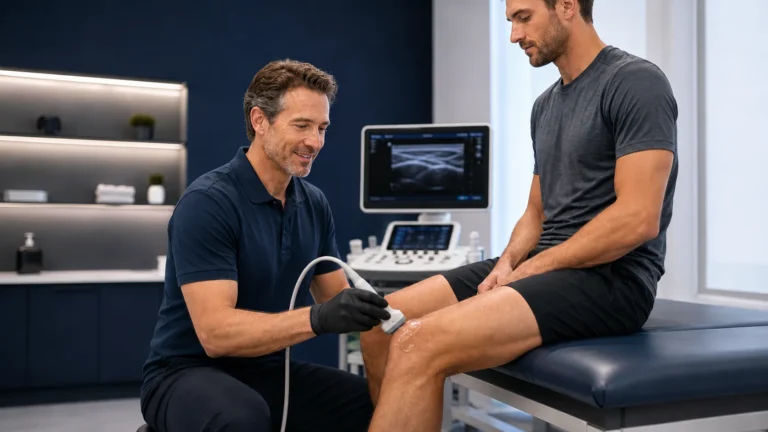

A recent YouTube video from a sports performance treatment provider promised something appealing: hands on corrections that fix movement dysfunction before it turns into an injury.
The pitch is common in manual therapy marketing, and it taps into something real, since strong athletes really can carry compensations that go unnoticed for years.
This article does not evaluate that specific practice or its claims. Instead, it asks a broader question any strength athlete can use.
What does the published research actually say about movement compensations in people who lift heavy, and about manual therapy as a fix for them?
The honest answer is more complicated, and more useful, than either a promotional video or a skeptic’s dismissal.
What “Movement Compensation” Actually Means
A movement compensation is a change in how a joint or muscle group works to get around a limitation somewhere else in the body.
A lifter with a stiff ankle might shift weight onto the opposite leg during a squat.
A lifter with a weak left glute might let the right hip do more of the work on every deadlift for months without noticing.
None of this is exotic or rare.
The body is very good at finding a path to the same output, even when that path is not the most efficient or protective one available.
The problem researchers actually study is narrower than “dysfunction,” a word that shows up constantly in manual therapy marketing but rarely in peer-reviewed injury research.
The two measurable things researchers can track are limb-to-limb asymmetry in strength or power, and movement-screen scores that are supposed to flag risky patterns.
Both have real research behind them, and both are more limited than most gym floor conversations suggest.
How Heavy Lifting Can Both Hide and Create Asymmetries
Strength sports reward consistency, and consistency can quietly reward a compensation the same way it rewards good technique.
A lifter who always sets up with a slight rotation in the hips may never feel it as a problem, because the nervous system adapts to whatever pattern gets repeated most.
Heavy barbell work is also bilateral by design in squats and deadlifts, which can mask a real strength difference between the two sides for years.
A stronger leg simply does more of the work, and the lift still goes up.
Sean J. Maloney’s 2019 critical review in the Journal of Strength and Conditioning Research looked directly at this question across dozens of studies on inter-limb asymmetry (Maloney, 2019).
The review’s central finding is not that asymmetry is harmless, and it is not that asymmetry is dangerous either.
It is that the evidence for asymmetry actually hurting performance or raising injury risk is inconsistent across the literature, and training interventions that reduce asymmetry do not reliably translate into better outcomes on their own.
A separate systematic review by Chris Bishop, Anthony Turner, and Paul Read reached a similar conclusion in the Journal of Sports Sciences, reporting that asymmetry’s relationship with both performance and injury risk varies by sport, by task, and by how asymmetry is even measured (Bishop, Turner, & Read, 2017).
That is a meaningfully different message than “any imbalance is a ticking time bomb,” which is the framing a lot of gym-floor screening sells.
The strength of association between asymmetry and injury outcomes is inconsistent enough across the literature that no single asymmetry test can currently be treated as a reliable injury predictor on its own.
Can a Movement Screen Actually Predict Injury?
The Functional Movement Screen and similar tools promise to spot compensation patterns before they cause an injury, which is exactly the pitch behind most hands-on assessment marketing.
Two separate meta-analyses have tested that promise directly, and both push back on it.
Bonazza and colleagues pooled the available Functional Movement Screen studies in the American Journal of Sports Medicine and found real limits on the tool’s reliability and its ability to predict future injury across general athletic populations (Bonazza, Smuin, Onks, Silvis, & Dhawan, 2017).
Moran and colleagues went further in the British Journal of Sports Medicine, concluding that Functional Movement Screen composite scores do not support its use as a stand-alone injury prediction tool, with only limited support even in the best-studied population, male military personnel (Moran, Schneiders, Mason, & Sullivan, 2017).
This does not mean movement screening is worthless.
It means the leap from “this screen flagged an asymmetry” to “this person will get hurt without a correction” is a bigger leap than the research supports.
A screen can still be a useful conversation starter with a qualified coach or clinician, the same way a good personal trainer uses an assessment to plan a program, not to diagnose a disease.
Where the “Hands On Corrections” Claim Comes From, and Where It Overreaches
Manual therapy providers, including chiropractors, physical therapists, and sports massage practitioners, build their marketing around a simple story: a trained pair of hands can find and fix the compensation a screen or an athlete cannot feel.
Part of that story rests on something true.
Manual assessment by an experienced clinician can pick up genuine restrictions in joint motion or muscle tone that a lifter has adapted around for so long they no longer notice it.
Where the story overreaches is the next step, the claim that manual correction reliably fixes the underlying dysfunction and meaningfully lowers injury risk going forward.
That is a much stronger claim than the manual therapy evidence base actually supports, and it is worth separating clearly from the video’s own framing rather than repeating it as settled fact.
A sports performance treatment provider featured on YouTube described the approach as using hands on corrections to fix movement dysfunction in athletes whose compensations had gone unnoticed for years.
That description is the provider’s own framing of their practice, not an independent finding, and it should be read that way.
What Systematic Reviews Actually Show About Massage and Soft Tissue Work
Weerapong, Hume, and Kolt reviewed the mechanisms and effects of massage on performance, recovery, and injury prevention in Sports Medicine, one of the most cited reviews on the topic (Weerapong, Hume, & Kolt, 2005).
Their conclusion was measured rather than enthusiastic.
Massage produced some psychological benefits fairly consistently, mild and short-lived changes in blood flow and muscle stiffness in some studies, and no strong, consistent evidence that it prevents injury or meaningfully boosts performance on its own.
That is the honest shape of the manual therapy evidence base for athletes: some plausible short-term effects on how tissue feels, real value for relaxation and perceived recovery, and a much thinner case for it being a durable fix for movement dysfunction.
None of this makes soft tissue work useless.
It means treating it as one input among several, not the intervention that resolves an asymmetry on its own.
A lifter chasing better mechanics through a foot massage or similar soft tissue technique is chasing a real, modest, mostly short-term effect, not a structural correction.
Common Compensation Patterns in Strength Athletes
A few compensation patterns show up often enough in strength sports that coaches and clinicians describe them consistently, even where the underlying research is still developing.
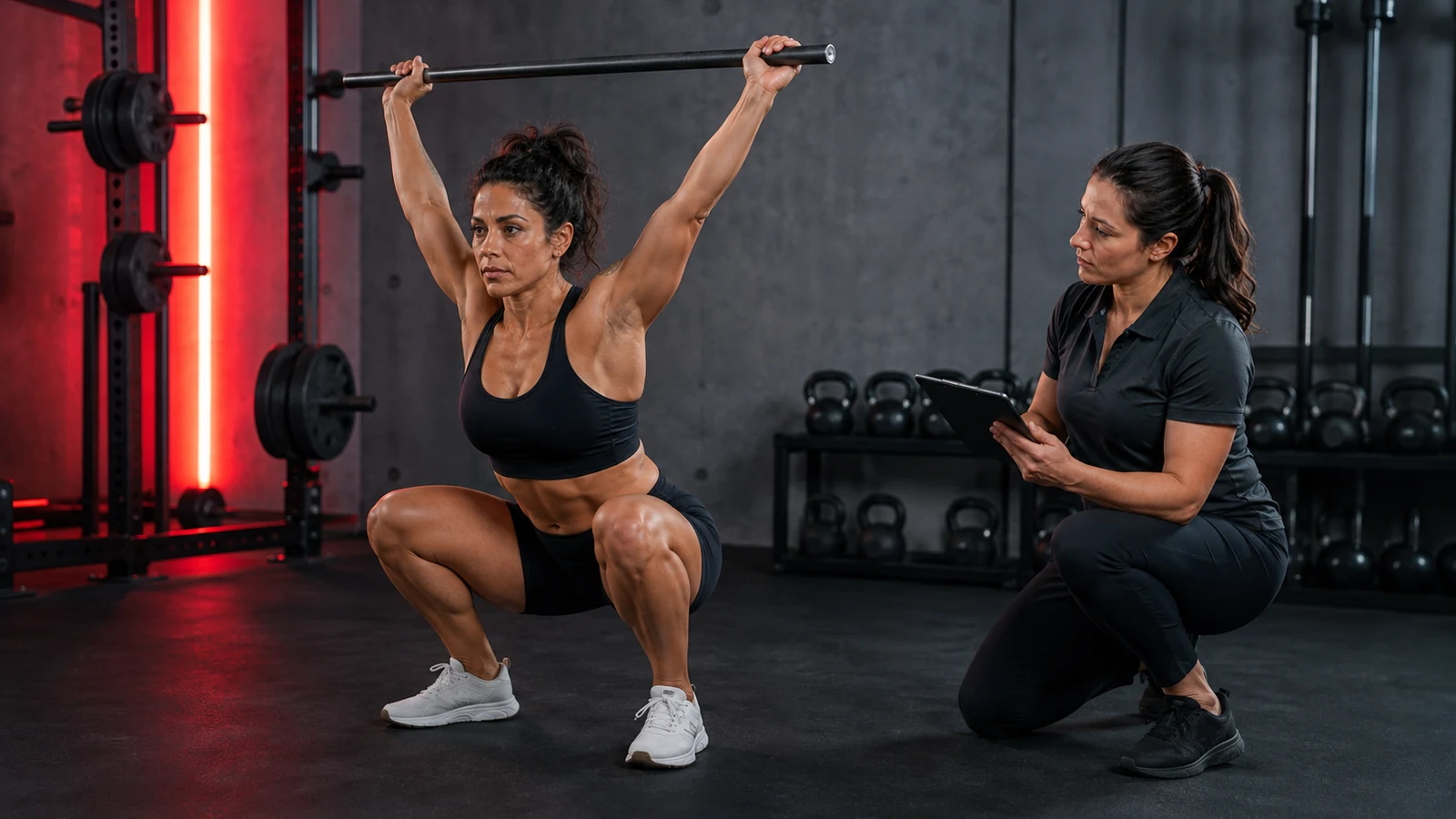
Hip shift under a heavy squat, where one side of the pelvis rises before the other, often traces back to a mobility limit or a strength gap on the side that shifts.
Rounded lower back on deadlifts can reflect a genuine range of motion limit, but it can also be a habit that got grooved in early training and never fully corrected.
Uneven bar path on the bench press, where the bar drifts toward the stronger side, frequently traces to a strength or stability difference between the two arms.
Removing variables can help isolate these patterns before assuming they need a hands-on fix.
A lifter comparing a floor press to a standard bench press is effectively removing leg drive and shortening the range of motion, which can reveal whether a compensation is coming from the shoulders and arms or from somewhere else in the chain.
Explosive movements can surface the same patterns even faster, since power output leaves less time to compensate smoothly.
That is one reason plyometric work like box jumps is sometimes used as a diagnostic tool as much as a training method, since a poor landing pattern under speed is harder to hide than one under a slow, heavy squat.
What This Evidence Does Not Prove
It is worth being explicit about the limits here, since the research on this topic is genuinely mixed rather than clean.
The evidence does not prove that asymmetry is safe to ignore in every athlete or every sport.
Some sport-specific and injury-specific studies do find real associations, particularly around previous injury history and larger strength deficits between limbs.
The evidence also does not prove that manual therapy has zero value, since the picture is one of modest and inconsistent benefit, not proof of no effect at all.
What the evidence does establish clearly is that no single screen, asymmetry test, or hands-on assessment currently has strong enough predictive power to be sold as a stand-alone injury prevention system.
Anyone presenting a movement screen or manual correction as a guarantee against future injury is going beyond what the current research supports.
Common Mistakes Strength Athletes Make Around This Issue
One common mistake is treating any detected asymmetry as an emergency that needs immediate correction before training can safely continue.
Given how inconsistent the asymmetry-injury link is across the literature, that reaction is often disproportionate to the actual risk.
A second mistake is the opposite extreme, ignoring a large and growing strength gap between limbs because the main lifts still go up.
A third mistake is outsourcing all responsibility for movement quality to a practitioner’s hands, rather than building unilateral work and mobility training into a normal program.
A fourth mistake is chasing symmetry for its own sake in a sport that is not actually symmetrical, since many throwing, striking, and rotational sports produce healthy, functional asymmetries that do not need fixing.
A More Complete Approach Than Hands-On Work Alone
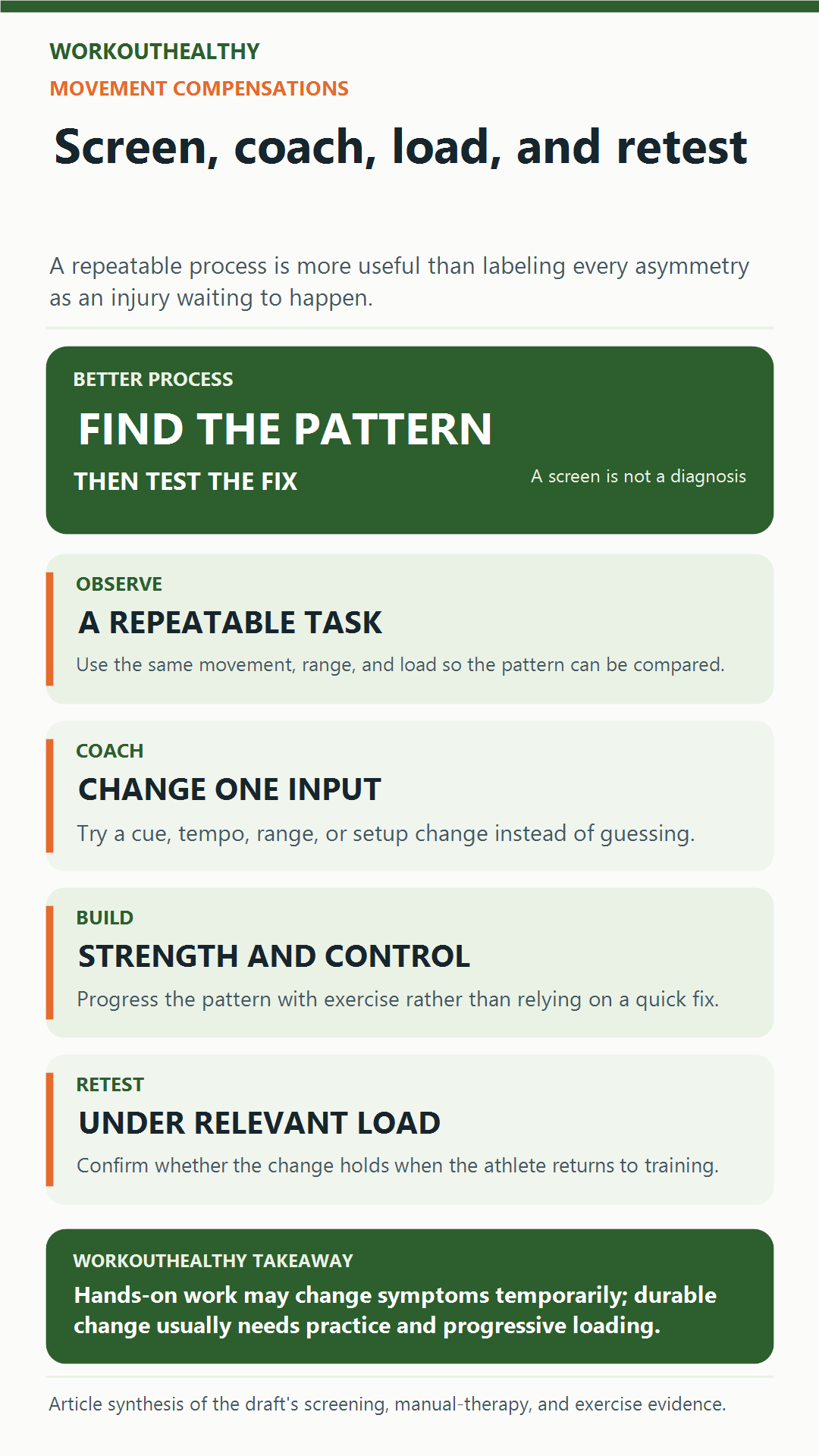
A more evidence-aligned approach treats manual therapy and screening as useful inputs inside a bigger plan, not as the plan itself.
Unilateral training, like single-leg presses, split squats, and single-arm rows, gives a genuine strength gap somewhere to close instead of hiding behind a bilateral lift.
Video review of the actual lifts, filmed from the front and the side, is a low-cost way to catch a hip shift or a bar drift long before it becomes a chronic pattern.
Programmed mobility work targeting the specific joint that seems restricted tends to outperform general stretching for fixing a real limitation.
Gradual load progression matters just as much, since a compensation that shows up only near a lifter’s absolute limit is a different problem than one showing up at a moderate, everyday working weight.
Manual therapy can fit into that plan as a short-term tool for perceived tightness or soreness, used alongside training changes rather than instead of them.

Who Should Get a Professional Assessment
Some situations genuinely call for a qualified clinician rather than a self-guided fix.
Pain that shows up in the same spot on the same lift, every session, over several weeks deserves an actual evaluation rather than a stretch or a foam roller.
A strength or range-of-motion gap between limbs that keeps growing rather than closing over months of training is worth a real look too.
Anyone recovering from a prior injury, especially anything involving surgery or a joint, should get individualized guidance before returning to heavy compensatory-risk lifts like squats and deadlifts.
A physical therapist, sports medicine physician, or qualified strength coach can combine a movement assessment with an actual training history, which is more useful than any single screen used alone.
Watch the Original Video
Want more explainers like this one? Subscribe to WorkoutHealthy Insider for practical explanations behind popular fitness claims.
References
Bishop, C., Turner, A., & Read, P. (2017). Effects of inter-limb asymmetries on physical and sports performance: A systematic review. Journal of Sports Sciences, 36(10), 1135–1144. https://doi.org/10.1080/02640414.2017.1361894
Bonazza, N. A., Smuin, D., Onks, C. A., Silvis, M. L., & Dhawan, A. (2017). Reliability, validity, and injury predictive value of the Functional Movement Screen: A systematic review and meta-analysis. American Journal of Sports Medicine, 45(3), 725–732. https://doi.org/10.1177/0363546516641937
Maloney, S. J. (2019). The relationship between asymmetry and athletic performance: A critical review. Journal of Strength and Conditioning Research, 33(9), 2579–2593. https://doi.org/10.1519/JSC.0000000000002608
Moran, R. W., Schneiders, A. G., Mason, J., & Sullivan, S. J. (2017). Do Functional Movement Screen (FMS) composite scores predict subsequent injury? A systematic review with meta-analysis. British Journal of Sports Medicine, 51(23), 1661–1669. https://doi.org/10.1136/bjsports-2016-096938
Weerapong, P., Hume, P. A., & Kolt, G. S. (2005). The mechanisms of massage and effects on performance, muscle recovery and injury prevention. Sports Medicine, 35(3), 235–256. https://doi.org/10.2165/00007256-200535030-00004
This article is for general information only and is not medical advice. If you have an injury, ongoing pain, or a medical condition, talk to a doctor or physical therapist before you change how you train or eat.