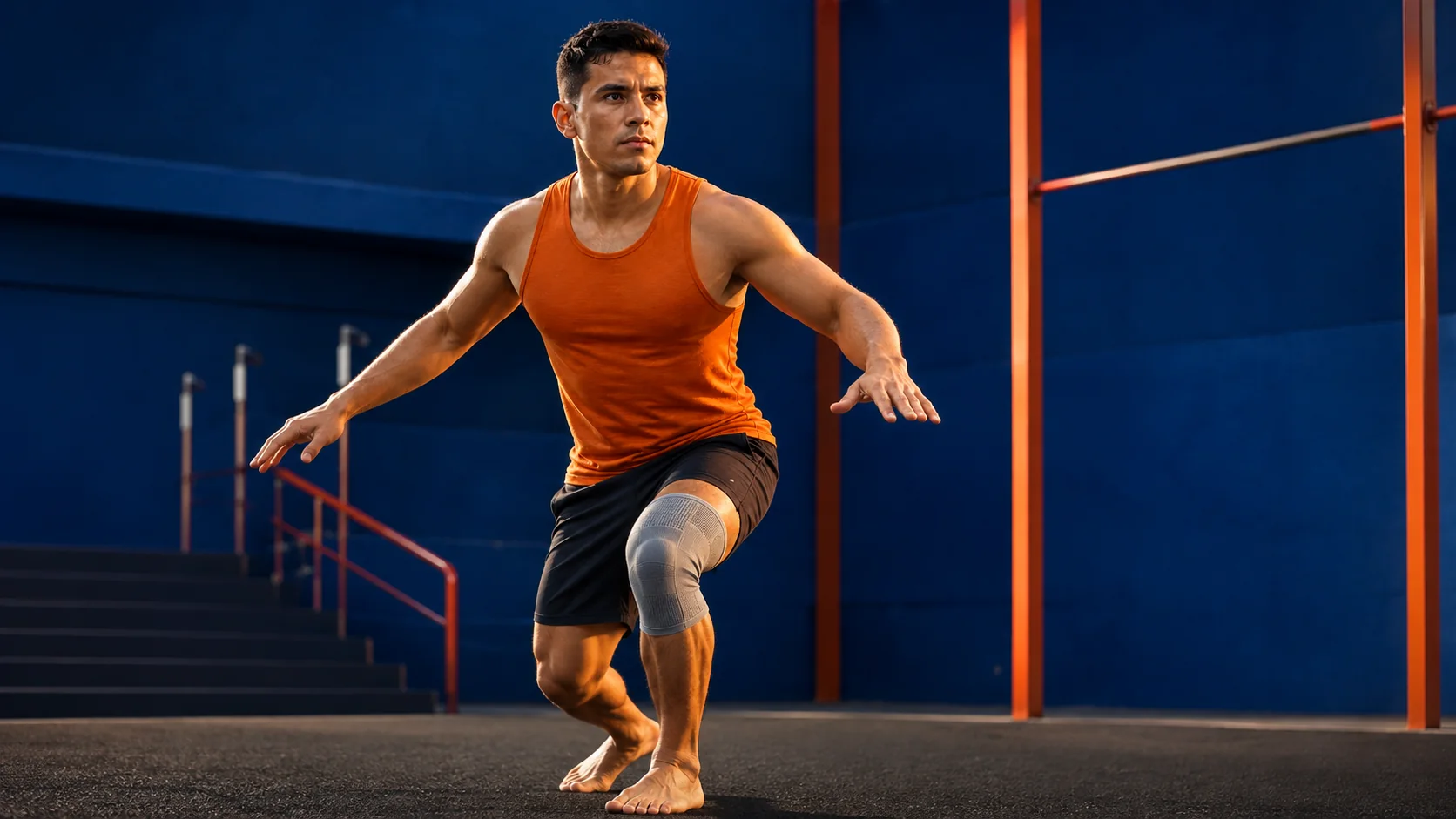

A Facebook post from Santa Cruz Medicinals recently described a rehabbing athlete discovering a foot method called GOATA.
The post said GOATA uses placement and patterns to help the body move naturally.
That is an appealing idea, especially for anyone who has done months of knee rehab without much progress.
But GOATA itself is a proprietary, trademarked movement system taught within a specific practitioner community, not a peer-reviewed clinical treatment with its own independent research base.
So this article does something the video does not try to do.
It separates the two things bundled inside that Facebook post.
One is a specific branded method, GOATA, which we can describe honestly but cannot verify against clinical trials because none appear to exist in the published literature.
The other is a much older, well-studied idea that GOATA is one commercial example of: that how your feet move and sense the ground can change what happens at your knee.
That second idea has real research behind it, and that research is what this article is actually built on.
What the Video Is Actually Describing
Santa Cruz Medicinals is a fitness and rehab-focused YouTube channel, and the video in question walks through GOATA as a foot-first approach to movement retraining.
Based on the channel’s own framing, GOATA stands for a system of foot placement, patterns, and awareness cues that a practitioner community teaches to clients and to other trainers and clinicians.
We looked for independent information about GOATA beyond what the video and its own promotional material claim.
We could not locate a peer-reviewed study that tests GOATA specifically, under that name, against a control group or a comparison treatment.
That does not automatically mean the underlying ideas are wrong.
Plenty of legitimate training methods package well-established physiology into a proprietary system, a certification, and a brand name.
It does mean readers should not treat “GOATA fixed my knee” as equivalent to “a clinical trial found this works.”
Those are two very different kinds of claims, and this article is careful to keep them separate.
The Foot-First Idea, in Plain Terms
Strip away the branding, and the core idea is not unusual in rehab and sports medicine circles.
Your foot is the only part of your body that actually touches the ground when you walk, run, squat, or land from a jump.
The feet hold a dense network of sensory receptors, and they sense pressure, angle, and surface texture, then send that information up through the ankle, knee, and hip with every single step.
If the foot senses the ground poorly, or moves through an unusual pattern, the joints above it often adjust to compensate.
Over thousands of repeated steps a day, small compensations can add up.
The knee sits directly between the foot and the hip, so it absorbs a lot of that adjustment.
This is why physical therapists increasingly look at the foot when a patient’s main complaint is actually at the knee.
The knee rarely causes its own problems. More often, it is the joint that pays the price for something happening at the foot or the hip.
Why the Foot Affects the Knee: The Mechanism
The lower leg works as a chain, not as three separate parts.
Your foot’s arch and its small intrinsic muscles help control how much your ankle rolls inward when you land on it, a motion called pronation.
A small amount of pronation is normal and even helps absorb shock.
Too much, especially if it happens fast and without much muscular control, tends to rotate the lower leg inward as well.
Because the shinbone and thighbone meet at the knee, that inward rotation changes how the kneecap tracks in its groove and how load passes through the joint.
Weak or poorly coordinated intrinsic foot muscles are one reason that inward rotation can go unchecked.
Poor proprioception, meaning a reduced sense of where your foot and knee are in space, is another.
Foot-first training programs, GOATA included based on its own description, generally target one or both of those two things: the strength and coordination of the small foot muscles, and the sensory feedback loop that lets your nervous system correct a bad landing before it becomes a bad habit.
Real Research: Barefoot Walking and Knee Joint Loading
One of the clearest studies connecting foot mechanics to knee load comes from Northwestern University researchers Najia Shakoor and Joel Block, published in Arthritis and Rheumatism in 2006.
They measured knee loads in people with knee osteoarthritis while walking barefoot compared with walking in their own conventional shoes.
Walking barefoot reduced peak knee loads at both the front and side of the joint compared with shoes.
The researchers concluded that footwear itself, not just gait retraining, changes how much force reaches an arthritic knee with every step.
This matters for the foot-first argument because it shows the connection between the foot and the knee is not just theoretical.
It is measurable, using force plates and motion capture, in a real clinical population with real knee pain.
It does not mean everyone with knee pain should throw away their shoes.
It does mean that what happens at the foot, including how a shoe changes that contact, has a direct and measurable effect on knee loading.
Real Research: Gait Retraining and Kneecap Pain
A second, frequently cited study looked at gait retraining rather than footwear.
Brian Noehren, John Scholz, and Irene Davis published a trial in the British Journal of Sports Medicine in 2011 involving runners with patellofemoral pain syndrome, a common form of kneecap pain.
Patellofemoral pain is closely linked to excess hip adduction and internal rotation while running, a pattern that also shows up at the foot and ankle.
Runners in the study received real-time visual feedback about their hip movement while running on a treadmill, across eight sessions over two weeks.
By the end of training, hip adduction dropped substantially, and so did the runners’ reported pain.
Function scores improved as well, and the changes held up at a one-month follow-up.
This study did not train the foot in isolation.
It retrained an entire movement pattern, and the foot’s contact with the ground was part of that pattern the whole time.
That is closer to what a foot-first method like GOATA is actually attempting, even though the specific cues and drills differ.
Real Research: Balance Training and ACL Injury Prevention
A third relevant line of evidence comes from ACL injury prevention research, specifically a well-known Italian study by Alberto Caraffa and colleagues, published in Knee Surgery, Sports Traumatology, Arthroscopy in 1996.
The researchers put semi-professional soccer players through a proprioceptive and balance training program using wobble boards, aimed at improving the sensory feedback between the foot, ankle, and knee.
Over three seasons, the trained group had a dramatically lower rate of ACL injuries than a comparison group that did not train this way.
This is an older study, and sports medicine has refined balance and neuromuscular training considerably since 1996.
Later research has generally supported the same core idea, that improving how the foot and ankle sense the ground reduces dangerous knee movement patterns during cutting and landing.
None of these three studies tested GOATA by name.
Together, they are the real evidence behind the broader foot-first philosophy that the video represents, and they are considerably stronger evidence than any single branded method can claim on its own.
The published research does not prove one brand of foot training works. It shows that foot mechanics, sensation, and gait all influence the knee, which is the idea any foot-first method is really selling.
What This Research Does Not Prove
It is worth being direct about the limits of this evidence.
The barefoot walking study measured a single walking session, not months of training, and it studied people who already had knee osteoarthritis.
The gait retraining study involved a small group of runners with one specific diagnosis, patellofemoral pain, over a short training window.
The ACL prevention study involved young male soccer players, a population that does not automatically represent every knee patient.
None of these studies used GOATA, so nothing here proves that GOATA specifically produces these outcomes.
None of them show that foot training alone can replace surgery, physical therapy, or medical evaluation for a structural knee injury.
And none of them claim that one foot cue or drill works the same way for every body, every injury, and every sport.
The honest summary is that foot-focused training is a legitimate, evidence-supported piece of knee rehab, not a universal fix and not a substitute for a proper diagnosis.
Common Mistakes People Make With Foot-First Training
The first common mistake is going barefoot or minimalist too fast.
Your foot’s intrinsic muscles and connective tissue need weeks to months to adapt to less support, not one aggressive week.
The second mistake is skipping strength work and only doing sensory or balance drills.
Awareness of your foot’s position matters, but a foot that senses well and still cannot generate strength will not fix a loaded movement like a squat or a run.
The third mistake is applying foot cues to every kind of knee pain as if the cause were always the same.
Kneecap pain, ligament injuries, cartilage wear, and tendon issues do not share one root cause, even though foot mechanics can influence all of them.
The fourth mistake is ignoring pain that increases rather than gradually easing during a new foot-training program.
Soreness from unfamiliar work is normal; sharp or worsening joint pain is a signal to stop and get it checked.
Who Should Check With a Professional First
Anyone with a diagnosed ligament tear, meniscus injury, or recent knee surgery should get clearance from their surgeon or physical therapist before starting a new foot-training program.
The same goes for anyone with moderate to severe knee osteoarthritis, since load changes that help one person can aggravate another.
People with diabetes or any condition that reduces sensation in the feet should be especially cautious with barefoot or minimalist approaches, since reduced sensation makes it harder to notice a developing injury.
Anyone with a bunion, hammertoe, or other structural foot deformity should talk to a podiatrist before changing footwear or foot-loading patterns significantly.
And if knee pain has lasted more than a few weeks, has swelling, or limits daily walking, that is a reason to see a doctor or physical therapist rather than start with a YouTube-taught method alone.
If you are weighing whether to bring in a coach for the transition, this guide on deciding whether you need a personal trainer covers how to vet one before you hand over your training plan.
A Practical, Safe Way to Start Foot-First Training
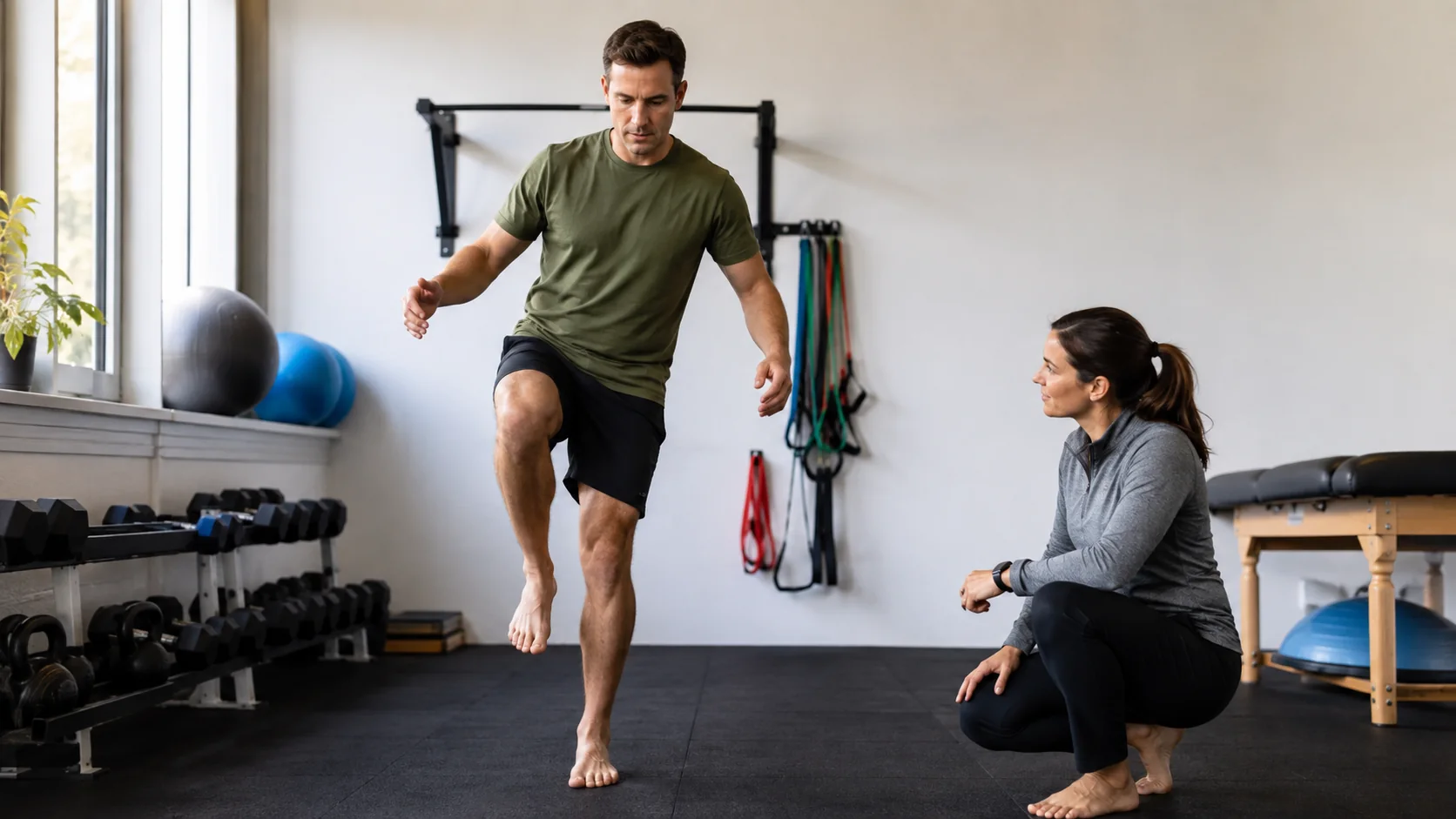
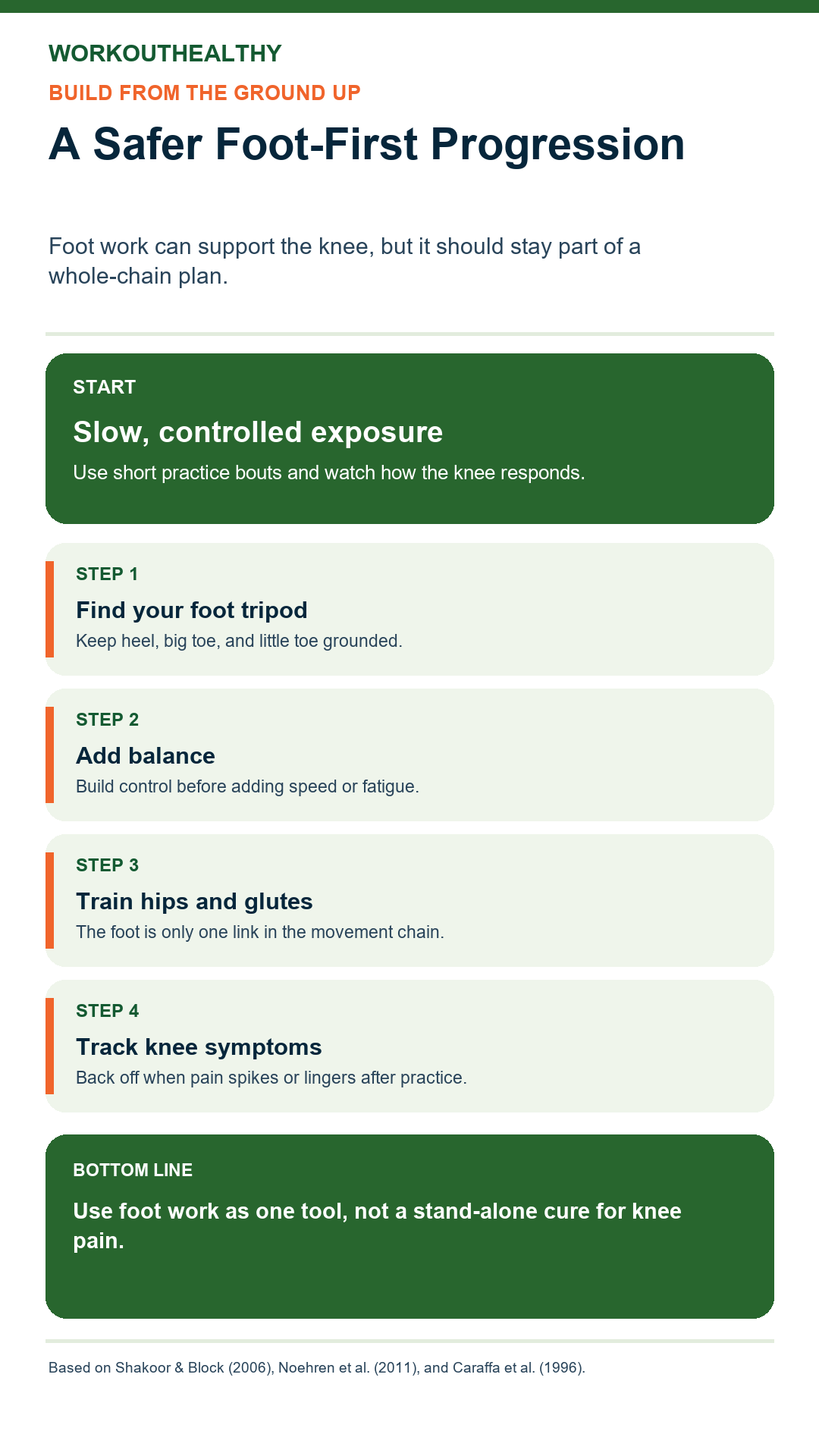
Start with awareness before you start with load.
Stand barefoot and notice whether your weight sits more on the inside or outside edge of your foot, and whether your toes grip the floor or stay passive.
Add short foot exercises, where you gently draw the ball of your foot toward your heel without curling your toes, holding for a few seconds at a time.
Practice this seated at first, then standing, then during a slow single-leg balance.
Introduce barefoot time on safe, flat surfaces at home before adding any barefoot or minimalist work to actual training sessions.
If you plan to transition toward minimalist shoes, do it gradually over eight to twelve weeks, adding a little more barefoot or minimalist time every week rather than switching all at once.
Most of this practice happens during ordinary walking, so how many miles you already walk in a day is a reasonable place to build in a little more barefoot or minimalist time before touching a formal training session.
Pair foot work with hip and glute strengthening, since the gait retraining research above changed hip movement, not just foot movement, and both matter for the knee.
Track your knee symptoms, not just your foot symptoms, since the whole point of this approach is a change further up the chain.
If a physical therapist is available to you, ask them to check your gait and foot mechanics directly rather than guessing from a video alone.
Watch the Original Video
Curious what else falls apart under a closer look? Subscribe to WorkoutHealthy Insider for practical explanations behind popular fitness claims.
References
Caraffa, A., Cerulli, G., Projetti, M., Aisa, G., & Rizzo, A. (1996). Prevention of anterior cruciate ligament injuries in soccer: A prospective controlled study of proprioceptive training. Knee Surgery, Sports Traumatology, Arthroscopy, 4(1), 19-21. https://doi.org/10.1007/bf01565992
Noehren, B., Scholz, J., & Davis, I. (2011). The effect of real-time gait retraining on hip kinematics, pain and function in subjects with patellofemoral pain syndrome. British Journal of Sports Medicine, 45(9), 691-696. https://doi.org/10.1136/bjsm.2009.069112
Shakoor, N., & Block, J. A. (2006). Walking barefoot decreases loading on the lower extremity joints in knee osteoarthritis. Arthritis & Rheumatism, 54(9), 2923-2927. https://doi.org/10.1002/art.22123
This article is for general information only and is not medical advice. If you have an injury, ongoing pain, or a medical condition, talk to a doctor or physical therapist before you change how you train or eat.