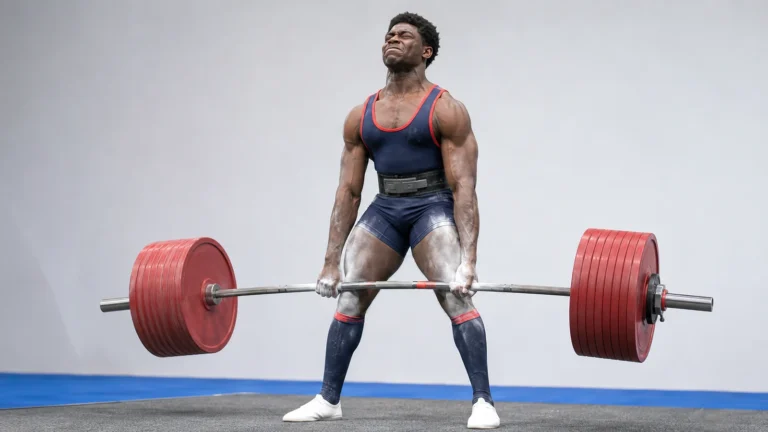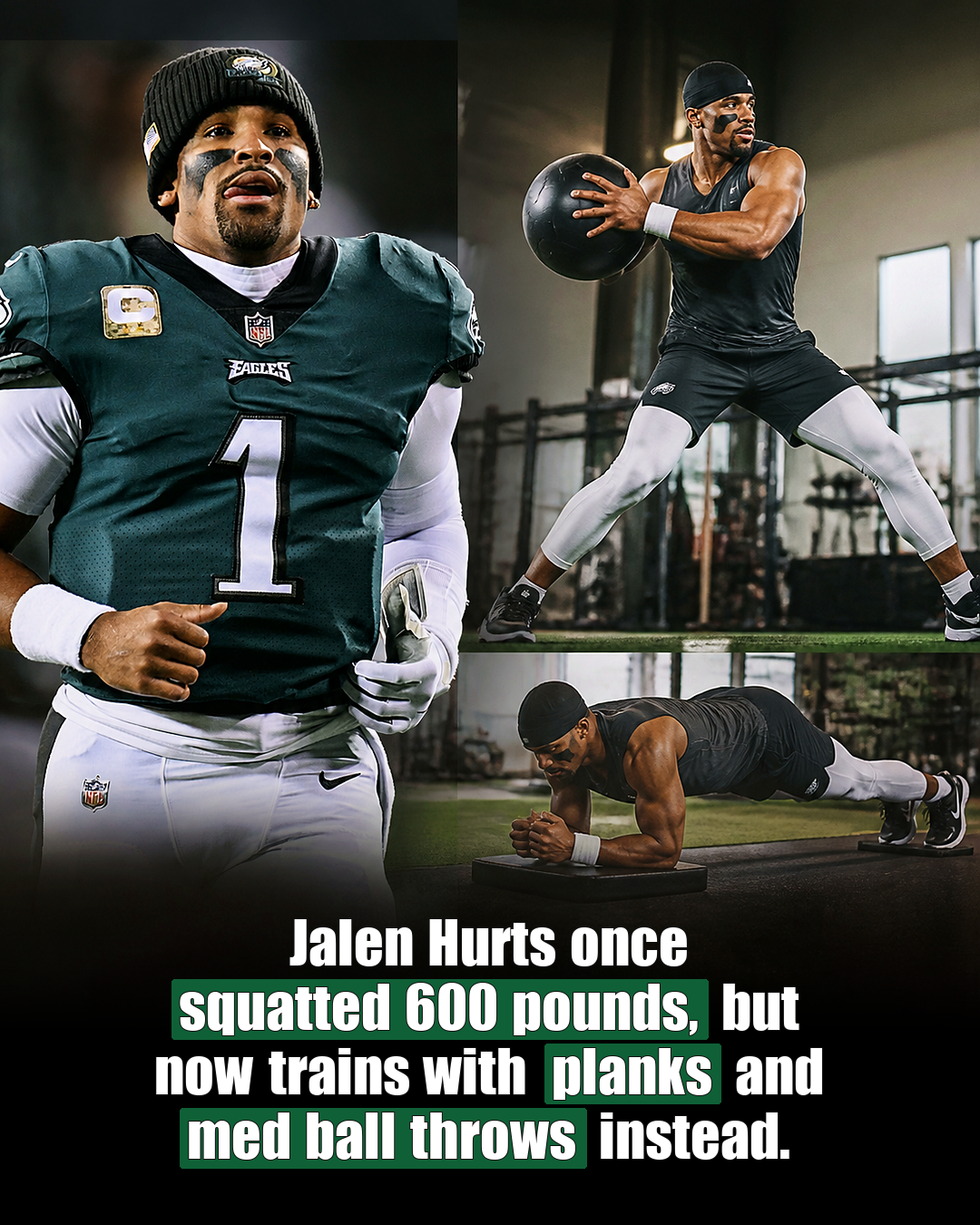

Jalen Hurts can squat 600 pounds. That number gets repeated often, because it is genuinely rare.
What gets repeated far less is that the Philadelphia Eagles quarterback and Super Bowl champion barely uses heavy squats in his actual training anymore.
His workouts have shifted toward a different goal entirely. Instead of chasing bigger numbers on a barbell, his trainer builds sessions around what actually shows up on Sundays.
Hurts is a two time Pro Bowl selection who helped lead the Eagles to a Super Bowl title.
His durability has become almost as important to the team as his arm or his legs.
A quarterback who cannot stay on the field cannot help a team win games, no matter how strong his lifts are in the weight room.
That reality has shaped how many NFL strength staffs think about training their most valuable, and most exposed, position on the roster.
What Hurts’s Training Actually Looks Like
Hurts works with trainer Taylor Kelly, who has reshaped his program around durability rather than raw strength totals.
Sessions often start with a long plank hold, sometimes up to four minutes, before moving into pushups.
Those pushups are not standard either. Kelly has Hurts vary hand position across sets, moving hands forward, inward, and outward to challenge the shoulder from different angles.
Kelly has been direct about why this comes first.
“If you can’t do that, we’ve gotta build that,” Kelly said, describing the plank and pushup foundation of the program.
Pressing work looks different too. Instead of barbell bench pressing, Hurts uses dumbbells and deliberately stops the movement at a 90 degree angle rather than pressing to full extension.
For a closer look at how that kind of substitution actually changes the exercise, see this comparison of a floor press versus a bench press.
Kelly explained the reasoning behind that specific detail.
“As a quarterback, we’re never finding ourselves having to go beyond 90 degrees,” Kelly said.
Medicine ball work rounds out the session. Hurts throws relatively light medicine balls, in the 5 to 6 pound range, from multiple angles to protect his lower back while still building rotational power.
The shoulder complex gets extra attention too, with scapular pushups and controlled holds built in specifically for quarterbacks.
“We’ll do a lot of scapular stuff. That helps quarterbacks to get full extension on their release point,” Kelly said.
Taken together, the philosophy is simple. Train for what actually happens on the field, not for a number on a bar.
Why Hurts Moved Away From Heavy Squats
Hurts was not always trained this way. Earlier in his career, heavy squatting was a bigger part of his program, and he built the kind of raw lower body strength that let him hit 600 pounds.
That number is impressive, and it is also demanding on the body. Very heavy squatting puts significant compressive load on the spine and knees, especially when repeated across years of training.
For a quarterback, the job does not actually require a bigger squat max. It requires quick footwork in the pocket, the ability to absorb a hit, and enough lower body power to extend plays and pick up yards when a throw is not there.
Kelly’s program still includes lower body strength work, just organized around movement quality and force absorption rather than chasing a single maximum lift.
The Science Behind Training for the Job, Not the Number
This approach lines up with a well established idea in exercise science called specificity of training.
The basic principle is that the body adapts most strongly to the exact type of stress it repeatedly faces.
A quarterback’s arm, shoulder, and torso move through a specific rotational pattern dozens of times per game.
Bench pressing to a full lockout does not closely mirror that pattern.
Explosive, rotational movements like box jumps can also build real muscle through a similar principle. A rotational medicine ball throw does. A 2010 review in the Strength and Conditioning Journal on medicine ball training for rotational power sports laid out this exact case, arguing that throwing movements build power in a way that transfers more directly to sports involving rotation, like throwing, hitting, and swinging.
A separate 2015 study published in the Journal of Strength and Conditioning Research tested this more directly.
Researchers had athletes complete six weeks of structured medicine ball training and found measurable improvements in throwing performance afterward.
That kind of direct evidence supports Kelly’s approach of building power through throwing patterns rather than only through traditional barbell lifts.
What the Research Says About Quarterback Shoulder Injuries
Kelly’s decision to stop presses at 90 degrees is a reasonable, cautious choice. It is worth being honest about what the actual injury research on NFL quarterbacks shows, though.
A 2018 review published in Current Reviews in Musculoskeletal Medicine, by researchers Jacob Kirsch, Tyrrell Burrus, and Asheesh Bedi, looked specifically at injury patterns in professional quarterbacks.
The review found that shoulder injuries are common in this position. It also found something that might surprise people.
Most upper body injuries in professional quarterbacks come from direct contact, not from the throwing motion itself.
In fact, the review noted that a large share of shoulder labrum injuries specifically happened during contact with another player, not during a throw.
This does not mean Kelly’s caution is misplaced. Protecting shoulder range of motion is still a reasonable, low risk choice for a quarterback’s long term durability.
But it is a useful reminder that in football specifically, getting hit is often a bigger threat to a quarterback’s shoulder than the mechanics of throwing.
The researchers themselves noted that solid, high quality research on preventing these injuries in professional quarterbacks is still limited.
What This Means for Everyday Lifters
Most people reading about Hurts’s training are not NFL quarterbacks. The core idea still applies broadly.
Training should generally match what a person actually needs their body to do.
A weekend rec league basketball player training for that sport benefits more from lateral movement, jumping, and quick direction changes than from chasing a bigger deadlift number.
A person recovering from a shoulder issue may genuinely benefit from limiting overhead range of motion the same way Hurts limits his press depth, at least temporarily.
That said, most healthy, non throwing athletes do not need to avoid full range of motion pressing.
Full range strength work has real, well documented benefits for shoulder health in the general population.
The lesson from Hurts’s program is not “avoid heavy lifting.” It is “match your training to your actual demands and any real limitations you have.”
This same idea shows up constantly in strength and conditioning research outside of football. Athletes in rotational sports like golf, baseball, and tennis generally benefit more from rotational power training than from generic maximal strength work alone.
Runners tend to benefit more from single leg strength and hip stability work than from heavy bilateral squatting.
The exercise itself is rarely the whole story. What matters more is whether the exercise actually resembles the demand the body needs to meet.
Common Mistakes People Make Copying Pro Athlete Routines
Copying an NFL quarterback’s exact program without matching context is one of the most common mistakes recreational lifters make.
Hurts’s program was built around his specific job, his specific injury history, and constant supervision from a trainer who tracks his movement daily.
Most people copying his routine online get none of that context.
Another common mistake is assuming lighter weight automatically means safer training. Kelly’s program is not light. It uses controlled range of motion and higher precision, not less effort.
People also tend to skip the boring parts, like the long plank holds and scapular work, while keeping the more exciting medicine ball throws.
Kelly’s program treats the boring foundational work as the actual prerequisite, not an optional warm up.
Finally, many people drop traditional strength training entirely after reading about an athlete who trains differently.
Hurts still builds a strength base. He has simply layered sport specific work on top of it, not replaced it outright.
A Practical Way to Apply This to Your Own Training
Start by identifying what your body actually needs to do well, whether that is a specific sport, a physically demanding job, or simply moving comfortably through daily life.
Keep a foundation of general strength work, since a baseline of strength supports almost every other physical goal.
Add rotational power work, like light medicine ball throws or cable rotations, if your sport or activity involves twisting or throwing motions.
Include core stability holds, like planks, as a genuine training block, not just a warm up to rush through.
Adjust range of motion on specific lifts only if you have a real, diagnosed reason to, ideally with guidance from a physical therapist or qualified coach.
Track how your body actually performs at your sport or activity, not just how much weight moves on a bar, as your main measure of progress.
Revisit your program every few months, the same way Kelly continues to adjust Hurts’s training as his career and body change.
Write down what your training is actually for before choosing exercises.
That answer could be a sport, a physically demanding job, or simply staying capable for daily life.
Let it guide the program, instead of picking exercises just because they look impressive on video.
References
Yahoo Sports, “Jalen Hurts’s Training Routine Rarely Includes Squats. Here’s What He Does Instead.”
Kirsch, J. M., Burrus, M. T., & Bedi, A. (2018). Common Injuries in Professional Football Quarterbacks. Current Reviews in Musculoskeletal Medicine.
Strength and Conditioning Journal (2010). Medicine Ball Training Implications for Rotational Power Sports.
Journal of Strength and Conditioning Research (2015). Effects of Six Weeks of Medicine Ball Training on Throwing Performance.
This article is for general information only. It is not personal medical or fitness advice. Anyone with a current shoulder, back, or knee injury should consult a doctor or physical therapist before changing a training program or adjusting range of motion on any exercise.