

A recent roundup video from the medical news channel Medical Dialogues covered three unrelated health stories in one segment.
Two of those stories, a metabolic health test and a study on chili peppers and cancer risk, are not covered here.
This article focuses on just the fitness story: the claim that vaping and smoking are linked to lower fitness levels in young adults.
That claim points to a real 2024 study, and this article explains exactly what it found, what it means, and what it does not prove.
If you vape, smoke, or care about someone who does, the real findings here are worth knowing.
What This New Study Actually Found
The study behind this claim was published in 2024 in the Journal of Applied Physiology.
Researchers at Virginia Commonwealth University, led by Tijana Simovic, studied two groups of young, otherwise healthy adults.
One group used e-cigarettes regularly, and the other group did not use any nicotine products.
Both groups completed a cardiopulmonary exercise test, the same kind of test used to measure how well the heart, lungs, and muscles work together during exercise.
The main measurement was peak oxygen consumption, often shortened to VO2peak.
VO2peak is considered one of the best single measures of cardiorespiratory fitness.
The e-cigarette users had significantly lower VO2peak than the non-users.
Their hearts also responded differently during exercise.
Researchers observed a lower chronotropic response, which means their heart rate did not climb as much as expected during hard effort.
Their muscles also used oxygen less efficiently during the same workload.
Resting heart function, blood pressure, and heart structure looked normal in both groups.
The difference only showed up once the body was actually pushed to work.
The video’s own framing describes the fitness gap as roughly 15 percent.
The published study itself, and every independent summary of it available for this article, does not spell out that exact percentage.
Because that specific number could not be independently confirmed against the paper itself, this article treats it as the video’s own shorthand rather than a confirmed figure.
What is confirmed, directly from the study, is that the fitness gap between users and non-users was large enough to be statistically significant, not a small or borderline difference.
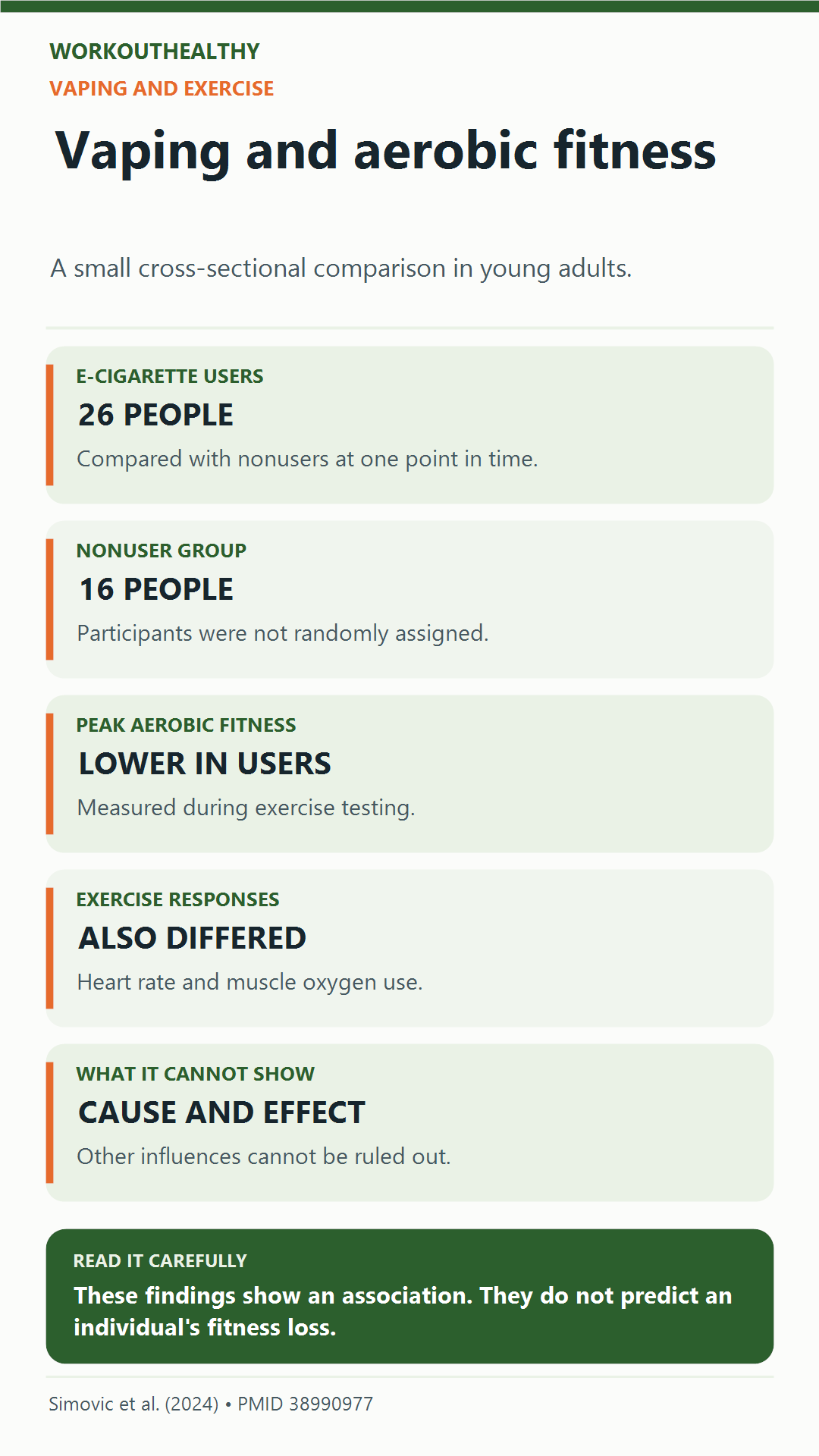
Young, otherwise healthy e-cigarette users showed lower peak oxygen consumption, a blunted heart rate response, and reduced oxygen use in their working muscles, even though their resting heart function looked completely normal.
Why Vaping Would Lower Oxygen Delivery
The study’s authors point to a few likely mechanisms.
Nicotine is a stimulant that narrows blood vessels.
Narrower blood vessels make it harder for blood, and the oxygen it carries, to reach working muscles.
E-cigarette aerosol also contains fine particles and chemicals beyond nicotine itself.
Those particles can irritate the lining of blood vessels and airways with repeated exposure.
Over time, that irritation may blunt how quickly the heart speeds up during exercise, which is the chronotropic response the study measured.
It may also reduce how efficiently muscle tissue pulls oxygen out of the blood.
None of this requires visible lung damage or a diagnosed disease.
The changes can show up in exercise testing years before someone would ever describe themselves as having a lung or heart problem.
A Second Study: Vaping Stresses the Heart Almost Like Smoking Does
The Virginia Commonwealth University study is not the only research pointing this direction.
A separate study published in the McGill Journal of Medicine in 2022 compared the immediate effects of vaping and cigarette smoking in young adults.
Researchers measured heart rate, blood pressure, and heart rate variability before and after each activity.
Both vaping and smoking raised heart rate and blood pressure within minutes.
The size of those changes was similar between the two.
The researchers described vaping as producing acute cardiovascular effects similar to cigarette smoking, not a safer alternative.
That study only looked at short term effects in a small group, not long term fitness.
Paired with the fitness study above, it points toward the same conclusion from a different angle.
Vaping is not a neutral habit for a body that also wants to perform well physically.
Vaping raised heart rate and blood pressure in young adults within minutes, in amounts similar to what cigarette smoking produced in the same study.
What This Evidence Does Not Prove
Both studies used relatively small groups of participants.
The Virginia Commonwealth University study compared 26 e-cigarette users with 16 non-users.
Small sample sizes make it harder to know how well the results generalize to every vaper.
The fitness study also compared two groups at a single point in time.
It did not follow the same people for years to watch fitness change as vaping continued.
That means it cannot prove vaping alone caused the lower fitness scores.
It is possible, though not confirmed, that people with already lower baseline fitness are more likely to vape in the first place.
Neither study measured how much fitness might return after someone quits.
Neither study separated occasional vaping from daily, heavy use.
Neither study is the actual source of the specific 15 percent figure used in the video covering this story.
Common Mistakes People Make About Vaping and Fitness
The biggest mistake is assuming vaping is fitness neutral because it does not involve burning tobacco.
Both studies above suggest that assumption does not hold up under actual testing.
Another mistake is expecting a resting heart rate or a daily step count to reveal this kind of fitness gap.
The differences in these studies only appeared during a real, structured exercise test that pushed the body hard.
A third mistake is treating occasional vaping the same as daily use.
The research reviewed here focused on regular users, not people who vape only rarely.
A fourth mistake is assuming exercise training can simply out-work nicotine’s effects.
Training still helps, but it works against a headwind that non-users do not have.
Finally, some people assume this research applies only to vaping and not to smoking.
The second study above found vaping’s acute cardiovascular effects were similar to smoking, not milder.
How Long It Takes Fitness to Bounce Back After Quitting
Neither study above followed people after they quit, so neither can put an exact number on fitness recovery.
Broader research on quitting smoking gives a rough sense of the timeline for related changes.
According to the National Cancer Institute’s Smokefree.gov program, heart attack risk starts dropping within 24 hours of quitting.
Many people notice breathing improve within about two weeks, including feeling less winded walking up a flight of stairs.
Lung tissue that has already scarred does not reverse, which is one more reason earlier is better than later.
Cardiorespiratory fitness itself typically needs consistent aerobic training on top of quitting to fully rebuild, not just time away from nicotine.
Who Should Check With a Doctor
Anyone who gets unusually short of breath during normal activity should mention it to a doctor.
That includes people who vape or smoke and people who do neither.
People with existing heart or lung conditions should talk to a doctor before starting a new exercise routine, especially if they currently vape or smoke.
Pregnant people who vape or smoke should discuss both nicotine use and any exercise plans with their provider.
Teenagers and young adults who vape regularly should not wait for symptoms before mentioning it to a doctor.
Chest tightness, an unusually fast heartbeat, or dizziness during exercise deserve prompt medical attention, not a wait and see approach.
Anyone trying to quit nicotine can also ask a doctor about cessation support, since quitting is genuinely difficult and support improves success rates.
Step-by-Step: How to Test and Rebuild Your Cardiorespiratory Fitness
You do not need a lab to get a rough sense of your own cardiorespiratory fitness.
Here is a practical way to check where you stand and build from there.
Step 1: Get a baseline reading.
Time yourself walking up four flights of stairs at a brisk, steady pace.
Our guide to the four flights of stairs test explains what the timing bands mean and where the test falls short.
Step 2: Talk to a doctor before making big changes.
If you currently smoke or vape, mention that when you get checked, especially if you have any chest symptoms.

Step 3: Start with low intensity, consistent cardio.
Walking most days of the week is a reasonable starting point for almost everyone.
Our guide on how many miles to walk each day breaks down a realistic weekly target.
Step 4: Add structured intervals once walking feels easy.
Short bursts of faster effort, followed by easier recovery periods, help train the heart’s ability to respond quickly during exercise, the same chronotropic response the vaping study measured.
Step 5: Track your effort, not just your time.
Rate how hard a workout feels on a simple 1 to 10 scale.
If effort keeps feeling easier at the same pace over several weeks, your fitness is likely improving.
Step 6: Be careful with stimulants during this process.
Caffeine and nicotine are both stimulants, but they do not affect the body the same way during exercise.
Our guide to caffeine timing before a workout covers what caffeine can and cannot do for performance.
Step 7: Support your cardiovascular system beyond cardio training.
Heat exposure, sleep, and stress management all interact with heart health.
Our article on sauna use and heart health looks at one example of that broader picture.
Step 8: Re-test every few weeks.
Repeat the same stair test, or a similar fixed activity, every three to four weeks.
A faster time, or an easier feeling at the same pace, is a real sign of progress.
Step 9: Treat quitting as part of the fitness plan, not separate from it.
The research above suggests fitness and nicotine use are connected, not independent variables.
A doctor, quitline, or cessation program can make quitting more successful than trying alone.
Watch the Original Video
Want more research explained in plain language? Subscribe to WorkoutHealthy Insider for practical explanations behind popular fitness claims.
References
National Cancer Institute, Smokefree.gov. (n.d.). Benefits of quitting. U.S. Department of Health and Human Services. https://smokefree.gov/quit-smoking/why-you-should-quit/benefits-of-quitting
Shahin, K., West, S. L., & Brenner, I. K. M. (2022). Acute cardiovascular effects of vaping compared to cigarette smoking in young adults. McGill Journal of Medicine, 20(1). https://doi.org/10.26443/mjm.v20i1.861
Simovic, T., Matheson, C., Cobb, K., Heefner, A., Thode, C., Colon, M., Tunon, E., Billingsley, H., Salmons, H., Ahmed, S. I., Carbone, S., Garten, R., Breland, A., Cobb, C. O., Nana-Sinkam, P., & Rodriguez-Miguelez, P. (2024). Young users of electronic cigarettes exhibit reduced cardiorespiratory fitness. Journal of Applied Physiology, 137(3), 569-580. https://doi.org/10.1152/japplphysiol.00292.2024
This article is for general information only and is not medical advice. If you have an injury, ongoing pain, or a medical condition, talk to a doctor or physical therapist before you change how you train or eat.