
Step aerobics is easy to recognize: a low platform, a beat, and repeated steps up and down. A current class may add intervals, dance transitions, or strength-flavored moves, but the core work is still rhythmic aerobic exercise. It can raise heart rate, challenge the legs, and give some people a more enjoyable alternative to a treadmill.
The social-media version calls it a Gen Z favorite, a “fat burner,” and a full-body functional workout. Those phrases say more about promotion than research. Whether a class helps you depends on its pace, platform height, duration, skill demands, and whether you can repeat it safely. The evidence is strongest for a genuine cardio workout and some balance-related benefits; it is weaker for trend claims and promises of unique fat loss.
What is step aerobics now?
Classic step aerobics uses a stable platform to turn stepping patterns into a continuous, music-driven workout. Instructors may layer in lateral moves, turns, arm patterns, or short harder intervals. Some classes add light resistance or bodyweight movements between step sequences. That variety can make the session feel athletic and social, but there is no standardized “modern step” protocol. One class may be mostly moderate cardio; another may be fast choreography with frequent jumps.
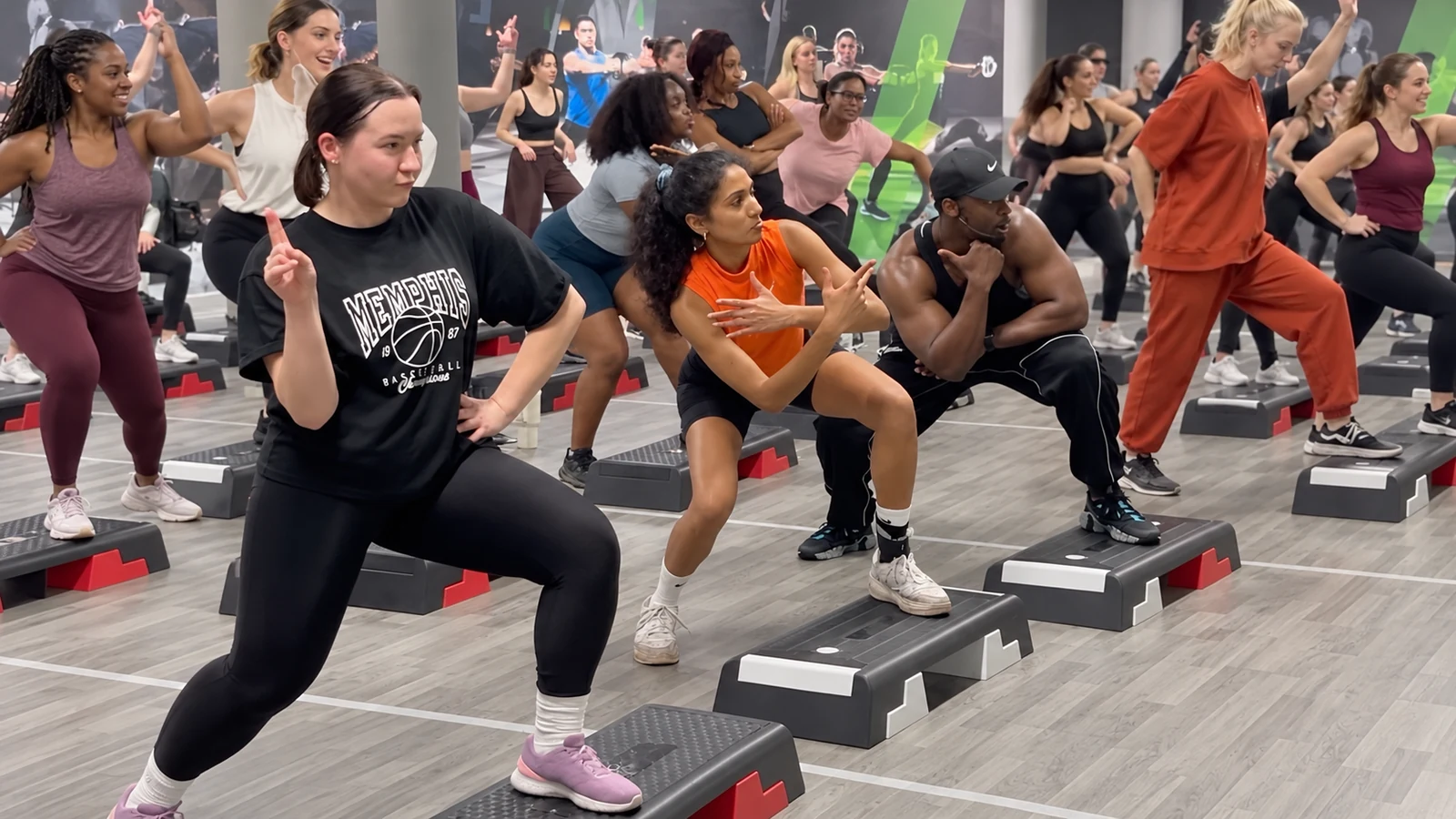
The photo attached to the Facebook post shows a crowded group class using step platforms. It demonstrates the format, not the age of the participants or a verified national trend. The caption’s statement that Gen Z or celebrities have made step aerobics a favorite is not backed by a cited participation survey. Enjoy the nostalgia if it motivates you, but do not mistake a lively image for evidence of a population-wide revival.
Step sessions are also accessible in different ways. A simple pattern—step up, bring the other foot up, step down—does not require advanced rhythm. More complex choreography is optional. A person who dislikes memorizing sequences can look for a beginner or low-impact class or do basic stepping at home with a secure platform and enough clear floor space.
The equipment need not be elaborate, but it must be stable, nonslip, and designed for stepping. An improvised wobbly stool is a poor substitute. Music can help pacing and enjoyment, though the workout’s training effect comes from the repeated movement, not from the playlist era.
Can step aerobics count as serious cardio?
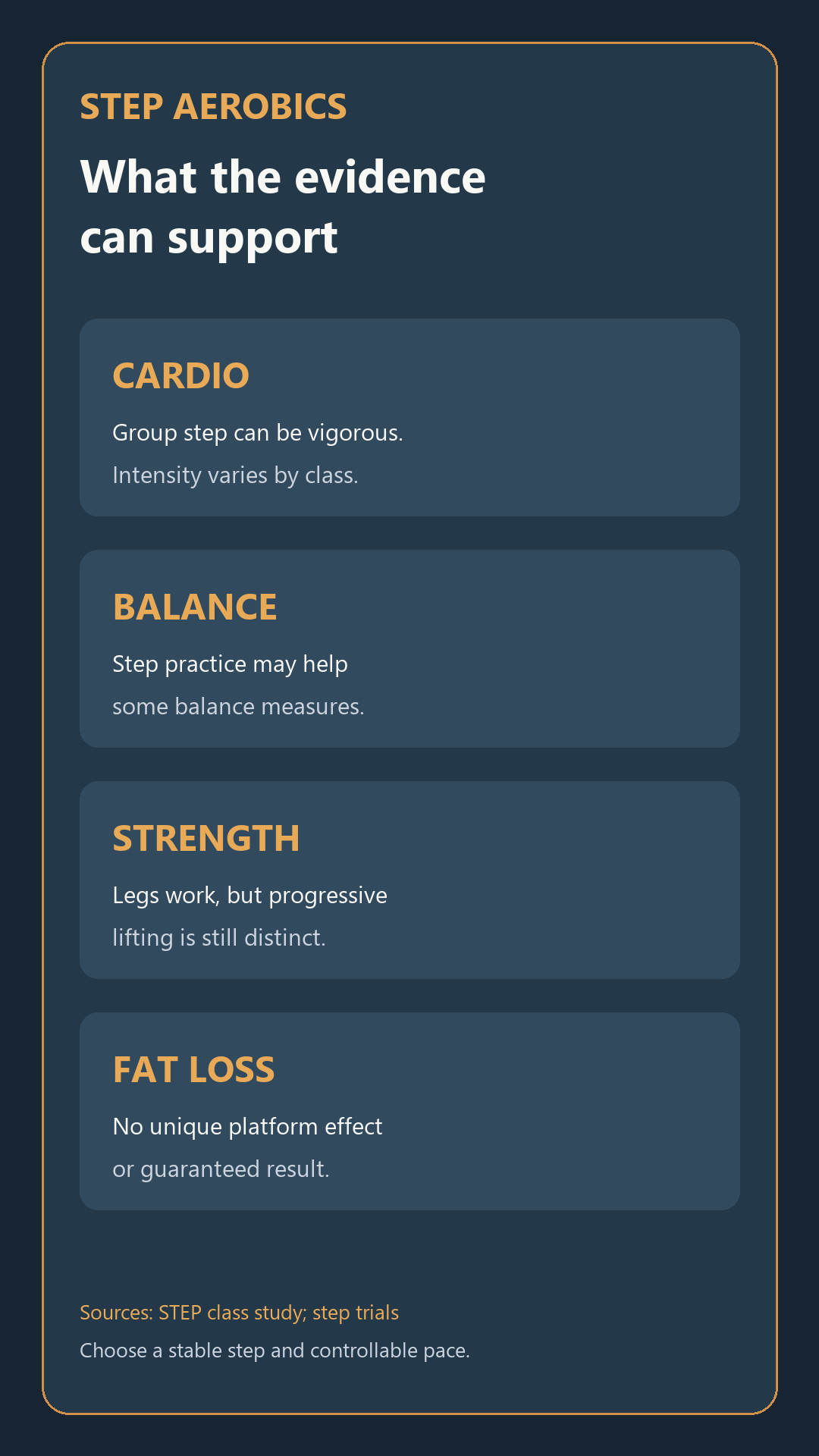
Yes, depending on how the class is run. In a small comparison of three commercial group fitness formats, ten people completed step aerobics, indoor cycling, and group resistance sessions. The step and cycling classes produced similar average heart-rate responses, both higher than the resistance class in that experiment. The step class averaged about 86% of the participants’ maximum heart rate. That shows that a step class can be demanding, not that every class will reach that intensity or that everyone should aim for it.
Training studies add a longer view. A trial in college-aged women compared continuous and interval step-dance programs with a nonexercise control over 12 weeks. Both step groups improved cardiovascular fitness and body-composition measures. The result is encouraging for the format, but the group, supervision, three weekly 50-minute sessions, and protocol may differ from a beginner class. One sweaty session is not the same as a sustained training program.
Intensity can be adjusted without turning every class into HIIT. Slower music, a lower step, fewer arm additions, and simpler patterns can lower demand. Faster cadence or more powerful stepping can raise it. A 40-minute study with ten trained women found that higher step heights increased average oxygen uptake and heart-rate reserve under its test conditions. That does not mean a higher step is always better; comfort, skill, and joint loading also matter.
Use the talk test as a simple guide. Moderate effort generally lets you talk but not sing; vigorous effort makes sustained conversation difficult. Start with a level you can control. The U.S. activity guidelines recommend accumulating 150 to 300 minutes of moderate aerobic activity weekly, or a smaller equivalent amount of vigorous activity, plus muscle-strengthening work on at least two days. A step class can contribute to the aerobic portion. If you prefer to vary effort outside a class, our running workout guide explains another way to organize intervals.
What about legs, core, coordination, and balance?
Stepping repeatedly uses the quadriceps, glutes, calves, and other muscles needed to raise and lower the body. The trunk helps keep balance. That makes the movement feel like more than a stationary bike ride for some people. Yet using a muscle does not automatically make a class an adequate strength program. The load may be too light or repetitive to keep building strength once you adapt. Progressive resistance training remains the clearer route to greater force and muscle size.
Coordinated stepping can challenge timing and balance, particularly as patterns change. In a small 13-week study of women aged 50 to 75, supervised step aerobics, walking, and a core-and-balance program each improved some dynamic balance measures. Step and walking generally performed better than the comparison program on certain static postural-stability measures. The study does not prove that step beats walking for every balance goal, but it supports the idea that practicing movement and turns can be useful.
A broader review of stepping interventions in older adults found improvements in stepping reaction time, gait, and balance, with fewer falls across its included trials. Those interventions were not all music-driven step-aerobics classes. The distinction matters: the review supports task-specific stepping practice, but cannot be pasted wholesale onto every high-energy class.
If you are learning choreography, start where you can see the platform and instructor clearly. Repeat the basic up-and-down movement until it feels automatic, then add turns or arm patterns. Getting lost in a combination is not a fitness failure; simplify and keep moving safely. Enjoyment may be a powerful reason to return, even though “surprisingly addictive” is personal, not a clinical result.
Is step aerobics a special “fat burner”?
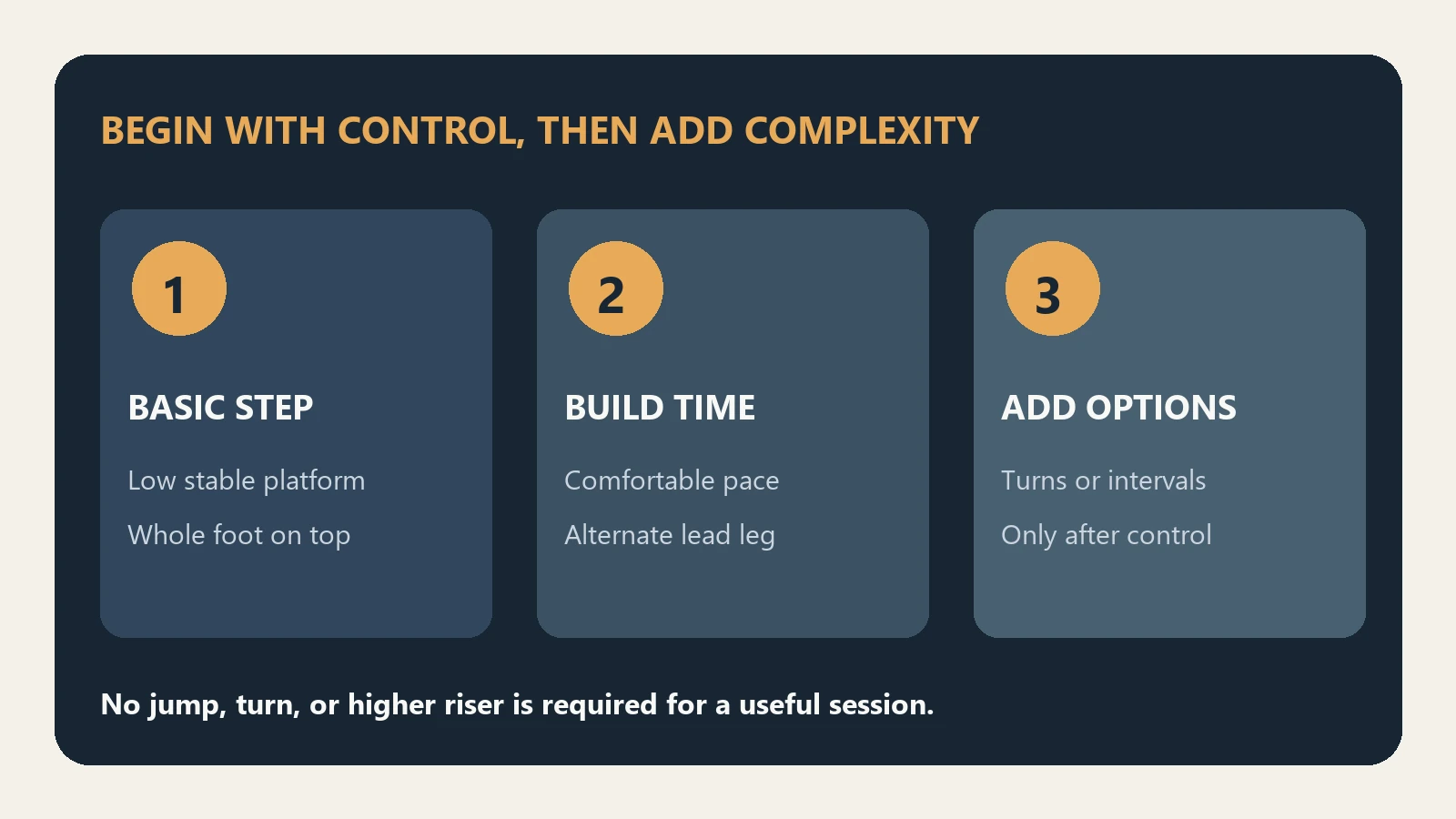
It burns energy because it is exercise, but there is no unique metabolic switch in a step platform. Calories used during a class vary with body size, pace, duration, step height, and individual efficiency. A small comparison study measured higher session energy expenditure for step and cycling than for a group resistance format. That is a comparison of those specific classes, not a guarantee of a fixed calorie number for everyone or proof of superior long-term fat loss.
Body-fat change over time depends on total energy balance, adherence, food intake, and many individual factors. The 12-week step-dance trial reported improved body-composition measures in its participants, but that does not mean every person who takes a weekly class will lose fat. Social captions often treat feeling sweaty as a proxy for a large calorie deficit. Sweat reflects cooling and conditions; it is not a direct fat-loss measure.
Some people will prefer a step class because it is fun enough to repeat. That may be more useful than a theoretically “optimal” treadmill session they avoid. If your goal is cardiovascular fitness, choose a class that reaches a suitable effort and can be progressed. If your goal is strength, add resistance training. If your goal is weight management, do not make the class carry the whole plan.
The best cardio format is one you can perform safely and consistently. A platform does not create a special fat-loss effect.
A simple way to start or restart
Begin with a stable, low platform and a short session. Practice basic stepping without a fast playlist: one foot up, the other joins, one foot down, then the other. Alternate the lead leg so one side does not do all the work. Keep your gaze toward the step when learning, make sure the whole foot lands on top, and move down with control rather than jumping off.
When that feels predictable, add several minutes of continuous stepping at a pace that lets you breathe comfortably. Then try a simple lateral step or a controlled knee lift. Add higher-energy intervals only after you can maintain the basic pattern without stumbling. You do not need to match an instructor’s every jump, turn, or arm flourish to get a useful aerobic session.
For an at-home option, clear space on all sides and check that the platform does not slide on the floor. Wear shoes with dependable grip. If you have a history of falls or balance problems, keep a stable support nearby or choose a class designed for your level. A regular stair is not automatically a safe substitute for a wide exercise platform, especially when moving laterally or to music.
Progress one variable at a time—duration, pace, or pattern complexity. Raising the step and cadence together makes it harder to tell which change caused discomfort. You can get a cardio workout with modest height. Our power-walking cardio guide offers a low-choreography alternative if stepping is not your thing.
Why platform height and technique matter
A taller platform increases the vertical work per step and often raises the demand, but it also changes joint angles and the consequences of a misstep. A biomechanics study comparing experienced instructors and novice students found technique-related differences in ankle and knee loading during basic step patterns. It is too small to set one universal “safe” step height, but it argues for learning control before chasing difficulty.
Try to place the whole foot on the platform rather than landing on its edge. Keep the knee tracking in a comfortable direction over the foot, and avoid a hard drop when stepping down. Use the hips and legs together instead of leaning dramatically backward or repeatedly pulling on the lower back. If fatigue makes foot placement inaccurate, slow down or lower the platform.
Overuse risk rises when the same movement is done frequently at high volume. A study of step-aerobics instructors reported many lower-extremity complaints over years of teaching, with work hours and platform height among factors related to days absent. Instructors’ exposure is much greater than a beginner’s, so the injury figures should not be used to predict your personal risk. They do reinforce the value of sensible dose, recovery, and technique.
Who should modify a step class?
Someone with active knee, ankle, foot, hip, or back pain should choose a tolerable height and pace or ask a clinician about modifications. Recent injury, balance impairment, or a fall history may call for supervised progression. A low-impact version avoids hops and abrupt pivots. If a movement causes sharp pain, dizziness, or unstable foot placement, stop or switch to a simpler pattern.
People returning from inactivity can keep the first sessions short and gradually extend them. For some, a floor-based aerobic dance or brisk walking session is a better starting point. If you have a known heart or lung condition, follow your clinician’s activity guidance for intensity and symptoms. Seek prompt care for chest pain, fainting, or unusual severe breathlessness rather than trying to “push through” a class.
The social caption’s promise that all you need is a riser and willpower misses these practical details. Safe space, appropriate footwear, a suitable starting level, and recovery all matter. You can enjoy the energy of group fitness without turning every class into an all-out interval test.
The takeaway
Step aerobics can provide meaningful aerobic work, and structured stepping may help balance and coordination in some groups. It also uses the legs heavily, but it should not be sold as a replacement for progressive strength training or a special fat-loss shortcut. The supposed “comeback” may be culturally appealing; the evidence-based reason to try it is simpler: you enjoy it, can control the moves, and can repeat it safely.
Sources
- Commercial group fitness class comparison, 2017, heart rate and energy expenditure.
- Continuous versus interval step-dance trial, 2005, 12-week training outcomes.
- Step aerobics, walking, and balance trial in women aged 50 to 75.
- Stepping-intervention systematic review, 2017, gait, balance, and falls in older adults.
- Step height and physiological response study, ten trained women.
- Step-aerobics biomechanics study, 2017, movement technique and joint loading.
- Instructor injury study, 2014, high-exposure overuse context.
- U.S. Physical Activity Guidelines, adult aerobic and strength recommendations.