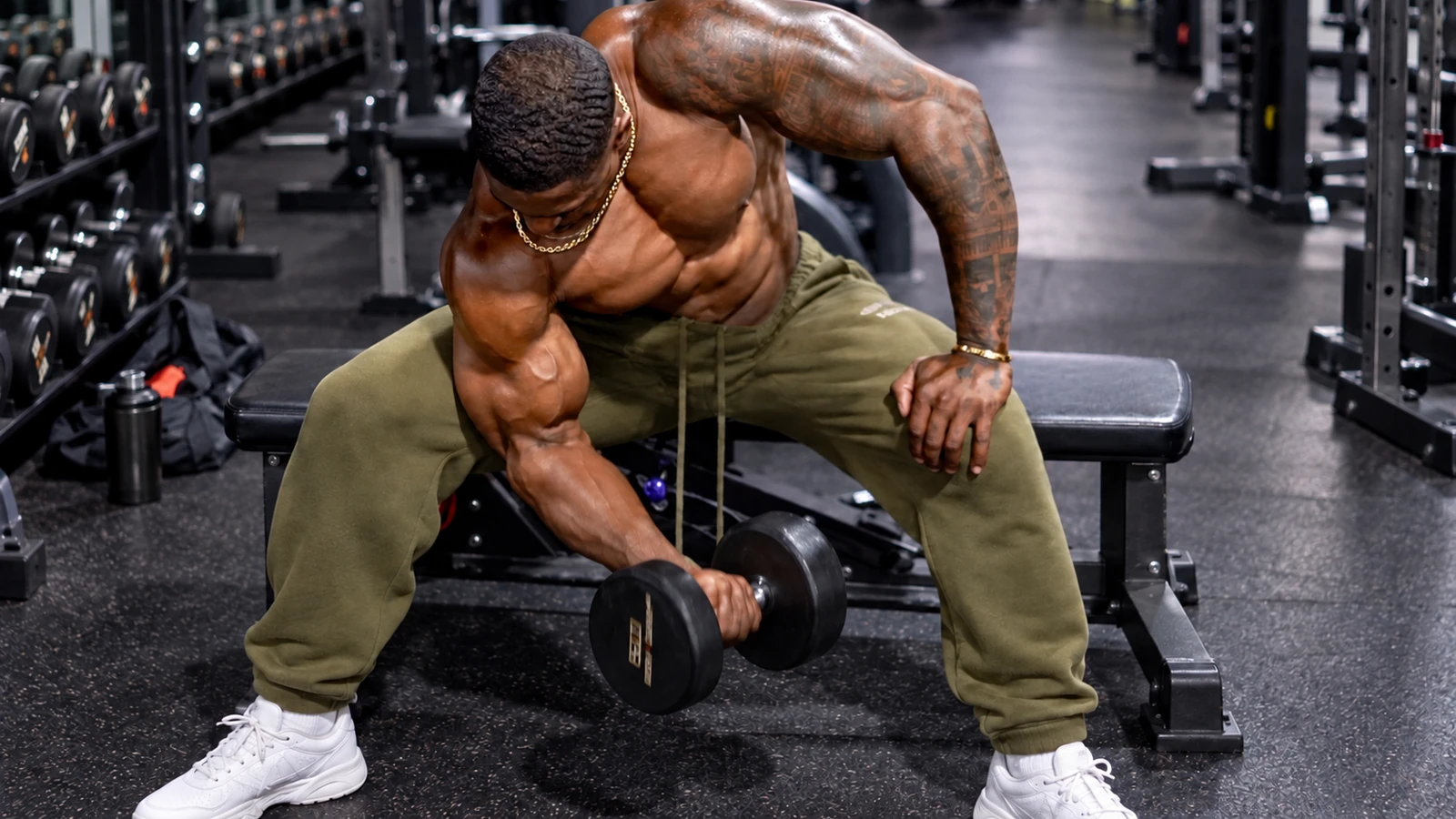

The Simeon Panda arm workout circulating online is based on a real routine he demonstrated: concentration curls, bodyweight dips, hammer curls, cable pushdowns, and a two-exercise cable superset.
Count the two finisher movements separately and the headline’s six moves are accurate.
The exercise list is legitimate, but the caption oversells what it does.
You do not need to shock a muscle, reach failure on every set, or copy a high-volume session exactly to grow your arms.
The useful part of this workout is the exercise sequence.
The total dose has to fit the lifter’s whole week.
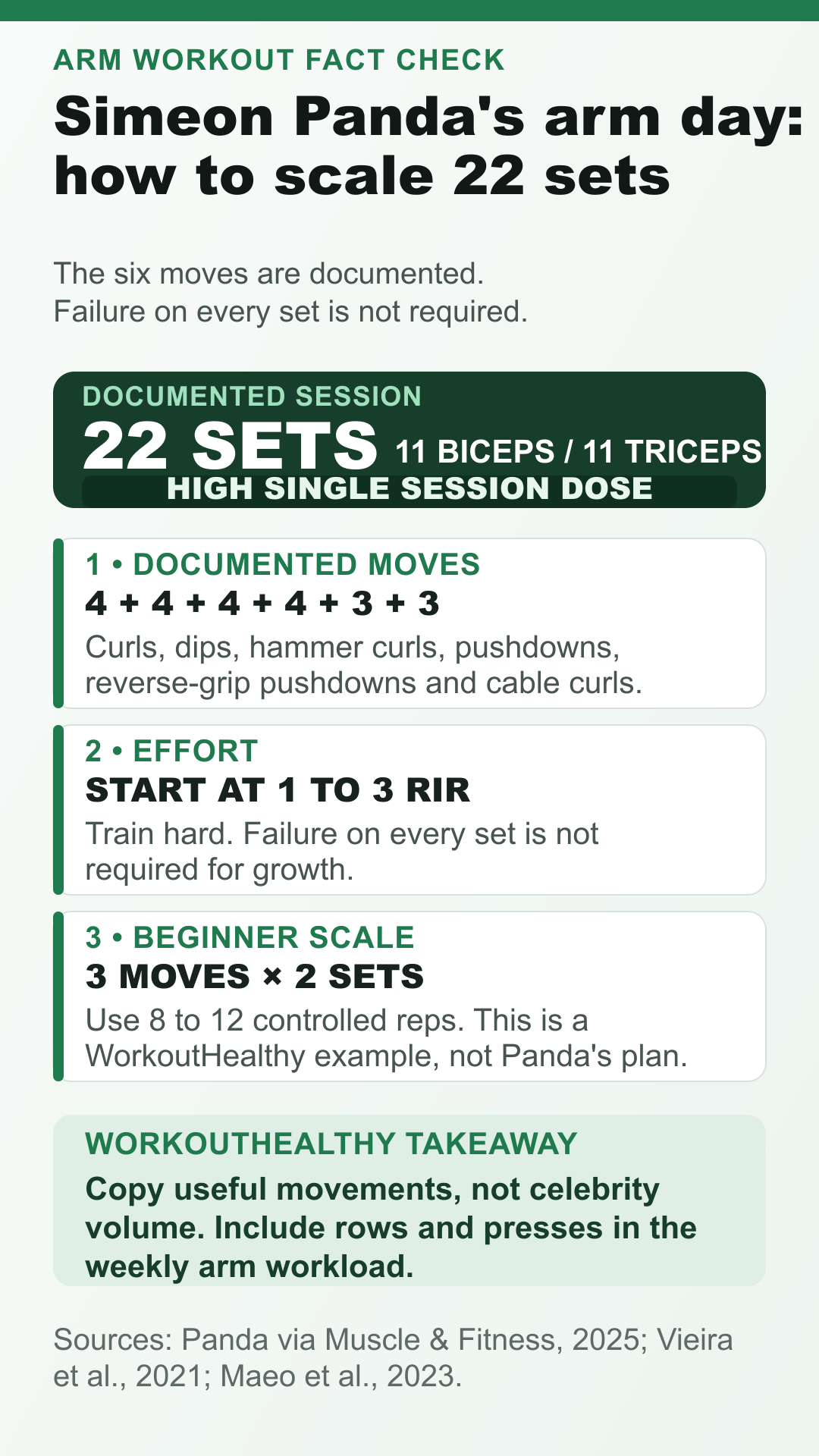
The documented six-move routine
A Muscle & Fitness report preserved the sets and repetitions shown with Panda’s post.
The first four movements use straight sets, while the last two form a superset.
| Exercise | Sets | Repetitions | Main role |
|---|---|---|---|
| Concentration curl | 4 | 6 to 10 | Elbow flexion with a supinated grip |
| Bodyweight dip | 4 | 10 | Compound pressing for triceps, chest, and shoulders |
| Hammer curl | 4 | 8 to 10 | Elbow flexion with a neutral grip |
| Cable triceps pushdown | 4 | 8 to 10 | Elbow extension with the arm near the torso |
| Single-arm reverse-grip pushdown | 3 | 8 to 10 | Unilateral elbow extension |
| Cable curl | 3 | 8 to 10 | Constant-resistance elbow flexion |
The reverse-grip pushdown and cable curl are alternated without a normal rest interval between exercises.
Rest after both movements, then repeat the pairing until all three rounds are complete.
Watch the authentic source
The post below uses the same Instagram link embedded in the published workout report.
The report connects that post to the exercise sequence rather than a fan-made reconstruction.
That provenance matters because many celebrity routines are rewritten until the exercises, order, and volume no longer match the original.
Here, the basic list survives the reposting process, while several explanations attached to it do not.
How much training is this?
The session provides 11 direct biceps sets from concentration curls, hammer curls, and cable curls.
It also provides 11 direct or strongly triceps-focused sets from dips and the two pushdown variations.
That is a large single-session dose before counting biceps work from rows and pulldowns or triceps work from presses elsewhere in the week.
Recent dose-response research supports more weekly volume as a potential driver of greater hypertrophy, but the returns diminish as sets accumulate.
Volume also has to be recoverable.
If repetition performance collapses, elbows remain irritated, or the next upper-body session suffers, the nominal number of sets overstates the amount of useful work completed.
Our review of a daily biceps and triceps experiment shows why weekly set totals matter more than a dramatic single-session number.
Someone who wants a wider menu of movements can use our dumbbell exercise library, but exercise variety should solve a programming problem.
It should not replace progressive overload with constant novelty.
Do the sets need to reach failure?
The social caption tells lifters to hit failure and shock their muscles.
Neither phrase is a biological requirement for growth.
Meta-analyses comparing failure with nonfailure training generally find similar hypertrophy when work is reasonably matched.
Hard sets matter, but stopping with roughly one to three good repetitions in reserve can stimulate growth while reducing the fatigue and technique breakdown created by repeated all-out sets.
Failure can still be used selectively.
The final set of a stable cable curl or pushdown is a more forgiving place for it than a dip performed while the shoulders are already tired.
Changing exercises can renew motivation or alter where tension is felt, but muscles do not become confused by a familiar lift.
Keep a useful movement long enough to improve its repetitions, load, range, or control.
What each exercise contributes
Concentration curls
Bracing the upper arm against the inner thigh limits body swing and makes the load easy to track.
The movement trains the biceps through elbow flexion, while the brachialis also contributes.
It does not isolate one magical biceps peak.
Muscle shape is strongly influenced by anatomy, and the practical goal is controlled elbow flexion through a comfortable range.
Bodyweight dips
Dips are the only compound exercise in the session.
They train the triceps along with the chest and front of the shoulders, so the caption’s suggestion that they also tax the back should be understood as stabilization rather than primary back training.
Bodyweight is not automatically the correct load.
Use assistance if ten controlled repetitions are not available, and choose a close-grip press or push-up variation if dips cause persistent front-of-shoulder pain.
Hammer curls
The neutral grip keeps the biceps active while increasing the contribution of the brachialis and brachioradialis.
It is a useful complement to a supinated curl, not a shortcut to guaranteed arm thickness.
A brief pause can improve control, but an exact one-second hold is optional.
The set still needs an appropriate load, a stable elbow, and a controlled lowering phase.
Pushdowns and cable curls
Cables keep external resistance on the movement across much of the repetition and make small load changes practical.
A standard pushdown and a reverse-grip pushdown are similar patterns, so the second variation adds volume more clearly than it adds a completely new stimulus.
The finisher alternates opposing elbow actions, which saves time and creates a strong pump.
A pump reflects temporary fluid and blood-flow changes, not proof that a workout will produce more long-term growth.
What the workout may be missing
All three triceps choices keep the upper arm near the torso.
A controlled overhead cable or dumbbell extension would train elbow extension with the triceps long head in a more lengthened position.
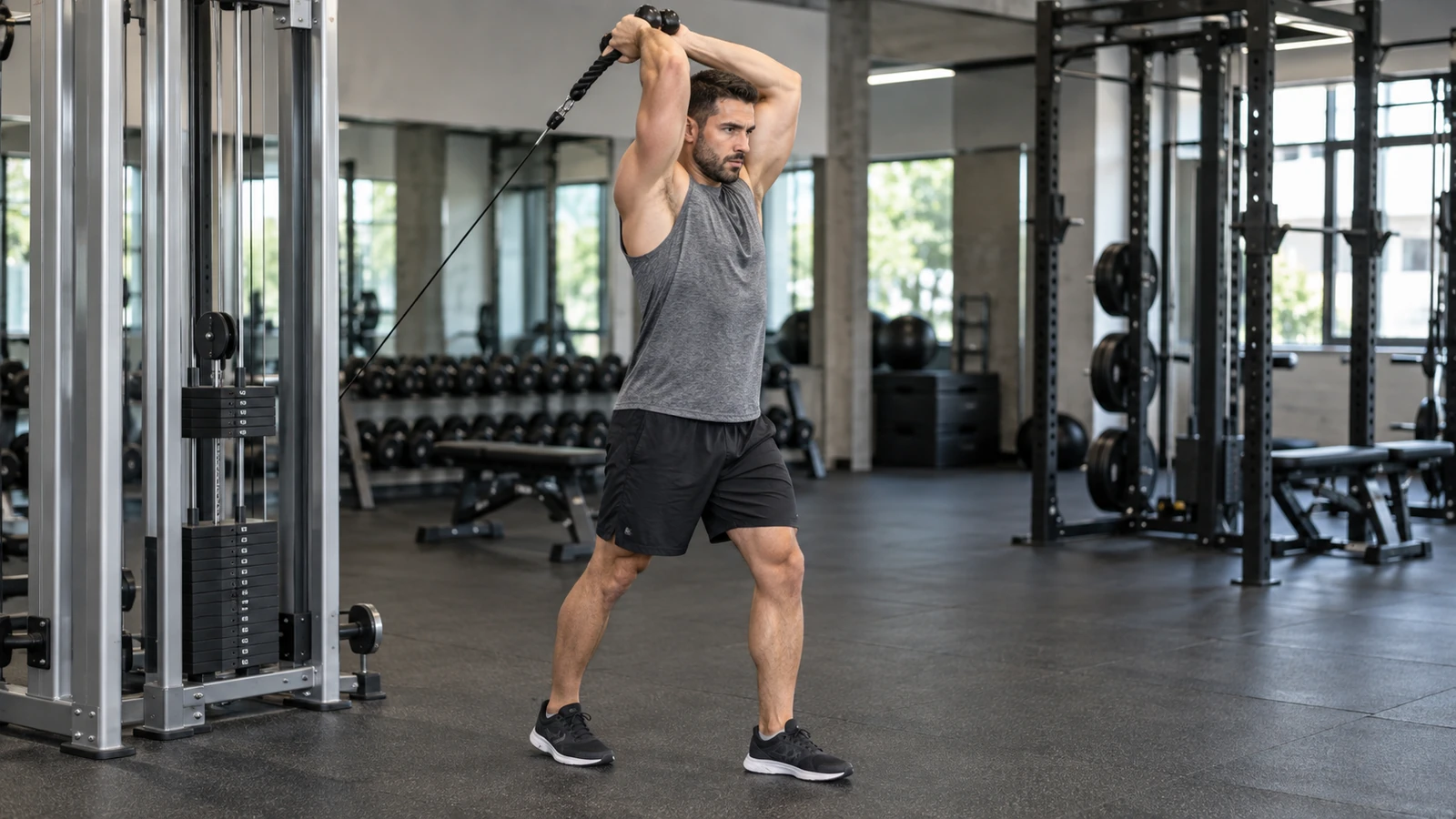
One direct comparison found substantially greater triceps growth from overhead cable extensions than from neutral-arm extensions.
That does not invalidate pushdowns, but it supports replacing one redundant pushdown slot when complete triceps development is the goal.
The biceps side also emphasizes curls with the upper arm beside or in front of the torso.
An incline curl can provide a different shoulder position, although no single angle is mandatory when the program already includes hard pulling and multiple curl patterns.
Our review of once-weekly body-part splits explains why spreading arm work across the week can be easier to recover from than one oversized session.
Direct arm work should be counted alongside those compound sets rather than programmed in isolation.
Technique changes worth making
Use a range you can control without joint pain, and let the elbow straighten without snapping into the end position.
The phrase lock out is a position cue, not permission to slam the joint.
Keep the weight moving through the largest comfortable range available.
Reviews of range-of-motion research generally favor full repetitions or work performed at longer muscle lengths over short repetitions confined to the contracted end.
Do not force the elbow to remain frozen if a small natural adjustment keeps the movement comfortable.
The goal is repeatable loading of the target muscles, not a pose that creates wrist, elbow, or shoulder irritation.
If grip comfort limits curls, try a neutral or angled handle that lets the wrist stay comfortable. Handle choice does not turn one curl into a universally superior exercise.
How to scale the workout
Beginner version
Choose one curl, one press or assisted dip, and one triceps isolation exercise.
Perform two sets of 8 to 12 controlled repetitions for each movement, twice per week if recovery is good.
That creates a manageable base for learning technique and progression.
Add a third set only after soreness, elbow comfort, and performance are stable.
Intermediate version
Perform three sets each of concentration curls, assisted or bodyweight dips, hammer curls, and overhead cable extensions.
Finish with two alternating sets of cable curls and pushdowns if the extra work remains productive.
This version preserves Panda’s mix of compound and isolation work while reducing the session from 22 arm-focused sets to a more manageable total.
The exact dose should still reflect pressing, pulling, and direct arm work completed elsewhere.
Full version
Use Panda’s published set counts only if you already tolerate high arm volume and can maintain performance across the session.
Start with two or three repetitions in reserve and reserve failure for an optional final isolation set.
If cables or dip bars are unavailable, substitute dumbbell curls and a controlled press or push-up variation.
Match the movement pattern and progression rather than trying to recreate every sensation.
How to progress it
Pick a load that places the first work set near the bottom of the prescribed repetition range with clean form.
Keep the load until all sets reach the top of the range at the planned effort.
Then make the smallest available increase and rebuild the repetitions.
If the cable stack jumps too far, add repetitions, slow an uncontrolled lowering phase, or use a small magnetic plate before adding another full set.
Record load, repetitions, assistance, and estimated repetitions in reserve.
A larger pump or more soreness is not a substitute for evidence that performance is improving.
Deload or reduce direct arm work when elbow tenderness accumulates, repetitions fall for several sessions, or pressing and pulling regress.
More work is useful only while it remains recoverable.
Where it fits in a week
A dedicated arm day can follow a lower-body day so the elbows and shoulders are not already fatigued from pressing or pulling.
Leave enough time before the next upper-body session for normal performance to return.
The smaller version can be divided across two days, with curls after pulling and triceps work after pressing.
Splitting volume often improves set quality without requiring more weekly exercises.
Count indirect work honestly.
Rows, pulldowns, presses, and close-grip patterns contribute meaningful arm stress even though they are not identical to direct curls and extensions.
The bottom line
Simeon Panda’s six-move arm workout is authentic, and its exercise sequence can build the biceps and triceps when the sets are progressed over time.
The routine is not powered by muscle confusion, a mandatory one-second squeeze, or failure on every set.
Its main limitation is dosage: roughly 11 direct biceps sets and 11 direct or strongly triceps-focused sets can be excessive in one session.
Most lifters should begin with fewer sets, keep one to three repetitions in reserve, and consider replacing a redundant pushdown with an overhead extension.
Copy the logic, not the celebrity’s workload.
Use stable exercises, comfortable range, measurable progression, and a volume you can recover from.
Get the next evidence check.
Five practical fitness stories worth your time, every Friday.
One email a week. No product pitches. Unsubscribe in one click.
References
- Felstead, S. Simeon Panda’s 6-move arm workout to build massive biceps and triceps. Muscle & Fitness.
- Panda S. Train Arms With Me. Instagram. 2025.
- Pelland JC, Remmert JF, Robinson ZP, Hinson SR, Zourdos MC. The Resistance Training Dose Response: Meta-Regressions Exploring the Effects of Weekly Volume and Frequency on Muscle Hypertrophy and Strength Gains. Sports Medicine. 2026.
- Vieira AF, et al. Effects of Resistance Training Performed to Failure or Not to Failure on Muscle Strength, Hypertrophy, and Power Output. Journal of Strength and Conditioning Research. 2021.
- Refalo MC, et al. Influence of Resistance Training Proximity-to-Failure on Skeletal Muscle Hypertrophy. Sports Medicine. 2023.
- Kassiano W, et al. Which ROMs Lead to Rome? A Systematic Review of the Effects of Range of Motion on Muscle Hypertrophy. Journal of Strength and Conditioning Research. 2023.
- Maeo S, et al. Triceps Brachii Hypertrophy Is Substantially Greater After Elbow Extension Training Performed in the Overhead Versus Neutral Arm Position. European Journal of Sport Science. 2023.
- American College of Sports Medicine. Resistance Training Prescription for Muscle Function, Hypertrophy, and Physical Performance in Healthy Adults. Medicine & Science in Sports & Exercise. 2026.
Medical disclaimer: This article is for general information only and is not medical advice. If you have an injury, ongoing pain, or a medical condition, talk to a doctor or physical therapist before you change how you train or eat.