
Keanu Reeves turns 62 this year. He is still doing his own knife work, his own gun reloads, and most of his own falls in the John Wick films.
That is not an accident.
A widely shared fitness roundup credits Reeves with an intense martial arts and firearms training program built for the role.
The general shape of that claim holds up well.
The specifics are more interesting than the summary. Reeves did not just “train hard.” He spent months learning several distinct combat disciplines at once, under some of the most respected names in stunt choreography and tactical shooting.
Who Keanu Reeves Is and Why This Role Mattered
Reeves built his career on physical roles long before John Wick.
He did his own motorcycle riding in the Matrix films. He trained in kung fu and wire work for those movies in the late 1990s.
John Wick, released in 2014, asked for something different. Director Chad Stahelski is a former stuntman who doubled for Reeves in The Matrix.
Stahelski and his creative partner David Leitch wanted a fighting style that looked real, not choreographed.
They wanted an actor who could sell every throw, every gun reload, and every close-quarters exchange without a stunt double stepping in for the wide shots.
Reeves was in his late forties when the first film went into production. By John Wick: Chapter 4 in 2023, he was 58.
He has called the physical demands of the franchise the hardest of his career. In an interview about training for Chapter 4, he said, “It’s been about 12 weeks of training. It’s new levels of action. You know, nun-chucks, which was challenging,” and described it as “the hardest physical role I’ve ever had in my career so far.”
What the Training Actually Involved
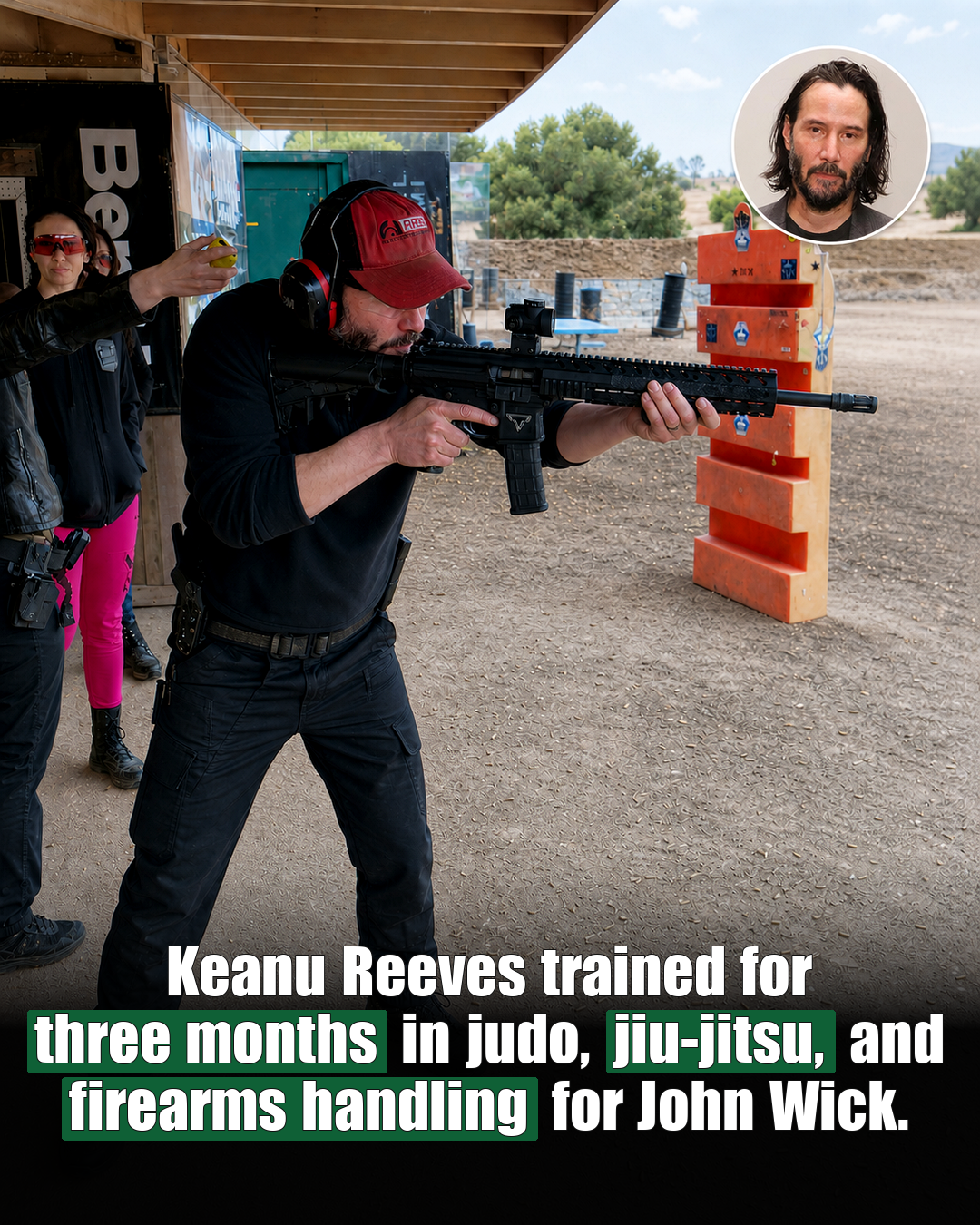
The training for the first John Wick took roughly three months.
Stahelski has said the process included judo, jiu-jitsu, and firearms handling, layered on top of general strength and conditioning.
Fight coordinator Jonathan Eusebio worked with Reeves directly on technique. For ground fighting, Reeves trained with the Machado brothers, a well known family of Brazilian jiu-jitsu instructors.
That training was serious enough that Reeves later received an honorary judo black belt, recognizing the level of technical skill he reached.
Firearms work came from a different specialist. Taran Butler, a competitive tactical shooter, taught Reeves the gun handling seen throughout the franchise, including fast reloads and target transitions under simulated pressure.
For John Wick: Chapter 3, Reeves also trained with a former Navy SEAL on more advanced tactical movement, the kind of close-quarters positioning used in real defensive shooting scenarios.
By Chapter 4, the list of skills had grown to include nunchucks and more complex vehicle stunts, including controlled 180 degree spins and reverse driving maneuvers performed while handling prop weapons.
None of this was simulated on camera. Stahelski has said repeatedly that the goal was for Reeves to actually perform the technique correctly, not just look like he was performing it.
The Style Has a Name: Gun-Fu
Stahelski describes the resulting fighting style as “gun-fu.”
He has defined it directly as “a combination of Japanese jiu-jitsu, Brazilian jiu-jitsu, tactical 3-gun, and standing Judo.”
The term borrows from Hong Kong action cinema, where director John Woo pioneered a style that blended gunplay with hand-to-hand choreography in the late 1980s.
Films like A Better Tomorrow treated a pistol as one more tool in a fighter’s body, not a separate weapon used only at range.
The John Wick version pulls from several real disciplines at once.
Judo supplies the throws: hip throws, shoulder throws, and sweeps that end a fight quickly.
Brazilian jiu-jitsu supplies the ground game, including chokes and joint locks once an opponent is down.
Kali, a Filipino martial art built around stick and knife work, supplies the trapping and mid-range weapon defense.
Tactical three-gun competition shooting supplies the fast, accurate weapon handling.
Gun-fu is not one martial art. It is four real disciplines stitched together so a fight never has to stop moving between them.
Why This Kind of Training Actually Works
There is real exercise science behind why this approach produces a convincing fighter in a matter of months, not years.
Motor skill research shows that basic technique can be learned and retained faster than most people expect.
A 2019 study published in PeerJ tested how quickly novice women could learn two Krav Maga strike techniques, a straight punch and a defensive kick (Di Bacco et al., 2019).
One group trained in a single 15 minute session. A second group trained across four separate days.
The single-session group performed just as well as the group with repeated practice. Both groups retained the skill for up to 12 days without any measurable drop-off.
That finding matters here. It helps explain why a few months of focused, well coached practice can produce technique that looks convincingly skilled on camera, even without years of competitive training.
Basic technique is not the same as full fighting readiness, and the researchers were careful about that distinction.
Simple, single movements can be acquired quickly. Complex sequences that chain multiple techniques together under real pressure take much longer to build.
The physical side of the training also has research behind it.
A 2017 systematic review in the journal Sports Medicine Open looked at the physical profile of Brazilian jiu-jitsu athletes across 58 studies (Andreato et al., 2017).
It found that grip strength, not aerobic fitness, was one of the clearest markers separating skilled practitioners from beginners.
Elite competitors showed handgrip strength in the range of 48 to 57 kilograms of force.
The review also found that explosive lower body power, measured through vertical jump, predicted success in match-deciding techniques more reliably than general endurance did.
That lines up with what stunt choreography actually needs: short, powerful, technically precise movements repeated many times during a shoot day, not long steady cardio output.
The same kind of explosive power shows up in other training methods. Our look at whether box jumps build muscle covers the plyometric side of that same principle.
How This Compares to a Typical Actor Fitness Program
Most actors preparing for a physical role follow a fairly standard formula.
They lift weights for muscle size, run or cycle for cardio, and clean up their diet to look lean on camera.
That approach is built around appearance and general fitness.
Reeves’ training followed a different logic entirely. It was built around a concept called specificity of training, sometimes called the SAID principle, which stands for specific adaptations to imposed demands.
The idea is simple. The body and nervous system adapt to the exact movements they repeatedly practice, not to generic conditioning.
A bodybuilding style program can build a muscular frame. It does not teach someone to disarm an opponent, transition into a choke, and draw a weapon in one continuous motion.
Reeves’ training instead prioritized skill first and used strength and conditioning to support that skill.
Grip work, explosive power, and short bursts of intensity were trained because grappling and gun handling actually demand them, not because they build an impressive physique.
This is closer to how real combat athletes train than how most Hollywood action leads train.
A boxer or judoka spends far more time on technique repetition than on generic gym work.
General fitness is treated as the supporting layer underneath it, not the main event.
Common Mistakes People Make Trying to Copy This
The biggest mistake is trying to learn everything at once without a real coach.
Reeves had multiple specialists working with him individually: a jiu-jitsu team, a judo influence, a dedicated firearms instructor, and a stunt coordinator overseeing how it all combined.
Trying to absorb judo, jiu-jitsu, knife defense, and gun handling from videos alone skips the correction that makes any of it safe or effective.
A qualified coach is worth the cost. Our guide on how to decide whether you need a personal trainer covers how to find one.
A second mistake is confusing screen-ready technique with fight-ready skill. Choreographed sequences are practiced repeatedly with a known partner and a known outcome.
Live sparring and real self-defense involve an opponent who is actively resisting, which is a completely different skill.
A third mistake is treating firearms training casually. Butler and the film’s tactical advisors work within strict range safety protocols and use trained professionals at every step.
Attempting to replicate fast reloads or movement drills without certified instruction and a controlled range environment is genuinely dangerous.
A fourth mistake is skipping the conditioning base. Reeves had general strength and mobility work supporting the skill training.
Jumping straight into high-intensity grappling or weapons drills without any conditioning background raises injury risk significantly, especially for joints and connective tissue that have not adapted to sudden, explosive loads.
Who Should Be Cautious Before Trying This Kind of Training
Anyone with an existing shoulder, knee, or spine injury should talk to a doctor or physical therapist before starting judo or jiu-jitsu.
Throws and ground grappling put real, sudden stress on joints, and an old injury can flare quickly under that kind of load.
Beginners to grappling sports should always start under a certified instructor at a licensed gym, never with an unsupervised training partner.
Chokes and joint locks carry real risk of injury when applied or escaped incorrectly.
Anyone new to firearms should only train with a certified instructor at a proper range, following that range’s safety rules without exception.
People with cardiovascular conditions should ease into high-intensity interval-style training gradually and get medical clearance first, since combat sport conditioning often involves short, maximal-effort bursts.
Older adults returning to any explosive or high-impact training after a long break should build a general strength and mobility base first, the same sequence Reeves himself followed before the technical work began.
A Practical How-To for Building Your Own Version
You do not need a movie budget to train the way Reeves did. You do need patience and the right order of operations.
Start with a conditioning base. Spend four to six weeks on general strength training and mobility work before adding any combat sport.
Focus on grip strength, core stability, and hip mobility, since all three show up constantly in both judo and jiu-jitsu.
Pick one grappling discipline first, not several at once. Judo and Brazilian jiu-jitsu are both excellent starting points, and most cities have certified schools offering beginner classes.
Attend two to three classes a week for the first few months. Consistency matters more than volume early on, since the nervous system needs repeated, correct exposure to a movement before it becomes automatic.
Let a real instructor correct your form in person. Video tutorials cannot see what your body is actually doing on the mat.
Add supplemental strength work on non-grappling days. Focus on compound lifts like deadlifts and rows for grip and posterior chain strength, since both support throws and ground control.
If you want to add firearms training, treat it as a completely separate track with its own certified instructor.
Never combine live-fire practice with grappling practice in the same session, and never train with firearms outside a proper range.
Only after several months of consistent, supervised practice in one discipline should you consider adding a second one, the same layered approach the John Wick production used across months, not days.
Track technical progress, not just how hard a session felt. Can you complete a throw with proper form under light resistance? Can you escape a basic hold? Those markers matter more than how tired you are afterward.
Expect the timeline to feel slow at first. Reeves had a team of specialists working with him daily for months, and he still called it the hardest physical challenge of his career.
A realistic goal for most people is basic competency in one discipline within three to six months of consistent, supervised training, not the multi-discipline fluency seen on screen.
For a different look at what a patient, phased comeback to serious training can look like, see our piece on George Foreman’s comeback training.
References
Andreato, L. V., Lara, F. J. D., Andrade, A., & Branco, B. H. M. (2017). Physical and physiological profiles of Brazilian jiu-jitsu athletes: A systematic review. Sports Medicine Open, 3, Article 9. https://doi.org/10.1186/s40798-016-0069-5
Di Bacco, V. E., Taherzadeh, M., Birot, O., & Gage, W. H. (2019). The effects of single versus multiple training sessions on the motor learning of two Krav Maga strike techniques, in women. PeerJ, 7, e8525. https://doi.org/10.7717/peerj.8525
This article is for general information only and is not medical advice. Judo, jiu-jitsu, and firearms training carry real risk of injury. Talk to a doctor before starting any new high-intensity training program, and only train combat sports or firearms under certified, in-person instruction.