

More than 800 years ago, a scholar and physician wrote health advice that could pass for a modern wellness column.
His name was Moses Maimonides.
A widely shared summary of his advice says to move gently every day, avoid overeating, and take the middle path.
Those ideas do appear in his writings, though not always in the book they are usually credited to.
Modern research supports more of this advice than you might expect.
What Maimonides Actually Wrote
The advice is often linked to his Regimen of Health.
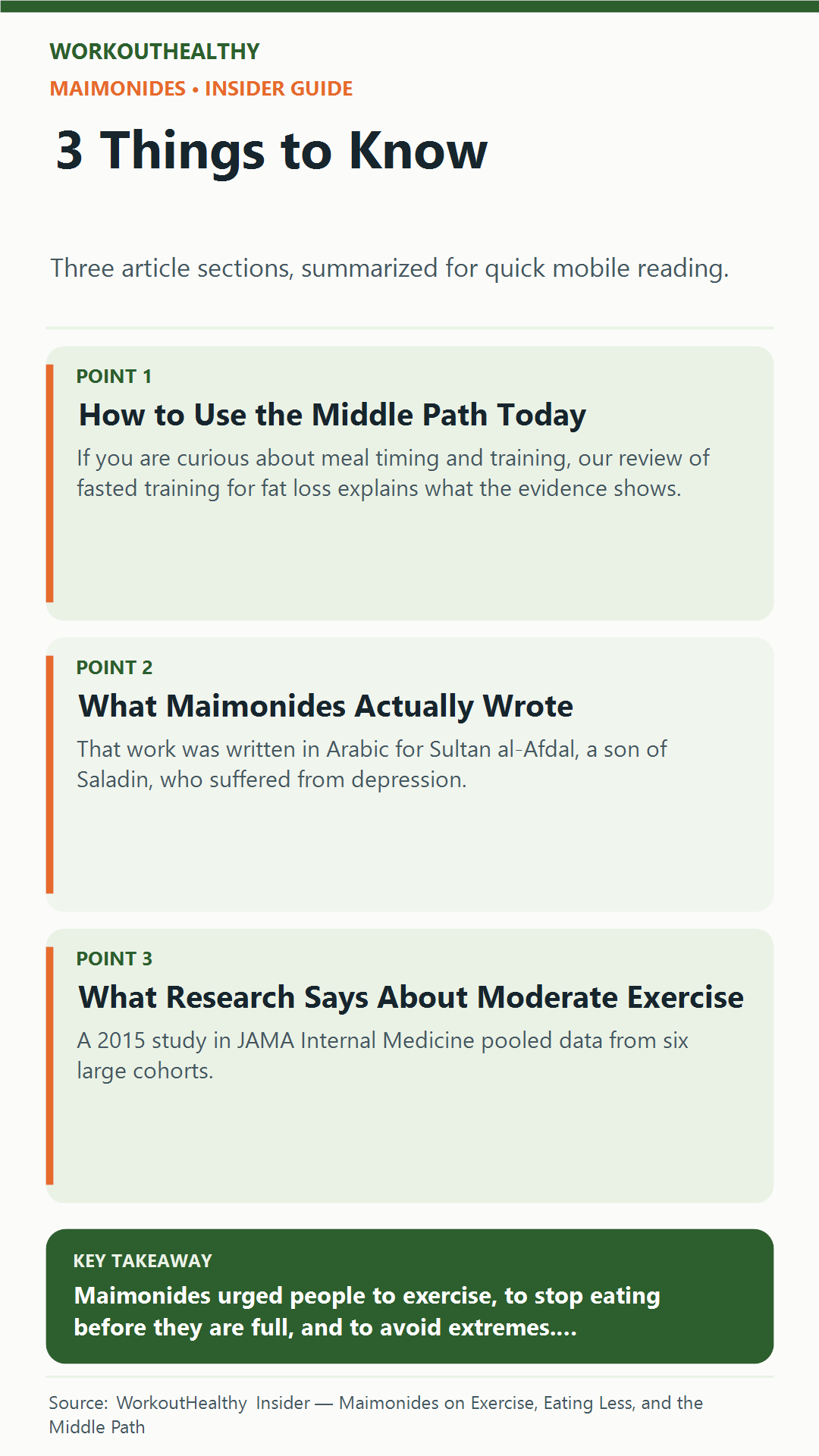
That work was written in Arabic for Sultan al-Afdal, a son of Saladin, who suffered from depression.
Its general theme was healthy living and avoiding excess.
The clearest wording on exercise and eating, though, comes from another work: the Mishneh Torah, in the section on human dispositions.
In Eliyahu Touger’s English translation, chapter 4 says, “One should not eat until his stomach is full.”
It adds that a person should stop at close to three quarters of full satisfaction.
The same chapter says a person should not eat until after a stroll “sufficient to raise his body temperature.”
It also states that as long as a person exercises and does not eat to the point of fullness, he will not suffer sickness and will grow in strength.
That last promise is too strong by modern standards, but the habits behind it are sound.
The word “daily” is a fair summary of his tone, but we did not find that exact wording in the passages we checked.
Who Maimonides Was
Maimonides was born in Córdoba, in what is now Spain, around 1135 or 1138.
He died in Fustat, Egypt, in 1204.
He was a major Jewish scholar and also a working doctor.
He served as a court physician to Saladin and, after Saladin’s death, to the ruling Ayyubid family.
His Regimen of Health was later translated into Latin and printed in Florence in 1477.
The Middle Path Idea
Maimonides did not invent moderation, but he built a whole approach around it.
In chapter 1 of the same section, he wrote that the two extremes of each trait “do not reflect a proper path.”
He described the right trait as the one equidistant from both extremes and called it the middle path.
He was writing mainly about character traits in that chapter.
His health advice follows the same logic, applied to food and movement.
The middle path is not a weak compromise. It is the version of a habit you can keep for decades.
What Research Says About Moderate Exercise
A 2015 study in JAMA Internal Medicine pooled data from six large cohorts.
Hannah Arem and colleagues followed 661,137 adults for a median of 14.2 years.
Compared with people who reported no leisure activity, those doing some activity below the guideline had a 20 percent lower risk of death.
People who met the guideline to twice the guideline had a 31 percent lower risk.
Benefits leveled off around three to five times the guideline, and extra gains beyond the minimum were modest.
The authors concluded that meeting the basic recommendation gave nearly the maximum longevity benefit.
The study also found no sign of harm at much higher activity levels.
So the message is not that more is bad. It is that the first steady step matters most.
That is a modern echo of the middle path. Most of the reward comes from doing a steady, reasonable amount.
If walking is your moderate habit, our piece on walking and the gut microbiome looks at another angle.
What Research Says About Eating Past Full
Stopping before full is hard to study directly.
Eating speed is one related habit that has been studied.
A 2015 meta analysis by Toshiaki Ohkuma and colleagues pooled 23 studies.
People who ate quickly had a higher average body mass index than people who ate slowly.
Fast eaters also had about twice the odds of obesity.
The authors noted that more research is needed to test whether slowing down helps with weight control.
What the Evidence Does Not Show
These studies are observational, so they show links rather than proven cause and effect.
No study proves that Maimonides’ exact rules prevent illness.
His claim that exercise and moderate eating keep away all sickness goes further than any modern evidence.
People who exercise and eat moderately still get sick.
They tend to do better on average, which is a more honest way to put it.
How to Use the Middle Path Today
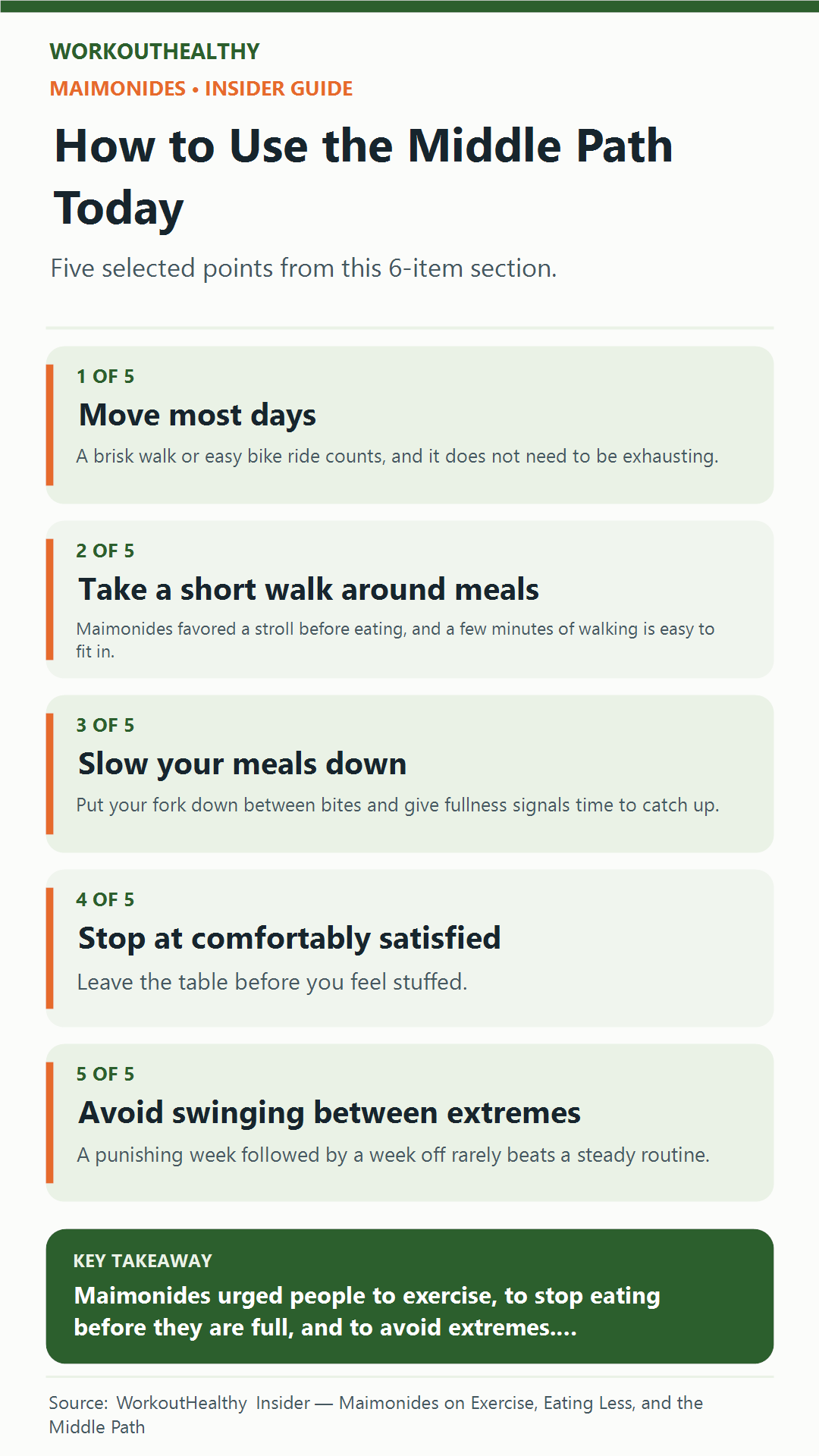
- Move most days. A brisk walk or easy bike ride counts, and it does not need to be exhausting.
- Take a short walk around meals. Maimonides favored a stroll before eating, and a few minutes of walking is easy to fit in.
- Slow your meals down. Put your fork down between bites and give fullness signals time to catch up.
- Stop at comfortably satisfied. Leave the table before you feel stuffed.
- Avoid swinging between extremes. A punishing week followed by a week off rarely beats a steady routine.
- Adjust with your life. Moderate means different things at 25 and at 75.
If you are curious about meal timing and training, our review of fasted training for fat loss explains what the evidence shows.
Who Should Adjust This Advice
People with diabetes, digestive conditions, or a history of eating problems should get personal guidance on meals and fullness.
The same goes for anyone told to follow a specific eating plan by a doctor.
If you have heart disease or have been inactive for a long time, check with your doctor before raising your activity level.
The Bottom Line
Maimonides urged people to exercise, to stop eating before they are full, and to avoid extremes.
The strongest wording comes from his Mishneh Torah, while his Regimen of Health carries the same spirit of moderation.
Modern studies support the core idea that steady, moderate activity brings most of the benefit.
For a modern voice with a similar message, read what a 104 year old woman says keeps you healthy.
Want more stories like this? Subscribe to WorkoutHealthy Insider for practical explanations behind popular fitness claims.
References
- Arem, H., Moore, S. C., Patel, A. V., Hartge, P., Berrington de González, A., Visvanathan, K., Campbell, P. T., Freedman, M., Weiderpass, E., Adami, H. O., Linet, M. S., Lee, I.-M., & Matthews, C. E. (2015). Leisure time physical activity and mortality. JAMA Internal Medicine, 175(6), 959 to 967. https://doi.org/10.1001/jamainternmed.2015.0533
- Maimonides, M. (1986 to 2007). Mishneh Torah, Hilchot De’ot (E. Touger, Trans.). Moznaim. https://www.sefaria.org/Mishneh_Torah,_Human_Dispositions.4
- Ohkuma, T., Hirakawa, Y., Nakamura, U., Kiyohara, Y., Kitazono, T., & Ninomiya, T. (2015). Association between eating rate and obesity: A systematic review and meta-analysis. International Journal of Obesity, 39(11), 1589 to 1596. https://doi.org/10.1038/ijo.2015.96
- Wikipedia contributors. (n.d.). Maimonides. In Wikipedia. Retrieved September 16, 2026, from https://en.wikipedia.org/wiki/Maimonides
This article is for general information only and is not medical advice. If you have an injury, ongoing pain, or a medical condition, talk to a doctor or physical therapist before you change how you train or eat.