
Saturday morning finally arrives.
You sat at a desk most of the week.
Now you are sprinting after a soccer ball, hauling mulch, or chasing your kids around a trail.
Doctors and physical therapists have a name for this pattern.
They call it the weekend warrior.
Tahoe Forest Health System posted a video called “Weekend Warrior Injury Prevention Tips.”
Tahoe Forest Health System is a real regional health system based in Truckee, California.
It runs Tahoe Forest Hospital, Incline Village Community Hospital, and a dedicated Orthopedics and Sports Medicine program.
That clinical background gives the video real weight.
So we went looking for the actual research behind the weekend warrior injury pattern.
Here is what real studies say, and what they do not say.
What the Video Claims
The video comes from Tahoe Forest Health System’s YouTube channel.
Tahoe Forest Health System is a nonprofit hospital district serving the Truckee Tahoe and Incline Village region.
It is affiliated with UC Davis Health.
Its website lists a dedicated Orthopedics and Sports Medicine service line, along with physical therapy and rehabilitation.
The health system has also earned an American Orthopaedic Association “Own the Bone” award for its bone health program.
That makes it a genuine clinical source, not an anonymous fitness influencer.
We could not verify which clinician appears in this specific video. The public page does not name one presenter.
So we treated the video as general patient education from a real hospital system.
Then we checked its core message against the published research.
That message is simple.
People who are inactive most of the week, then push hard on the weekend, face a real and specific injury risk.
The video frames this as something to prepare for, not something to avoid entirely.
That framing matches the actual science closely.
What Real Research Shows About Who Gets Hurt
Sports medicine researchers have tracked athletic injuries by age and activity level for decades.
One classic study reviewed more than 4,500 injury cases treated at a sports medicine clinic (DeHaven & Lintner, 1986).
The researchers found that injury patterns shifted clearly with age.
Younger, regularly trained athletes tended toward acute injuries from contact and collision.
Older, recreational athletes showed a different pattern.
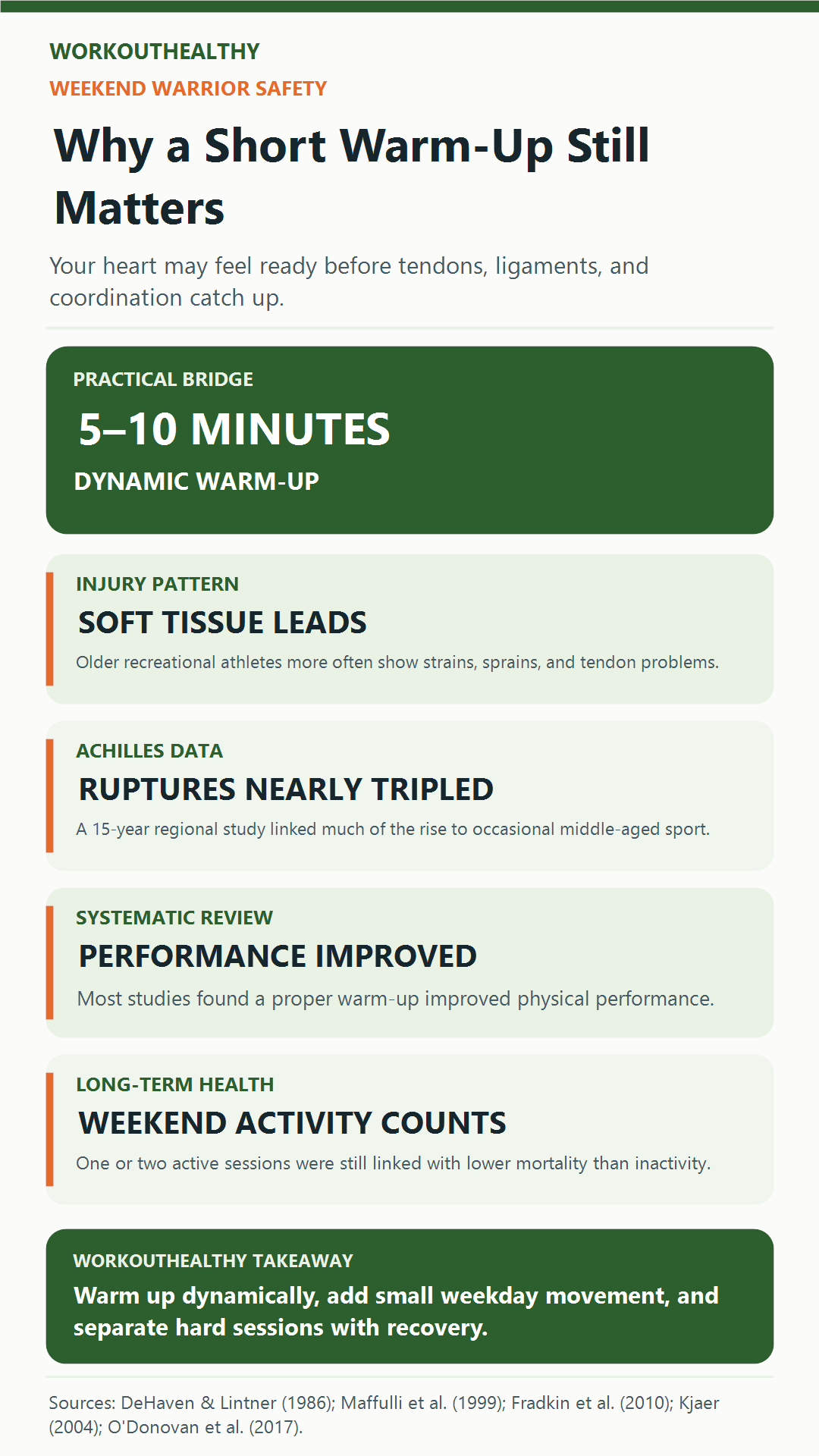
Their injuries leaned more toward soft tissue damage, including strains, sprains, and tendon problems.
That shift matters for weekend warriors specifically.
Most adults doing one intense weekend session fit this second group closely.
They are not weekly competitive athletes with a conditioned, trained body.
They are adults with a desk job and a body that has mostly been sitting.
The research keeps pointing to that mismatch, not the activity itself, as the real driver of risk.
The danger in the weekend warrior pattern is rarely the activity itself. It is a body meeting a hard effort it has not been prepared for.
What Real Research Shows About Tendon Injuries in Weekend Athletes
Achilles tendon rupture is one of the clearest examples of a weekend warrior injury.
A 15 year study tracked every Achilles tendon rupture treated in one Scottish health region (Maffulli et al., 1999).
The incidence of rupture nearly tripled over that period.
The researchers linked much of that rise to a specific group.
Middle aged adults who played sport only occasionally made up a large share of the cases.
These were not lifelong athletes.
Many had returned to a sport from years earlier. They had not rebuilt the tissue strength it once required.
A tendon does not know how fit your heart is.
It only knows how much load it has handled recently.
That gap between cardiovascular fitness and tendon readiness is exactly where this kind of injury lives.
Someone can pass a fitness test on a treadmill and still tear a tendon that was never asked to sprint or cut sideways.
What Real Research Shows About Muscle Soreness and Recovery
Not every weekend warrior injury is dramatic.
Many are milder, but they still matter for how safe the next weekend is.
A widely cited review looked closely at delayed onset muscle soreness (Cheung, Hume, & Maxwell, 2003). That is the deep ache that shows up a day or two after unfamiliar exercise.
The review found this soreness comes from tiny amounts of damage inside muscle fibers.
That damage is normal, and it is part of how muscle adapts over time.
But the review also found that soreness and weakness can last for several days after an unaccustomed, hard session.
During that window, the muscle is weaker and less coordinated than usual.
Strength and normal movement control do not snap right back the next morning.
That matters directly for weekend warriors.
A person who is still deeply sore from Saturday, then pushes just as hard again on Sunday, is loading tissue that has not recovered.
That second session often carries more real injury risk than the first one did.
What Real Research Shows About Warming Up
A systematic review pooled dozens of studies on warm up routines and physical performance (Fradkin, Zazryn, & Smoliga, 2010).
The review found that a proper warm up reliably improved performance in most of the studies analyzed.
A good warm up raises muscle temperature and blood flow before hard effort begins.
It also gives connective tissue and the nervous system a chance to prepare gradually.
That preparation matters more, not less, for someone who has been sitting all week.
A five minute jog and a few dynamic stretches is not a small ritual.
It is the closest thing a weekend warrior has to a bridge between a sedentary body and a demanding sport.
The performance review did not test injury prevention. Some structured, sport-specific neuromuscular warm-up programs have reduced lower-limb injuries in studied athletes, but that does not prove a five-minute routine prevents every weekend injury.
One practical planning framework is RAMP: raise body temperature with easy movement, activate the muscles needed for the activity, mobilize the relevant joints, and then potentiate with a few gradually faster or more demanding versions of the activity. It is a framework for preparation, not a guarantee against injury.
The Mechanism: Why Fitness and Tissue Readiness Are Not the Same Thing
Understanding why this injury pattern happens starts with a basic biology fact.
Different tissues in the body adapt to exercise at very different speeds.
A detailed review of tendon and muscle biology explains this clearly (Kjaer, 2004).
Cardiovascular fitness, the kind a person builds through a few weeks of steady activity, can improve fairly quickly.
Tendons, ligaments, and the connective tissue around muscle adapt on a much slower timeline.
That review describes how these tissues rebuild their internal structure gradually, in response to repeated loading over weeks and months.
A person can feel cardiovascular ready long before their tendons and ligaments actually are.
That mismatch is not a character flaw or a lack of effort.
It is simply how human tissue works.
A weekly, once a week burst of hard activity never gives connective tissue the repeated loading it needs to catch up.
The heart and lungs can feel ready for Saturday. The tendons and ligaments usually are not.
What This Evidence Does Not Prove
It is worth being precise about what this research shows, and what it does not.
None of these studies prove that weekend only exercise is a mistake to avoid.
A large study following adults for years found something important on the other side of this question (O’Donovan, Lee, Hamer, & Stamatakis, 2017).
Some packed most of their weekly activity into one or two sessions. They still showed a lower risk of early death than people who stayed inactive all week.
In that study, the total weekly amount of activity mattered more than exactly how it was spread out.
That is genuinely good news for anyone who cannot exercise on weekdays.
Our own review of daily steps and mortality covers a closely related pattern in walking specifically.
So the honest picture has two true parts at once.
The weekend warrior pattern is linked to a real injury risk, and it is also linked to a real long term health benefit.
These studies are observational, which means they show patterns, not a guaranteed outcome for any one person.
They cannot tell an individual reader exactly how much risk their next Saturday carries.
They also do not identify one single fix that eliminates that risk completely.
A short video cannot capture all of that nuance, and neither can one article.
Common Mistakes
A few patterns show up again and again in this research and in sports medicine clinics.
The first is skipping any warm up and going straight into hard effort.
The second is treating a Saturday session like years of regular play. The actual training never continued.
The third is doing back to back intense days, without any recovery time between them.
The fourth is ignoring early soreness or a nagging ache and pushing through it anyway.
The fifth is jumping straight into a sport’s most demanding version, like a full pickup basketball game, instead of easing in.
Building some strength and movement capacity during the week is one real way to close that gap.
Our piece on whether box jumps actually build muscle covers how explosive movements load joints, and why control matters more than height.
The sixth mistake is assuming that a good cardio base means the whole body is ready for a demanding sport.
As the tendon research above shows, that assumption is exactly where injuries tend to happen.
Who Should Be Extra Careful
Some weekend warriors carry a higher baseline risk than others.
Adults over 40 who have not played a sport regularly in years should treat that gap seriously.
Tendon tissue changes with age, and it adapts even more slowly than it did at 25.
Anyone with a past sprain, strain, or tendon injury in the same joint should assume that spot is still a weak point.
People returning from a long break should ease back in slowly.
That is true whether the break came from illness, injury, or a busy season at work.
Anyone with joint pain that lingers for more than a few days after activity should get it checked before the next hard session.
People trying a brand new sport for the first time should treat that first session as a trial run. A first pickup soccer game in years is a good example.
Checking your baseline fitness honestly is a useful first step.
Our breakdown of the four flight stair test is a simple, low cost way to get a rough read on where you actually stand.
Anyone with a chronic condition, recent surgery, or an unexplained symptom should talk with a doctor or physical therapist before ramping up weekend activity.
Cardiovascular fitness can arrive in weeks. Tendon and ligament readiness takes months of steady loading to catch up.
A Practical Takeaway
None of this research is a reason to skip your weekend activity.
It is a reason to prepare for it a little more deliberately.
Spend five to ten minutes on a real warm up before anything intense begins.

Ease into the first ten or fifteen minutes of a new sport instead of going at full speed immediately.
Add short bursts of movement during the week, even without a full workout, to keep tissue somewhat used to loading.
Our guide on how many miles to walk each day is a reasonable starting point for building that weekday base.
Build some basic strength ahead of your busiest weekend activities, not after an injury forces the issue.
Space out back to back intense days with at least one lighter or rest day between them.
Pay attention to soreness that lasts more than two or three days, and scale back the next session if it has not faded.
Treat a nagging ache as information, not as something to simply push through.
A weekend warrior does not have to become a daily athlete to train more safely.
Small, consistent preparation during the week is what actually closes the gap.
Watch the video
Want more like this? Subscribe to WorkoutHealthy Insider for practical explanations behind popular fitness claims.
References
Cheung, K., Hume, P. A., & Maxwell, L. (2003). Delayed onset muscle soreness: Treatment strategies and performance factors. Sports Medicine, 33(2), 145 to 164. https://doi.org/10.2165/00007256-200333020-00005
DeHaven, K. E., & Lintner, D. M. (1986). Athletic injuries: Comparison by age, sport, and gender. American Journal of Sports Medicine, 14(3), 218 to 224. https://doi.org/10.1177/036354658601400307
Herman, K., Barton, C., Malliaras, P., & Morrissey, D. (2012). The effectiveness of neuromuscular warm-up strategies, that require no additional equipment, for preventing lower limb injuries during sports participation: A systematic review. BMC Medicine, 10, 75. https://doi.org/10.1186/1741-7015-10-75
Jeffreys, I. (2007). Warm-up revisited: The RAMP method of optimizing warm-ups. Professional Strength and Conditioning, 6, 12 to 18.
Fradkin, A. J., Zazryn, T. R., & Smoliga, J. M. (2010). Effects of warming up on physical performance: A systematic review with meta analysis. Journal of Strength and Conditioning Research, 24(1), 140 to 148. https://doi.org/10.1519/JSC.0b013e3181c643a0
Kjaer, M. (2004). Role of extracellular matrix in adaptation of tendon and skeletal muscle to mechanical loading. Physiological Reviews, 84(2), 649 to 698. https://doi.org/10.1152/physrev.00031.2003
Maffulli, N., Waterston, S. W., Squair, J., Reaper, J., & Douglas, S. (1999). Changing incidence of Achilles tendon rupture in Scotland: A 15 year study. Clinical Journal of Sport Medicine, 9(3), 157 to 160. https://doi.org/10.1097/00042752-199907000-00007
O’Donovan, G., Lee, I. M., Hamer, M., & Stamatakis, E. (2017). Association of “weekend warrior” and other leisure time physical activity patterns with risks for all cause, cardiovascular disease, and cancer mortality. JAMA Internal Medicine, 177(3), 335 to 342. https://doi.org/10.1001/jamainternmed.2016.8014
This article is for general information only and is not medical advice. If you have an injury, ongoing pain, or a medical condition, talk to a doctor or physical therapist before you change how you train or eat.