
272.5 kilograms is 600.7 pounds.
That is roughly the weight of a small motorcycle, pressed off the chest and locked out at the elbows using nothing but a barbell, a bench, wrist wraps, and a belt.
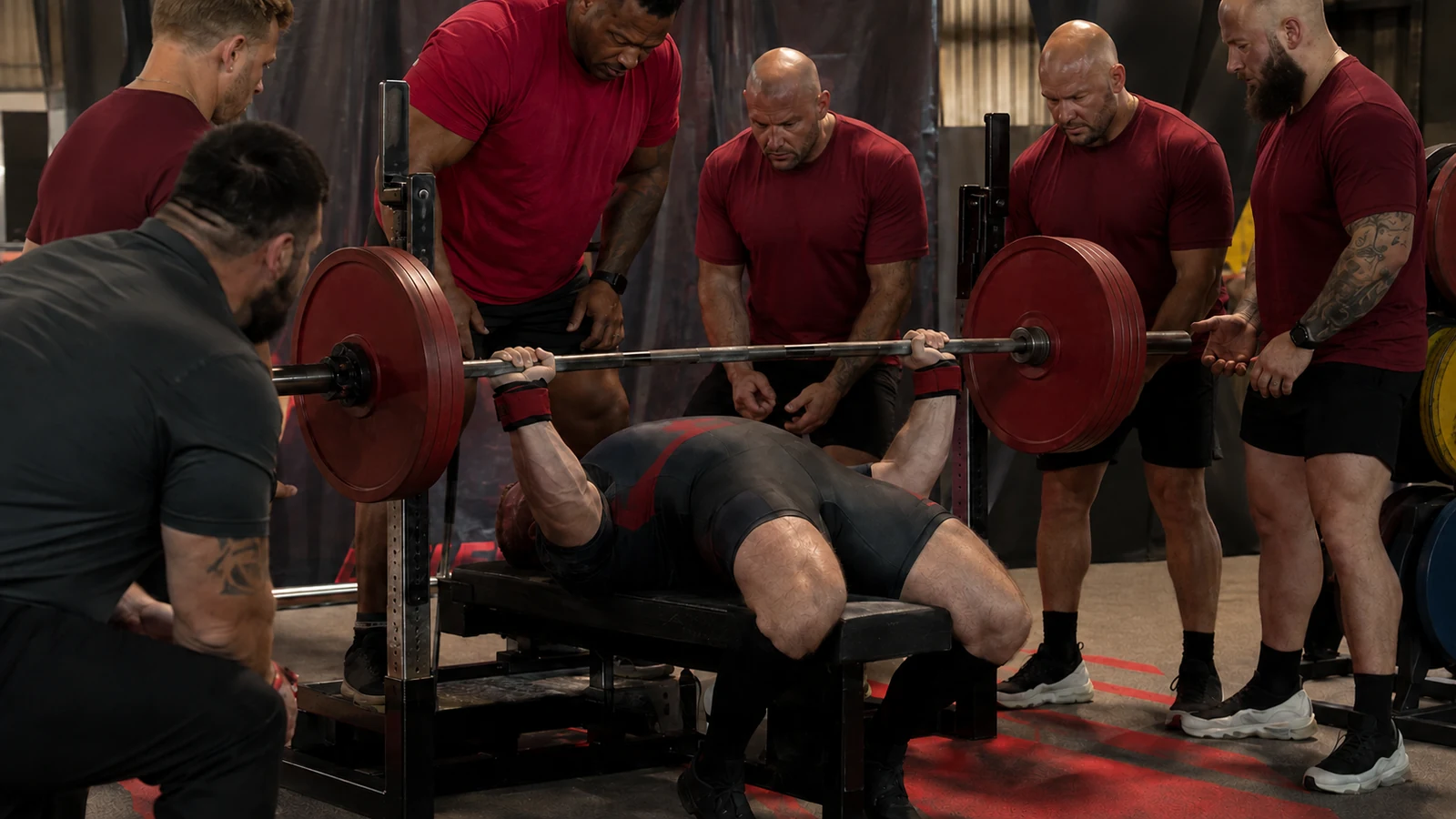
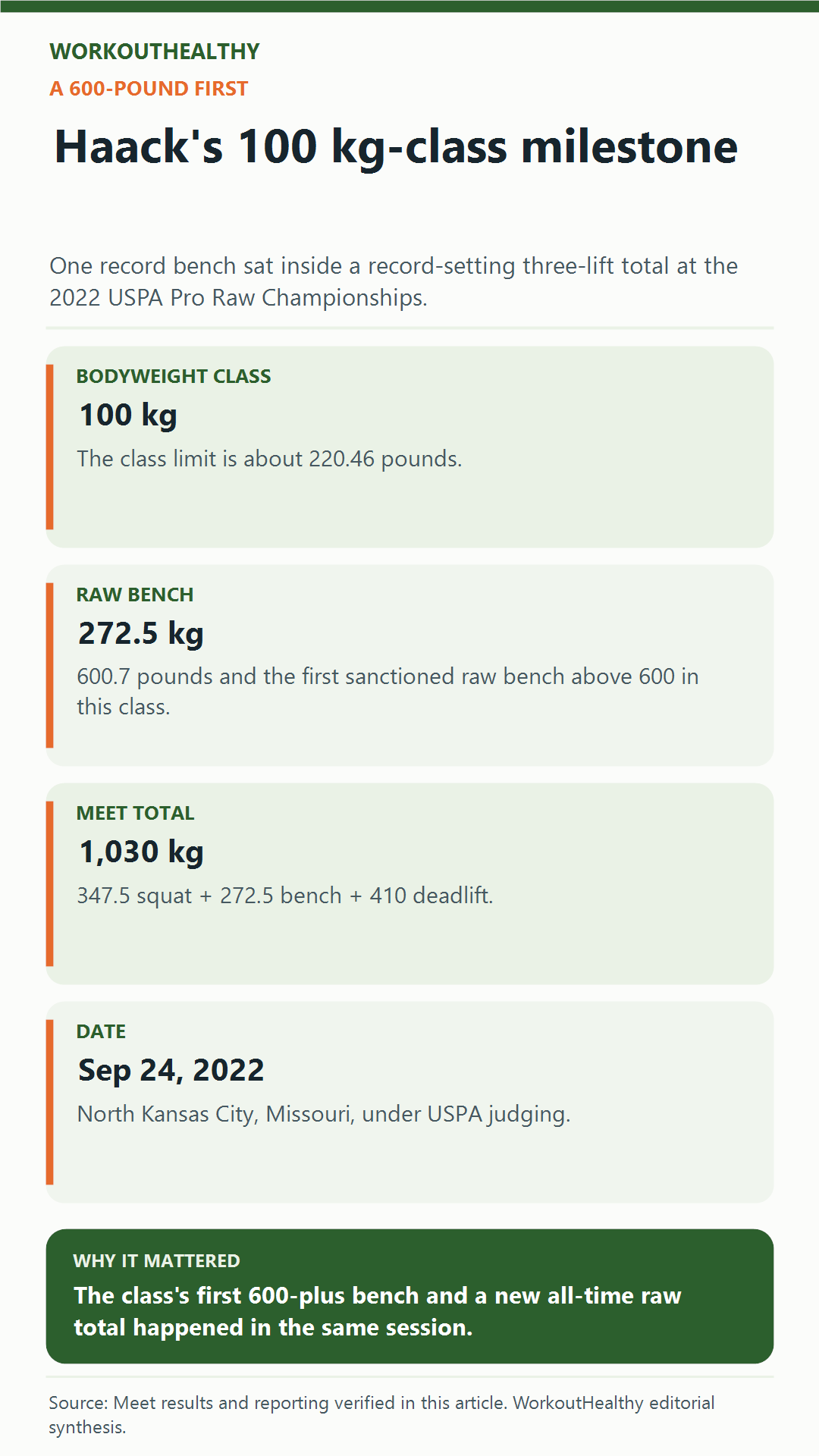
On September 24, 2022, at a USPA meet in North Kansas City, Missouri, a powerlifter named John Haack pressed that exact weight and became the first man in the 100 kilogram weight class, roughly 220 pounds, to bench press more than 600 pounds raw in competition.
He did it on the same day he set a new all time raw total in that same weight class.
Both marks came from the same meet, the same 100 kilogram bodyweight limit, and the same afternoon of lifting.
What Happened at the 2022 USPA Raw Pro
The meet is recorded in competition databases as the USPA Pro Raw Championships, though it circulated widely online under the shorthand “2022 USPA Raw Pro.”
It took place in North Kansas City, Missouri, on September 24, 2022, sanctioned by the United States Powerlifting Association, one of the larger raw powerlifting federations in American competition.
Haack competed in the men’s 100 kilogram class, the weight bracket for lifters who weigh up to 220.46 pounds on meet day.
His full set of results that day, confirmed through BarBend’s event coverage and cross checked against the OpenPowerlifting competition database, was a 347.5 kilogram squat, a 272.5 kilogram bench press, and a 410 kilogram deadlift.
Add those three lifts together and the total comes to 1,030 kilograms, or 2,270.5 pounds, all lifted in the same session under the same judging.
Why “First at 600 Pounds” Is a Real Milestone
BarBend, the outlet that first reported the lift, described Haack as the first man in the 100 kilogram class to bench press more than 600 pounds in a sanctioned raw competition.
That distinction is worth taking seriously rather than treating as marketing language, because bench press strength does not scale with bodyweight the way squats and deadlifts tend to.
A lifter’s legs and hips can usually move more total weight relative to bodyweight than a lifter’s chest, shoulders, and triceps can press from a dead stop on the chest.
Pushing past 600 pounds raw, with wrist wraps and a belt but no supportive bench shirt, put Haack ahead of every other lifter who had competed in that weight class up to that point.
It is worth being precise about what “first” means here.
It refers to the 100 kilogram class in raw competition, tracked through USPA’s own results and cross referenced against the wider OpenPowerlifting database, not to bench press history as a whole or to every federation that has ever sanctioned a meet.
“Haack becomes the first man in the 100 kilogram weight class to successfully eclipse a 600 pound bench press in competition.”
The Same Day Total That Made It Bigger
A maximal bench press is already a demanding single lift on its own.
Haack’s total, though, came from three separate near maximal attempts on three different lifts, performed back to back over several hours of competition.
His 1,030 kilogram total broke his own prior all time raw total record in the 100 kilogram class, according to BarBend’s coverage of the meet.
Setting a bench record and a total record on the same day means his squat and deadlift also held up under full competition pressure, not just his pressing strength in isolation.
That combination, a first ever weight class milestone and a total record on the same platform, is part of why the 2022 USPA Raw Pro is remembered as one of Haack’s signature meets.
What “Raw” Actually Means Under USPA Rules
The word raw gets used loosely outside competitive powerlifting, so it is worth being specific.
Under USPA’s raw division rules, lifters are permitted a small set of supportive equipment: a lifting belt, wrist wraps, and knee sleeves are the common pieces.
What raw lifters do not wear is a bench shirt, a stiff multi-ply garment worn in equipped divisions that can add well over a hundred pounds to a competition bench press by storing and releasing elastic energy across the chest and shoulders as the bar descends.
Haack’s 272.5 kilogram bench came with wrist wraps and a belt, and nothing else supporting the lift itself.
That is close to the same equipment most everyday gym lifters already train in, which is part of why a number like 600.7 pounds resonates outside the powerlifting world specifically.
Haack’s Broader Reputation, Briefly
Haack is frequently described in strength sports media as one of the most well rounded raw powerlifters competing today, built on strong numbers across all three lifts rather than one standout lift carrying his total.
That reputation comes from a long competitive record across multiple meets, multiple federations, and more than one weight class over several years.
This article focuses specifically on the bench press and total records from the September 2022 USPA Raw Pro in the 100 kilogram class, rather than retelling his entire competitive history.
The Mechanics Behind a Bench This Heavy
Pressing 600 pounds raw is not simply a matter of having strong pecs.
Research on bench press mechanics has found that grip width and forearm rotation change which muscles carry the most load during the lift, shifting demand between the chest, the front of the shoulder, and the triceps depending on hand position (Lehman, 2005).
Competitive raw bench pressers typically train a wide grip near the legal limit marked on most competition bars, which shortens the bar’s travel distance and can let the chest take on more of the work.
Leg drive and a tight arch through the upper back matter as well, even though the lift looks like a purely upper body movement from the outside.
A stable base through the feet and a tucked shoulder blade position let a lifter transfer force through the torso instead of losing it through an unstable bench setup.
The bench itself matters too.
Removing the bench entirely changes the leverage and the leg drive involved, which is part of why a floor press builds strength differently than a full bench press despite looking similar at a glance.
What This Record Does Not Prove
A single verified world record answers a narrow question well and a much broader question poorly.
It confirms that on one specific day, under one federation’s judging, Haack pressed 272.5 kilograms and totaled 1,030 kilograms in the 100 kilogram class.
It does not mean every lifter at his bodyweight can get anywhere near that number with enough training time.
Individual differences in limb length, tendon insertion points, and muscle fiber makeup all affect how much weight a given lifter can eventually press, and research on competitive powerlifters has specifically linked upper limb proportions to bench press performance outcomes (Pasini et al., 2023).
It also does not mean the record is permanent.
Powerlifting records get broken as training methods and competition depth improve, so readers should treat any specific record as accurate to its reporting date rather than assume it still stands untouched years later.
Common Mistakes Lifters Make Chasing a Bigger Bench
Most lifters chasing a bigger bench press run into the same handful of mistakes.
The most common one is benching heavy, near maximal singles too often, without enough lower intensity volume in between to build the muscle and connective tissue that heavy singles actually require.
A second mistake is ignoring the lower body and upper back entirely because the bench press looks like a pure upper body lift on the surface.
Leg drive and a tight upper back both contribute real force to a heavy bench, and skipping them leaves strength on the table.
A third mistake is copying grip width or setup details from an elite lifter’s competition video without adjusting for very different limb lengths and shoulder mobility.
What works for one lifter’s shoulder anatomy can be uncomfortable, or even risky, for another lifter to copy exactly.
Who Should Check With a Doctor Before Loading Up Heavy
Heavy bench pressing puts real stress on the shoulders, elbows, and wrists, and it is not a lift to approach carelessly at near maximal loads.
Anyone with a history of shoulder impingement, a prior pec or rotator cuff injury, or ongoing elbow or wrist pain should talk to a doctor or physical therapist before attempting heavy singles.
Lifters returning from any surgery, especially shoulder or chest surgery, need medical clearance first, not just a pain free warm up set.
People with uncontrolled blood pressure should also be cautious, since a maximal effort lift briefly spikes blood pressure well above resting levels.
None of this is a reason to avoid the bench press.
It is a reason to build toward heavy loads gradually, and under qualified supervision when the weights get serious.
Readers new to structured strength training who are unsure whether they need that kind of guidance can start with the basics of deciding whether a personal trainer is worth hiring before loading a bar anywhere near a personal maximum.
A Practical Path Toward a Bigger Raw Bench
Nobody presses 600 pounds without years of consistent, structured training behind it.
A sensible starting point is training the bench press two to three times a week, with most working sets kept a few reps short of failure rather than grinding out true maximal singles every session.
Elite powerlifters commonly use rate of perceived exertion, or RPE, to manage how close a given set comes to failure, and research tracking RPE against actual bar speed in competitive powerlifters found the two measures line up closely enough to guide training loads in the squat, bench press, and deadlift (Helms et al., 2017).
A typical training structure cycles through phases of higher volume, lighter weight work, then gradually narrows toward heavier, lower rep sets as a competition or a testing day approaches.
Accessory work for the triceps, the upper back, and the front of the shoulder rounds out a bench focused program, since the bench press itself rarely keeps improving from bench press sets alone once a lifter moves past the beginner stage.
Progress at this level is measured in single digit kilograms added per year, not per week, which is part of why a record like Haack’s takes a full competitive career to build toward.
Recovery between heavy sessions matters just as much as the sessions themselves, a point echoed in the ongoing debate over how much training volume the body can actually absorb between heavy workouts.
Watch the Original Video
Want more verified strength world records like this one? Subscribe to WorkoutHealthy Insider for practical explanations behind popular fitness claims.
References
Helms, E. R., Storey, A., Cross, M. R., Brown, S. R., Lenetsky, S., Ramsay, H., Dillen, C., & Zourdos, M. C. (2017). RPE and velocity relationships for the back squat, bench press, and deadlift in powerlifters. Journal of Strength and Conditioning Research, 31(2), 292-297. https://doi.org/10.1519/JSC.0000000000001517
Lehman, G. J. (2005). The influence of grip width and forearm pronation/supination on upper-body myoelectric activity during the flat bench press. Journal of Strength and Conditioning Research, 19(3), 587-591. https://doi.org/10.1519/00124278-200508000-00017
Pasini, A., Caruso, L., Bortolotto, E., Lamberti, N., Toselli, S., Manfredini, F., Zaccagni, L., & Rinaldo, N. (2023). Prediction of bench press performance in powerlifting: The role of upper limb anthropometry. Journal of Human Sport and Exercise, 18(2). https://doi.org/10.14198/jhse.2023.182.18
This article is for general information only and is not medical advice. If you have an injury, ongoing pain, or a medical condition, talk to a doctor or physical therapist before you change how you train or eat.