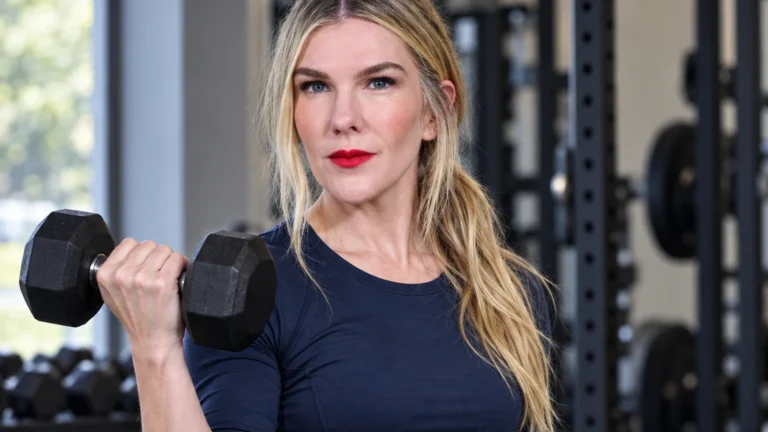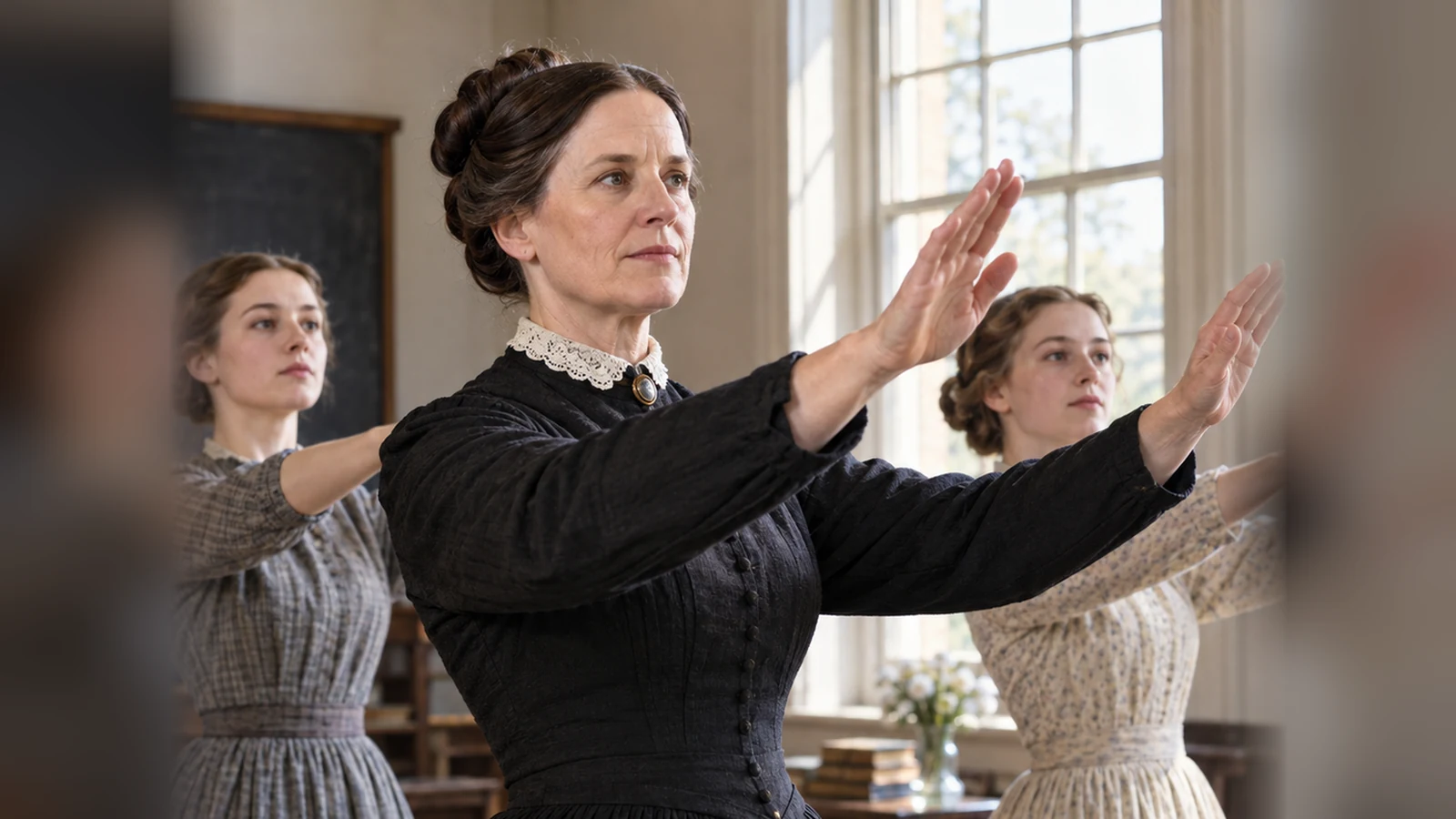

Home workouts with no equipment feel like a modern trend.
In the 1850s, an American educator was already making the case for them.
Her name was Catharine Beecher.
A popular post says she designed simple daily calisthenics so ordinary women could build strength without a gym.
The no equipment part is well supported. A few other details need adjusting.
Who Catharine Beecher Was
Catharine Esther Beecher was born on September 6, 1800, and died on May 12, 1878.
In 1823, she and her sister Mary co-founded the Hartford Female Seminary in Connecticut.
She later founded the Western Female Institute in Cincinnati, along with her father, Lyman Beecher.
She was a strong advocate for including daily physical education in schools.
She also believed tight corsets and poor eating habits were ruining young women’s health.
The Book That Laid Out Her System
Beecher’s best known exercise work is Physiology and Calisthenics for Schools and Families.
It first appeared in 1856, and Harper & Brothers of New York printed an 1858 edition.
Much has been written about her group classes.
This article looks at a different question: who the exercises were for, and what they needed.
No Apparatus Required
The book is clear on equipment.
It says the system “can be practiced in schools of every description, in the family, in nurseries, in hospitals, and in health establishments, without apparatus.”
The text presents the exercises as usable in ordinary rooms like parlors and schoolrooms.
That made them available to people who had no gymnasium and no money for one.
Access, not willpower, was the barrier her system was built to remove.
The popular post also says she used household items as props.
We could not confirm that detail in the text we checked. The book’s own emphasis is on needing no apparatus at all.
How Often, and What Kind of Moves
Beecher wanted this done often, not now and then.
She treated exercise as a regular part of the school day, the same way a lesson is.
For schools, the book says “half an hour each school session should be set apart for physical training.”
The exercises are grouped by body area, with sections such as:
- Exercises for the chest and lungs
- Exercises to perfect the muscles of the arms and hands
- Exercises for the muscles of the trunk
- Exercises for the feet and legs
The book also says the method suits mixed schools, so boys and girls could do the exercises together.
So while women’s health was central to her concerns, the system itself was not limited to women.
Notice how practical the structure is.
Each section targets a body region, so a teacher or parent could cover the whole body in one short session.
There is no need to learn complex routines or buy anything first.
That same idea sits behind most modern home workout plans.
The best equipment is the kind you never have to buy, find, or wait for. Your own body is always in the room.
What Research Says About Bodyweight Strength Work
Modern research supports the idea that strength work does not need a gym.
In 2018, Emmanuel Stamatakis and colleagues pooled data from 11 population cohorts.
The core sample included 80,306 adults aged 30 and older.
They looked at strength promoting exercise and later death rates.
Their definition covered two kinds of activity: gym based exercise and exercises using your own bodyweight.
Taking part in any strength promoting exercise was linked to a 23 percent lower risk of death from any cause.
It was also linked to a 31 percent lower risk of death from cancer.
These results come from observational data, so they show links, not proof of cause.
People who do strength work may differ in other healthy ways.
Still, the study counted bodyweight work as real strength exercise, which is exactly the kind Beecher promoted.
What Guidelines Say Today
The World Health Organization’s 2020 guidelines echo Beecher’s push for regular activity.
Fiona Bull and colleagues summarized them in the British Journal of Sports Medicine.
Children and teens should average at least 60 minutes a day of moderate to vigorous activity.
Adults should also do muscle strengthening activities on two or more days a week.
Beecher’s half hour each school session would not reach the youth target alone. It would be a solid start.
How to Use Beecher’s Idea at Home
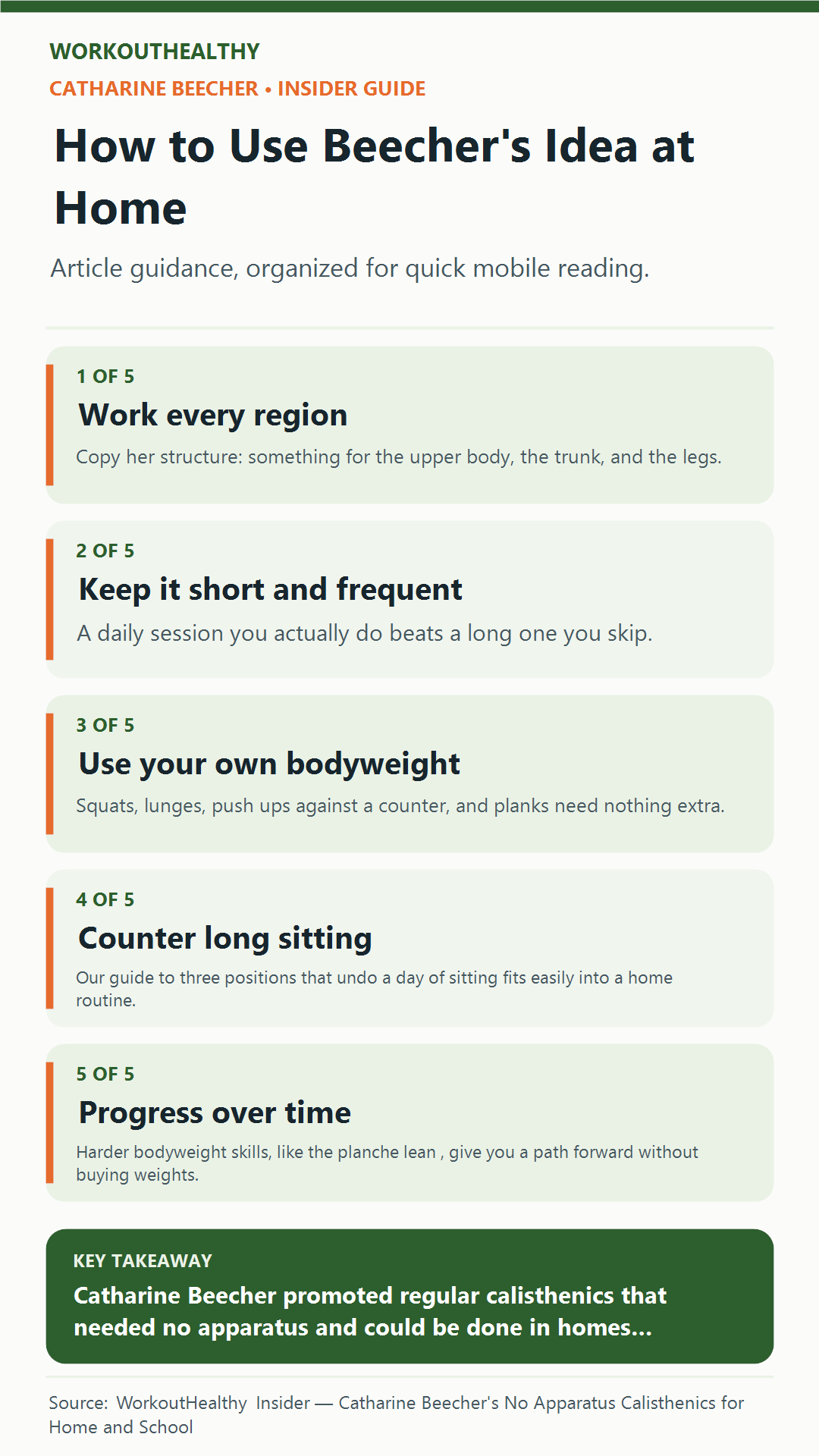
- Work every region. Copy her structure: something for the upper body, the trunk, and the legs.
- Keep it short and frequent. A daily session you actually do beats a long one you skip.
- Use your own bodyweight. Squats, lunges, push ups against a counter, and planks need nothing extra.
- Counter long sitting. Our guide to three positions that undo a day of sitting fits easily into a home routine.
- Progress over time. Harder bodyweight skills, like the planche lean, give you a path forward without buying weights.
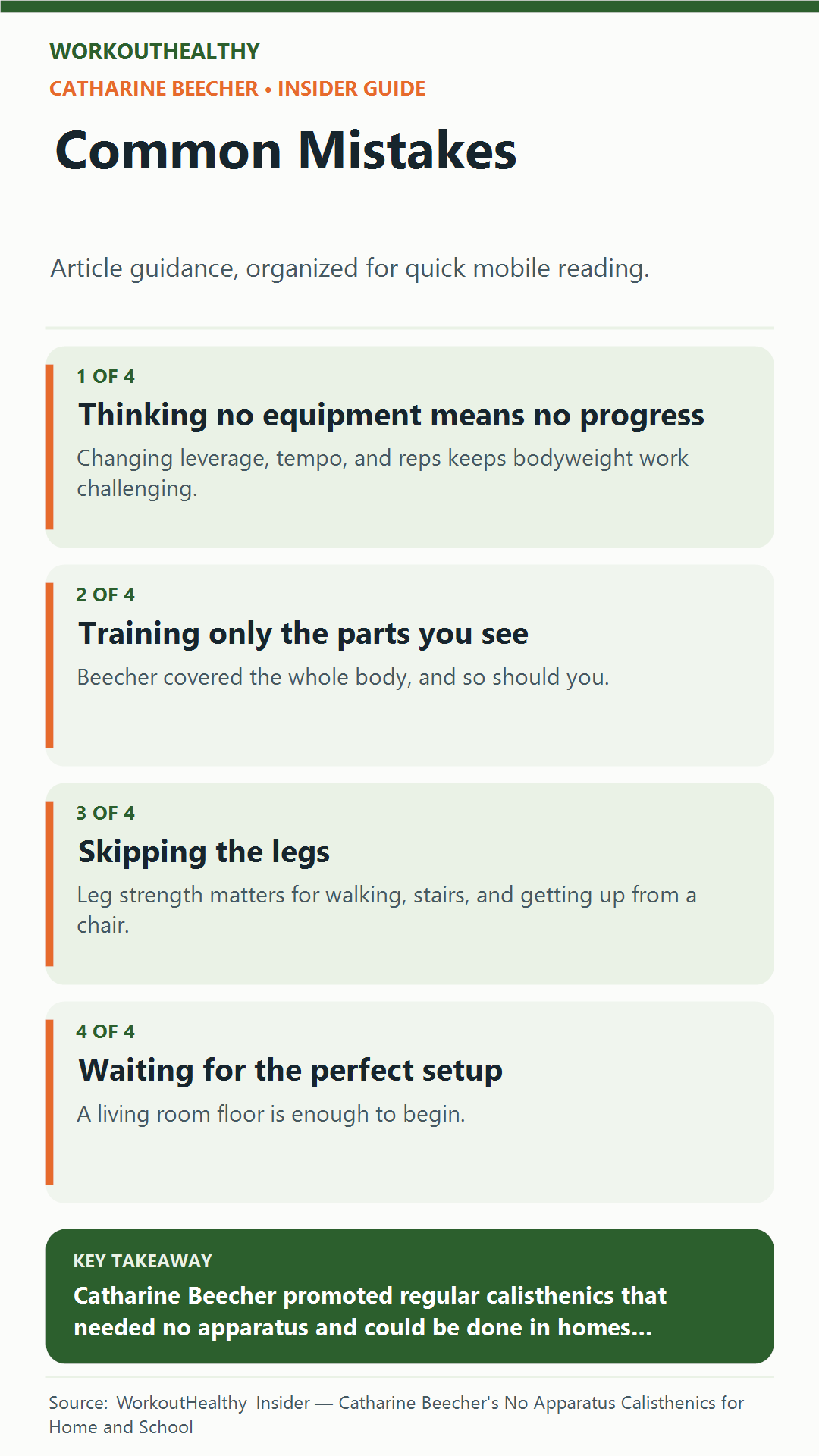
Common Mistakes
- Thinking no equipment means no progress. Changing leverage, tempo, and reps keeps bodyweight work challenging.
- Training only the parts you see. Beecher covered the whole body, and so should you.
- Skipping the legs. Leg strength matters for walking, stairs, and getting up from a chair.
- Waiting for the perfect setup. A living room floor is enough to begin.
Who Should Be Careful
People with joint pain, recent surgery, or heart disease should check with a doctor before starting a new routine.
Pregnant women should ask their care team which moves suit each stage.
Older adults with balance problems should do standing moves near a sturdy counter or chair.
Stop any exercise that causes sharp pain, dizziness, or chest discomfort.
The Bottom Line
Catharine Beecher promoted regular calisthenics that needed no apparatus and could be done in homes and schools.
The claim about household props could not be confirmed, and her system was meant for boys as well as girls.
Her core idea, frequent whole body exercise without a gym, still fits modern research and guidelines.
Want more stories like this? Subscribe to WorkoutHealthy Insider for practical explanations behind popular fitness claims.
References
- Beecher, C. E. (1858). Physiology and calisthenics for schools and families. Harper & Brothers. https://archive.org/details/physiologycalist00beecrich
- Bull, F. C., Al-Ansari, S. S., Biddle, S., Borodulin, K., Buman, M. P., Cardon, G., et al. (2020). World Health Organization 2020 guidelines on physical activity and sedentary behaviour. British Journal of Sports Medicine, 54(24), 1451 to 1462. https://doi.org/10.1136/bjsports-2020-102955
- Stamatakis, E., Lee, I. M., Bennie, J., Freeston, J., Hamer, M., O’Donovan, G., Ding, D., Bauman, A., & Mavros, Y. (2018). Does strength-promoting exercise confer unique health benefits? A pooled analysis of data on 11 population cohorts with all-cause, cancer, and cardiovascular mortality endpoints. American Journal of Epidemiology, 187(5), 1102 to 1112. https://doi.org/10.1093/aje/kwx345
- Wikipedia contributors. (n.d.). Catharine Beecher. In Wikipedia. Retrieved September 16, 2026, from https://en.wikipedia.org/wiki/Catharine_Beecher
This article is for general information only and is not medical advice. If you have an injury, ongoing pain, or a medical condition, talk to a doctor or physical therapist before you change how you train or eat.