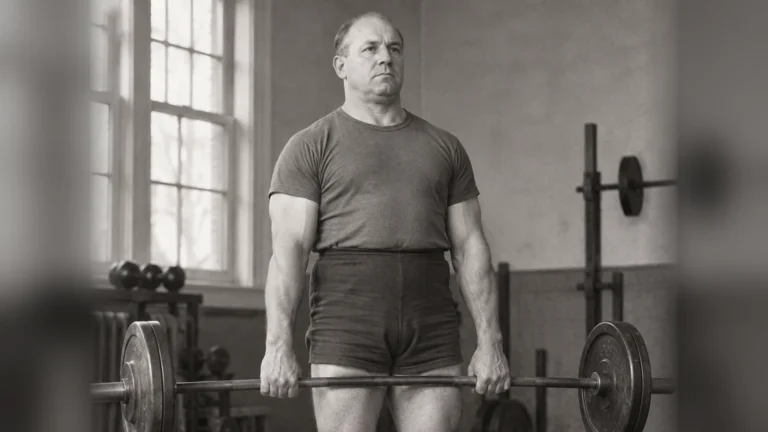

George Foreman’s second heavyweight title is one of sport’s clearest arguments for patience. He returned to boxing in 1987 after roughly a decade away, absorbed years of jokes about his age and body, and knocked out Michael Moorer for two heavyweight belts in 1994.
A WorkoutHealthy Facebook post compressed that comeback into a 70-pound loss powered by old-school roadwork. The roadwork is well supported. The neat 70-pound transformation is not.
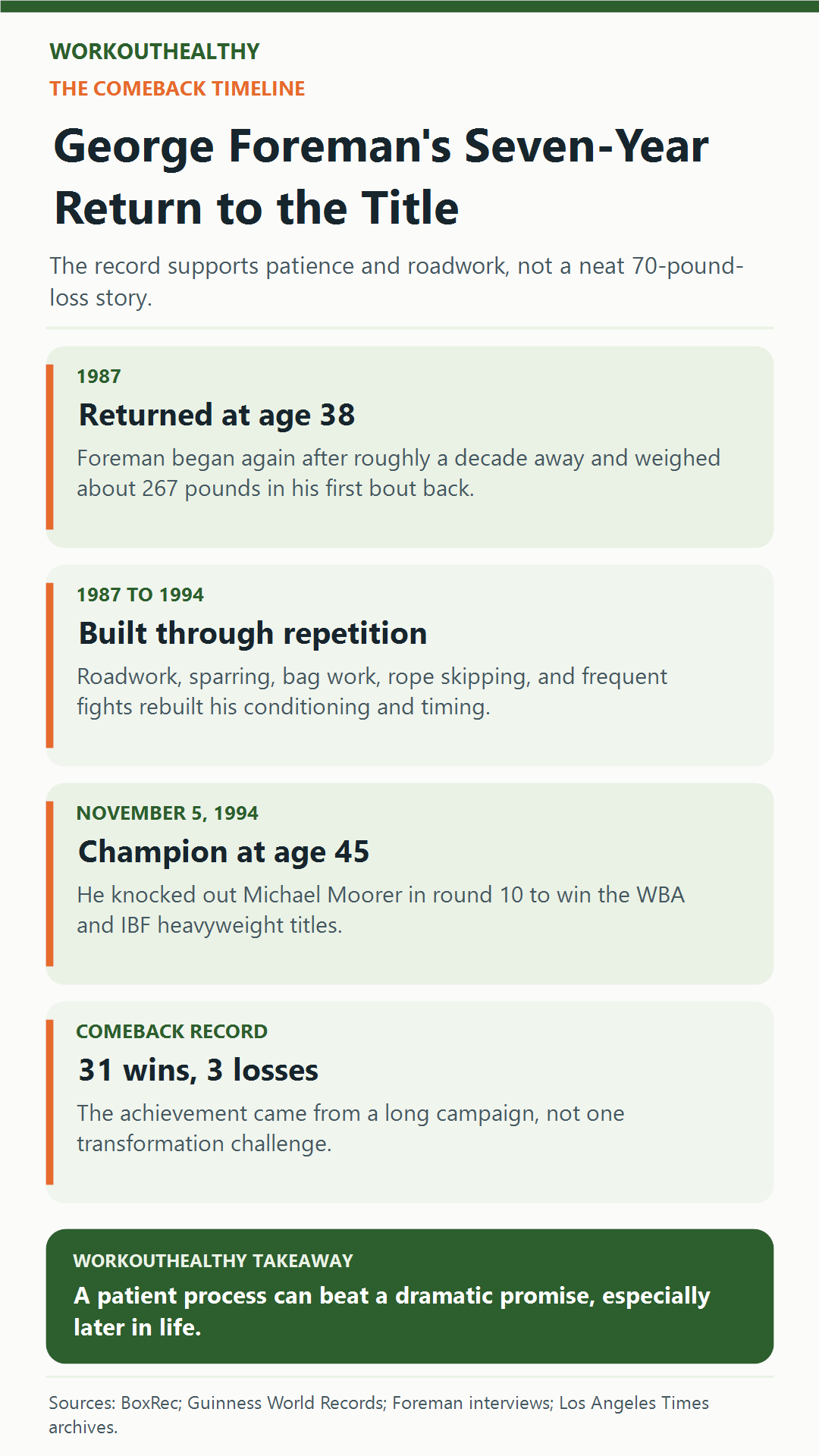
Foreman entered his first comeback fight at about 267 pounds and fought Moorer at roughly 250. His successful return was not a straight-line attempt to recreate the lighter champion of 1973. It was a seven-year campaign built around conditioning, repetition, tactical change, and a mature fighter’s strengths.
Foreman’s comeback was powerful because it took years. Turning it into a quick weight-loss story removes the part most worth learning from.
What the viral claim says
The Facebook creative says Foreman regained the heavyweight title at 45 after losing 70 pounds and returning to old-school roadwork. It pairs an accurate historic achievement with a transformation number that makes the story feel familiar.
That format is common in fitness content. A long, complicated career becomes one before-and-after image, one large number, and one simple method. The simplification creates a strong post, but it can change the meaning of the achievement.
Foreman’s achievement is documented. Guinness World Records continues to recognize him as the oldest boxer to win the heavyweight championship, based on his November 5, 1994 knockout of Moorer at age 45.
Roadwork is also documented. Foreman described running on golf-course grass to reduce pounding, then completing boxing work that included sparring, heavy-bag work, speed-bag work, and rope skipping. What does not fit the record is a clean 70-pound loss leading directly to the title.
The record does not show a 70-pound cut
Contemporary coverage placed Foreman around 267 pounds for his March 1987 return. He weighed approximately 250 pounds for the Moorer fight. Those figures move, as heavyweight weights do across camps, but they do not describe a 70-pound reduction.
The number may come from comparing an unverified off-season high with a later training weight. It may also reflect the way comeback stories grow when they are repeated without the original weigh-in record. Neither possibility supports presenting 70 pounds as an established fact.
More importantly, Foreman did not define success by becoming the 220-pound fighter who had first won the title. In 1990, he told the Los Angeles Times that his camp wanted him to work hard, eat well, drink fluids, and stop obsessing over the scale.
That is almost the opposite of a dramatic weight-loss narrative. He needed boxing fitness at a body size he could sustain, not a social-media reveal.
What Foreman’s comeback training included
Foreman later described roadwork followed by an hour and a half in the gym. That boxing session could include sparring, bag punching, speed-bag work, and skipping rope. He said the comeback required far more training than he had done as a younger fighter.
Each element served a different purpose. Running built general endurance and helped him tolerate sustained work. Rope skipping developed rhythm and lower-leg conditioning. Bag work let him repeat punches under fatigue, while sparring connected conditioning to distance, defense, and decision-making.
The useful lesson is not that roadwork is magic. It is that general conditioning and sport-specific practice had to support each other. Running alone does not prepare someone to absorb punches, read an opponent, and deliver power late in a fight.
For non-boxers, walking and running can still create a base for ordinary training. The article on daily steps and mortality explains why the benefit is best understood as a gradual association rather than a guaranteed result from one exact dose.
He built a different kind of fighter
The older Foreman could not rely on the same speed, workload, or intimidation that had defined his first championship run. His comeback style was more patient. He conserved energy, used physical pressure, trusted his power, and waited for openings.
That adaptation is easy to miss when the story is told only through weight. A comeback often succeeds because the person stops trying to reproduce an earlier version of the body and builds a plan for the body that exists now.
Foreman also fought frequently during the early comeback, collecting rounds and rebuilding comfort under competition. He finished the comeback portion of his career 31-3, a record that shows how much work stood between the announcement and the title.
Frequent fights carried risks that do not translate into a general fitness recommendation. The transferable principle is exposure: practice the actual skill often enough that the return is not based on confidence alone.
The night patience became a title
Moorer was 19 years younger and entered the fight as an unbeaten heavyweight champion. Foreman spent much of the bout absorbing activity, staying composed, and looking for the right-hand opening his team believed would appear.
In round 10, he landed the combination that ended the fight. The knockout made him the oldest heavyweight champion in history and completed a return that had begun seven years earlier.
The result does not prove that patience always wins or that age is only a number. Professional boxing depends on exceptional skill, genetics, coaching, opponent selection, and risk tolerance. Foreman was not an ordinary beginner starting an exercise habit at 38.
It does show that an older athlete can use different strengths instead of pretending that time changed nothing. That is a more honest form of inspiration than treating the win as proof that anyone can copy his routine.
The WorkoutHealthy patient-comeback map
Here is the original-value framework for a normal return to fitness. Build it in four phases: re-entry, base, specificity, and proof.
Re-entry: Spend the first two weeks learning what your current body tolerates. Use conservative loads, short aerobic sessions, and repeatable movements. The goal is information, not a test of your old identity.
Base: Add only enough weekly work to improve consistency and general capacity. Walking, easy cycling, basic strength training, and simple mobility can prepare you to do more without turning every day into recovery from the last.
Specificity: Once the base is stable, devote more of the plan to the actual goal. A future 5K runner needs running. A lifter needs the chosen lifts. A recreational boxer needs coached boxing practice, not just road miles.
Proof: Use a modest test that matches the goal and can be repeated safely. It might be a set distance at a comfortable heart rate, a clean set of repetitions, or several weeks without skipped sessions. One viral before-and-after photo is not required.
Move to the next phase when performance and recovery agree, not when a calendar post says the transformation should be finished.
What everyday comebacks can copy
Copy the time horizon. Most returns take longer than motivation predicts, especially when work, family, sleep, and health have to coexist with the plan. A slower build is not evidence that the program is failing.
Copy the combination of general and specific conditioning. A stair climb can offer useful information about exertion, but it is not a diagnosis. Our evidence check on the four-flight stair test explains where that popular claim helps and where it overreaches.
Copy the willingness to change strategy. The best comeback may use lower-impact cardio, machines, reduced range of motion, or different weekly frequency. Those are adjustments, not moral failures.
Leave the professional-boxing risk behind. Head impacts, rapid weight changes, and extreme camps are not general health practices. If symptoms, medication, or a long period of inactivity complicate the return, a clinician and qualified trainer can help define a safer starting point. The guide to hiring a personal trainer can help with the coaching side.
Copy Foreman’s patience with the scale, too. Body weight can provide useful trend data, but it cannot show whether conditioning, skill, blood pressure, strength, or daily energy improved. Use the same time of day and similar conditions if you track it, then judge the weekly pattern instead of reacting to one reading.
For a return after years away, performance markers may be more motivating than appearance. A longer comfortable walk, an extra controlled repetition, or a session completed with less fatigue can prove that the base is changing before a dramatic visual difference appears.
Finally, keep the public story separate from the private plan. Foreman had promoters, opponents, and a championship narrative. An everyday comeback only needs to improve the life of the person doing it. The schedule can bend around work, caregiving, and recovery without becoming less legitimate.
A comeback plan should respect the person you are now while moving toward the capacity you want next.
The bottom line
George Foreman’s roadwork and old-school boxing practice were real parts of his return. The available weigh-in record does not support the Facebook post’s clean 70-pound-loss claim.
The accurate story is better: Foreman returned at 38, trained and fought for years, adapted his style, and reclaimed the heavyweight title at 45. That is not a quick transformation. It is a case study in patient preparation.
Get the next evidence check.
Five practical fitness stories worth your time, every Friday.
One email a week. No product pitches. Unsubscribe in one click.
Medical disclaimer: This article is general product information, not medical advice. The equipment described here is not a treatment for any condition. If you have an injury, ongoing pain, or a medical condition, talk to a doctor or physical therapist before using any of it.