

How much exercise to lower A1C? The useful answer separates the activity guideline, the programs studied and the plan appropriate for you.
Use the comparisons below to read study estimates in context and the activity record to prepare a care discussion. A weekly total is not a personal A1C forecast.
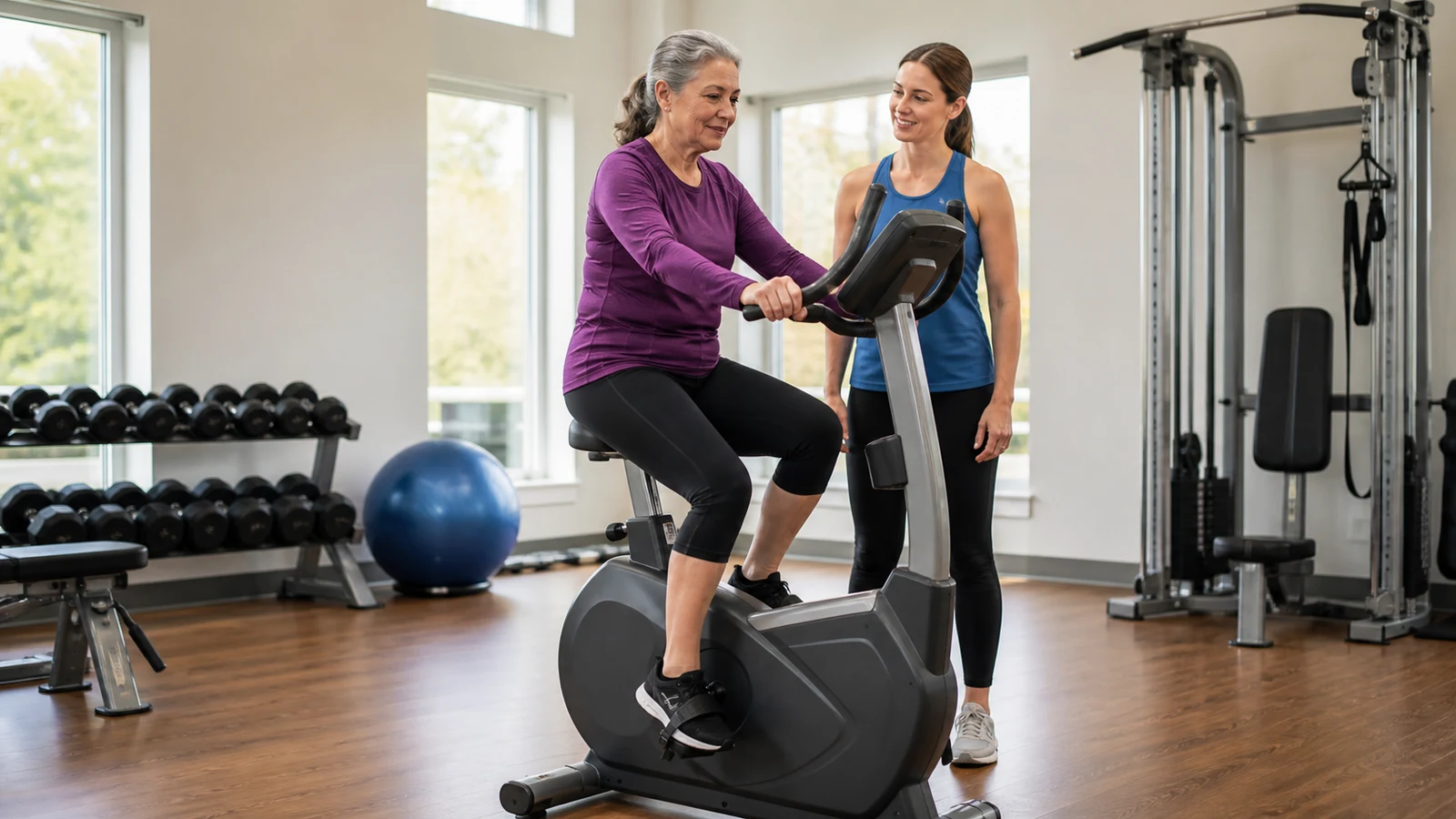
The featured exercise illustration is not a photograph of trial participants or evidence that the pictured movements produce a measured A1C change.
A1C is a longer term measure, not a workout score
A1C, also written as HbA1c, reflects average blood glucose over about three months. NIDDK explains that recent weeks contribute more to the result than earlier months, but the test does not show a sudden, temporary rise or fall after one workout.
This is why checking glucose after exercise cannot tell you how much a weekly program will change A1C. The immediate response and the longer term outcome answer different questions.
If the immediate response is your concern, our article on blood sugar after exercise explains why a reading may rise, fall or stay steady. Here, the focus is repeated exercise programs and the A1C measurements used to evaluate them.
What the weekly minute studies found
Jayedi and colleagues combined 26 randomized trials involving 1,253 adults with type 2 diabetes. The interventions were supervised aerobic training programs lasting at least 12 weeks, rather than a single session or a general instruction to move more.
Their model estimated increasing average A1C benefit toward about 100 weekly minutes, followed by a flatter curve. At that point, the estimated reduction versus control was 0.96 percentage points, with a 95 percent confidence interval of 0.67 to 1.25 percentage points.
Those figures describe a pooled model under the study conditions. They do not establish that a reader should stop at 100 minutes or expect that A1C change.
Wrench and colleagues reviewed 16 studies and also found that aerobic programs improved A1C compared with control groups. However, their analysis did not find a statistically significant relationship between the size of the improvement and exercise volume or intensity.
The authors noted differences between programs and a limited range of intensities among the studies. Their result challenges a precise minute based rule; it does not mean exercise had no benefit.
| Source | What it found or recommends | What not to infer |
|---|---|---|
| Jayedi et al., 2022 | A modeled A1C response flattened near 100 weekly minutes of supervised aerobic training. | A personal maximum or guaranteed drop. |
| Wrench et al., 2022 | Aerobic exercise helped overall; volume and intensity did not significantly predict the A1C improvement. | That every exercise program works equally well for everyone. |
| Gallardo-Gómez et al., 2024 | A broader activity analysis used intensity weighted MET minutes, with results related to starting A1C. | That its dose is interchangeable with ordinary weekly minutes. |
| ADA Standards of Care, 2026 | Broad aerobic and resistance activity guidance, individualized for the person. | A formula for predicting an individual’s A1C result. |
Why 100 study minutes and 150 guideline minutes differ
A research model asks what relationship appears across the programs included in an analysis. A clinical guideline addresses a broader set of health benefits, risks and practical care decisions.
For most adults with type 2 diabetes, ADA recommends at least 150 weekly minutes of moderate to vigorous aerobic activity across at least three days, plus two to three resistance sessions on nonconsecutive days. Adapt this guidance to abilities, preferences, treatment and complications; the 100 minute model does not replace it.
Nor does a flatter curve mean that additional activity has no value for fitness, function or other health outcomes. The model did not establish an exercise ceiling for every outcome a person might care about.
Check the units before comparing exercise headlines
In the 2024 analysis, Gallardo-Gómez and colleagues combined 126 studies involving 6,718 participants and expressed activity in MET minutes per week. That unit incorporates the intensity assigned to an activity as well as its duration.
Their model identified a dose around 1,100 MET minutes per week, which is not 1,100 ordinary exercise minutes. The paper also reported that it could not estimate the time needed to achieve the modeled A1C changes because the programs and responses varied.
Changing the unit changes the comparison. A headline about intensity weighted activity cannot be placed beside a supervised aerobic minute total as though both describe the same program.
A1C changes also need clear units: a change described in percentage points is different from a relative percentage change. Likewise, a standardized effect size in a meta-analysis is not automatically an A1C percentage point change.
Before comparing two numbers, ask what each measures, who was studied and over what period. This avoids turning different research summaries into an apparent contradiction or a personal calculator.
Make the weekly total more useful
A weekly total can help describe activity, but it leaves out details needed to understand a program. The same total could represent different activities, levels of effort and amounts of support.
Keep aerobic activity and resistance sessions identifiable in a record rather than automatically treating them as interchangeable minutes. Record what you actually completed, without translating the total into a predicted A1C drop.
| Record | Why it helps |
|---|---|
| Activity type and dates | Shows what the weekly total contains and how it is distributed. |
| Duration and usual effort | Describes the sessions beyond a single grand total. |
| Support or supervision | Clarifies how the activity differs from a supervised research program. |
| What made participation easier or harder | Helps identify a practical barrier to address. |
| Monitoring information requested by the team | Keeps glucose observations connected to the existing care plan. |
For example, imagine that someone plans several sessions but repeatedly misses one because transport is unreliable. A completed activity record reveals a different problem from a plan that is consistently completed but difficult to tolerate.
The first discussion might concern access or a different setting; the second needs attention to the experience of the activity. Neither situation can be understood from a target number alone.
This is a record keeping example, not a recommended schedule or a prediction about either person’s health. Its purpose is to make the next conversation more specific.
Plan around treatment and glucose safety
People taking insulin or medicines that stimulate insulin release can have low glucose during or after activity; ADA recommends individualized monitoring and medication or carbohydrate adjustments. Agree a response plan as activity changes, do not change medicines yourself, and review problematic lows alongside A1C.
Ask your team how eye, nerve, foot or cardiovascular complications affect activity choices. Another person’s plan may not suit you.

How to discuss progress without chasing a promised result
Bring the activity record and your agreed monitoring information to a review. Ask when the team wants to reassess A1C and how it will consider other changes in your care over the same period.
Useful questions include:
- How should the general activity guidance be adapted to my current abilities and treatment?
- Which activity details would help you interpret my progress?
- What glucose responses or symptoms should trigger a call or a change under my existing plan?
- What support would make the agreed activity more practical to continue?
- How will we judge progress alongside A1C, including function, fitness and any low glucose episodes?
Research averages are useful context for that discussion. They are not a score that a person must match to prove that their effort counted.
The strongest practical answer combines repeatable activity, appropriate support and an individualized review plan. The evidence supports exercise in type 2 diabetes while leaving the exact A1C response uncertain for any one person.
Medical disclaimer: This article provides general fitness and health education, not a diagnosis or a personalized diabetes treatment or exercise plan. Work with your healthcare team on activity, A1C goals, glucose monitoring and medicines, and do not change medication on your own.
References
American Diabetes Association Professional Practice Committee for Diabetes. (2026). [Physical activity guidance]. Diabetes Care, 49(Supplement 1), S89 to S131. Read the standards.
Gallardo-Gómez, D., et al. (2024). [Activity-dose analysis]. Diabetes Care, 47(2), 295 to 303. Read the study abstract.
Jayedi, A., Emadi, A., & Shab-Bidar, S. (2022). [Aerobic-dose analysis]. Sports Medicine, 52(8), 1919 to 1938. Read the study abstract.
National Institute of Diabetes and Digestive and Kidney Diseases. (2018). The A1C test & diabetes. Read the test explanation.
Wrench, E., et al. (2022). [Aerobic-dose review]. Acta Diabetologica, 59(11), 1399 to 1415. Read the review.