
In the late 1940s, American iron game writers argued about what lifting was really for.
Was it for strength you could prove on a bar, or for muscles you could show on a stage?
Harry Paschall, an editor and cartoonist at Strength & Health magazine, took a clear side.
A popular post says he argued that real strength comes from basic barbell training, not from posing or muscle display alone.
That summary is close to the record, with a few details worth sorting out.
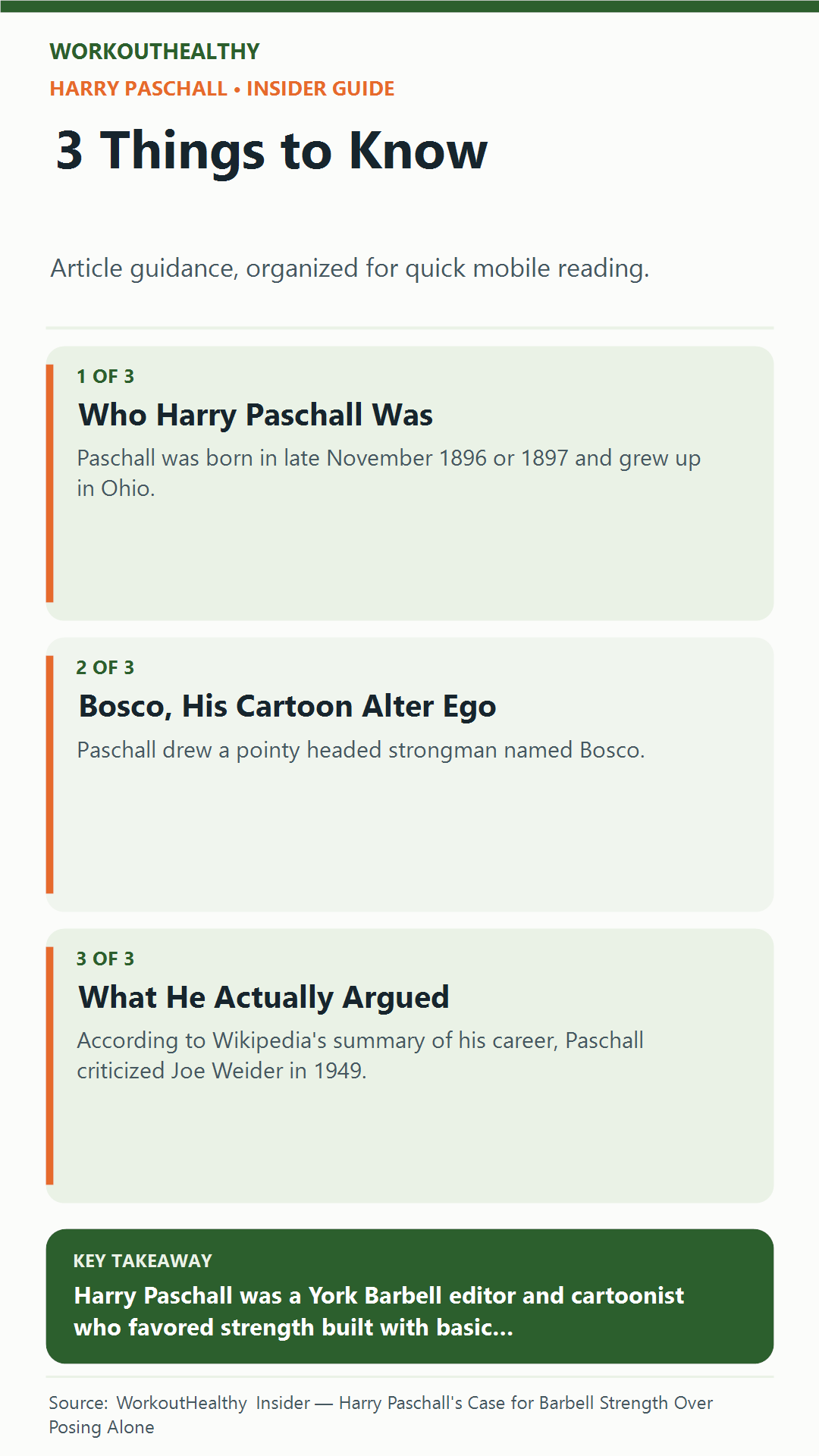
Who Harry Paschall Was
Paschall was born in late November 1896 or 1897 and grew up in Ohio.
As a boy, he was inspired by seeing the strongman Arthur Saxon.
He worked as a cartoonist and commercial artist, and taught weightlifting in Marion, Ohio, by the 1920s.
He founded a lifting club there before moving to York, Pennsylvania.
At Strength & Health, the York Barbell magazine run by Bob Hoffman, he started as a cartoonist.
He later became its managing editor, serving from 1955 until his death from a heart attack in September 1957.
Bosco, His Cartoon Alter Ego
Paschall drew a pointy headed strongman named Bosco.
Bosco became his pen name and his brand.
He called his training books “Bosco Books” and often referred to himself as “Old Man Bosco.”
Those books include Muscle Moulding, from 1950, and Development of Strength, from 1951.
The humor mattered. It let him poke at fads and vanity without sounding like a lecture.
What He Actually Argued
According to Wikipedia’s summary of his career, Paschall criticized Joe Weider in 1949.
He argued that bodybuilders were not “real strength athletes.”
We could not read the original 1949 magazine text, so we cannot quote his exact wording.
The general position fits the magazine he wrote for, which gave Olympic weightlifting a central place.
It also fits the rivalry of the era between the York camp and Weider’s bodybuilding magazines.
One nuance is often lost. Paschall did not reject muscle size.
Ads for Development of Strength promised great strength along with a strong looking physique.
His complaint was with training for looks alone, not with looking good.
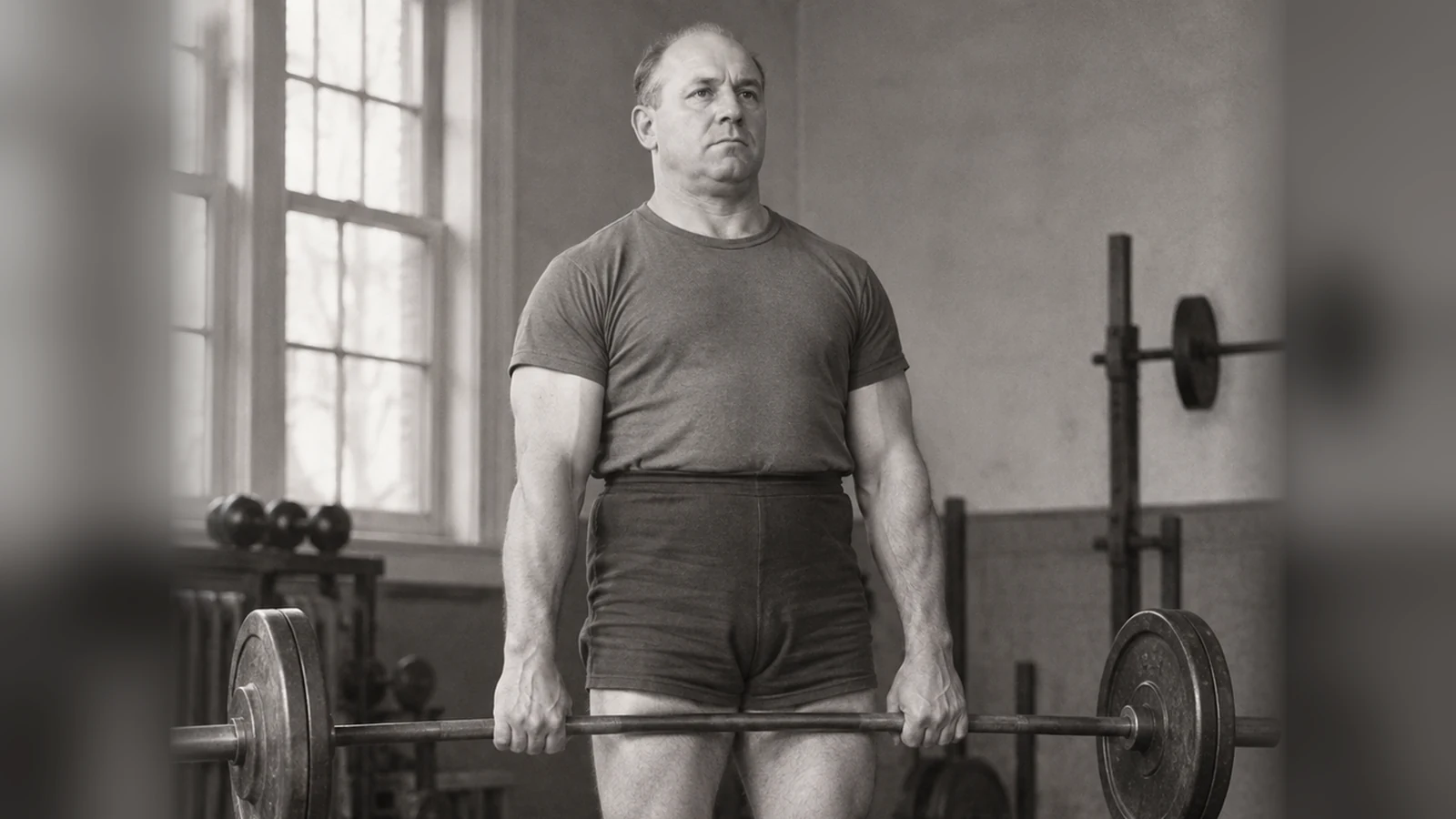
Muscle that can lift something is still muscle. Strength just gives it a job.
His Short, Basic Routines
Writer Clarence Bass, who has written about Paschall’s books, describes a strongly minimal style.
Bass quotes Paschall saying it was important to learn “not how much exercise is necessary, but how little.”
Paschall built short routines around the 20 rep squat, the press, the curl, and the pullover.
He also wrote that “resting had something to do with athletic accomplishment.”
Bass notes that Paschall laid out training cycles with harder weeks followed by easier recovery weeks.
That is an early version of what coaches now call planned variation.
What Research Says About Basic Compound Lifts
Modern studies give some support to Paschall’s focus on big, multi joint lifts.
In 2017, Paoli and colleagues split 36 active men into two groups for 8 weeks.
One group did only multi joint exercises. The other did only single joint exercises.
Total work volume was matched between the groups.
Both groups improved body composition by a similar amount.
The multi joint group gained more strength, with squat 1RM rising 13.8 percent versus 8.3 percent.
Their VO2max also rose 12.5 percent, compared with 5.1 percent in the single joint group.
The authors concluded that multi joint programs appeared more efficient for strength and fitness.
Strength and Size Are Related, Not Identical
Paschall’s split between strength and show has a modern echo too.
In 2017, Schoenfeld and colleagues pooled 21 studies comparing heavy and light load training.
Gains in one rep max strength were greater with heavy loads.
Changes in muscle size were similar between heavy and light loads.
In plain terms, you can grow with many rep ranges.
If you want to lift more, though, heavier practice on the lift itself matters.
That supports Paschall’s view that strength is a specific skill you train on purpose.
Where the Old Argument Falls Short
This is where the history needs a caution label.
The fight between strength and physique camps was partly about magazine sales and loyalty.
Today, both goals are valid, and many lifters train for both at once.
Isolation work also has a place, especially for weak spots, rehab, and muscle balance.
The Paoli study was short and involved only young active men.
Neither study tested Paschall’s exact routines or his 20 rep squat plan.
For a closer look at how simple muscle building really is, see our article on whether building muscle is as simple as one coach claims.
How to Use Paschall’s Idea Today
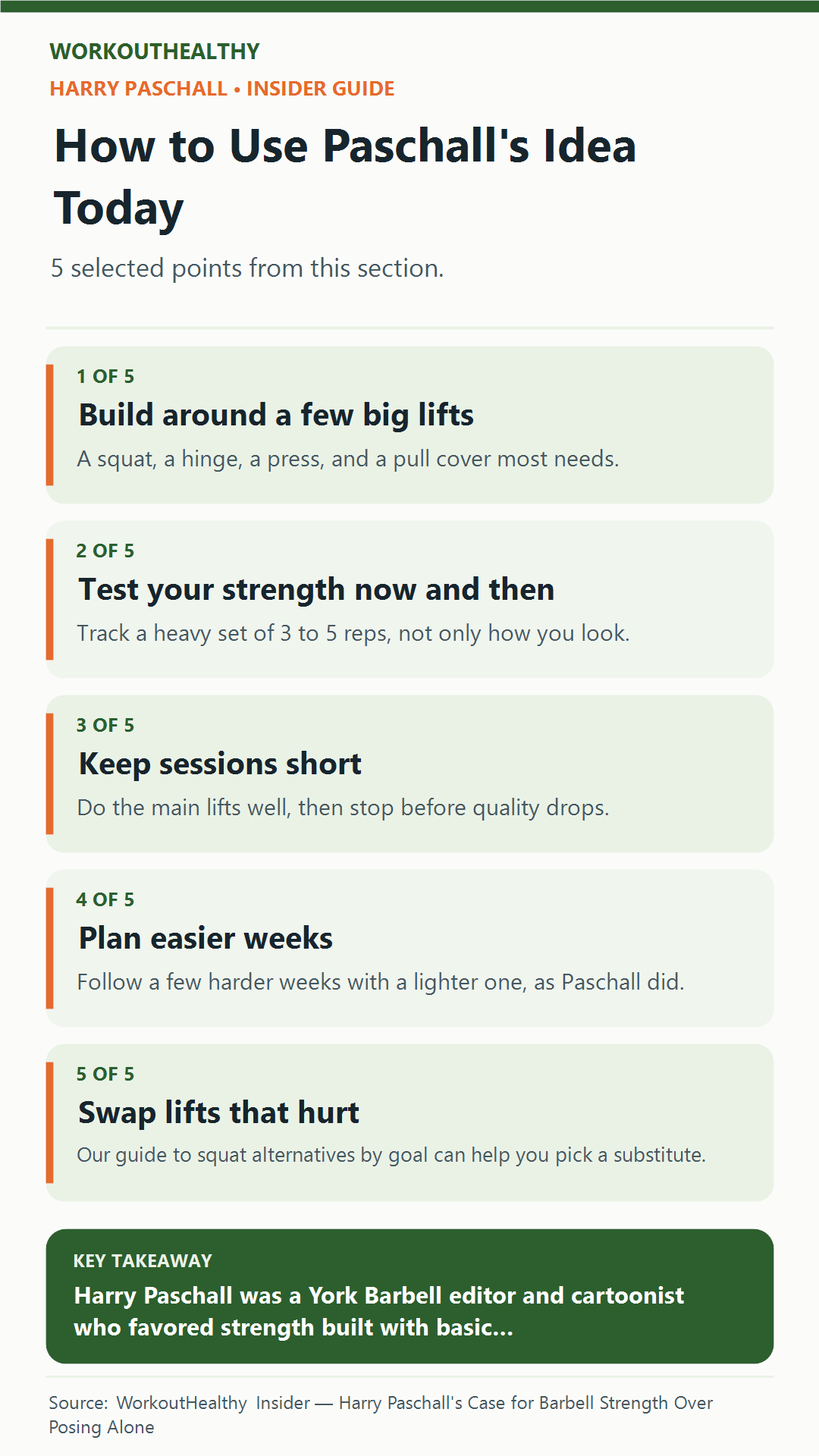
- Build around a few big lifts. A squat, a hinge, a press, and a pull cover most needs.
- Test your strength now and then. Track a heavy set of 3 to 5 reps, not only how you look.
- Keep sessions short. Do the main lifts well, then stop before quality drops.
- Plan easier weeks. Follow a few harder weeks with a lighter one, as Paschall did.
- Swap lifts that hurt. Our guide to squat alternatives by goal can help you pick a substitute.
- Add accessories with a reason. Use curls and raises to fill gaps, not to replace the basics.
For a sense of how far focused squat training can go, read about Russel Orhii’s 338 kg squat.
Who Should Be Careful
Beginners should learn barbell lifts with light weights and good coaching first.
Anyone with back, knee, or shoulder problems should get medical advice before heavy lifting.
Always use safety pins or a spotter when you squat or press near your limit.
The Bottom Line
Harry Paschall was a York Barbell editor and cartoonist who favored strength built with basic barbell lifts.
The record shows he criticized bodybuilders in 1949, though we could not read his exact words.
Research supports compound lifts and heavy practice for strength.
It does not support treating strength and physique as enemies.
Want more stories like this? Subscribe to WorkoutHealthy Insider for practical explanations behind popular fitness claims.
References
- Bass, C. (n.d.). Harry Paschall and his alter ego Bosco. Clarence Bass’ Ripped Enterprises. https://www.cbass.com/BoscoPaschall.htm
- Paoli, A., Gentil, P., Moro, T., Marcolin, G., & Bianco, A. (2017). Resistance training with single vs. multi-joint exercises at equal total load volume: Effects on body composition, cardiorespiratory fitness, and muscle strength. Frontiers in Physiology, 8, 1105. https://doi.org/10.3389/fphys.2017.01105
- Schoenfeld, B. J., Grgic, J., Ogborn, D., & Krieger, J. W. (2017). Strength and hypertrophy adaptations between low- vs. high-load resistance training: A systematic review and meta-analysis. Journal of Strength and Conditioning Research, 31(12), 3508 to 3523. https://doi.org/10.1519/JSC.0000000000002200
- Super Strength Training. (n.d.). Development of strength by Harry B. Paschall.
- Wikipedia contributors. (n.d.). Harry Paschall. In Wikipedia. Retrieved September 16, 2026, from https://en.wikipedia.org/wiki/Harry_Paschall
This article is for general information only and is not medical advice. If you have an injury, ongoing pain, or a medical condition, talk to a doctor or physical therapist before you change how you train or eat.