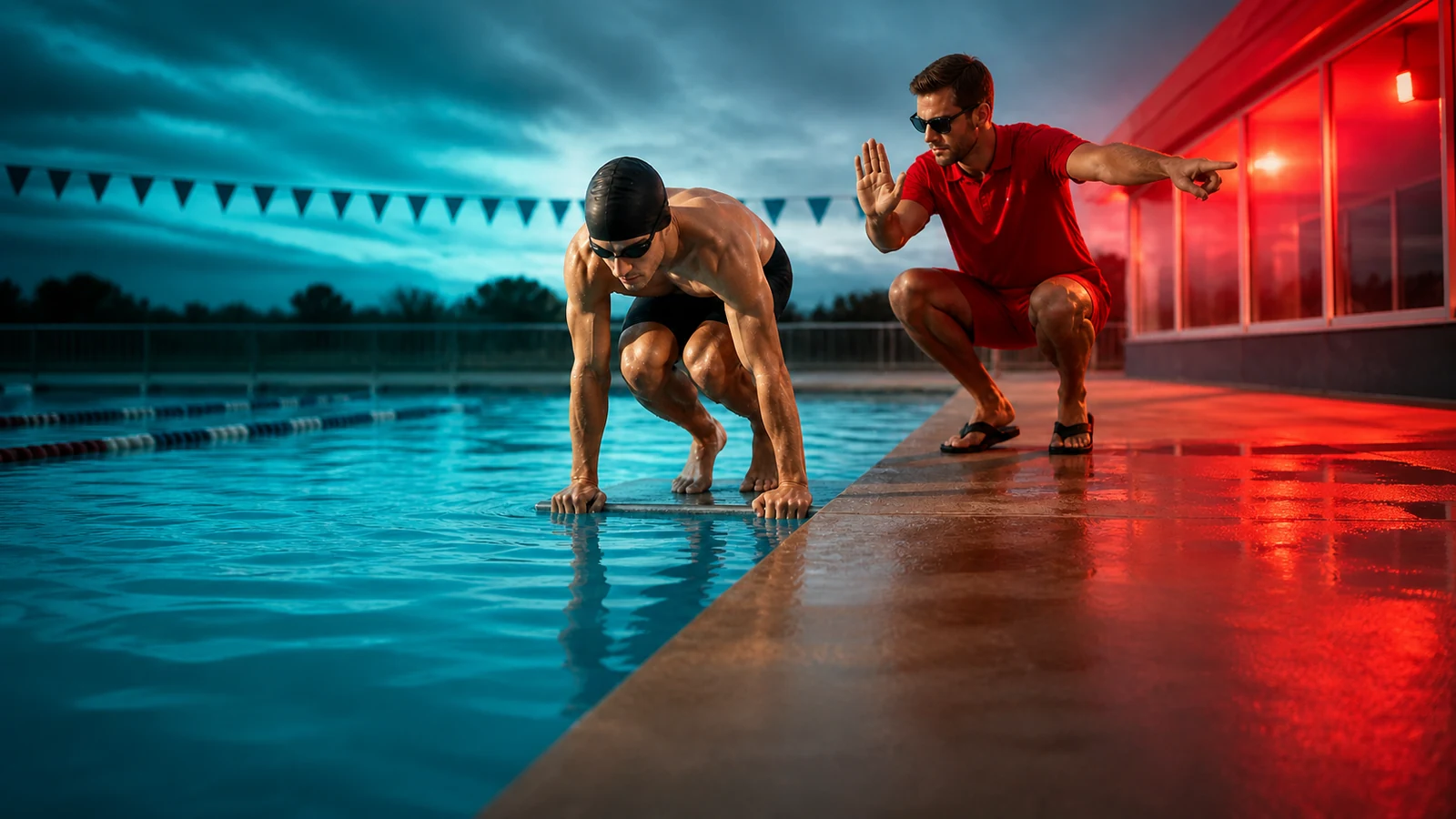

Summer fills the water with people again.
Pools, lakes, rivers, and beaches see swimmers, surfers, water skiers, and divers all season long.
A video from The Centers for Advanced Orthopaedics offers safety tips for aquatic sports and orthopedic injury prevention.
A separate article on this site already covers summer sports injuries, heat illness, and shoulder overuse in competitive swimmers.
This article takes a different angle, the traumatic orthopedic injuries that come from diving, water skiing, wakeboarding, and surfing.
What the Video Claims
The video comes from The Centers for Advanced Orthopaedics, a real orthopedic practice group.
Public search results and the practice’s own website describe it as the largest group of orthopedic specialists in the Virginia, Washington D.C., and Maryland region.
The group reports more than 400 providers across dozens of locations in that area.
Unlike some practice videos, this one does not name or feature a single credentialed physician on screen.
Its description instead points viewers to “the specialists” at the practice as a group.
That is worth stating plainly, since this article cannot verify an individual doctor’s credentials for a person who is not named.
The video itself is short and covers a lot of ground quickly.
It tells viewers to always swim with a buddy and to wear a life jacket for boating and water sports.
It warns viewers to check water depth before getting in and to never dive into shallow water.
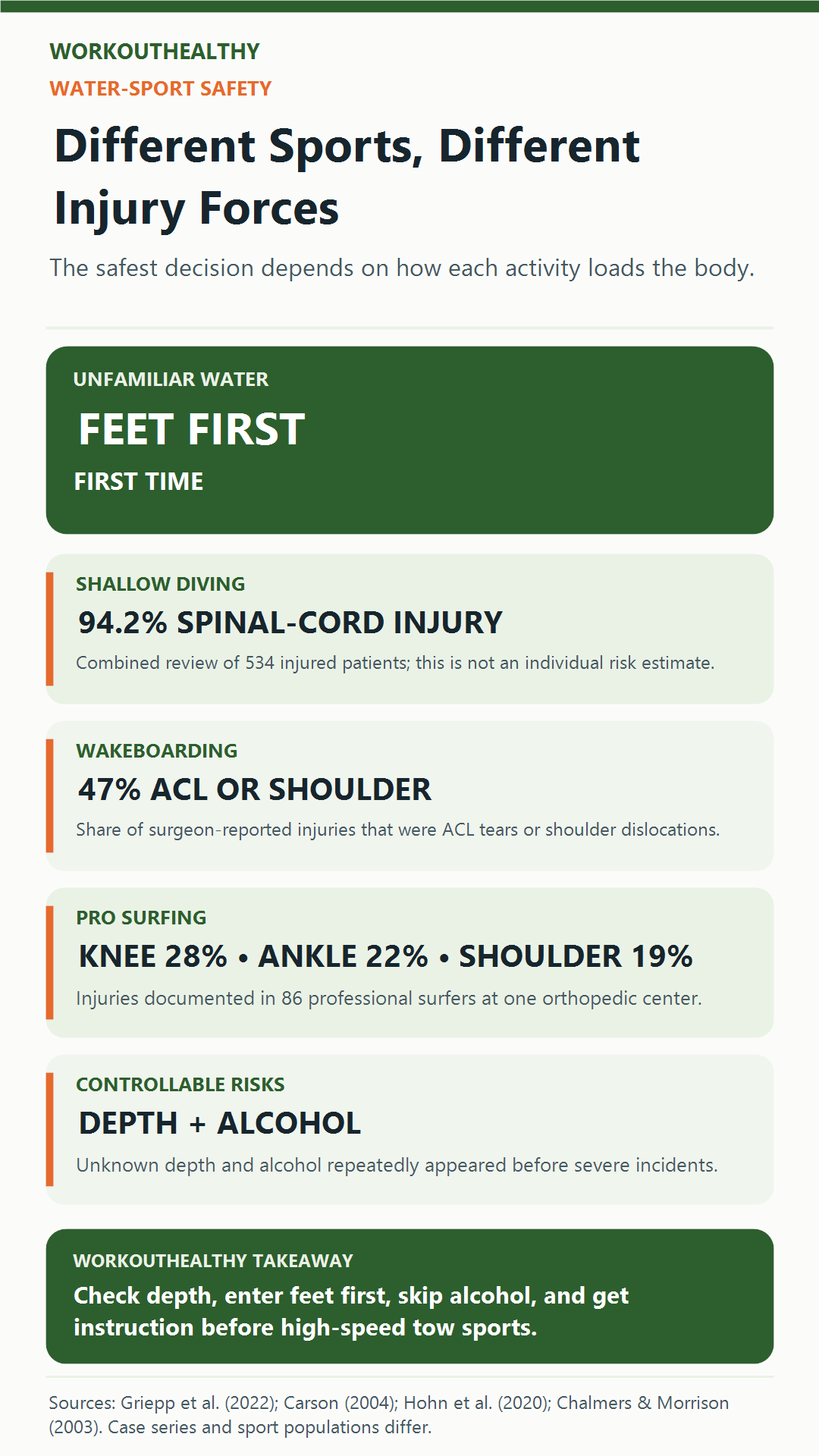
Its memorable line is “feet first, first time” for any unfamiliar body of water.
It also mentions warming up, stretching, staying hydrated, and following the three points of contact rule on a boat.
The description names sprains, strains, fractures, and severe spinal cord and head injuries as common outcomes of diving into shallow water.
A short safety video cannot walk through published research or explain exactly how these injuries happen.
This article does that, using real studies on diving, water skiing, wakeboarding, and surfing trauma.
What Real Research Shows About Diving Into Shallow Water
The video’s warning against diving into shallow water lines up closely with the medical literature.
A 2022 study reviewed cervical spine injuries from breaking ocean waves at a single trauma center over ten years.
Researchers led by Daniel Griepp identified 19 patients hurt in shallow beach water.
Six of them were injured while diving head first into an incoming wave.
Six more were struck by a large wave while standing upright, and seven were tumbled by the surf.
Every patient with a high injury severity score on imaging had actual spinal cord damage and needed surgery.
The same research team combined their data with seven other published studies, covering 534 total patients.
Across that combined group, 94.2 percent of patients had a spinal cord injury, not just a fracture.
An estimated 64.8 percent were left with permanent neurologic damage.
12.5 percent were left permanently quadriplegic.
A separate, older study looked specifically at diving injuries among amateur divers rather than wave related incidents.
Researchers led by Demetrios Korres reviewed 20 patients treated over a 34 year span.
The typical patient was young, healthy, athletic, and male.
Every single case in that study happened between May and September.
The C5 and C6 vertebrae in the neck were the ones most commonly fractured.
Five of the 20 patients died within the first month of their injury.
Nearly every patient in the combined diving injury data had actual spinal cord damage, not just a broken bone.
These are small studies, but the pattern across both is consistent and severe.
Diving head first into water of unknown or shallow depth is a genuinely high stakes decision.
What Real Research Shows About Water Skiing and Wakeboarding Injuries
Wakeboarding and water skiing put a different kind of stress on the body than diving does.
A study led by William Carson surveyed 156 orthopedic surgeons and 86 wakeboarders directly.
Surgeons reported 122 total wakeboarding injuries they had personally treated.
Nearly half of those, 47 percent, were either torn ACLs or dislocated shoulders.
ACL tears alone made up 31 percent of the surgeon reported injuries.
Shoulder dislocations made up another 15 percent.
About 21 percent of all reported injuries were some type of fracture.
On the rider side, 77 percent of the wakeboarders surveyed said they had been hurt at least once.
Their most common injuries were ACL tears and ankle sprains, at 17 percent each.
A broader review of aquatic sport injuries also flagged a rarer but severe risk in water skiing.
Propeller strikes from a tow boat can cause amputation, though this is uncommon.
The injury pattern here looks different from diving.
These are high speed falls and sudden twisting forces, not a single head first impact.
What Real Research Shows About Surfing Injuries
Surfing injuries have their own distinct pattern in the research too.
A 2020 study reviewed the medical records of 86 professional surfers treated at one orthopedic center over 25 years.
Researchers led by Eric Hohn documented 163 total injuries in that group.
The knee was the most frequently injured area, at 28.2 percent of all injuries.
The ankle followed at 22.1 percent, and the shoulder at 19 percent.
Within knee injuries, 49 percent involved the medial collateral ligament.
Within ankle injuries, 75 percent were sprains.
Shoulder injuries were more varied, with instability in 48 percent of cases.
Rotator cuff tears made up 42 percent of shoulder injuries, and labral tears made up 35 percent.
Surfers’ rear leg, the one carrying weight and turning force during a maneuver, was hurt far more often than the front leg.
About 34.6 percent of all injuries in the study needed surgery, and shoulder injuries were the most likely to require it.
This is a meaningfully different shoulder injury pattern than the one covered in this site’s earlier article on competitive swimmers.
That article focused on gradual overuse from repetitive overhead swim strokes.
Surfing shoulder injuries in this study were more often traumatic, tied to wipeouts, paddling force, and board impact.
What Real Research Shows About General Water Sport Trauma Patterns
A wider review helps explain how these individual sports fit into a bigger picture.
Researchers David Chalmers and Luke Morrison reviewed non submersion injuries across many aquatic activities.
Their review covered swimming, diving, boating, surf sports, fishing, water polo, and water sliding.
Most individual injuries in these activities were not severe.
But certain activities carried a real risk of catastrophic, disabling injury.
Diving carried a clear risk of spinal cord injury, matching the studies already covered here.
Water skiing and swimming both carried some risk of amputation from propeller strikes.
The review also identified specific behaviors that raised risk across several activities.
Not knowing the depth of the water was a major risk factor for diving injuries.
Alcohol use raised the risk of injury in both diving and boating.
Higher blood alcohol levels were tied to a higher risk of death in boating incidents specifically.
For water sliding, both obesity and riding tandem with another person raised injury risk.
Alcohol use and simply not knowing the water’s depth showed up again and again as real, controllable risk factors.
None of these are exotic risks.
They are ordinary decisions that show up before most water sport injuries happen.
The Mechanism
Each of these injury types comes from a different kind of physical force.
A head first dive into shallow water sends the body’s full momentum straight down the spine.
When the head strikes the bottom, the neck bones absorb that force in a fraction of a second.
That sudden compression is what fractures the C5 and C6 vertebrae so often seen in the diving studies.
If the spinal cord itself gets compressed or bruised in that moment, the resulting damage is frequently permanent.
Water skiing and wakeboarding work through a very different mechanism.
A rider moving at speed suddenly catches an edge, falls, or gets thrown by wake or slack in the tow rope.
The knee can twist while the foot stays fixed in a binding, which is a classic setup for an ACL tear.
A sudden jolt through an outstretched arm can pop a shoulder out of its socket.
Surfing adds yet another pattern on top of these.
Thousands of paddling strokes build up fatigue and stress in the shoulder over a season.
On top of that steady load, a hard wipeout or a strike from the board or the ocean floor can cause a sudden injury.
The rear leg takes extra rotational stress during turns, which likely explains why it gets hurt more often.
The common thread across water skiing, wakeboarding, and surfing is sudden force layered onto a body already working hard.
That is different from the slow, repetitive overuse pattern seen in competitive pool swimming.
What This Evidence Does Not Prove
It is worth being precise about what these studies can and cannot show.
Most of the diving injury research comes from small case series at single hospitals.
The Korres study had only 20 patients, and the Griepp single center group had only 19.
Small samples like these describe real patterns but cannot give a precise individual risk number.
The professional surfer study looked only at elite, sponsored athletes seen at one clinic.
Recreational surfers who ride less often and less aggressively may face a different injury mix.
The wakeboarding survey relied on people’s memory and self reporting, not medical records for every case.
Memory based surveys can overstate or understate how common an injury really was.
The broader Chalmers and Morrison review itself noted a lack of high quality studies in this area.
None of this research proves that any single safety step guarantees an injury free summer.
These studies show which risk factors and injury patterns show up again and again.
They do not replace instruction, supervision, or basic caution in the water.
Who Should Be Extra Careful
A few groups stand out as higher risk based on this research.
Young, healthy, athletic men were the typical diving injury patient in the Korres study.
That does not mean other people are immune, since the Griepp study included patients from age 17 to 79.
Anyone entering unfamiliar water, a lake, quarry, or unmarked swimming area, should treat the depth as unknown.
Anyone who has been drinking alcohol should not dive, water ski, or operate a boat at all.
First time water skiers and wakeboarders should get real instruction before attempting jumps or tricks.
A properly fitted life jacket and a quick release tow system both matter for that group.
Surfers coming back from a shoulder injury deserve particular caution, given how often shoulder injuries needed surgery in the Hohn study.
Anyone recovering from a major joint surgery should follow a structured, doctor guided return to sport.
Misty Copeland’s hip replacement recovery is a real example of how demanding that comeback can be.
People with a history of a prior neck or shoulder injury carry added risk in any of these activities.
Children need direct supervision around any deep or unfamiliar water, not just a life jacket.
A Practical Takeaway
The research points toward a short list of concrete habits.
Never dive head first into water of unknown or shallow depth.
Check the depth first, and go in feet first the first time, every time.
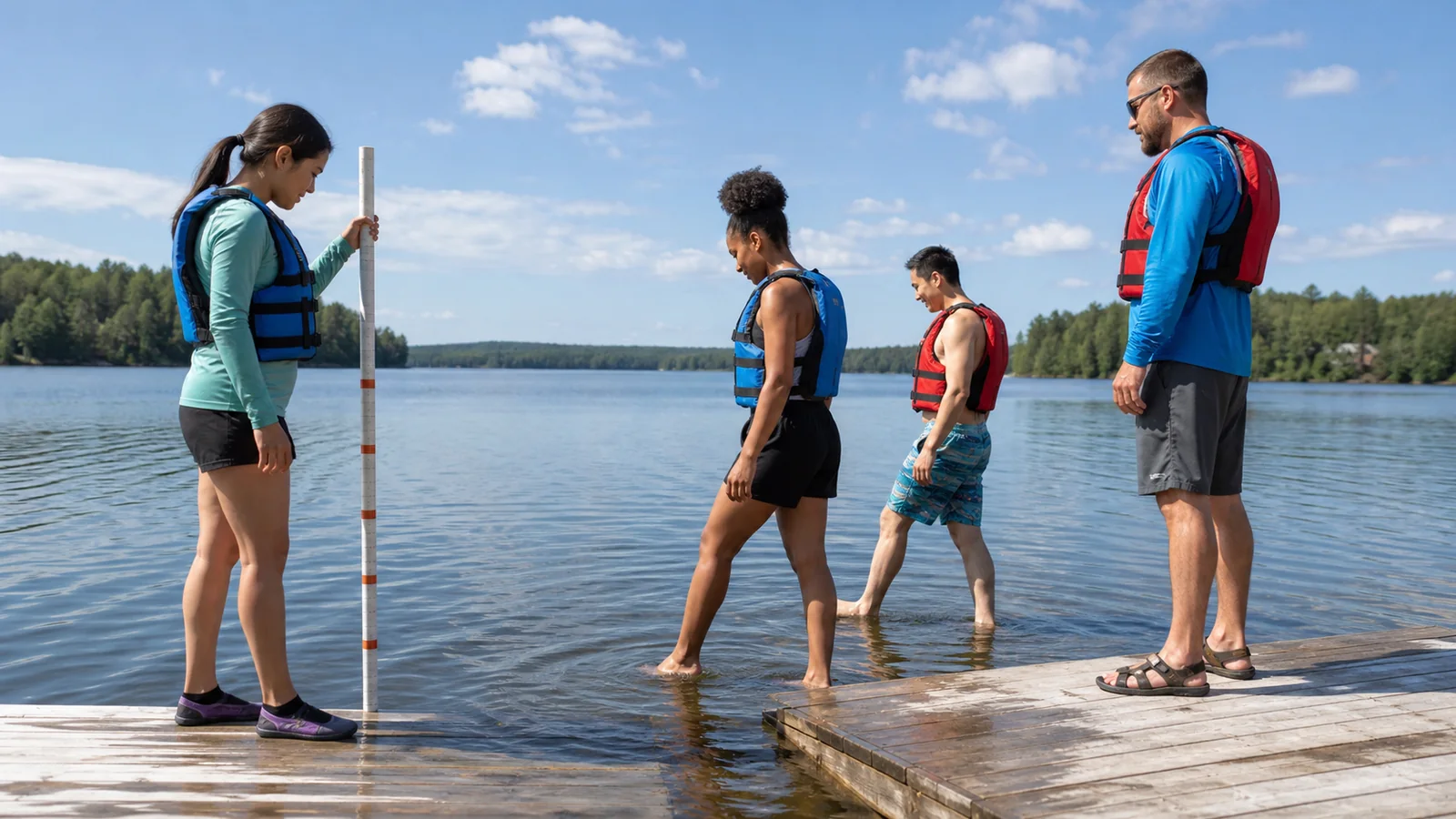
Save head first dives for water you already know is deep enough.
Skip alcohol entirely before diving, boating, or water skiing.
Take a real lesson before trying water skiing or wakeboarding for the first time.
Wear a life jacket rated for the specific activity, not just any flotation device.
Build shoulder and core strength before surf season starts, rather than during it.
A low impact cardio option like jumping rope can help rebuild general fitness during the off season.
A simple readiness check, like the four flights stair test, can help gauge conditioning before jumping back into high intensity water sports.
Anyone with shoulder instability after a wipeout should get it checked before paddling out again.
Anyone with neck pain, numbness, or weakness after a fall or dive needs emergency care immediately.
Small, boring precautions do more for injury prevention than any single dramatic decision.
Want more like this? Subscribe to WorkoutHealthy Insider for practical explanations behind popular fitness claims.
Watch the video
References
- Carson, W. G. (2004). Wakeboarding injuries. The American Journal of Sports Medicine, 32(1), 164 to 173. https://doi.org/10.1177/0363546503258910
- Chalmers, D., & Morrison, L. (2003). Epidemiology of non submersion injuries in aquatic sporting and recreational activities. Sports Medicine, 33(10), 745 to 770. https://doi.org/10.2165/00007256-200333100-00003
- Griepp, D. W., De la Garza Ramos, R., Lee, J., Miller, A., Prasad, M., Gelfand, Y., Cardozo-Stolberg, S., & Murthy, S. G. (2022). Beach breaking waves and related cervical spine injuries: A level one trauma center experience and systematic review. World Neurosurgery, 160, e471 to e480. https://doi.org/10.1016/j.wneu.2022.01.055
- Hohn, E., Robinson, S., Merriman, J., Parrish, R., & Kramer, W. (2020). Orthopedic injuries in professional surfers: A retrospective study at a single orthopedic center. Clinical Journal of Sport Medicine, 30(4), 378 to 382. https://doi.org/10.1097/JSM.0000000000000596
- Korres, D. S., Benetos, I. S., Themistocleous, G. S., Mavrogenis, A. F., Nikolakakos, L., & Liantis, P. T. (2006). Diving injuries of the cervical spine in amateur divers. The Spine Journal, 6(1), 44 to 49. https://doi.org/10.1016/j.spinee.2005.06.013
This article is for general information only and is not medical advice. If you have an injury, ongoing pain, or a medical condition, talk to a doctor or physical therapist before you change how you train or eat.