

A YouTube video asks a simple question about exercise and the heart.
How much, how hard, and how often should you actually train?
The question sounds simple, but cardiovascular research has spent decades answering it.
Here is what the published evidence says, piece by piece. The featured image is an illustration, not a photograph of the video host.
What the Video Claims
The video is titled “Exercise Prescription for Heart Health: How Much, How Hard & How Often?”
It comes from a channel called DrLogic360.
The channel describes its host as a board certified cardiologist.
We could not fully verify that specific claim through an independent source.
The video description names Dr. Joseph Gnanaraj. An independent Trinity Health provider profile lists a cardiologist of that name and says he is board-certified in cardiovascular disease. That supports the credential claim, but the provider listing does not itself verify who controls the YouTube channel or identify the illustrated person in the featured image.
Because of that, this article leans on the published research itself, not on the video’s authority.
The video’s title frames exercise like a prescription with three variables.
Those variables are dose, intensity, and frequency.
That framing matches how cardiologists and exercise scientists actually talk about physical activity.
Below is what large, published studies say about each variable.
What Real Research Shows About How Much Exercise You Need
The current Physical Activity Guidelines for Americans set a clear target.
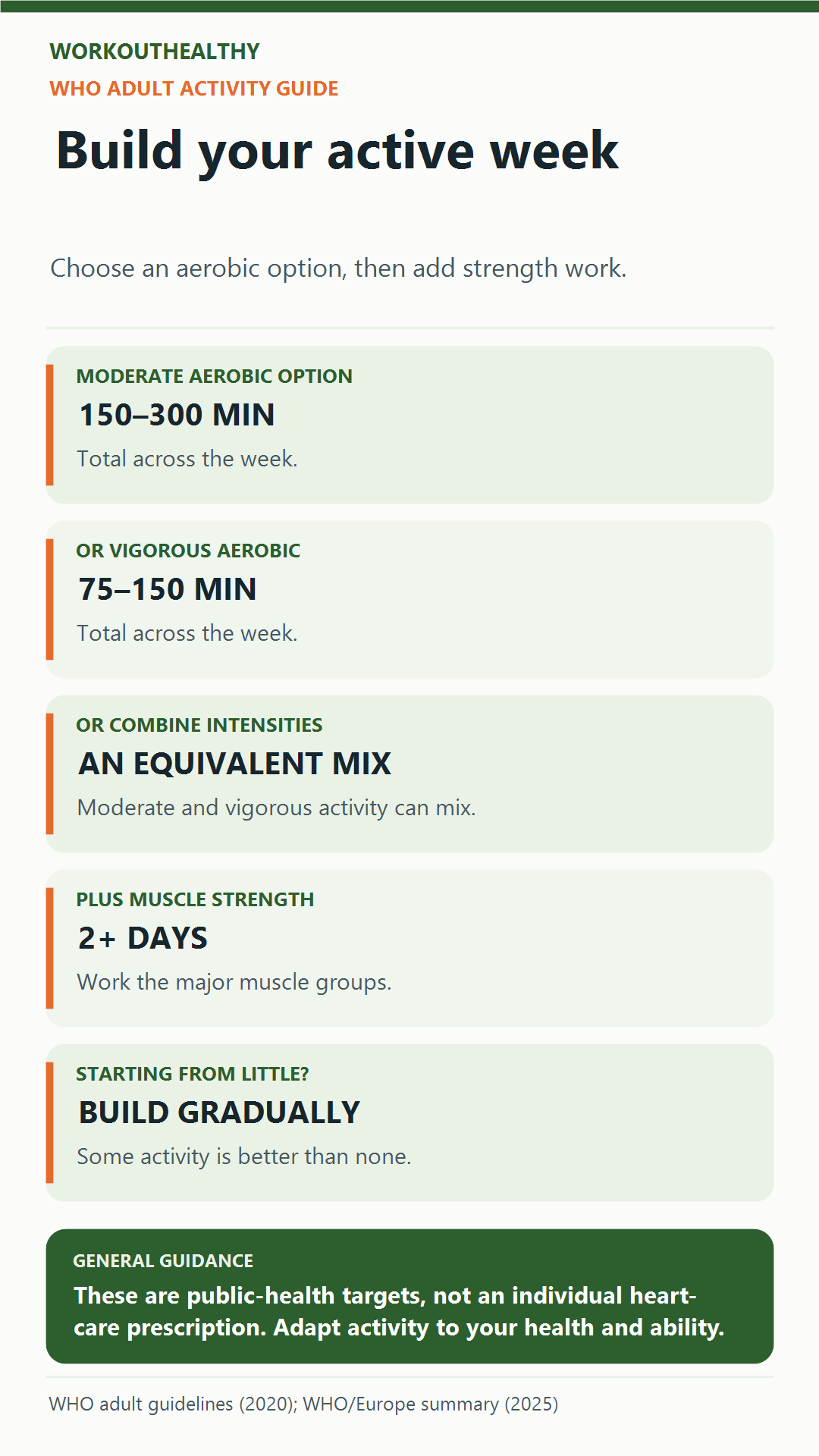
Adults should get 150 to 300 minutes of moderate intensity aerobic activity each week.
Or 75 to 150 minutes of vigorous intensity activity instead.
A mix of both counts too, as long as the total adds up (Piercy et al., 2018).
The World Health Organization published nearly identical numbers in its own 2020 guidelines (Bull et al., 2020).
The U.S. and WHO recommendations converge on these public-health ranges, drawing on overlapping bodies of evidence. They are population targets, not a personalized exercise prescription for someone with diagnosed heart disease.
Resistance-band work can count toward the muscle-strengthening part of the recommendation; it is not automatically counted as moderate aerobic minutes unless the session actually reaches that intensity.
Additional health benefits continue for people who go beyond 300 minutes a week.
There is no single hard ceiling written into the official guidelines themselves (Piercy et al., 2018).
In population studies, the largest relative difference in observed risk is often between doing nothing and doing a little.
A large study from Taiwan tracked more than 416,000 adults for about eight years (Wen et al., 2011).
Participants reporting about 15 minutes of daily activity had a 14 percent lower mortality rate during follow-up than inactive participants. The study was observational, so this is an association rather than proof that those 15 minutes alone caused the difference.
Additional activity was associated with further benefit, but the largest relative change in the study’s dose-response pattern was near the inactive end. Even a modest, sustainable start can be worthwhile.
Walking is one of the simplest ways to reach these weekly minutes.
Our guide to how many miles you should walk a day breaks down what that looks like in practice.
What Real Research Shows About Exercise Intensity and Your Heart
Intensity is the second part of the video’s question.
Research on runners offers a useful answer here.
One large study followed thousands of adults in the Aerobics Center Longitudinal Study (Lee et al., 2014).
Runners had a 30 percent lower risk of dying from any cause than non runners.
They also had a 45 percent lower risk of dying from heart disease.
That benefit showed up even among runners who ran less than 51 minutes a week.
The study found lower mortality among runners across several lower-dose categories, including those reporting less than 51 minutes a week. Those category comparisons do not prove that pace or duration never matters; they show that a long or fast run was not required for an observed association.
A separate study from Denmark looked at jogging specifically (Schnohr et al., 2015).
Light and moderate joggers had lower death rates than people who did not jog at all.
Strenuous joggers, the ones running fast and often, did not show that same advantage.
Their death rate looked statistically similar to people who did not jog.
The authors described a possible U-shaped association. But the strenuous-jogging estimate was imprecise, with a wide confidence interval, so the study cannot establish that hard exercise is harmful or that one effort level is universally best.
The Copenhagen study suggests a lower-risk range of jogging, but its strenuous-jogger estimate was too imprecise to define a harmful upper limit.
A practical way to gauge aerobic intensity is the CDC talk test: at moderate intensity, you can usually talk but not sing; at vigorous intensity, you can usually say only a few words before pausing for breath. This is a rule of thumb, not a diagnostic cardiac test.
What Real Research Shows About How Often You Should Train
Frequency is the third piece of the video’s question.
The guidelines do not require daily exercise to get a heart benefit.
Spreading activity across most days of the week is still the most studied pattern (Piercy et al., 2018).
A large pooled analysis looked at this question from a different angle (Arem et al., 2015).
Researchers combined data from six large studies, covering more than 661,000 adults.
People who met the minimum guideline had a 31 percent lower risk of dying during the study.
People who did three to five times that amount had an even lower risk, close to 39 percent.
The lowest observed mortality risk was around three to five times the recommended minimum. The analysis found no excess mortality at ten or more times the minimum, but it did not show that ever-higher amounts keep adding benefit.
A similar leveling off pattern shows up in step count research too.
Our article on daily steps and mortality risk covers that pattern in more detail.
Older versions of the guidelines required at least 10 minutes per session to count.
The current guidelines dropped that rule, since short bouts add up too (Piercy et al., 2018).
That means a few short walks across the day can count toward your weekly total.
The Mechanism
Why would moderate, repeated exercise help the heart specifically?
Regular aerobic activity strengthens the heart muscle itself.
It improves how efficiently the heart pumps blood with each beat.
It also helps blood vessels stay flexible and responsive.
Exercise lowers resting blood pressure over time in most people.
It improves cholesterol patterns, often raising HDL and lowering triglycerides.
It improves how the body handles blood sugar and insulin.
Exercise also supports the lining of blood vessels, called the endothelium.
A healthier endothelium is linked to fewer blood clots and slower plaque buildup.
These are plausible pathways through which regular activity can support cardiovascular health. The cohort studies cited here do not isolate how much each mechanism contributes to a person’s risk, so the mechanisms should not be treated as separately proven causal shares of the observed dose-response pattern.
The guidelines also recommend muscle strengthening activity at least twice a week (Piercy et al., 2018).
Strength training supports heart health indirectly, through better metabolic health and body composition.
Our look at whether lifting weights keeps your brain young covers some of that broader research.
What This Evidence Does Not Prove
These studies show strong associations, not a guaranteed outcome for any one person.
Most of this research is observational, not a randomized controlled trial.
That means people who exercise more may differ in other ways too.
They may already be healthier, wealthier, or less likely to smoke.
Researchers try to adjust for these factors statistically, but adjustment is never perfect.
The Copenhagen jogging study, in particular, involved a fairly small number of strenuous joggers.
A small group makes it harder to draw firm conclusions about any upper limit.
None of these studies prove a specific number of minutes is exactly right for your heart.
Most participants in these studies did not have diagnosed heart disease when the research began.
People already living with a heart condition need individualized guidance, not a population average.
They show a pattern across large populations, which is different from a personal guarantee.
Common Mistakes
One common mistake is doing nothing while waiting for a “perfect” plan.
The research is clear that any activity beats none.
Another mistake is chasing intensity before building a consistent habit.
These studies do not directly compare a consistent moderate routine with an otherwise equivalent sporadic vigorous routine. For most people, the better practical plan is one they can sustain safely and build on over time.
A third mistake is treating exercise as all or nothing.
Ten minutes here and ten minutes there still add up across a week.
A fourth mistake is ignoring the strength training half of the guidelines.
Aerobic exercise and muscle strengthening work through different pathways.
Both are included in public-health guidance, although they contribute through partly different pathways and are not interchangeable minute for minute.
A fifth mistake is jumping straight into hard efforts when unaccustomed to them. A gradual warm-up is a practical way to ease into vigorous activity, but it should not be presented as a guarantee against a cardiac event.
Who Should Be Extra Careful
Most healthy adults can start moderate activity without a medical clearance.
Some groups should talk to a doctor before increasing intensity.
That includes anyone with diagnosed heart disease or a history of heart attack.
It includes people with uncontrolled high blood pressure.
It includes anyone who feels chest pain, dizziness, or unusual shortness of breath during activity.
People who are new to vigorous exercise after years of being sedentary should ease in gradually.
Heat adds another layer of cardiovascular strain worth understanding.
Our article on sauna use and heart health covers how passive heat exposure affects the cardiovascular system.
The same caution about easing in gradually applies there too.
Pregnant women and people recovering from surgery also need individualized guidance.
A doctor can adjust these general numbers to fit a specific situation.
A Practical Takeaway
Start with the guideline range if you are healthy and cleared for exercise.
Aim for 150 to 300 minutes of moderate activity a week.
Or 75 to 150 minutes of something more vigorous.
Spread it across most days rather than cramming it into one session.
Add muscle strengthening activity on two or more days a week.
If you are inactive today, do not wait for a perfect plan to start.
The research shows the jump from zero to a little activity matters the most.
You can build up from there over weeks and months.
More is not automatically better once you pass a few times the minimum.
A simple way to judge moderate intensity is the talk test.
You should be able to talk in short sentences but not sing.

Vigorous intensity feels different from moderate intensity.
You can usually only say a few words before needing another breath.
The evidence supports building a sustainable, appropriately intense weekly routine rather than assuming the hardest session is automatically best.
Watch the Original Video
Want more like this? Subscribe to WorkoutHealthy Insider for practical explanations behind popular fitness claims.
References
Arem, H., Moore, S. C., Patel, A., Hartge, P., Berrington de Gonzalez, A., Visvanathan, K., Campbell, P. T., Freedman, M., Weiderpass, E., Adami, H. O., Linet, M. S., Lee, I. M., & Matthews, C. E. (2015). Leisure time physical activity and mortality: A detailed pooled analysis of the dose response relationship. JAMA Internal Medicine, 175(6), 959 to 967. https://doi.org/10.1001/jamainternmed.2015.0533
Bull, F. C., Al-Ansari, S. S., Biddle, S., et al. (2020). World Health Organization 2020 guidelines on physical activity and sedentary behaviour. British Journal of Sports Medicine, 54(24), 1451 to 1462. https://doi.org/10.1136/bjsports-2020-102955
Lee, D. C., Pate, R. R., Lavie, C. J., Sui, X., Church, T. S., & Blair, S. N. (2014). Leisure time running reduces all cause and cardiovascular mortality risk. Journal of the American College of Cardiology, 64(5), 472 to 481. https://doi.org/10.1016/j.jacc.2014.04.058
Piercy, K. L., Troiano, R. P., Ballard, R. M., Carlson, S. A., Fulton, J. E., Galuska, D. A., George, S. M., & Olson, R. D. (2018). The Physical Activity Guidelines for Americans. JAMA, 320(19), 2020 to 2028. https://doi.org/10.1001/jama.2018.14854
Schnohr, P., O’Keefe, J. H., Marott, J. L., Lange, P., & Jensen, G. B. (2015). Dose of jogging and long term mortality: The Copenhagen City Heart Study. Journal of the American College of Cardiology, 65(5), 411 to 419. https://doi.org/10.1016/j.jacc.2014.11.023
Wen, C. P., Wai, J. P. M., Tsai, M. K., Yang, Y. C., Cheng, T. Y. D., Lee, M. C., Chan, H. T., Tsao, C. K., Tsai, S. P., & Wu, X. (2011). Minimum amount of physical activity for reduced mortality and extended life expectancy: A prospective cohort study. The Lancet, 378(9798), 1244 to 1253. https://doi.org/10.1016/S0140-6736(11)60749-6
This article is for general information only and is not medical advice. If you have an injury, ongoing pain, or a medical condition, talk to a doctor or physical therapist before you change how you train or eat.