
A viral clip claims four exercises can help rehabilitate a spinal cord injury.
That claim needs real scrutiny.
Spinal cord injuries differ enormously from person to person.
No single set of exercises fits every injury level or severity.
This article looks at what peer-reviewed research actually shows about exercise-based recovery after spinal cord injury.
It also explains why this is not a topic for a generic online routine.
What the Video Claims
A YouTube video from WALK N RUN PHYSIOTHERAPY & REHABILITATION, a clinic based in India, presents four exercises for spinal cord injury rehabilitation and treatment.
The video frames these exercises as part of a treatment approach for people recovering from spinal cord injury.
It does not specify the injury level, completeness, or time since injury for the movements it shows.
That detail matters enormously in spinal cord injury care.
A person with a cervical motor-incomplete injury may have very different goals and safety needs from someone with a thoracic motor-complete injury.
This article does not repeat, endorse, or walk through the video’s four exercises.
Doing so would risk suggesting a single routine fits every spinal cord injury, and none does.
Instead, this article looks at the actual body of clinical rehabilitation research behind exercise-based approaches to spinal cord injury recovery.
What Real Research Shows About Locomotor Training
Locomotor training is one of the most studied exercise-based approaches in spinal cord injury rehabilitation.
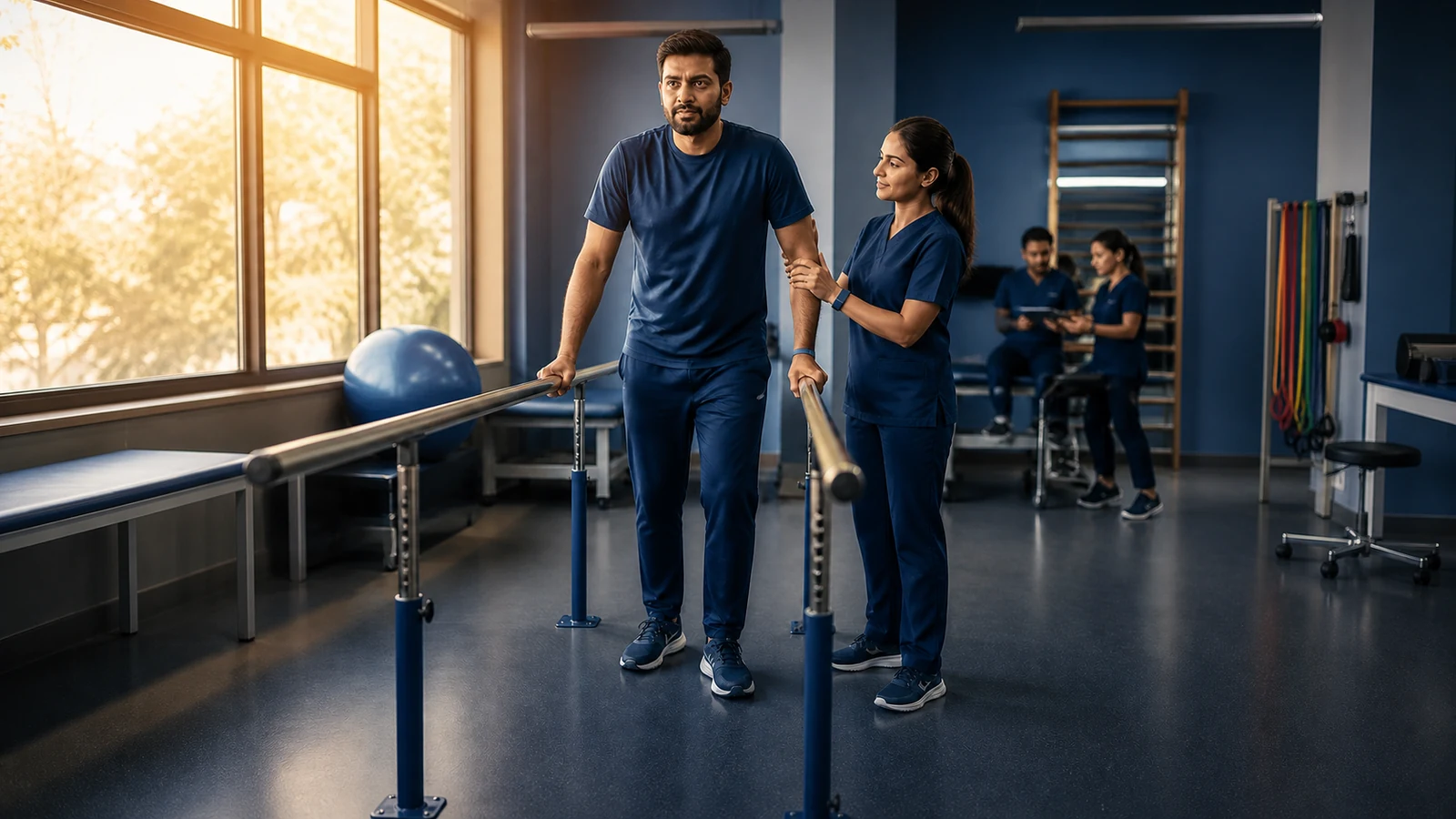
It usually involves practicing stepping patterns, often with body weight partly supported by a harness above a treadmill.
A therapist, or in some programs a robotic device, helps guide the legs through a walking pattern.
The idea is to give the spinal cord repeated, task-specific input that resembles normal walking.
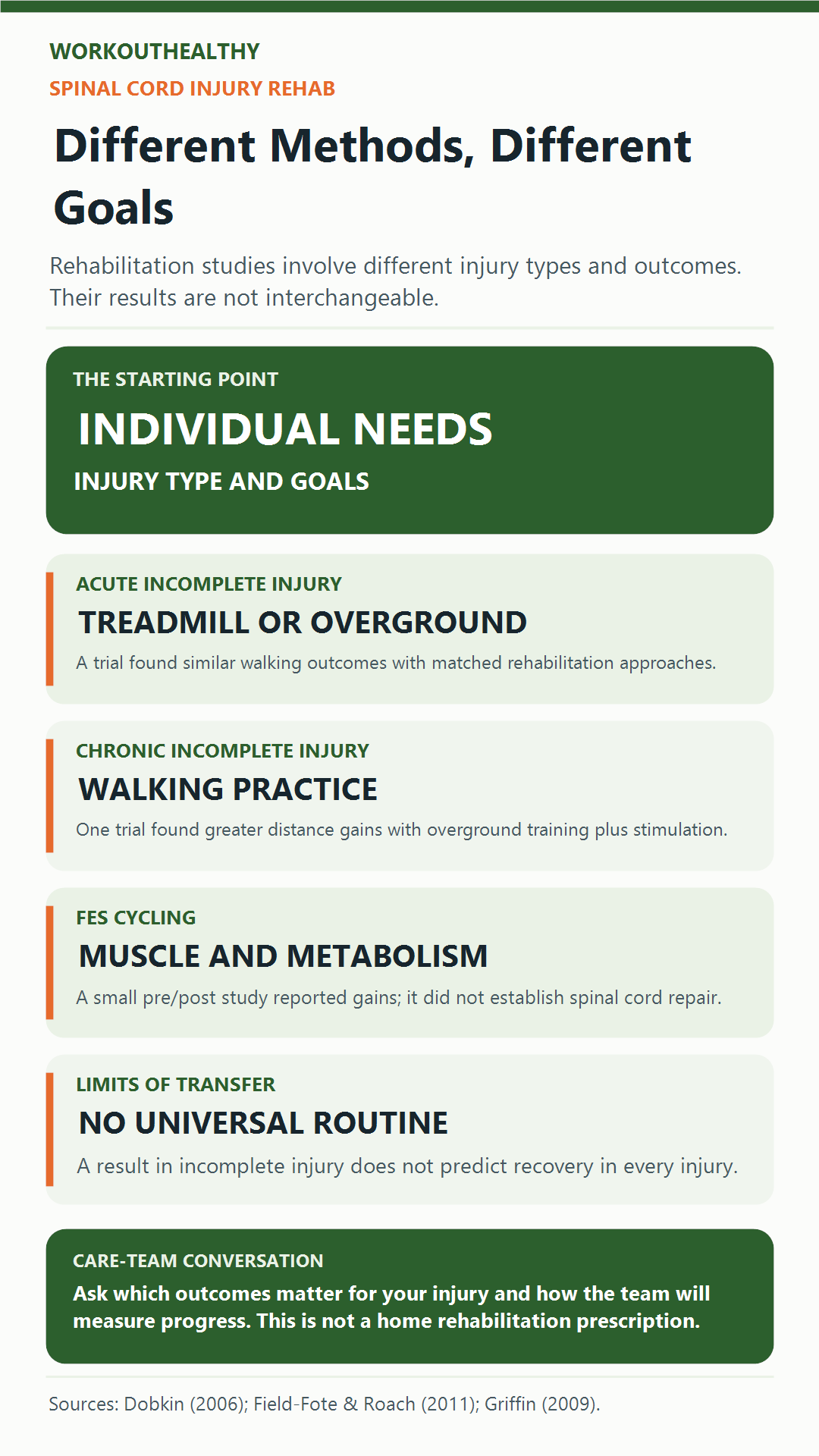
One of the largest trials in this area was the Spinal Cord Injury Locomotor Trial, published in the journal Neurology (Dobkin et al., 2006).
It compared body-weight-supported treadmill training against a structured over-ground walking program in people with acute incomplete spinal cord injury.
The trial found that both approaches produced similar improvements in walking ability.
Neither treadmill-based training nor over-ground training was clearly superior.
That is an important, honest finding.
One possible interpretation is that task-specific practice matters alongside equipment choice, but the trial did not isolate practice dose as the reason for similar outcomes.
A separate randomized trial by Field-Fote and Roach (2011), published in Physical Therapy, compared four different locomotor training approaches in people with chronic spinal cord injury.
These included body-weight-supported treadmill training with manual assistance, treadmill training paired with functional electrical stimulation, and over-ground training paired with stimulation.
Over-ground training paired with stimulation produced the greatest distance gains in that trial; walking-speed gains did not differ significantly between groups.
This does not mean treadmill training is ineffective.
It means the best approach likely depends on the person, the equipment available, and the specific goals of therapy.
A seven-center observational cohort by Harkema and colleagues (2012), published in Archives of Physical Medicine and Rehabilitation, followed 196 people with chronic motor-incomplete spinal cord injury through locomotor training-based rehabilitation.
Participants’ balance and walking measures improved from enrollment to discharge, but this observational study had no control group, so it cannot isolate the training effect.
Improvements varied widely between participants.
Some people gained substantial walking speed.
Others saw much smaller changes.
The researchers observed different average gains between AIS C and D groups; this cohort did not establish a universal prediction based on injury level.
Across the strongest trials in this field, one pattern repeats. Task-specific, repeated practice can improve function after spinal cord injury, but how much depends heavily on the individual’s own injury.
What Real Research Shows About Functional Electrical Stimulation
Functional electrical stimulation, often called FES, uses small electrical currents to activate muscles that a person cannot voluntarily control after spinal cord injury.
One common application is FES cycling, where stimulated leg muscles pedal a stationary bike in a coordinated pattern.
A small before-and-after study by Griffin and colleagues (2009), published in the Journal of Electromyography and Kinesiology, followed 18 people with spinal cord injury through 10 weeks of FES cycling, two or three times weekly.
Lean mass increased in that study; bone and adipose mass did not change. With no comparison group, the observed changes cannot be attributed with certainty to FES cycling alone.
The investigators reported lower glucose and insulin responses after an oral glucose test, lower selected inflammatory markers, and changes in lower-extremity motor and sensory scores; these are preliminary findings from a small uncontrolled study.
This matters because muscle loss and metabolic changes are common and serious concerns after spinal cord injury.
Reduced muscle mass below the level of injury can affect bone density, blood sugar regulation, and cardiovascular health over time, echoing the broader concerns we cover in losing weight and muscle mass in the general population, though the mechanism after paralysis is different.
FES cycling should not be presented as a proven way to restore voluntary muscle control. This study recorded changes in neurological scores, but it did not establish spinal cord repair.
It does not reverse the underlying nerve damage.
What it appears to do, based on this and similar research, is provide a way to load and activate paralyzed muscle tissue that would otherwise sit unused.
That activity may carry real metabolic and tissue-level benefits, separate from any change in walking ability.
The Mechanism
The idea connecting all of these approaches is neuroplasticity.
Neuroplasticity is the nervous system’s ability to reorganize itself in response to activity and experience.
After a spinal cord injury, some connections between the brain and the body below the injury are damaged or lost.
But the spinal cord itself retains circuits that can still process information and generate patterns like stepping, even without a fully intact connection to the brain.
Edgerton and colleagues (2004), in a review published in the Annual Review of Neuroscience, described this as activity-dependent plasticity in the spinal cord.
Repeated stepping practice may engage remaining spinal circuits, but the exact mechanism of each person’s functional change is not established by these clinical outcome studies.
This is sometimes described as the spinal cord learning a task through repetition, separate from the brain’s own learning.
Researchers have also explored combining activity-based training with direct spinal cord stimulation.
Harkema and colleagues (2011), in a single case study in The Lancet, reported assisted full-weight-bearing standing during epidural stimulation and some voluntary leg movement after months of training, observed only while stimulation was active.
This was a single case study, not a large trial.
Its results have not been shown to apply to everyone with a similar injury.
It is included here to show how researchers think about the mechanism, not as proof that this specific intervention works for most people with spinal cord injury.
This broader idea, that the nervous system can reorganize itself with the right repeated input, extends well beyond spinal cord injury.
Our coverage of whether lifting weights keeps your brain young looks at similar activity-dependent adaptation in a very different part of the nervous system.
What This Evidence Does Not Prove
This research does not prove that any specific set of exercises works the same way for every person with a spinal cord injury.
Injury level matters enormously.
A cervical injury can affect the arms, trunk, and legs.
A thoracic or lumbar injury may leave arm function intact.
Completeness matters just as much.
A neurologically complete injury is classified by the absence of sensory and motor function in the lowest sacral segments; that definition does not mean every body function below the injury is absent.
A neurologically incomplete injury retains some sacral sensory or motor function. Recovery potential varies and cannot be predicted from that label alone.
None of the studies described above suggest that locomotor training or FES cycling can restore normal walking for everyone.
Many participants in these trials had incomplete injuries, which respond differently than complete injuries.
Results also varied widely within each study, not just between studies.
Time since injury was related to improvement in the 2012 cohort; age, overall health, and access may also matter clinically, but the cited studies do not quantify all of those effects here.
None of this research was designed around a home video format, and none of it supports using one as a substitute for clinical care.
Who Should Work With a Clinical Team
This is not a general fitness topic, and it should not be treated like one.
Anyone living with a spinal cord injury needs an individualized program built by a qualified rehabilitation team.
That team typically includes a physiatrist, a physical therapist with neurological rehabilitation training, and often an occupational therapist.
These clinicians assess injury level, completeness, spasticity, bone density, cardiovascular status, and skin integrity before recommending any exercise approach.
They also watch for risks that do not apply to general fitness, like autonomic dysreflexia, orthostatic hypotension, and pressure injuries.
A generic online video, including the one this article discusses, cannot account for any of that.
It cannot know a viewer’s injury level.
It cannot know whether a movement is safe for that specific spinal cord.
Attempting exercises from a video without clinical guidance carries real risk, including injury to already vulnerable tissue.
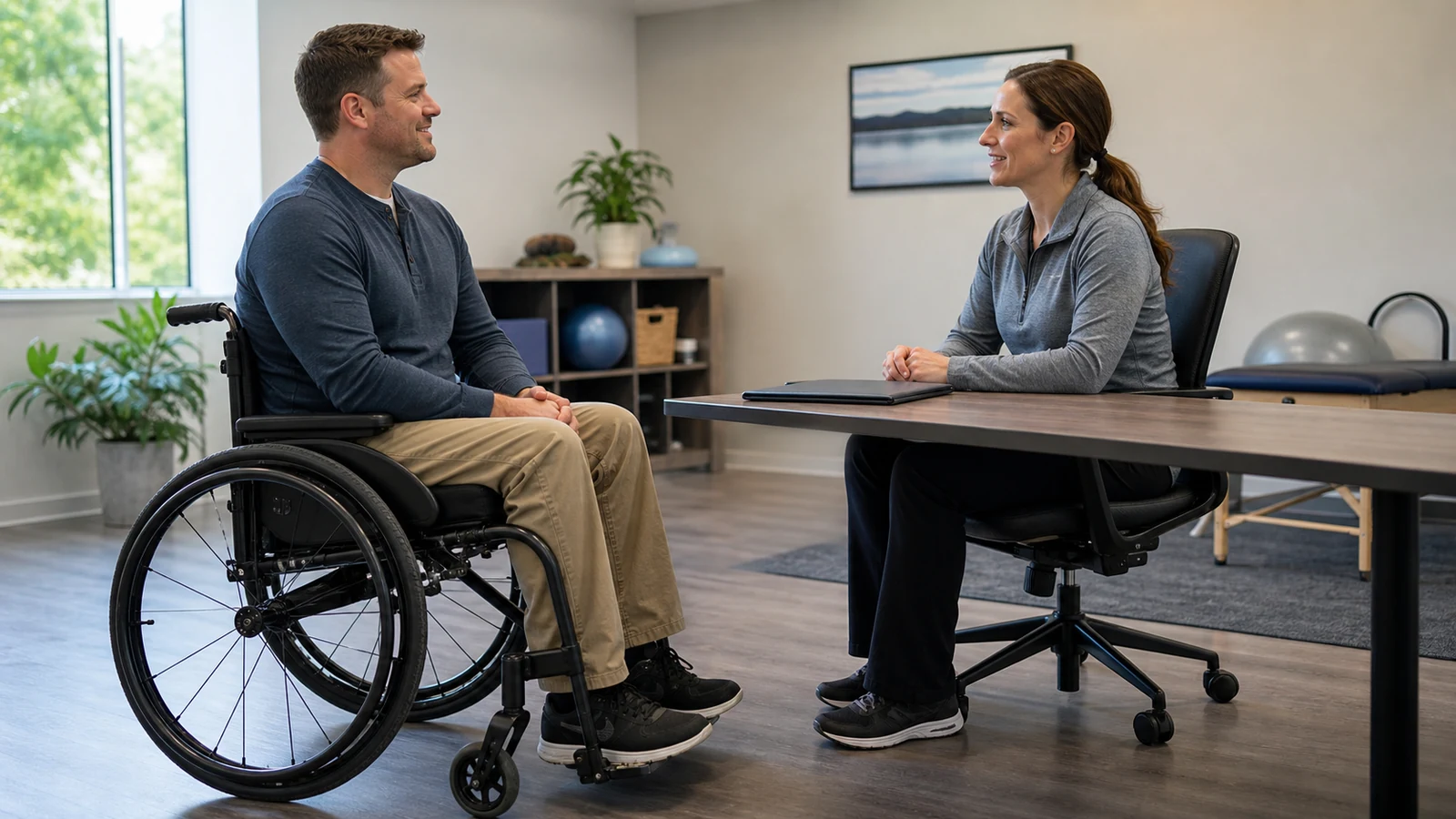
If you or someone you know has a spinal cord injury, the right first step is a conversation with the treating rehabilitation team, not a home exercise video.
Recovery paths after a major injury vary enormously between individuals, a pattern also visible in a very different context, like our look at what Misty Copeland’s hip replacement recovery actually took.
A Practical Takeaway
The most useful thing this research offers is not a workout to copy.
It is a set of questions worth bringing to a clinical rehabilitation team.
Ask how your team is maintaining joint range of motion and preventing contractures. The SCI Model Systems exercise guide includes stretching, supported positioning, and functional practice, but the exact plan depends on your injury and safety needs.
Ask whether supported standing or weight-bearing practice is appropriate and whether bone density and fracture risk have been assessed first. Standing may be used for positioning, stretching, and task practice; the evidence that passive standing preserves bone mass is inconclusive. Do not treat it as a guaranteed bone-density or circulation therapy.
Ask how seated balance and trunk control are being trained for reaching, transfers, and other functional tasks. Supported reaching or sitting practice can be adapted to the level and completeness of injury; it is not a generic core workout.
Ask whether locomotor training, body-weight-supported treadmill work, or over-ground gait training fits your specific injury.
Ask whether functional electrical stimulation is available and appropriate, whether for cycling or another application.
Ask how progress will be measured, and over what timeframe.
Ask what warning signs mean therapy should stop or change.
General population guidance, like recommendations on how many miles to walk in a day, does not transfer to spinal cord injury rehabilitation.
A rehabilitation team should tailor the dose, sequence, and monitoring of exercise to the person’s injury, goals, and medical risks.
A generic daily target from a video or general-population guide cannot substitute for that individualized plan.
The research summarized in this article should shape the questions you bring to your care team.
It should never replace their judgment.
Watch the video
Want more like this? Subscribe to WorkoutHealthy Insider for practical explanations behind popular fitness claims.
References
American Spinal Injury Association and International Spinal Cord Society. (2019). International Standards for Neurological Classification of Spinal Cord Injury: Revised 2019. The complete/incomplete distinction is based on sacral sparing at S4-S5.
Model Systems Knowledge Translation Center. (2024). Exercise After Spinal Cord Injury. MSKTC SCI factsheet.
SCIRE Professional. Standing: Bone Health After Spinal Cord Injury. Evidence review.
Dobkin, B., Apple, D., Barbeau, H., Basso, M., Behrman, A., Deforge, D., Ditunno, J., Dudley, G., Elashoff, R., Fugate, L., Harkema, S., Saulino, M., Scott, M., & the Spinal Cord Injury Locomotor Trial Group. (2006). Weight-supported treadmill vs over-ground training for walking after acute incomplete SCI. Neurology, 66(4), 484 to 493. https://doi.org/10.1212/01.wnl.0000202600.72018.39
Edgerton, V. R., Tillakaratne, N. J., Bigbee, A. J., de Leon, R. D., & Roy, R. R. (2004). Plasticity of the spinal neural circuitry after injury. Annual Review of Neuroscience, 27, 145 to 167. https://doi.org/10.1146/annurev.neuro.27.070203.144308
Field-Fote, E. C., & Roach, K. E. (2011). Influence of a locomotor training approach on walking speed and distance in people with chronic spinal cord injury: A randomized clinical trial. Physical Therapy, 91(1), 48 to 60. https://doi.org/10.2522/ptj.20090359
Griffin, L., Decker, M. J., Hwang, J. Y., Wang, B., Kitchen, K., Ding, Z., & Ivy, J. L. (2009). Functional electrical stimulation cycling improves body composition, metabolic and neural factors in persons with spinal cord injury. Journal of Electromyography and Kinesiology, 19(4), 614 to 622. https://doi.org/10.1016/j.jelekin.2008.03.002
Harkema, S., Gerasimenko, Y., Hodes, J., Burdick, J., Angeli, C., Chen, Y., Ferreira, C., Willhite, A., Rejc, E., Grossman, R. G., & Edgerton, V. R. (2011). Effect of epidural stimulation of the lumbosacral spinal cord on voluntary movement, standing, and assisted stepping after motor complete paraplegia: A case study. The Lancet, 377(9781), 1938 to 1947. https://doi.org/10.1016/S0140-6736(11)60547-3
Harkema, S. J., Schmidt-Read, M., Lorenz, D. J., Edgerton, V. R., & Behrman, A. L. (2012). Balance and ambulation improvements in individuals with chronic incomplete spinal cord injury using locomotor training-based rehabilitation. Archives of Physical Medicine and Rehabilitation, 93(9), 1508 to 1517. https://doi.org/10.1016/j.apmr.2011.01.024
This article is for general information only and is not medical advice. If you have an injury, ongoing pain, or a medical condition, talk to a doctor or physical therapist before you change how you train or eat.