
A YouTube video from the channel Daily Trending News claims to reveal Aishwarya Rai’s daily beauty and fitness routine.
The video frames itself as an inside look at her habits.
Aishwarya Rai is a real, internationally known actress and a former Miss World.
She is not an anonymous influencer, and claims made about her deserve real sourcing.
Daily Trending News is a general entertainment aggregator channel.
It is not Aishwarya Rai’s own team, and it is not a documented, on the record interview.
This article separates what a video like this typically claims from what can actually be confirmed.
It also covers the real, peer reviewed research behind the kinds of habits videos like this usually describe.
What the Video Claims
Videos in this genre tend to describe a similar set of habits for any wellness focused celebrity.
Common claims include a morning yoga practice, a daily walk, simple home cooked meals, and a skincare routine built around hydration and sleep.
Some versions add specific details, like a named yoga pose or an exact number of daily steps.
None of the specific claims in this particular video are sourced to a documented, dated interview in its own description.
That does not automatically make every claim false.
It does mean none of it should be repeated as her own confirmed words without a real source behind it.
Aggregator channels like this one are usually built for view counts, not accuracy.
A dramatic title like “reveals her secrets” performs better than a cautious one, even when nothing has actually been revealed.
That business model rewards confident sounding claims, not careful sourcing.
What’s Actually Confirmed
A few basic facts about Aishwarya Rai are extremely well documented.
She won Miss World in 1994 and has had a decades long acting career across Indian and international film.
She became a mother in November 2011, a fact widely covered by international press at the time.
Those facts are not in question.
The specific fitness, diet, and skincare details attributed to her in videos like this one are a different matter.
A careful search for a single, dated, on the record interview backing this video’s specific claims did not turn one up.
Many entertainment sites repeat similar sounding claims about celebrity routines without linking back to an original interview.
That pattern is common for lower authority aggregator channels covering any famous person, not just Aishwarya Rai.
WorkoutHealthy has covered a similar situation before with a different celebrity.
Our look at Gabrielle Union’s viral fitness routine found real, documented quotes that told a different story than the version circulating online.
In this case, no comparable documented interview could be located for the claims made in this specific video.
A genuinely confirmed claim usually has a few things this video’s description does not.
It names a specific outlet, gives a publication date, and quotes the person directly rather than paraphrasing a rumor.
Until a source like that surfaces, the specific routine in this video stays in the category of unverified claim, not fact.
A famous name attached to a routine is not the same thing as that person confirming the routine.
The Real Research Behind Yoga and Walking
Yoga and walking are two of the habits most often attached to celebrity wellness routines in videos like this one.
That makes them worth examining on their own, separate from any specific celebrity.
A 2010 review in The Journal of Alternative and Complementary Medicine compared yoga to other forms of exercise.
The researchers looked across multiple studies and multiple health outcomes (Ross & Thomas, 2010).
Those outcomes included cardiovascular endurance, muscular strength, flexibility, balance, and psychological measures like anxiety and depression.
They found yoga performed as well as, or better than, other exercise on several of these measures, including markers of stress and mood.
Flexibility and balance stood out as areas where yoga outperformed many standard exercise programs.
A separate 2015 review focused specifically on yoga and stress.
It analyzed randomized controlled trials, the strongest kind of evidence available (Pascoe & Bauer, 2015).
That review found consistent reductions in stress hormones and self reported stress after yoga programs.
It also found improvements in how participants’ bodies responded to stressful situations, including heart rate and blood pressure reactivity.
The effect showed up across many different yoga styles, not just one specific practice.
Walking has an even larger body of research behind it.
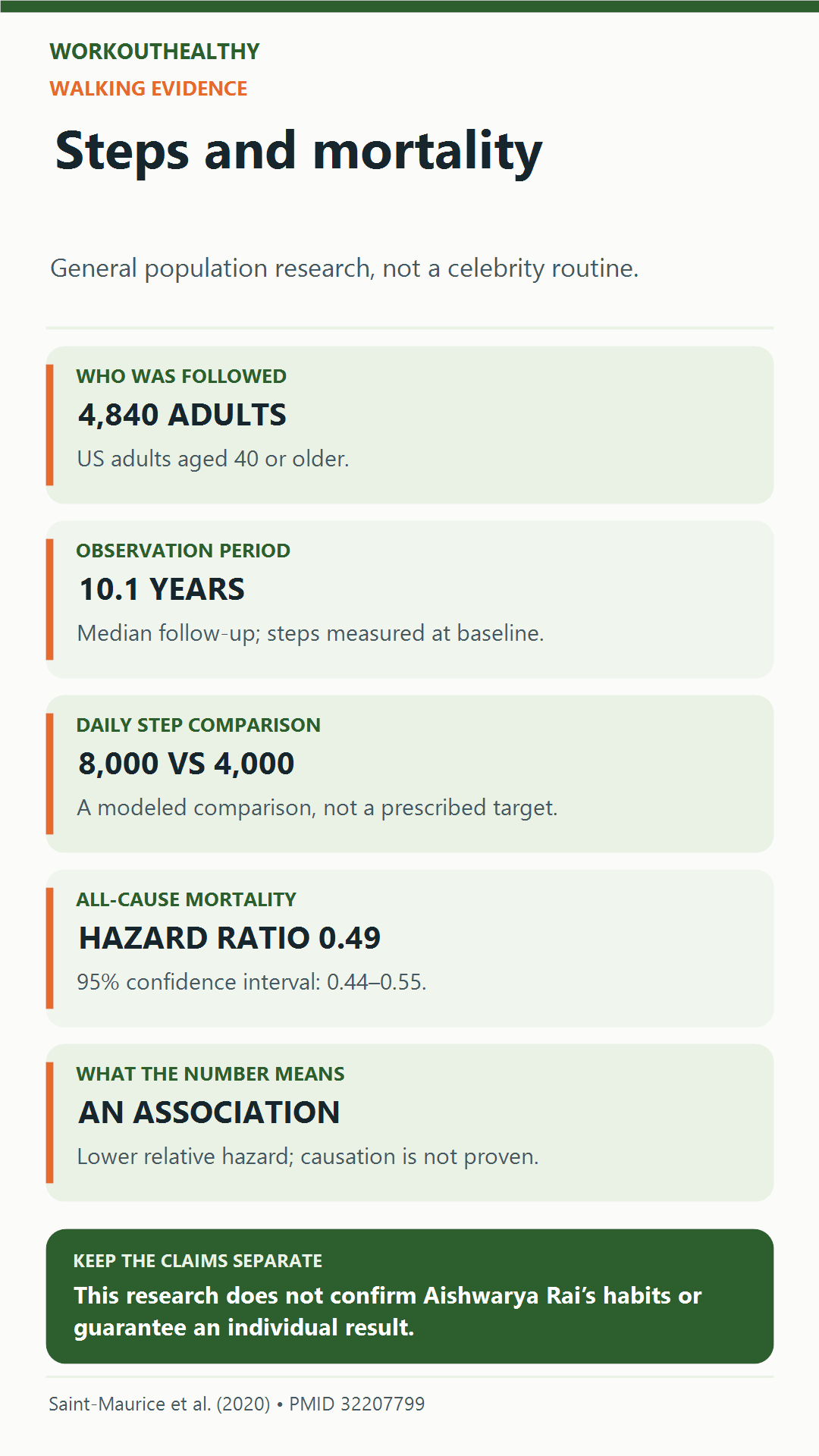
A 2020 study published in JAMA followed thousands of adults using wearable step trackers (Saint-Maurice et al., 2020).
Participants wore the trackers for about a week, and researchers then followed their health outcomes for years afterward.
It found that people who walked more steps per day had a meaningfully lower risk of dying during the study period.
The benefit was not limited to intense walking.
Simply increasing daily step count, even at a normal pace, was linked to a lower risk of death from any cause.
The researchers also noted that walking pace mattered less than most people assume.
Total volume of movement across the day was more strongly linked to the outcome than how fast any single walk was.
That is good news for anyone who finds a brisk daily stroll more realistic than a structured run.
Our guide to how many miles you should walk a day breaks down what that step count actually looks like in practice.
A closer look at the daily steps and mortality research covers how researchers measured this relationship in more detail.
There is also research connecting regular moderate exercise to skin health, which fits the beauty framing this video uses.
A 2015 study in the journal Aging Cell found that exercise triggers a molecule called interleukin 15 in skin tissue (Crane et al., 2015).
The study used both human participants and an animal model to trace this pathway in detail.
In that study, this molecule was linked to healthier skin structure in older, physically active mice compared to sedentary ones.
The active mice showed thicker skin layers and fewer signs of age related skin damage than sedentary mice of the same age.
The researchers proposed this as one biological pathway connecting regular movement to visibly healthier skin over time.
This is a mechanism, not a promise, and it takes sustained activity rather than a single workout to matter.
None of this research proves anything about Aishwarya Rai’s specific habits.
It does show that yoga, walking, and general movement have real, measurable benefits, regardless of which celebrity a video attaches them to.
The science behind yoga and walking is real and well studied, even when the celebrity story attached to it is not.
What This Evidence Does Not Prove
These studies say nothing about any individual celebrity’s private routine.
They describe average effects across groups of study participants, not guarantees for any one person.
The JAMA step count study was observational, meaning it tracked existing habits rather than assigning people to walk more (Saint-Maurice et al., 2020).
Observational research can show a strong pattern without proving that walking alone caused the lower death risk.
People who already walk more may also sleep better, eat differently, or have fewer underlying health conditions.
The yoga research has a similar limit.
Study participants often already chose to try yoga, which can affect who shows up for the research in the first place.
Sample sizes in individual yoga trials also tend to be smaller than large step count studies.
Smaller samples make it harder to know how well a result generalizes to everyone.
The skin and exercise research adds another layer of caution.
Much of that mechanism was first mapped out in animal models before being partly confirmed in humans.
None of these studies were designed around Aishwarya Rai or any specific public figure.
They cannot confirm what she personally does each morning, and this article does not claim that they do.
Common Mistakes People Make Chasing a Celebrity Routine
The biggest mistake is treating an unsourced video as if it were a verified interview.
A polished video with a famous face can feel authoritative even without a single named source.
Another common mistake is copying an extreme version of a routine without easing into it.
Jumping straight into daily yoga and long walks after months of inactivity raises the risk of soreness and injury.
People also tend to skip the parts of a claimed routine that are hardest to verify, like diet, while adopting the exercise habits wholesale.
A diet described in a tabloid style video is often the least verifiable part of the whole claim.
Finally, many people assume a beauty focused routine will change their skin quickly.
The research on exercise and skin health describes gradual, cumulative changes, not an overnight transformation (Crane et al., 2015).
Another mistake is assuming a famous person’s genetics, professional trainers, and personal chef explain nothing about their results.
Access to those resources changes how consistently someone can train and eat well, regardless of what the routine actually contains.
Comparing your own progress to a public figure’s appearance ignores that gap entirely.
A Practical Takeaway
You do not need to confirm anyone’s celebrity routine to benefit from what the research actually supports.
Start with walking, since it requires no equipment and has the largest body of supporting research.
A simple starting goal is a 20 to 30 minute walk most days of the week.
Most phones already count steps automatically, which makes tracking progress easy without buying anything new.
From there, most people can build toward the step counts linked to lower mortality risk in the JAMA research (Saint-Maurice et al., 2020).
Adding two or three yoga sessions a week is a reasonable next step for stress and flexibility.
A few beginner friendly poses, like child’s pose, cat cow, and downward facing dog, cover a lot of ground on their own.
A beginner class or a well reviewed app is enough to start, without needing any special equipment.
Consistency across weeks matters more than intensity on any single day.
A short walk done daily beats a long walk done once a month.
For relaxation between workouts, some people also find value in simple recovery habits.
Our piece on whether foot massage can help you relax looks at one low effort option worth considering.
Anyone starting a new exercise routine after a long break, or managing an existing health condition, should check with a doctor first.
That advice applies regardless of which celebrity’s name is attached to the routine that inspired the change.
Watch the Original Video
Want more like this? Subscribe to WorkoutHealthy Insider for practical explanations behind popular fitness claims.
References
Ross, A., & Thomas, S. (2010). The health benefits of yoga and exercise: A review of comparison studies. The Journal of Alternative and Complementary Medicine, 16(1), 3 to 12. https://doi.org/10.1089/acm.2009.0044
Pascoe, M. C., & Bauer, I. E. (2015). A systematic review of randomised control trials on the effects of yoga on stress measures and mood. Journal of Psychiatric Research, 68, 270 to 282. https://doi.org/10.1016/j.jpsychires.2015.07.013
Saint-Maurice, P. F., Troiano, R. P., Bassett, D. R., Jr., Graubard, B. I., Carlson, S. A., Shiroma, E. J., Fulton, J. E., & Matthews, C. E. (2020). Association of daily step count and step intensity with mortality among US adults. JAMA, 323(12), 1151 to 1160. https://doi.org/10.1001/jama.2020.1382
Crane, J. D., MacNeil, L. G., Lally, J. S., Ford, R. J., Bujak, A. L., Brar, I. K., Kemp, B. E., Raha, S., Steinberg, G. R., & Tarnopolsky, M. A. (2015). Exercise-stimulated interleukin-15 is controlled by AMPK and regulates skin metabolism and aging. Aging Cell, 14(4), 625 to 634. https://doi.org/10.1111/acel.12341
This article is for general information only and is not medical advice. If you have an injury, ongoing pain, or a medical condition, talk to a doctor or physical therapist before you change how you train or eat.