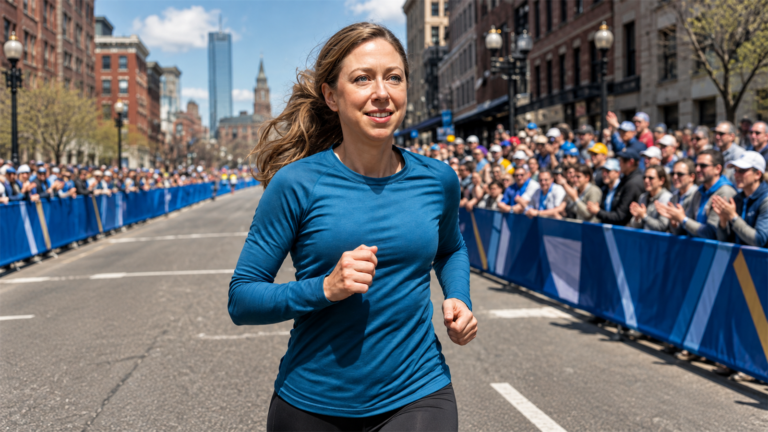

A YouTube channel called Healthyday Yoga Telugu posted a video with a simple promise.
Do ten minutes of cardio at home every day, and your heart will thank you.
No equipment. No gym membership. Just ten minutes and your own living room floor.
That idea sounds appealing, especially when a full workout feels impossible to fit in.
But does ten minutes actually protect your heart, or is that just a catchy hook?
This article looks at what real cardiovascular research says about short daily cardio sessions.
What the Video Claims
The video is titled “10 Min Daily Cardio Workout at Home,” and it walks through a sequence of simple bodyweight moves.
Think jumping jacks, high knees, mountain climbers, and similar exercises.
The channel frames this short routine as enough daily activity to support heart health.
It suggests that consistency, not duration, is what matters most.
That framing is common in home workout content, and it actually lines up with a real trend in exercise science.
What “Exercise Snacks” Research Actually Shows
Researchers have a name for brief bouts of exercise squeezed into a day.
They call them “exercise snacks.”
A 2025 systematic review pooled data from 11 clinical trials involving 414 physically inactive adults (Rodríguez et al., 2025).
The review found that these short, scattered bouts of exercise significantly improved cardiorespiratory fitness.
Cardiorespiratory fitness is a measure of how well your heart and lungs deliver oxygen to working muscles.
Cardiorespiratory fitness is one of the strongest predictors of long term heart health that researchers can measure.
People in these trials also stuck with the short sessions at a high rate, with compliance around 91 percent.
That matters, because a workout only helps your heart if you actually keep doing it.
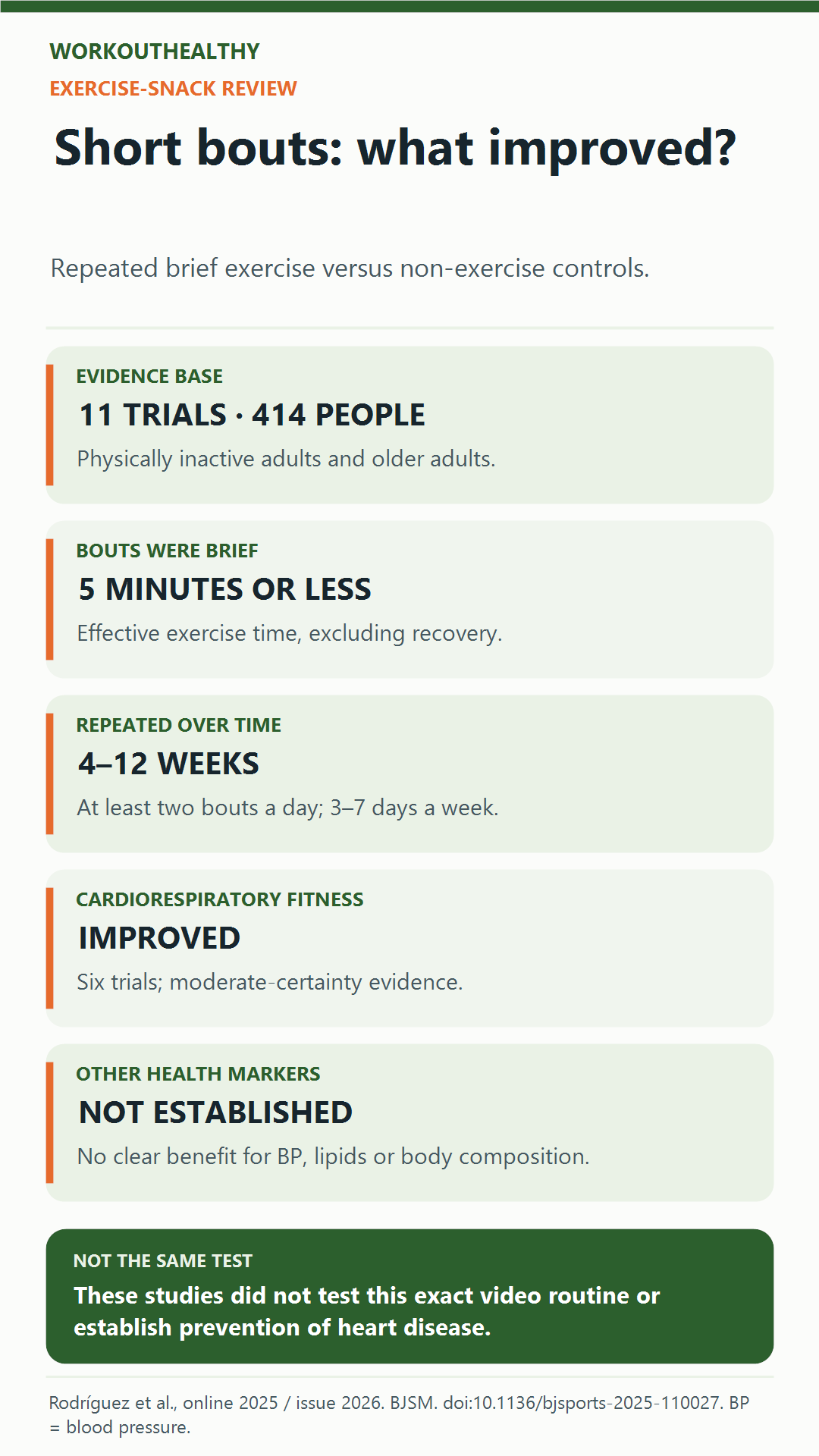
A separate randomized controlled trial tested this idea head to head against a longer, steady cardio session.
Researchers assigned inactive adults to either short exercise snacks or one continuous moderate intensity workout (Yin et al., 2024).
Both groups trained for several weeks.
The short, snack style sessions improved cardiorespiratory fitness about as well as the longer continuous workout did.
That is a meaningful finding for anyone who struggles to find one solid block of free time.
Why Short Bursts Can Work for Your Heart
The mechanism behind this is not mysterious.
Your heart is a muscle, and muscles adapt to repeated demand.
When you raise your heart rate, even briefly, your heart has to pump harder and faster to keep up.
Do that regularly, and your heart gradually gets better at moving blood with each beat.
Researchers call this an improvement in stroke volume.
Your muscles also build more small blood vessels and more efficient energy producing structures called mitochondria.
None of that requires an hour.
It requires repeated effort above your resting level, done often enough for your body to adapt.
Ten minutes of jumping jacks and high knees can absolutely create that kind of demand.
A Bigger Study on Brief Activity and Heart Risk
The exercise snack idea also shows up in research on everyday movement, not just structured workouts.
A large study followed thousands of adults who wore wrist activity trackers (Stamatakis et al., 2022).
None of them exercised in any structured way.
But many of them still hit short bursts of vigorous movement during daily life, like climbing stairs quickly or rushing to catch a bus.
Researchers called this vigorous intermittent lifestyle physical activity, or VILPA for short.
People who averaged just a few minutes of these short vigorous bursts each day had a notably lower risk of dying from cardiovascular disease.
That risk was lower compared to people who logged no vigorous bursts at all.
The effect size was substantial, even though the total daily time involved was small.
This does not prove that one specific ten minute home video causes the exact same effect.
But it lines up with the exercise snack findings above.
Brief, repeated bursts of harder effort seem to matter more for heart health than researchers used to think.
What This Evidence Does Not Prove
It is worth being honest about the limits here.
None of these studies tested this exact YouTube video or its specific exercise sequence.
The exercise snack trials used varied protocols, like stair climbing or short cycling sprints, not one fixed ten minute bodyweight routine.
The randomized trial by Yin and colleagues also found a real limit.
Short exercise snacks improved cardiorespiratory fitness, but they did not improve maximal fat oxidation the way longer continuous training did (Yin et al., 2024).
In plain terms, short bursts may not be the best tool for every fitness goal.
The systematic review also focused specifically on adults who started out physically inactive.
Results might look different for someone who already trains regularly.
And none of this research means ten minutes replaces general activity guidelines for adults.
Major health organizations still recommend a weekly total of moderate or vigorous activity.
A daily walk still counts toward that total, as we cover in how many miles you should walk each day.
How Ten Minutes Stacks Up Against a Full Cardio Session
It’s natural to wonder if ten minutes can really compare to a 30 or 45 minute cardio session.
The honest answer is that it depends on what you’re measuring.
For cardiorespiratory fitness specifically, the exercise snack trial found results similar to a longer continuous workout (Yin et al., 2024).
Both groups in that study improved by a comparable amount over the same number of weeks.
But cardiorespiratory fitness is not the only outcome that matters for your health.
Total calories burned, for example, still tends to favor longer sessions.
That’s simply because more time is spent moving.
Weight management goals often benefit from that extra volume, even when heart fitness gains look similar.
So ten minutes is not a strict upgrade over a longer workout.
It is a genuinely useful floor, not a ceiling.
Think of it as a minimum effective dose rather than the ideal amount for every single goal.
Common Mistakes People Make With Short Home Cardio Routines
The biggest mistake is treating “short” as the same thing as “easy.”
For exercise snacks to work, the effort needs to feel genuinely hard for that short window.
A slow, low effort version of jumping jacks for ten minutes will not create the same heart rate response.
Another common mistake is skipping any kind of warm up.
Jumping straight into high knees or mountain climbers from a cold start raises injury risk, especially for calves and ankles.
A minute or two of easy marching in place is usually enough to prepare your body.
People also tend to let form slip once they get tired near the end of the ten minutes.
Sloppy landings during jumping jacks or high knees can strain ankles and knees over time.
It also helps to track effort with something simple, like a basic talk test.
You should be able to speak in short phrases but not hold a full conversation.
That rough guide keeps intensity in a useful zone without needing a heart rate monitor.
Who Should Check With a Doctor First
Short daily cardio is generally considered low risk for most healthy adults.
But a few groups should talk to a doctor before starting a routine like this.
That includes anyone with diagnosed heart disease, uncontrolled high blood pressure, or a history of chest pain during exercise.
People managing diabetes with blood sugar swings should also check in first.
Intensity changes can affect blood sugar levels in ways worth planning around.
Anyone recovering from a recent injury, surgery, or illness should get clearance before adding jumping movements.
Pregnant women should also check with their doctor, since some high impact moves may need modification.
None of this means short cardio is dangerous for these groups.
It just means a doctor can help tailor the intensity and movement choices safely.
A Practical Way to Try This at Home
If you want to test this idea yourself, start with a realistic structure.
Pick three or four bodyweight moves you can do with decent form.
Jumping jacks, high knees, butt kicks, and mountain climbers all work well.
Do each move for 30 to 45 seconds, then rest for 15 seconds before the next one.
Repeat that circuit for about ten minutes total.
Aim to feel noticeably out of breath by the end of each work interval.
If ten minutes feels too hard on day one, start with five minutes and build up over a couple of weeks.
Try to do this most days of the week, not just occasionally.
The exercise snack research suggests that frequency matters as much as any single session’s length (Rodríguez et al., 2025).
You can also stack a few short sessions across the day instead of doing them all at once.
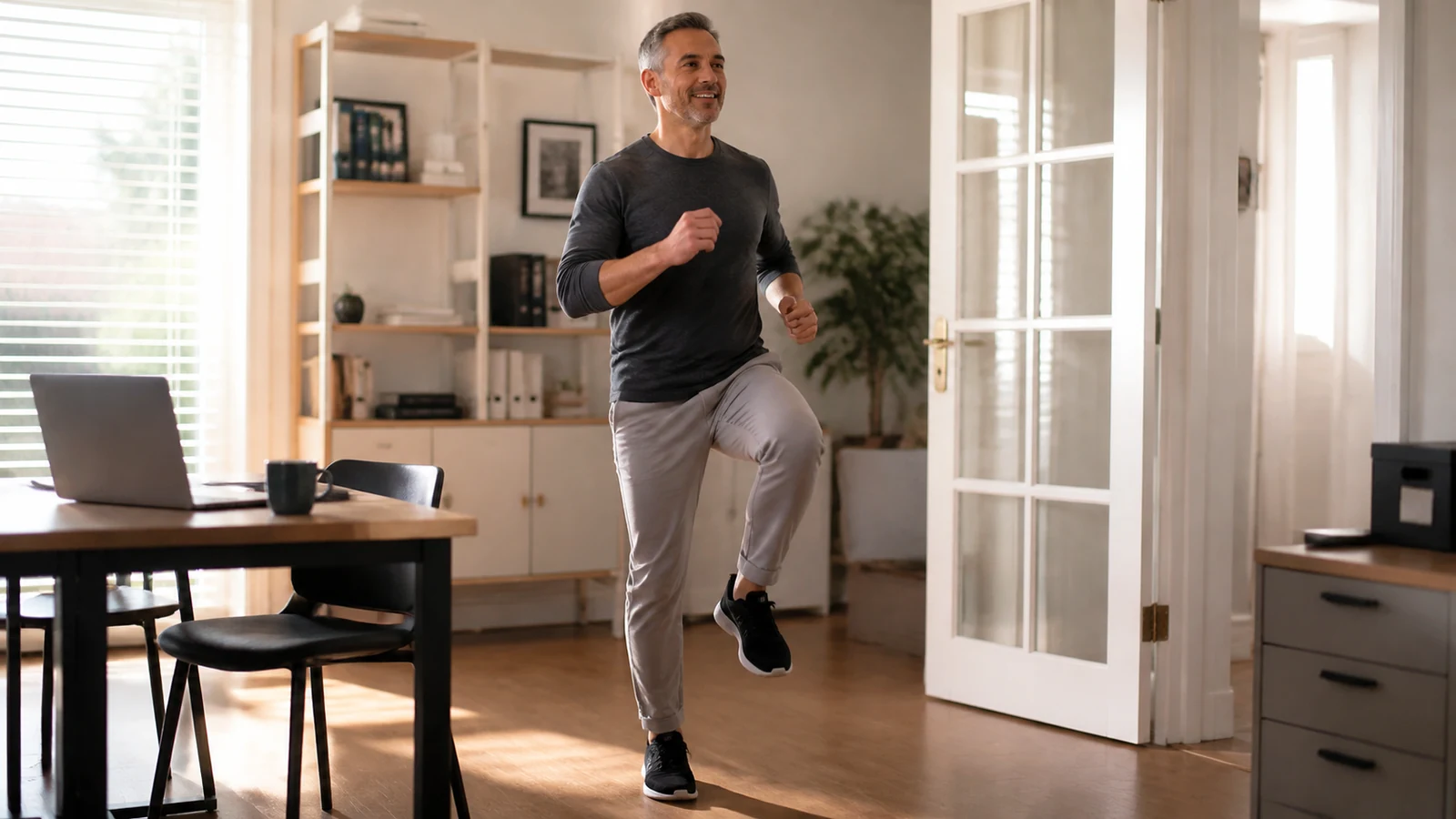
Climbing a flight of stairs quickly, similar to the four flight stair test, is another simple way to add a short vigorous burst.
For a different angle on the same goal, our piece on sauna use and heart health covers another research backed heart habit.
And if daily step counts feel more realistic than structured workouts, the research on daily steps and mortality is a good complementary read.
Progressing Past the First Few Weeks
Ten minutes is a great starting point, but your body will adapt to it over time.
As your fitness improves, the same routine will start to feel easier.
That’s actually a good sign, not a reason to worry.
When a workout stops feeling hard, it usually means less of a training stimulus.
You can respond in a few simple ways.
Try adding a second short round, spaced earlier and later in the day.
You could also swap in a harder version of the same move, like adding a small jump.
Shortening rest periods between exercises, from 15 seconds down to 10, is another option.
None of these changes need to happen quickly.
Give your body two to four weeks at a given level before making the routine harder.
That pacing lowers injury risk and still keeps your progress moving forward.
Watch the Original Video
Get the next evidence check.
Five practical fitness stories worth your time, every Friday.
One email a week. No product pitches. Unsubscribe in one click.
References
Rodríguez, M. A., Quintana-Cepedal, M., Cheval, B., Thøgersen-Ntoumani, C., Crespo, I., & Olmedillas, H. (2025). Effect of exercise snacks on fitness and cardiometabolic health in physically inactive individuals: Systematic review and meta-analysis. British Journal of Sports Medicine, 60(2), 133 to 141. https://doi.org/10.1136/bjsports-2025-110027
Yin, M., Deng, S., Chen, Z., Zhang, B., Zheng, H., Bai, M., Li, H., Zhang, X., Deng, J., Liu, Q., Little, J. P., & Li, Y. (2024). Exercise snacks are a time-efficient alternative to moderate-intensity continuous training for improving cardiorespiratory fitness but not maximal fat oxidation in inactive adults: A randomized controlled trial. Applied Physiology, Nutrition, and Metabolism, 49(7), 920 to 932. https://doi.org/10.1139/apnm-2023-0593
Stamatakis, E., Ahmadi, M. N., Gill, J. M. R., Thøgersen-Ntoumani, C., Gibala, M. J., Doherty, A., & Hamer, M. (2022). Association of wearable device-measured vigorous intermittent lifestyle physical activity with mortality. Nature Medicine, 28(12), 2521 to 2529. https://doi.org/10.1038/s41591-022-02100-x
Medical disclaimer: This article is for general information only and is not medical advice. If you have an injury, ongoing pain, or a medical condition, talk to a doctor or physical therapist before you change how you train or eat.