
Image context: the featured image is an editorial reconstruction of adults walking, not identified study participants or evidence of a cancer outcome.
Does walking reduce cancer risk? Research links higher physical activity, including more daily steps, with lower incidence of some cancers, but it does not establish a step count that guarantees prevention.
The answer depends on what a study measured: new diagnoses, deaths from cancer, or deaths from any cause. A walking headline becomes misleading when it moves a percentage from one of those outcomes to another.
The studies below help explain the promising evidence and its uncertainty. They also show why the claim that 7,500 daily steps sustained for two years reduces advanced-cancer risk remains unsupported by the sources reviewed here.
What the walking studies measured
Three research questions sit behind very similar headlines. This comparison keeps their measurements, reference groups and outcomes attached to their findings.
| Research | Exposure and comparison | Cancer finding | Main limit |
|---|---|---|---|
| Shreves and colleagues, 2025 UK Biobank cohort | Seven days of wrist accelerometry; modeled 7,000 versus 5,000 daily steps | For a composite of 13 cancer types, hazard ratio 0.89; 95% confidence interval 0.83 to 0.96 | Observational association after a short measurement window, not a trial assigning extra steps |
| Ding and colleagues, 2025 systematic review and meta-analysis | Prospective device-measured step studies; modeled 7,000 versus 2,000 daily steps | Incidence: 0.94, interval 0.87 to 1.01, two studies; mortality: 0.63, interval 0.55 to 0.72, three studies | Different outcomes have different evidence sets; incidence evidence was rated low certainty |
| Stein and colleagues, 2025 UK Biobank cohort | Self-reported usual brisk versus slow walking pace | Five inverse cancer-site associations in the main analysis; three remained significant after multiple-comparison correction | Pace categories are not measured steps or a test of changing walking speed |
A hazard ratio below 1 indicates a lower estimated rate of the specified event during follow-up relative to the reference group. It is not the percentage of participants who avoided cancer because they walked.
The wearable and walking-pace papers both draw on the same large research resource, UK Biobank. Their results should not be counted as wholly independent experiments simply because the titles and author lists differ.
What the wearable cancer-incidence study adds
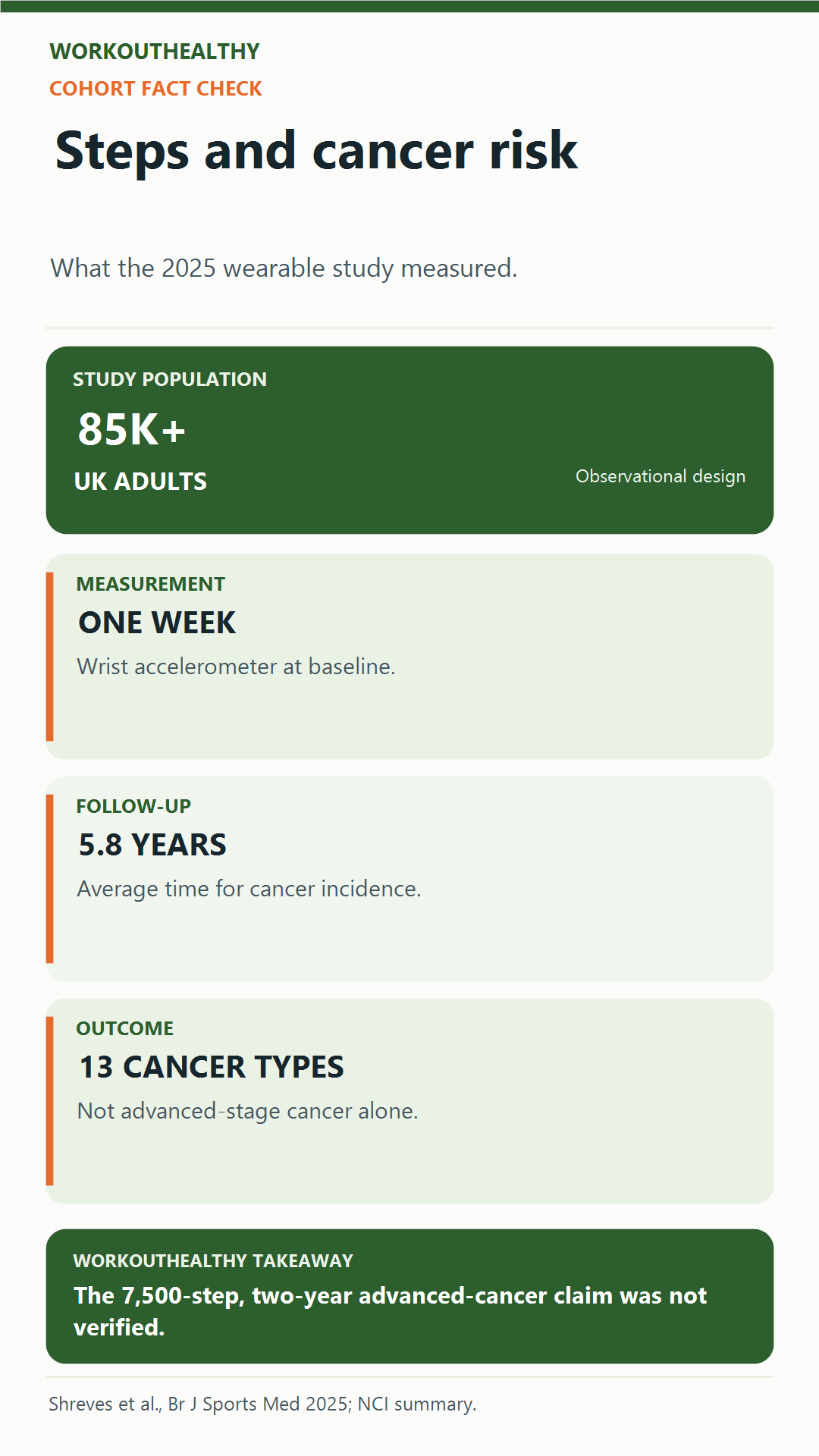
The Shreves study included 85,394 adults, with a median age of 63 at accelerometer assessment. Over an average 5.8 years, 2,633 developed one of the 13 cancers in its main composite outcome.
The researchers estimated activity from a device worn for one week, then linked participants to health records. This captured ordinary daily movement rather than only exercise someone remembered reporting on a questionnaire.
The step-count table used a slightly smaller analysis set: 83,688 participants and 2,569 cases. Keeping that distinction prevents the full cohort’s sample size from being assigned to every separate model.
Compared with 5,000 daily steps, the modeled association at 7,000 was an 11% lower rate of the composite cancer outcome; at 9,000, it was 16% lower. The corresponding hazard ratios were 0.89 and 0.84, with 95% confidence intervals of 0.83 to 0.96 and 0.76 to 0.93.
The curve began to flatten around 9,000 steps, rather than identifying a point where further movement became useless. These are comparisons between modeled activity levels, not instructions showing that adding 2,000 steps will reduce a particular person’s cancer risk by 11%.
The main outcome combined cancers previously associated with physical activity, including breast, colon and lung cancers. A combined result does not imply an identical association for every cancer type or establish an effect on advanced-stage disease.
Why incidence and cancer deaths differ
Cancer incidence counts new diagnoses during follow-up. Cancer mortality counts deaths attributed to cancer, while all-cause mortality counts deaths from any cause.
Advanced-stage cancer incidence is a more specific outcome requiring information about stage. None of those labels can be substituted for another without changing the research question.
The 2025 Ding synthesis included 57 studies in its systematic review and 31 in its meta-analyses, but only two studies informed the pooled cancer-incidence estimate. At 7,000 versus 2,000 steps, that estimate was 0.94, with an interval from 0.87 to 1.01.
Because the interval includes 1, this comparison did not show a statistically clear association with fewer new cancer diagnoses. It also does not prove walking has no effect: the estimate remains uncertain, and the authors rated this evidence low certainty.
The separate cancer-mortality estimate was 0.63, with an interval from 0.55 to 0.72, based on three studies. Describing that as 37% fewer new cancers would change the outcome and misrepresent the result.
The earlier Paluch analysis of 15 international cohorts concerned all-cause mortality. Its findings cannot establish a two-year walking prescription for preventing advanced cancer either.
Why the comparison step count matters
The wearable cohort compared 7,000 with 5,000 steps, whereas the 2025 synthesis compared 7,000 with 2,000. Those are different contrasts, even before accounting for different participants, cancer definitions and statistical models.
You cannot subtract the reported percentages to calculate what happens between 2,000 and 5,000 steps. You also cannot declare one paper has disproved the other just because their headline estimates differ.
A useful reading habit is to complete this sentence before sharing a number: “Compared with ___, the study estimated ___ for ___.” If the headline leaves a blank, open the source before treating its percentage as meaningful.
Confidence intervals describe uncertainty around the study estimate; they do not give your personal probability of developing cancer. An individual’s absolute risk also depends on age, cancer type, medical history and other factors that a step counter cannot resolve.
Does walking faster change cancer risk?
The Stein paper followed 334,924 UK Biobank participants for a median 10.9 years and examined 28 cancer types. Participants classified their usual pace as slow, steady average or brisk at baseline.
Brisk versus slow pace was associated with lower risks of five cancer types in the main adjusted analysis. After the researchers corrected for multiple comparisons, only anal cancer, hepatocellular carcinoma and lung cancer remained statistically significant.
That correction matters because testing many cancer sites creates more opportunities for apparently significant findings. The authors also examined smoking and early diagnoses, but self-report and residual confounding remained limitations.
This does not mean readers should race to prevent those three cancers. Faster walkers may differ in fitness, health and other ways, and the study did not randomly assign people to walk faster.
In the wearable cohort, peak 30-minute cadence was not significantly associated with the cancer outcome after adjustment for total daily steps. That specific cadence result and a self-reported usual-pace result measure different things, so neither supports a universal claim that speed always matters or never matters.
The 7,500-step claim still lacks support
The original social claim combines 7,500 steps, two years of sustained exposure and advanced-cancer risk. The reviewed papers do not establish that combination as a validated finding.
A seven-day device measure followed by several years of cancer records does not show that people maintained one step count for exactly two years. Excluding early diagnoses to examine reverse causation is also different from prescribing a two-year walking program.
Studies involving people who already have advanced cancer ask another set of questions, such as function or prognosis. Their step counts cannot be used to prove prevention of advanced disease in people without that diagnosis.
The broad case for physical activity deserves attention without borrowing this unsupported precision. A plausible biological explanation, such as changes in insulin or inflammation, cannot supply a missing step threshold or cancer-stage outcome.
A five-question check for a walking headline
Use this compact check when a new walking-and-cancer claim appears. It is an evidence-reading aid, not a cancer-risk score.
| Write down | What to look for | What not to assume |
|---|---|---|
| The people | Age, country, baseline diagnosis and how participants were selected | A healthier volunteer cohort represents every patient |
| The measurement | Device steps, reported pace, exercise minutes and length of observation | One week proves years of identical behavior |
| The comparator | The exact reference count or activity category | Every percentage compares walking with no walking |
| The outcome | New diagnoses, stage, cancer deaths or all deaths | Lower mortality automatically means fewer diagnoses |
| The uncertainty | Interval, study count, adjustments and sensitivity analyses | A precise-looking number predicts your own benefit |
Even careful adjustment cannot remove every difference between active and less active people. Smoking, existing illness, access to care and changes in activity can affect how these associations should be interpreted.
The wearable study’s volunteers were mostly White and healthier than the general population, and their behavior could change after measurement. These limitations qualify the estimate without making the research worthless.
Make walking a habit alongside prevention
The NCI’s physical-activity guidance supports activity as part of cancer prevention, based on a wider evidence base than one step-count paper. It does not turn the numbers above into a guaranteed personal cancer-prevention dose.
For everyday planning, consider where comfortable movement fits: an accessible errand, time outdoors or a route with a companion. Note practical barriers such as footing, fatigue or transport rather than grading the day against an unproven cancer threshold.
If illness, mobility limits or cancer treatment affect activity, discuss what movement and support fit your situation with your care team. Useful questions concern current restrictions, symptoms that should change the plan and activities that suit your ability.
Walking does not replace recommended screening, symptom evaluation or prescribed treatment. The NCI screening overview explains why screening remains a separate part of care.
The defensible answer is encouraging and bounded: walking can contribute to an active life, while cancer-specific step evidence remains observational and uneven. Keep the source, comparison and outcome attached to every claim.
Want more evidence explained clearly? Subscribe to WorkoutHealthy Insider for practical guides to fitness and health research.
References
Ding, D., Nguyen, B., Nau, T., et al. (2025). Daily steps and health outcomes in adults: A systematic review and dose-response meta-analysis. The Lancet Public Health, 10(8), e668 to e681. Original indexed abstract.
National Cancer Institute. (2025). Daily physical activity, even at light intensities, linked to lower cancer risk. Study advisory.
National Cancer Institute. Physical activity and cancer; Cancer screening. Physical-activity fact sheet; screening overview.
Paluch, A. E., Bajpai, S., Bassett, D. R., et al. (2022). Daily steps and all-cause mortality: A meta-analysis of 15 international cohorts. The Lancet Public Health, 7(3), e219 to e228. Original indexed abstract.
Shreves, A. H., Small, S. R., Walmsley, R., et al. (2025). Amount and intensity of daily total physical activity, step count and risk of incident cancer in the UK Biobank. British Journal of Sports Medicine, 59(12), 839 to 847. Full author manuscript.
Stein, M. J., Baurecht, H., Bohmann, P., et al. (2025). Usual walking pace and risk of 28 cancers: Results from the UK Biobank. BMC Cancer, 25, 869. Full primary paper.
Medical disclaimer: This article provides general fitness and health information, not medical advice or a personal cancer-prevention or treatment plan. If you have a medical condition, symptoms or treatment-related restrictions, ask your qualified care team how physical activity fits your care.