
Most people cannot touch their toes.
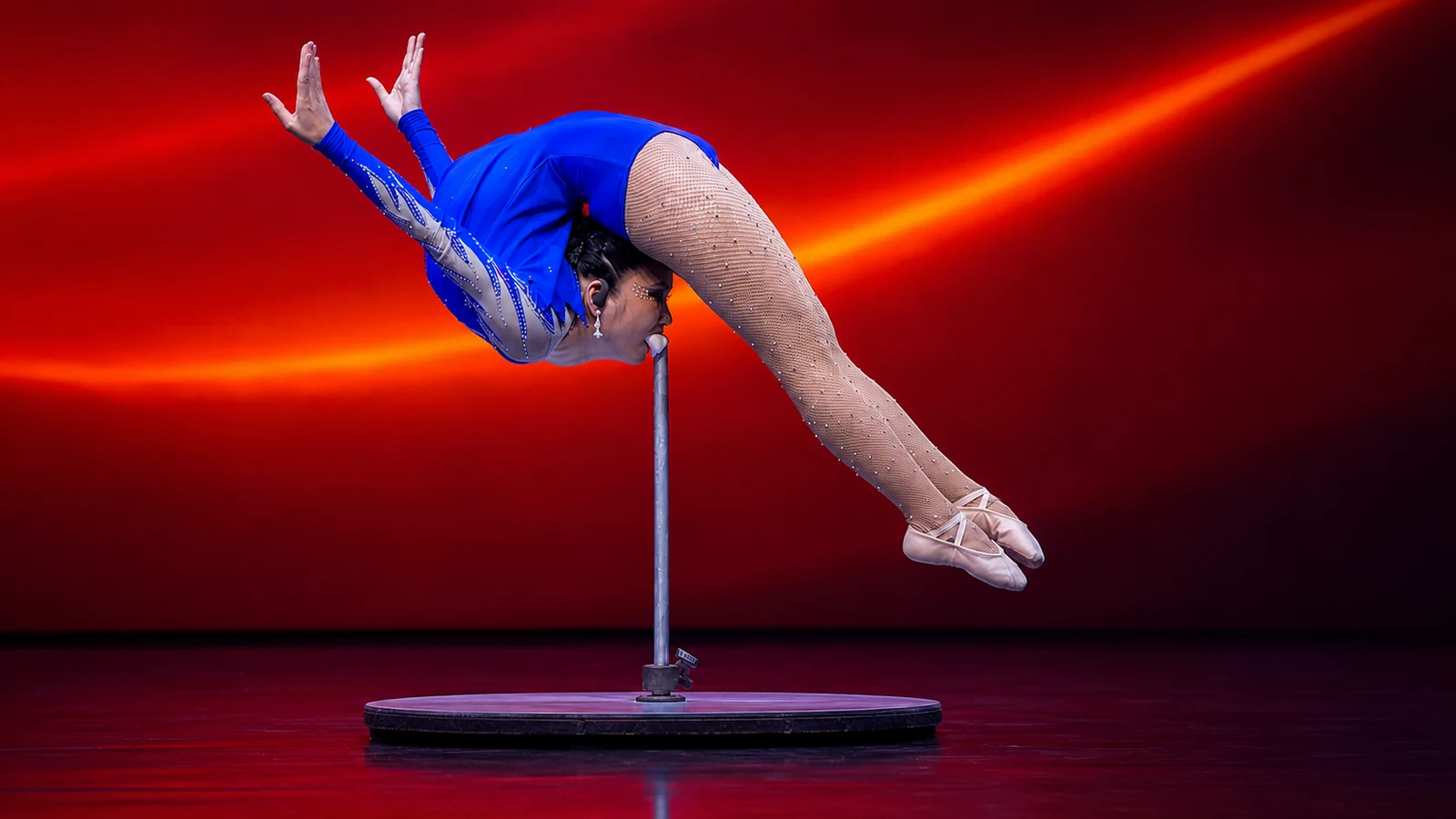
Tsatsral Erdenebileg folded her spine backward until her feet pointed past her own head, holding her entire body weight on a bite plate gripped in her teeth.
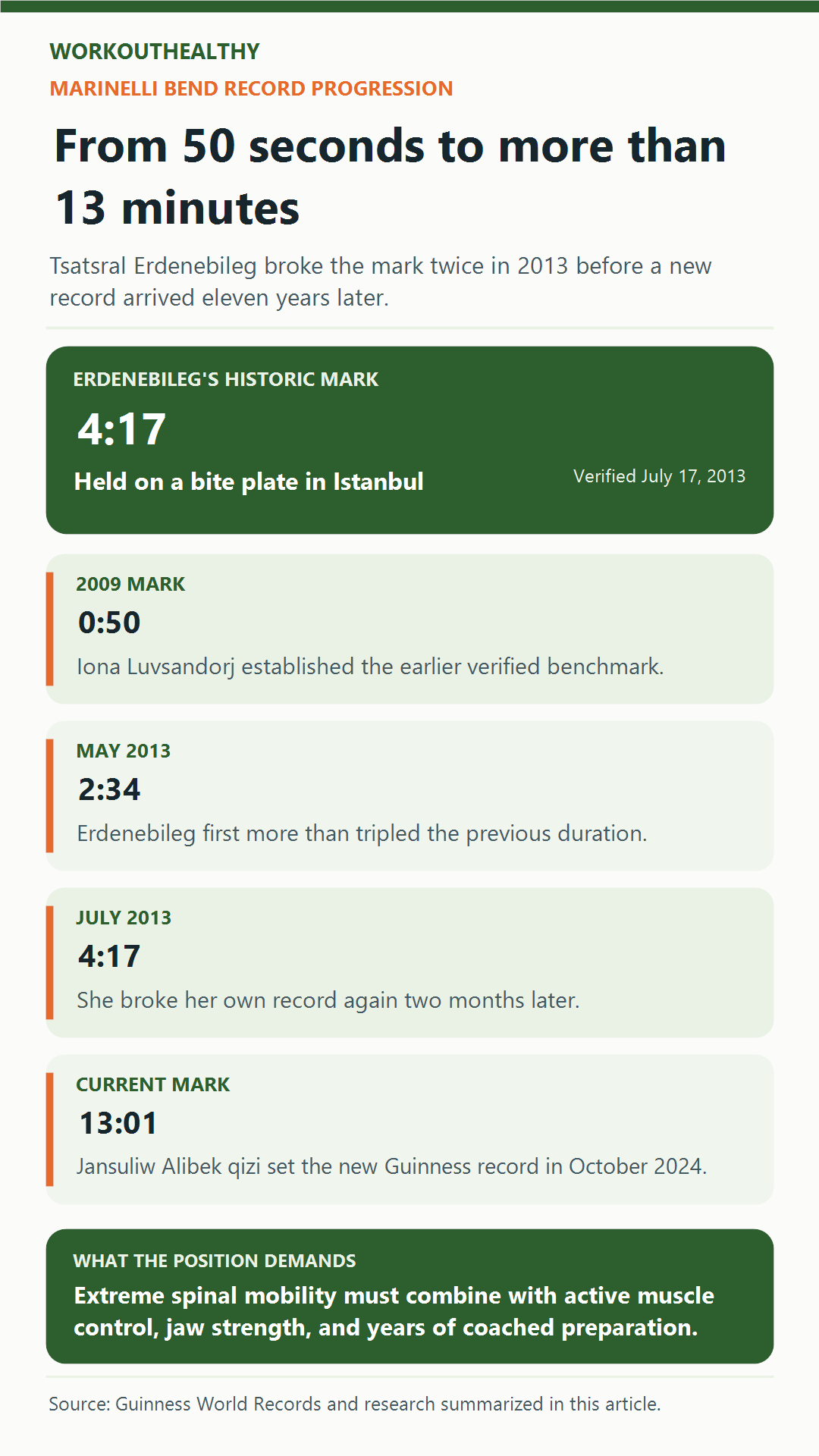
She held that position for 4 minutes and 17 seconds.
Guinness World Records confirmed it as the longest time anyone had ever held the Marinelli bend, one of contortion’s most extreme and dangerous positions.
That record was set in Istanbul, Turkey, on July 17, 2013.
It stood for more than a decade before another contortionist finally broke it.
What actually happens inside a body that can do this, and what it does not prove about flexibility training for everyone else, is worth slowing down on.
The Record, Verified
Guinness World Records defines the Marinelli bend as a backbend held up entirely by a mouth grip.
The performer grips a short post or bite plate between the teeth, then arches backward and upward until the legs fold over the head and the feet point forward, past the face.
Erdenebileg, from Mongolia, set the confirmed record of 4 minutes 17 seconds on the set of a Turkish television program called Rekorlar Dünyası, filmed in Istanbul.
It was not her first attempt at the title.
Two months earlier, in May 2013, she had already broken the previous record with a hold of 2 minutes 34 seconds.
That May mark had itself broken an earlier record of 50 seconds, set by fellow Mongolian contortionist Iona Luvsandorj in 2009.
Erdenebileg broke her own record twice in the same year.
A Record That Held for Eleven Years
The workbook behind this article listed Erdenebileg’s mark as the current record.
Checking Guinness’s own record page directly tells a fuller story.
On October 6, 2024, a contortionist named Jansuliw Alibek qizı held the Marinelli bend for 13 minutes and 1 second in the Takhtakupir District of Karakalpakstan, Uzbekistan.
That is nearly three times Erdenebileg’s duration.
Guinness’s own listing now credits Alibek qizı as the current record holder, with Erdenebileg’s 4 minutes 17 seconds recorded as the mark she broke.
None of that erases what Erdenebileg did.
She held the world record for this exact feat for roughly eleven years, longer than most Guinness records survive before someone else takes them.
This article tells her record honestly, as the historic mark it is, while pointing to who holds the title today.
What the Marinelli Bend Actually Asks of a Body
Contortion performers and coaches treat the Marinelli bend as one of the hardest and riskiest positions in the discipline.
It usually closes out a contortion act, because almost nothing else in the performance demands more from the body.
The position is named after H.B. Marinelli, a contortionist and international theatrical agent who worked in the late 1800s and early 1900s.
Two features set it apart from an ordinary backbend.
First, the entire bodyweight passes through the mouth and jaw instead of the hands or feet.
Second, the spine has to bend back far enough that the legs clear the head entirely, not just arch toward it.
Some Mongolian and Chinese contortion acts perform a double Marinelli bend, where a second performer does a handstand on top of the first while the base holds the position.
That version typically lasts five to six seconds, nowhere near what Erdenebileg or Alibek qizı held solo.
Why Some Spines Can Bend This Far
A 2008 study in the Journal of Neurosurgery: Spine used dynamic MRI to scan the spines of five professional contortionists as they moved through their full range of motion (Peoples et al., 2008).
The researchers measured a combined 238 degrees of motion between full spinal extension and full spinal flexion across the whole spine.
That is far beyond what a typical adult spine moves through during daily activity.
The same imaging turned up something worth noting honestly.
Three of the five contortionists studied had small fractures at the front edge of certain vertebrae in the lower back, changes the researchers linked to repeated hyperextension.
The fractures had healed and were not causing pain at the time of the study.
Their presence still shows this level of spinal motion is not free of physical cost, even in trained professionals.
All five contortionists in that small study also showed a mild rightward curve in their spines, a pattern the researchers noted without a confirmed explanation.
A spine that can fold this far is not simply a looser version of an average spine. It is a spine, and often a set of joints throughout the body, that years of specific training have gradually reshaped.
Flexible by Birth, or Flexible by Training?
Elite contortionists usually combine two things: unusually mobile joints to begin with, and years of progressive training layered on top.
Generalized joint hypermobility describes joints that move beyond a typical range without another tissue disease present.
A 2025 study in Scientific Reports examined how joint hypermobility affects strength, the body’s sense of joint position, and functional performance (Akaras et al., 2025).
The researchers found that people with hypermobile joints did not automatically have worse strength or balance.
They did show measurable differences in how well they could sense joint position without looking, a skill called proprioception.
That distinction matters for anyone watching a feat like the Marinelli bend and assuming flexibility alone explains it.
Holding an extreme position under control, rather than simply moving into it once, still demands real strength and precise joint awareness, not looseness by itself.
Research specifically on the Marinelli bend does not exist in the mainstream sports science literature.
What follows draws on the closest available research, on general spinal flexibility, joint hypermobility, and stretching adaptation, applied honestly to a position that has never been studied directly.
The Part of This Record Almost Nobody Talks About
Most coverage of the Marinelli bend focuses on the spine.
The jaw and teeth deserve attention too, since they are the only points of contact holding the entire body up.
A 2020 study in the Journal of the Royal Society of New Zealand measured maximum voluntary bite force across a group of adults (Jansen van Vuuren et al., 2020).
The average came out to about 430 newtons, with individual results ranging from roughly 84 newtons up to more than 1,600 newtons.
That study measured ordinary chewing forces and the stress they place on teeth and dental restorations, not a sustained bodyweight hold like the Marinelli bend.
Still, it shows that human teeth and jaw muscles are built to handle meaningful compressive force, which is part of why a trained mouth grip can support bodyweight at all.
It does not mean the position is safe to attempt casually.
A sustained hold under bodyweight tension is a very different load than a quick bite, and untrained teeth, gums, and jaw joints have no reason to tolerate it.
What This Record Does Not Prove
A verified Guinness record proves one specific thing.
On July 17, 2013, Tsatsral Erdenebileg held a Marinelli bend position for 4 minutes and 17 seconds, under Guinness’s rules and in front of its adjudicators.
It does not prove that this level of flexibility is achievable, or advisable, for most people.
Erdenebileg built this capacity over years of contortion training, almost certainly starting very young, the way most elite contortionists do.
It also does not prove the position carries no risk just because it was performed successfully, more than once.
The spinal imaging research above found real, if healed, changes even in trained contortionists’ vertebrae.
Records like this one also change hands.
Guinness’s own listing already shows a newer, longer hold, and there is no reason to assume this is the last time that happens.
Who Should Never Attempt This
The Marinelli bend is not a stretch to try at home.
No responsible coach would suggest working toward it without years of supervised, contortion-specific training.
Anyone with a history of vertebral fractures, disc disease, or spinal surgery should not load their spine into extreme extension at all.
Anyone with jaw joint problems, including temporomandibular joint disorder, should not place bodyweight load through the jaw under any circumstances.
Dental work such as crowns, bridges, or already weakened teeth changes how much force a bite grip can safely tolerate, and that is a question for a dentist, not a guess.
Uncontrolled high blood pressure, glaucoma, or a recent eye procedure are also reasons to avoid extreme inverted or heavily flexed positions without medical clearance first.
None of the training progression below leads toward attempting a Marinelli bend.
It leads toward safer, general spinal and hip flexibility, the kind that supports everyday movement rather than an extreme circus skill.
Building Real Flexibility Without Chasing the Extreme

Most people do not need anywhere close to a contortionist’s range of motion to get real value from flexibility training.
A 2025 systematic review and meta-analysis in Sports Medicine looked at how static stretching actually improves range of motion, pooling results across dozens of studies (Ingram et al., 2025).
The review found that both a single stretching session and stretching programs sustained over weeks improved range of motion, and that the mechanisms behind short-term and long-term gains appear to differ.
Early gains seem to come more from increased tolerance to the stretch sensation itself.
Longer-term gains involve real structural adaptation in the muscle and connective tissue.
That distinction is useful for anyone starting a flexibility practice.
Feeling looser after one session is real, but it is not the same as the tissue-level change that takes weeks of consistent work to build.
Step 1: Start with general mobility, not target stretches.
Gentle daily movement through the hips, thoracic spine, and shoulders builds a base before any specific flexibility goal makes sense.
Step 2: Warm the tissue before stretching it hard.
Light cardio or dynamic movement for five to ten minutes prepares muscles and connective tissue to lengthen more safely than a cold static stretch does.
Step 3: Hold stretches long enough for them to matter.
Research generally supports holds of 30 seconds or longer, repeated consistently, over a single quick 10 second stretch.
Step 4: Progress by weeks, not single sessions.
Meaningful range of motion changes build over a training block of several weeks, not one motivated afternoon.
Step 5: Stop at tension, not pain.
A stretch should feel like effort and mild discomfort.
Sharp or shooting pain is a signal to back off immediately, not push through.
Extreme flexibility performers like Erdenebileg train under coaches who can read exactly how one specific spine and set of joints respond to load, something a general article cannot replicate for every reader.
Anyone recovering from a joint or connective tissue issue should build flexibility work around a physical therapist’s guidance first, the same careful approach that shaped Misty Copeland’s return to movement after hip replacement surgery.
A Record That Fits a Larger Pattern
Erdenebileg’s record belongs to a larger pattern in Guinness feats, one that rewards years of specific, patient training rather than a single burst of effort.
DonnaJean Wilde’s push-up world record came from pacing built over years of training, not raw effort on one attempt.
Edith Connor’s Guinness record for oldest female bodybuilder shows the same pattern starting from a completely different sport, at a much later age.
Erdenebileg’s 4 minutes and 17 seconds were not a lucky attempt. They were the visible end of years of training that most of the audience never saw.
Watch the Record
Guinness World Records itself filmed and published this look back at Erdenebileg’s record-setting hold.
You can see the full history of this record, including its current holder, on Guinness World Records’ own listing page.
Want more world records explained like this one? Subscribe to WorkoutHealthy Insider for practical explanations behind popular fitness claims.
References
Akaras, E., Deniz, G., Eymir, M., & Sönmez, M. (2025). The effects of joint hypermobility on strength, proprioception, and functional performance. Scientific Reports, 15(1), Article 40529. https://doi.org/10.1038/s41598-025-24199-x
Ingram, L. A., Tomkinson, G. R., d’Unienville, N. M. A., Gower, B., Gleadhill, S., Boyle, T., & Bennett, H. (2025). Mechanisms underlying range of motion improvements following acute and chronic static stretching: A systematic review, meta-analysis and multivariate meta-regression. Sports Medicine, 55(6), 1449–1466. https://doi.org/10.1007/s40279-025-02204-7
Jansen van Vuuren, L., Broadbent, J. M., Duncan, W. J., & Waddell, J. N. (2020). Maximum voluntary bite force, occlusal contact points and associated stresses on posterior teeth. Journal of the Royal Society of New Zealand, 50(1), 132–143. https://doi.org/10.1080/03036758.2019.1691612
Peoples, R. R., Perkins, T. G., Powell, J. W., Hanson, E. H., Snyder, T. H., Mueller, T. L., & Orrison, W. W. (2008). Whole-spine dynamic magnetic resonance study of contortionists: Anatomy and pathology. Journal of Neurosurgery: Spine, 8(6), 501–509. https://doi.org/10.3171/spi/2008/8/6/501
This article is for general information only and is not medical advice. If you have an injury, ongoing pain, or a medical condition, talk to a doctor or physical therapist before you change how you train or eat.